
Whose flag is this?
THE LONG ANSWER ◢
Stop trying to memorise flags one at a time. Learn the families instead: the small number of layouts and colour systems that most national flags are built from. Once you can place a flag in its family, you are choosing between four or five countries rather than nearly two hundred.
That is the whole trick, and it is why people who look unreasonably good at this are usually not doing feats of memory.
Key Takeaways
- Most national flags follow a handful of patterns: tricolours (vertical or horizontal), the Nordic cross, the Pan-African and Pan-Arab colours, and the Union-Jack canton.
- NAVA's five principles of good flag design are: keep it simple, use meaningful symbolism, use two or three basic colours, avoid lettering and seals, and make it distinctive.
- Simplicity is what makes a flag work "at a distance, at full speed, in bad weather" - which is also what makes it easy to recall.
- The genuinely hard pairs are hard for a reason: they share a family and differ only in ratio, shade or one small emblem.
What are the flag families?
Five groups will carry you a long way.
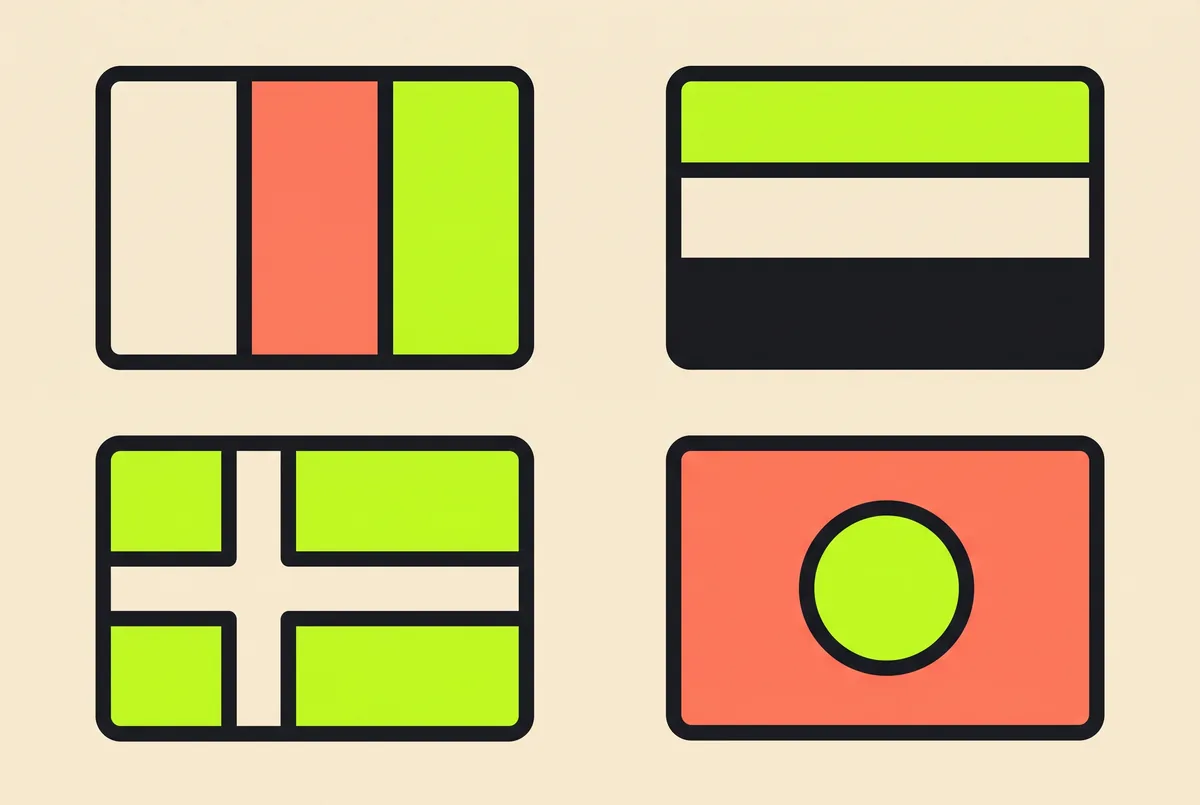
Vertical tricolours. France set the template and a great many followed. If you see three equal vertical bands, you are usually in Europe, Africa or the Americas, and the colours narrow it fast.
Horizontal tricolours. The Dutch template. Russia, the Netherlands and a long list of others. Same idea rotated, and a very common source of mix-ups.
The Nordic cross. An off-centre cross with the intersection towards the hoist. Denmark, Sweden, Norway, Finland, Iceland. This one is unmistakable once you know it, and it identifies the region instantly.
Pan-African colours. Red, gold and green, often with black. Common across the continent and usually distinguished by an emblem or a star rather than by layout.
Pan-Arab colours. Red, white, black and green in horizontal bands. Egypt, Iraq, Yemen, Jordan, Sudan and others, separated by stars, eagles or a triangle at the hoist.
Learn those five and you have a decision tree instead of a list.
Why are some flags so much easier to remember?
Because they were designed better, and there is a published account of what "better" means.
The North American Vexillological Association, the largest organisation in the world devoted to the study of flags, sets out five principles in Good Flag, Bad Flag: keep it simple, use meaningful symbolism, use two or three basic colours, avoid lettering and seals, and make it distinctive.
Every one of those is a memorability rule as much as a design rule. Simplicity is what makes flags work at a distance, at full speed, in bad weather and in peripheral vision, and the same property is what lets your memory hold them. Japan, Canada and Switzerland are recognisable anywhere on earth because there is almost nothing to forget.
The corollary is the flags that break the rules. A detailed seal on a coloured field is hard to recall precisely because it fails the simplicity test, which is exactly why so many of them look alike from any distance at all.
Which flags catch everyone out?
The pairs that share a family and differ in one small dimension.
Chad and Romania. Blue, yellow, red vertical tricolours. The difference is a slightly darker blue on Chad's. This is the hardest pair in the set and nobody should feel bad about it.
Indonesia and Monaco. Red over white, differing essentially in proportion.
Netherlands and Luxembourg. Red, white, blue horizontal, with Luxembourg's blue lighter.
Australia and New Zealand. Both blue ensigns with the Union Jack and the Southern Cross. New Zealand has four red stars with white borders; Australia has six white stars, one of them the seven-pointed Commonwealth Star below the canton.
The lesson these teach is the useful one: when a flag is in a crowded family, stop looking at the layout and start looking at the one thing that differs.
How do you actually practise?
Little and often beats a cramming session, which is a large part of why this is a daily.
Name the family first, then commit. Guessing "vertical tricolour, so European or African" before you guess a country forces the useful step rather than fishing for a whole answer.
Pay attention to the ones you get wrong, because they are almost always family confusions rather than blanks. If you missed Chad, you did not fail to recognise Chad; you recognised Romania.
Frequently Asked Questions
What is the study of flags called?
Vexillology, from the Latin vexillum, a Roman military standard. It covers the design, history and social meaning of flags. The North American Vexillological Association is the largest organisation devoted to it.
What are the rules of good flag design?
NAVA's five principles are: keep it simple, use meaningful symbolism, use two or three basic colours, avoid lettering and seals, and make it distinctive. They are published in the booklet Good Flag, Bad Flag, and they double as an explanation of why some flags are so much easier to remember.
Which two national flags are hardest to tell apart?
Chad and Romania. Both are blue, yellow and red vertical tricolours of the same proportions, and the only reliable difference is that Chad's blue band is slightly darker. Indonesia and Monaco are a close second, differing mainly in ratio.
Why do so many flags use the same colours?
Because colour groups carry shared meaning. The Pan-African colours (red, gold, green, often with black) and the Pan-Arab colours (red, white, black, green) signal a common regional or political heritage, so flags within those groups distinguish themselves by emblem rather than palette.
What is the fastest way to get better at flag quizzes?
Learn the five main families first: vertical tricolour, horizontal tricolour, Nordic cross, Pan-African and Pan-Arab. Identifying the family narrows nearly two hundred options to a handful, which turns recall into a much easier choice between near neighbours.
Sources
- North American Vexillological Association, Good Flag, Bad Flag - retrieved 29 July 2026, https://nava.org/good-flag-bad-flag
- NAVA, Guidance on Flag Design - retrieved 29 July 2026, https://nava.org/content.aspx?page_id=22&club_id=622278&module_id=475717
- Ausflag, Good Flag, Bad Flag: principles of good flag design (PDF) - retrieved 29 July 2026, https://www.ausflag.com.au/assets/images/Good-Flag-Bad-Flag.pdf
- Flags For Good, What is Vexillology? A Flag Expert Explains - retrieved 29 July 2026, https://flagsforgood.com/blogs/news/what-is-vexillology