IQ Test
Five logic puzzles. No timer. How sharp are you?
THE LONG ANSWER ◢
No. Not in the way "IQ test" implies, and that includes ours.
That is an odd thing to open with on a page containing an IQ test, so here is the useful version: five logic puzzles can tell you whether you spotted five patterns. They cannot tell you your IQ, because an IQ score is not a measure of how many puzzles you solved. It is a measure of where you sit relative to a carefully built reference population, and that reference population is the entire expensive part.
Key Takeaways
- An IQ score is a comparison against a norming sample, not a puzzle tally. Without the sample there is no score, only a count.
- Clinical instruments like the WAIS-IV and Stanford-Binet 5 publish test-retest reliability above .90; the WAIS-IV full-scale figure is around .96.
- Real scores come with a confidence interval, usually plus or minus 3 to 5 points. A site quoting an IQ to two decimal places is inventing precision.
- No court and no school accepts an online IQ score. That is the clearest available statement of what these are worth.
What makes an IQ test a real IQ test?
Four things, and a web quiz has none of them.
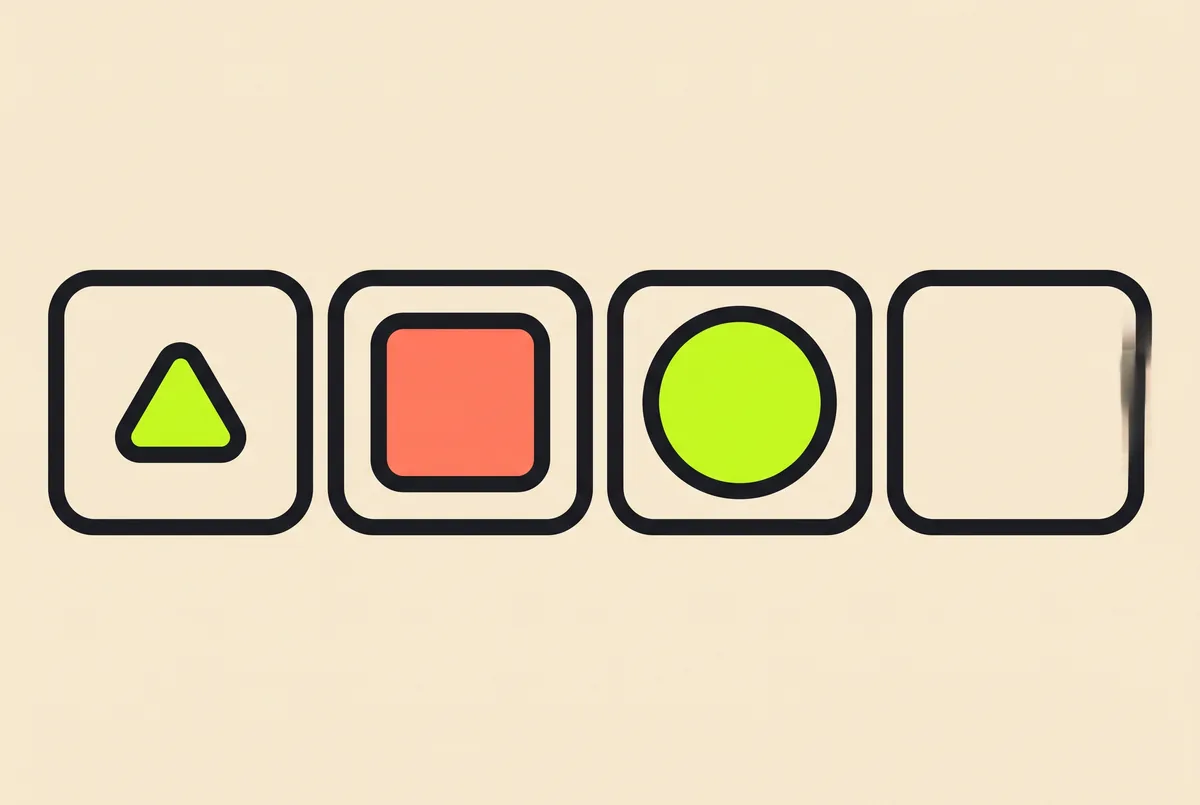
A stratified norming sample. Thousands of people, deliberately matched to the population on age, sex, education and region, all sitting the same test under the same conditions. Your score is your position in that distribution. This is the expensive part and the reason real tests cost money.
Published reliability. If you sit the test twice, how close are the two scores? Well-validated instruments report test-retest coefficients above .90, with the WAIS-IV full-scale figure around .96. A test that has never published this number cannot be evaluated at all.
Controlled administration. A trained psychologist runs the room, reads the instructions the same way every time, watches whether you are actually trying, and applies standard start and stop rules. A browser tab cannot do any of that.
A confidence interval. Every real score is reported as a range, typically plus or minus 3 to 5 points, because measurement has error. Precision beyond that is decoration.
So what is this test?
Five logic and pattern puzzles, no timer, scored on how many you get right. We show you a band rather than a number, because a number would be a lie with a decimal point in it.
The puzzles are the same kind of item that appears in real cognitive tests: sequence completion, pattern matching, simple deduction. That similarity is why these quizzes feel legitimate. But "uses similar puzzles" and "produces a comparable score" are entirely different claims, and only the first one is true here.
What five items genuinely tell you is whether you spotted five specific patterns on one particular day. That is a fun thing to know and a terrible basis for a conclusion about yourself.
Why do online IQ tests give such flattering scores?
Because a flattering score is the product.
Most free tests exist to sell you something: a detailed report, a certificate, a subscription. A result that makes you feel clever converts better than one that does not, and since there is no norming sample constraining the output, the number can be whatever the site wants. Two decimal places make it look measured.
Watch for the tells. No published norming sample. No reliability coefficient. No confidence interval. A score suspiciously above 100 for nearly everyone. A payment step between you and your result.
We do not charge for this and we do not give you a number, which removes most of the incentive to flatter you and most of the ability to.
When does an IQ score actually matter?
When something real depends on it, at which point it must be a clinical assessment.
Educational placement, disability determination and forensic evaluation all require individually administered tests with documented psychometric properties. No court accepts an online score as evidence of intellectual disability, and no school district places a child based on a website quiz. If you need a score for a reason, you need a psychologist, not a tab.
If you are just curious how your brain handles a sequence puzzle at eleven at night: that is what this is for, and it is a perfectly good reason to click.
Frequently Asked Questions
Are online IQ tests accurate?
Not as IQ measurements. They cannot replicate standardised administration and most publish no norming sample, no reliability coefficient and no confidence interval, so results are estimates at best. Some carefully built online tests do publish those figures, but a short free quiz almost never does.
What is a good score on this test?
There is no meaningful "good" here, because five items cannot place you in a distribution. Getting all five right means you spotted five patterns. We report a band rather than a number precisely so it cannot be mistaken for an IQ.
Why does this test not give me an IQ number?
Because we would have to invent it. An IQ number is a position within a normed reference population, and we have not built one. Reporting a precise figure without that sample would be false precision, which is the single most common thing wrong with free IQ tests.
How reliable are real IQ tests?
Well-validated clinical instruments publish test-retest reliability above .90, with the WAIS-IV full-scale coefficient around .96. Scores are still reported with a confidence interval of roughly plus or minus 3 to 5 points, because even the best instruments carry measurement error.
Can I use an online IQ score for anything official?
No. Educational placement, disability determinations and forensic evaluations all require individually administered clinical tests with documented technical properties. Courts and school districts do not accept web quiz results, and that is the clearest statement of the difference.
Sources
- Stanford-Binet, What makes an IQ test official? The real criteria - retrieved 29 July 2026, https://www.stanford-binet.org/blog/what-makes-an-iq-test-official
- Cogn-IQ, WAIS vs Stanford-Binet: Structure, Scoring, Differences - retrieved 29 July 2026, https://www.cogn-iq.org/blog/wais-vs-stanford-binet/
- What's My IQ, IQ Test Validity and Reliability: How Accurate Are Online Tests? - retrieved 29 July 2026, https://whatsmyiq.org/blog/iq-test-validity-reliability-online-tests
- ACIS, Professional IQ Test vs Online IQ Test: Accuracy and Limits - retrieved 29 July 2026, https://acisiq.com/professional-iq-test-vs-online-iq-test