
MORSE CODE
TRANSLATOR
Type a message and watch it turn to dots and dashes - or paste Morse and read it back. Letters split by spaces, words by a slash.
Dots and dashes. Letters split by spaces, words by /.
PLAY ANOTHER →
Turn text into Grade-1 braille cells and back.
⠋⠑⠑⠇ ⠊⠞CODESCipher IdentifierPaste a mystery message - auto-detect which cipher it is, then decode it.
AUTO-DETECT · 20+ CIPHERSCODESFlag Semaphore AlphabetEvery letter, two flags, eight angles. See the full A-Z chart.
26 LETTERS · A-ZCODESAtbash Cipher DecoderMirror the alphabet - A becomes Z, B becomes Y.
A↔Z MIRRORTHE LONG ANSWER ◢
Morse is a timing code. The dots and dashes you see written down are a convenience; what actually travels down the wire is a single signal switching on and off, and every piece of meaning lives in how long it stays in each state.
That is why Morse works over a telegraph wire, a radio carrier, a torch, a mirror or a hand tapping on a pipe. It needs one channel with two states and a shared sense of timing.
Key Takeaways
- Everything is measured in one time unit. A dot is 1 unit, a dash is 3, the gap inside a character is 1, between characters 3, and between words 7.
- The gaps are part of the code. Without them the stream of on-and-off is unreadable.
- Letter assignments follow frequency: E is one dot and T one dash because they are the commonest letters in English.
- SOS was chosen in 1906 for its unmistakable rhythm, not because it stands for anything, and it is one continuous prosign rather than three letters.
The timing rule is the whole system
Pick a length and call it one unit. Everything else is a multiple.
| Element | Length |
|---|---|
| Dot | 1 unit on |
| Dash | 3 units on |
| Gap between elements of a character | 1 unit off |
| Gap between characters | 3 units off |
| Gap between words | 7 units off |
This is often called the 1:3:7 standard, and the important consequence is that silence carries as much information as sound. The difference between the letter C and the sequence N-N is entirely in how long the operator paused. Send the right tones with sloppy gaps and you have transmitted nothing.
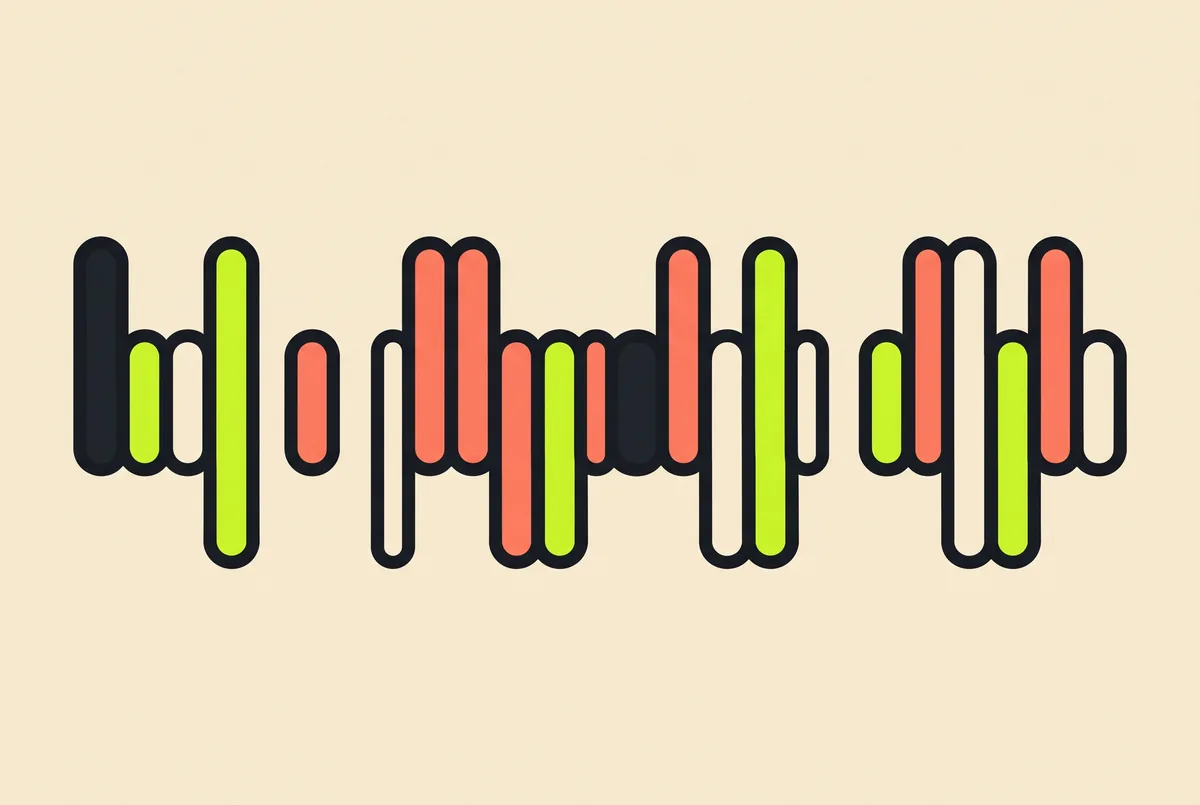
Identical tones in identical order. The only difference is the gap in the middle, and it changes one letter into two. This is the thing a written page cannot show you.
It also means Morse has no fixed speed. Shrink the unit and the whole code speeds up proportionally, which is why operator skill is measured in words per minute rather than in anything about the alphabet itself.
Why is E just one dot?
Because Alfred Vail counted.
Samuel Morse and Vail developed the system from 1838, and Vail engineered the key, sounder and register that made it practical. He also did the part that makes the code efficient rather than merely workable: he assigned the shortest sequences to the most frequent letters. E, the commonest letter in English, is a single dot. T is a single dash. Rare letters like Q and Y get four elements.
That is frequency-based compression, arrived at by hand roughly a century before information theory gave it a name. It is the reason ordinary English sends faster in Morse than a naive alphabetical assignment would allow.
On 24 May 1844, Morse sent the first message over the first US telegraph line to Vail: "What hath God wrought!"
What are prosigns, and what is SOS really?
A prosign is a procedural signal: a sequence sent as one continuous unit, without the character gaps that would break it into letters.
SOS is the famous one, and it is routinely misunderstood. It was agreed at the Berlin radiotelegraph convention, signed on 3 November 1906 and effective from 1 July 1908. It does not stand for "save our souls" or "save our ship"; those are later backfills. It was chosen because three dots, three dashes, three dots is a rhythm that survives static, fading and bad conditions and cannot easily be mistaken for anything else.
And although we write it as three letters, SOS is a single prosign sent with no gaps between the S and O segments. Written strictly it is one nine-element run. Sending it as three separate letters is, pedantically, not SOS at all.
Nine elements run together with no letter gaps, which is what makes this one signal rather than three letters. 15 words per minute, 600 Hz.
Is Morse still used?
Less than the romance suggests, and more than you would expect.
Maritime distress moved to satellite systems decades ago. But Morse survives in amateur radio, where its narrow bandwidth and readability at very low signal strength are genuine technical advantages: a human ear can pull a Morse signal out of noise that would defeat voice. Aviation navigation beacons still identify themselves in Morse. And it remains a practical fallback anywhere you have one channel and two states, which is exactly the condition it was designed for.
The complete alphabet
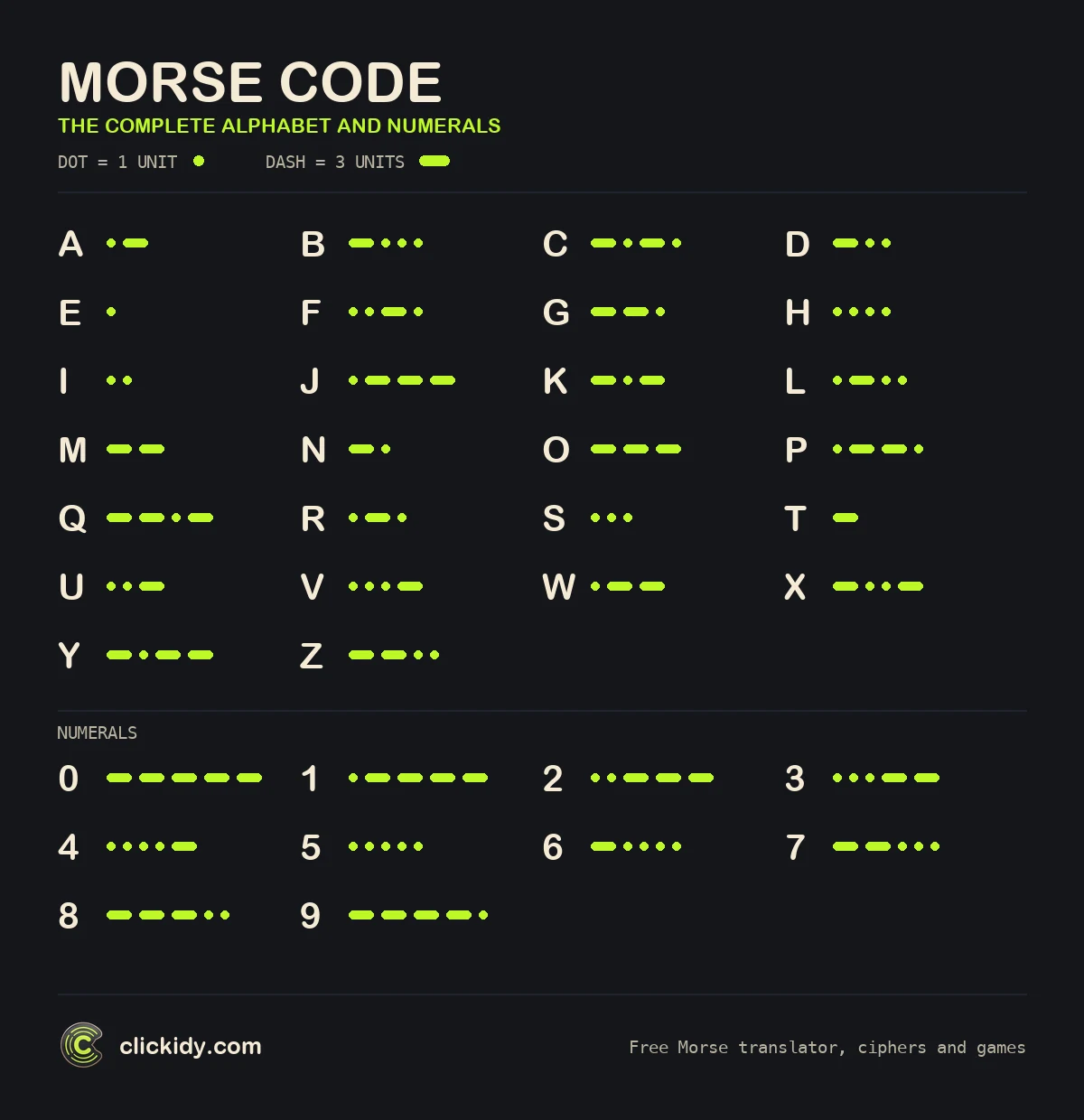
Every letter and numeral, with the codes drawn to scale so a dash really is three times the length of a dot. Save it, print it, put it on a wall.
Frequently Asked Questions
How long is a dash compared to a dot?
Three times as long. In International Morse a dot is one time unit and a dash is three. The gap between elements within a character is one unit, between characters three, and between words seven. This is the 1:3:7 standard.
Why is SOS used as a distress signal?
Because the pattern is unmistakable, not because it abbreviates anything. It was adopted at the 1906 Berlin radiotelegraph convention, effective 1 July 1908, and the sequence of three dots, three dashes and three dots stays recognisable through static and fading. "Save our souls" was invented afterwards.
Who actually invented Morse code?
Samuel Morse and Alfred Vail developed it together from 1838. Vail's contribution is often understated: he built the key, sounder and register, and he assigned the shortest codes to the most frequent letters, which is what makes the code efficient.
Why do the gaps matter so much?
Because Morse is a timing code, so silence is data. The same tones with different pauses spell different things: without a correct three-unit character gap, the letter C is indistinguishable from N followed by N. Getting the spacing wrong garbles the message even when every tone is right.
Is Morse code still used today?
Yes, in specific places. Maritime distress moved to satellite, but Morse remains standard in amateur radio because it is readable at signal strengths that defeat voice, and aviation navigation beacons still identify themselves with it.
Sources
- Britannica, Samuel F. B. Morse: Telegraph, Biography and Facts - retrieved 29 July 2026, https://www.britannica.com/biography/Samuel-F-B-Morse
- Smithsonian Institution Archives, A Forgotten History: Alfred Vail and Samuel Morse - retrieved 29 July 2026, https://siarchives.si.edu/blog/forgotten-history-alfred-vail-and-samuel-morse
- Morse Hub, Morse Code Timing Rules: The 1:3:7 Standard Explained - retrieved 29 July 2026, https://www.morsehub.com/morse-code-timing-rules
- Electronics Notes, Morse Code SOS Distress Message - retrieved 29 July 2026, https://www.electronics-notes.com/articles/history/morse-code-telegraph/morse-code-sos-distress-message.php