
Personality Test
The four classic temperaments. Which one runs you?
THE LONG ANSWER ◢
The four temperaments are a personality model that sorts everyone into one of four types: sanguine, choleric, melancholic or phlegmatic. It is about 2,400 years old, it started as a theory about bodily fluids, and it was entirely wrong about the fluids. The four types have comfortably outlived the biology that produced them.
Our test asks you five questions and gives you one of those four. Here is where they came from, and how much you should actually believe the answer.
Key Takeaways
- The four temperaments come from humourism, the ancient idea that four bodily fluids govern health and personality, described by Hippocrates around 400 BC.
- Galen turned them into a personality system in De Temperamentis around AD 190, and it stayed the standard model in European and Islamic medicine for well over a millennium.
- The medical theory collapsed in the 1800s. Rudolf Virchow's cellular pathology, published in 1858, replaced it.
- The four types survived anyway, and in the 1960s Hans Eysenck found them sitting in the quadrants of two measurable dimensions.
Where do the four temperaments come from?

They come from blood, phlegm and two kinds of bile. The Greek physician Hippocrates, who lived from around 460 to 370 BC, described the body as governed by four humours: blood, yellow bile, black bile and phlegm. Health was a matter of keeping them balanced. Personality, in this view, was whichever one you had too much of.
The names still carry the plumbing if you look. Sanguine comes from the Latin for blood. Choleric comes from kholé, Greek for bile. Melancholic is black bile, literally. Phlegmatic is exactly what it sounds like, and it is a little unfair that the calmest of the four got named after the least appealing fluid.
It was Galen, the Greek physician working in Rome from around AD 129 to 200, who turned this into an actual personality system. In De Temperamentis he arranged temperaments along two axes, hot against cold and dry against moist, and named the four resulting categories after the humours. He also described nine types rather than four, because he thought most people were mixtures rather than pure cases. That detail gets dropped from almost every modern version, including, in the interests of a five-question quiz, ours.
What are the four types meant to be?
Warm, driven, deep and calm, roughly in that order. Galen's framework became the standard account of personality in medieval Islamic medicine and in European medicine right through the Renaissance, which is a long run for any idea.
Sanguine, from blood, is the warm one. Optimistic, sociable, confident, and historically also flagged as a bit self-interested. This is the temperament that replies "I'm in" to the group chat before reading the whole message.
Choleric, from yellow bile, is the driven one. Decisive, forceful, quick to take charge, and quick to lose their temper. The classical sources are noticeably less charmed by this one than modern personality tests tend to be.
Melancholic, from black bile, is the deep one. Precise, principled, drawn to art and poetry, and inclined towards sadness and fear. It is the only one of the four whose name became a whole mood in English.
Phlegmatic, from phlegm, is the calm one. Steady, rational, generous, unbothered, with laziness listed as the failure mode. Every group has one, and everyone else in the group is quietly grateful for them.
Is any of this actually true?
The medicine is not. Humoral theory was dismantled over the 1800s, and Rudolf Virchow's cellular pathology, published in 1858, is usually given as the point where it lost. Virchow argued that disease should be understood by looking at cells under a microscope rather than at imbalanced fluids. Combined with the germ theory that Pasteur and Koch built out shortly after, that ended humourism as a working medical model.
So nobody has too much black bile. There is no black bile. If a personality test tells you your results are caused by your humours, it is out by roughly two centuries.
Modern personality psychology does not use temperaments either. It mostly uses the Big Five, a set of five measured dimensions rather than four boxes. Our test is deliberately not that, and it is deliberately not a trademarked instrument. It is five questions on a public-domain framework, written by us, for fun. It is not a diagnosis, an assessment, or a thing to put on a CV.
So why won't the four types go away?
Because the axes underneath them turned out to be real, even though the fluids were not. In the 1960s the psychologist Hans Eysenck built a model around two dimensions he could actually measure: extraversion, meaning outgoing and stimulation-seeking against reserved and inward, and neuroticism, meaning emotionally reactive against stable.
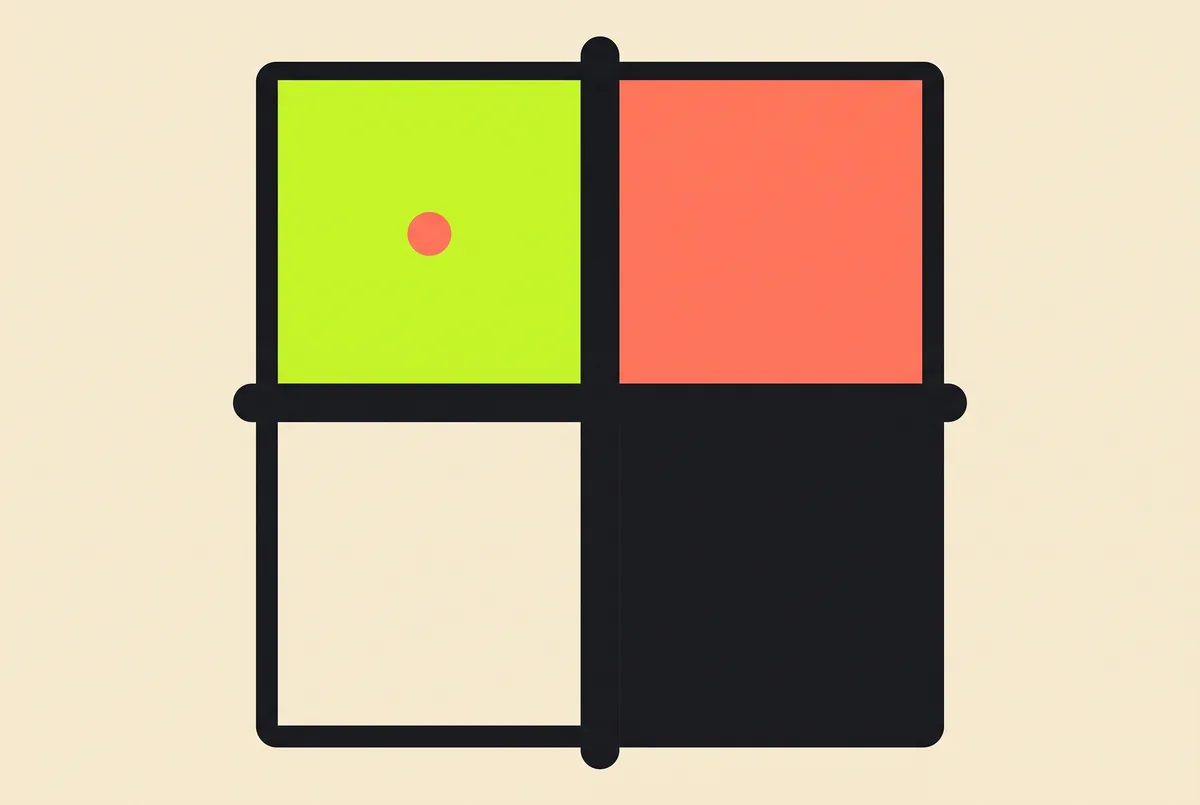
Here is the good bit. When you cross those two dimensions at right angles, the four quadrants you get back are the four classical temperaments. Stable and extraverted lands on sanguine. Unstable and extraverted lands on choleric. Unstable and introverted lands on melancholic. Stable and introverted lands on phlegmatic. Eysenck later added a third dimension, psychoticism, to make the PEN model, but the first two are the ones that recovered Galen.
That is a genuinely strange result. A model built from a wrong theory about bile, two thousand years earlier, had accidentally carved up the space along lines that a twentieth-century researcher would arrive at from measurement. The four temperaments are not a good theory of the body. They are a surprisingly durable rough map of where people sit on two things that do vary.
What does your result actually mean, then?
That five questions put you nearest one of four corners. That is it, and that is genuinely all we are claiming.
A five-question quiz cannot measure your personality, and anyone who tells you theirs can is selling something. What it can do is give you a label with a very long history attached, which is more interesting than most quiz results manage. If the result feels wrong, that is worth something too, because our questions force a single answer where the honest one is usually "depends on the day". Galen would have agreed with you, incidentally. He is the one who said most people are mixtures.
Take it as a conversation, not a verdict. Then go and argue with whoever sent you the link about whether they are really choleric.
Frequently Asked Questions
What are the four temperaments in order?
Sanguine, choleric, melancholic and phlegmatic. They correspond to the four humours of ancient medicine: blood, yellow bile, black bile and phlegm. Hippocrates described the humours around 400 BC and Galen turned them into a personality typology in De Temperamentis around AD 190.
Is the four temperaments test scientifically valid?
No, and it is not meant to be. Humoral theory was discredited as medicine in the 1800s, and modern personality psychology uses measured dimensions such as the Big Five instead. The four types survive as a historical framework and a decent conversation starter, not as an assessment.
What is the difference between the four temperaments and MBTI or the Big Five?
The temperaments are four categories from ancient medicine, free to use and roughly 2,400 years old. The Big Five is a modern research model of five measured dimensions. MBTI is a separate trademarked instrument. Our test uses the public-domain temperaments and original questions, and is not based on either of the others.
Which temperament is the rarest?
There is no reliable answer, because the four temperaments were never a measured system with real population data behind them. Any site quoting exact percentages for the classical temperaments is quoting its own visitors at best, and inventing numbers at worst.
Can you be more than one temperament?
Yes, and Galen thought this was the normal case. He described nine types in total: the four pure temperaments plus five mixed forms, on the grounds that most people show a dominant leaning rather than a pure excess. A five-question quiz has to pick one, which is a limitation of the quiz, not a fact about you.
Sources
- Wikipedia, Four temperaments - retrieved 29 July 2026, https://en.wikipedia.org/wiki/Four_temperaments
- Brewminate, The 'Four Temperaments' in Ancient and Medieval Medicine - retrieved 29 July 2026, https://brewminate.com/the-four-temperaments-in-ancient-and-medieval-medicine/
- Britannica, Rudolf Virchow: Biography, Discovery, & Facts - retrieved 29 July 2026, https://www.britannica.com/biography/Rudolf-Virchow
- Clinical Medicine & Research, Virchow's Contribution to the Understanding of Thrombosis and Cellular Biology - retrieved 29 July 2026, https://www.clinmedres.org/content/8/3-4/168
- Cogn-IQ Encyclopedia, Hans Eysenck: The PEN Model of Personality and a Contested Legacy - retrieved 29 July 2026, https://www.cogn-iq.org/learn/history/hans-eysenck/
- Lumen Learning, Personality Traits: Eysenck Personality Dimensions - retrieved 29 July 2026, https://content.one.lumenlearning.com/introductiontopsychology/chapter/learn-it-eysenck-personality-dimensions/