
Bolivia
A high-altitude South American country with two capitals and a mirror-flat salt desert you can see from space. Bolivia keeps its government in La Paz but its constitution in Sucre.
WHAT THE FLAG MEANS ◢
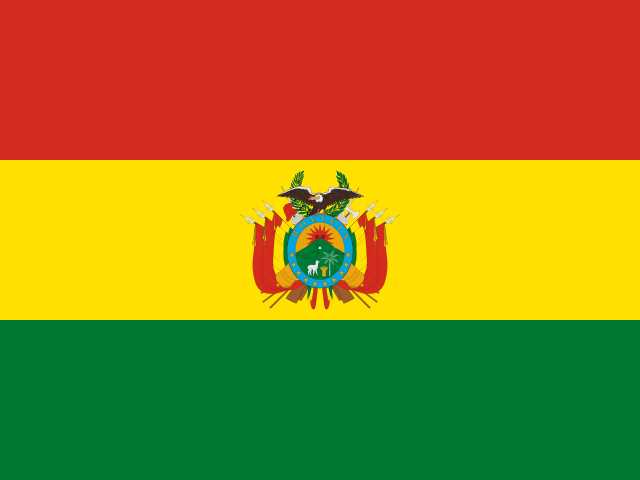
Three horizontal bands of red, yellow and green. The 2009 constitution names the tricolour a symbol of the State but assigns the colours no meaning; a supreme decree of the same year supplies one, giving red the blood shed by the nation's heroes for the birth and preservation of the Republic and the consolidation of the Plurinational State, yellow the mineral and subsoil riches of the Bolivian people, and green the wealth of nature and hope. The coat of arms sits at the centre of the yellow band only on the flags of state institutions and the armed forces, not on the plain tricolour that citizens fly. Bolivia has a second official flag: the same constitutional article also names the wiphala, a square seven-by-seven chequered banner of forty-nine coloured squares, and it is hoisted beside the tricolour on central-government buildings.
Source: gacetaoficialdebolivia.gob.bo · oas.org · lexivox.org
Bolivia FACTS ◢
| Capital | Sucre |
|---|---|
| Continent | South America |
| Population | 12,581,843 (2025) |
| Area | 1,098,581 km² |
| Population density | 11/km² |
| Currency | Boliviano (BOB) |
| Official languages | Araona, Aymara, Baure, Bésiro, Canichana, Cavineño, Cayubaba, Chimán, Chácobo, Ese Ejja, Guaraní, Guarasu'we, Guarayu, Itonama, Leco, Machajuyai-kallawaya and 21 more |
| Calling code | +591 |
| Internet TLD | .bo |
| Time zone | UTC-04:00 |
| Drives on the | Right |
| ISO codes | BO / BOL |
DID YOU KNOW? ◢
- The Salar de Uyuni is the world's largest salt flat, turning into a giant mirror after rain.
- La Paz is the highest administrative capital on Earth, sitting over 3,600 metres above sea level.
- Lake Titicaca, which it shares with Peru, is the highest navigable lake in the world.
- Bolivia has two capitals: Sucre is constitutional, while La Paz holds the government.
Bolivia QUICK ANSWERS ◢
What is the capital of Bolivia?
The capital of Bolivia is Sucre.
What is the population of Bolivia?
Bolivia had a population of 12,581,843 in 2025.
What currency does Bolivia use?
Bolivia uses the Boliviano (BOB).
What languages are spoken in Bolivia?
The official languages of Bolivia are 37 in all, among them Araona, Aymara, Baure, Bésiro, Canichana, Cavineño, Cayubaba, Chimán, Chácobo, Ese Ejja, Guaraní, Guarasu'we, Guarayu, Itonama, Leco, Machajuyai-kallawaya.
Think you know your flags? Play Flag Daily → · Browse all countries →
MORE ON THE FLAG ◢
Bolivia flies two flags, and both are official. One is the tricolour of red, yellow and green. The other is the wiphala, a square banner of forty-nine coloured patches in a seven-by-seven grid with a white diagonal through it. Article 6 of the 2009 Constitution puts both in one sentence, and the decree implementing that article defines the word "flag", for Bolivia, as two objects rather than one.
The colour meanings that travel with the tricolour are real too, and much younger than the flag. They were written into Bolivian law in 2004, a hundred and fifty-three years after the law that fixed the bands' order.
Key Takeaways
- Article 6 of the 2009 Constitution lists seven symbols of the State, and both flags are on it.
- Supreme Decree 0241 of 2009 defines Bolivia's flag as two things: tricolour and wiphala.
- The law of 5 November 1851 fixed the order of the bands and gave the colours no meaning.
- Blood, riches and nature come from a 2004 decree; the mineral reading for yellow arrived in 2009.
- The coat of arms belongs on state and military flags, not on the one citizens fly.
What does Bolivia's constitution say about the flag?
One sentence, and it is a list rather than an explanation.
Article 6 has two paragraphs. The first makes Sucre the capital. The second reads: "Los símbolos del Estado son la bandera tricolor rojo, amarillo y verde; el himno boliviano; el escudo de armas; la wiphala; la escarapela; la flor de la kantuta y la flor del patujú." The symbols of the State are the tricolour flag red, yellow and green; the anthem; the coat of arms; the wiphala; the cockade; the kantuta flower and the patujú flower.
Seven symbols, in one breath, in no stated order of rank. Two of them are flowers. Nothing else in the constitution mentions the flag, and nothing in it says what red, yellow or green stand for. Article 108 makes respecting the symbols a duty of Bolivians, and that is all.
The wiphala's standing here repays precision. The constitution calls the tricolour a "bandera" and lists the wiphala without that word. What makes it a flag is the implementing decree, whose Article 4(a) defines "Bandera" and says Bolivia has two, "la enseña tricolor compuesta por tres franjas horizontales rojo, amarillo y verde y la Wiphala".
How did the Bolivian flag reach its present design?
Three instruments across twenty-six years, and the last of them stuck.
The first flag came from a decree of 17 August 1825, weeks after independence. The law that replaced it records only what changed: on 25 July 1826 the Constituent Congress kept the same flag "poniéndose en lugar de las cinco estrellas de oro, una faja amarilla superior", an upper yellow band where five gold stars had been, with the arms of the Republic at the centre.
Today's arrangement came from the National Convention at Oruro on 31 October 1851; President Manuel Isidoro Belzu signed it into execution on 5 November. Its first article: "Los colores de que consta el pabellon Nacional, se colocarán en la manera siguiente: el punzó en la parte superior, el amarillo al centro y el verde en la parte inferior, debiendo sustituirse á la moharra el Cóndor de Bolivia."
Punzó at the top, yellow in the middle, green at the bottom, with the Condor of Bolivia replacing the spearhead on the staff. The top band is not "rojo" in that text but punzó, a vivid poppy scarlet. Neither this law nor the 1826 one gives a reason for any of the colours. Both read as instructions to whoever makes the flag, and the choice itself is explained in neither.
If you could not pick the result out of a line-up, a daily flag round gives three guesses at the country, and three written clues with no flag to lean on is the harder version.
Where do blood, minerals and land come from?
From two supreme decrees, of 2004 and 2009, and neither mentions land.
Supreme Decree 27630, issued under President Carlos Mesa on 19 July 2004, is where the readings enter Bolivian law. Its recitals name what came before - an 1851 law, an 1888 decree and a 1961 law - and say what those did: they set out "las características de la Bandera y el Escudo nacionales", the characteristics of the flag and the arms. Characteristics, not meanings.
The 2004 text gives red the blood shed by the nation's heroes for the birth and preservation of the Republic; yellow "nuestras riquezas y recursos naturales", our riches and natural resources; and green "la riqueza de nuestra naturaleza y la esperanza", the richness of our nature, and hope.
Supreme Decree 0241 of 5 August 2009 repealed that text and rewrote the list. Red gained a clause for the consolidation of the Plurinational State. Yellow narrowed to "las riquezas minerales y del subsuelo", so the mineral reading is a 2009 arrival, not a 2004 one. Green survived unchanged: "la riqueza de la naturaleza y la esperanza".
The usual English gloss is therefore sound on red, sound on yellow once you know which decree is quoted, and wrong on green. Neither instrument makes the tricolour's green fertile land. Both make it the wealth of nature and hope.
Does the Bolivian flag have the coat of arms on it?
Some lawful versions do. Most of the ones in private hands do not.
Article 5 of the 2009 decree describes the flag as three horizontal bands of equal size and nothing else. The arms enter one article later, and conditionally. Article 9 puts them at the centre of the yellow band, on both faces, for the tricolour hoisted at the Palacio de Gobierno, the legislature, the courts, ministries, prefectures, embassies and international bodies, with laurel and olive around them on the armed forces' flag.
Article 12 covers everyone else. On patriotic commemorations and civic holidays the civilian population hoists the tricolour at home, a right extended to any foreigner who wants to join in, and no arms are mentioned. The 2004 decree it replaced said so outright: citizens use the flag "sin el Escudo Nacional".
What does Bolivian law say the wiphala is?
Considerably more than it says about the tricolour.
The 2009 decree defines it as a square flag "de origen precolombino" of forty-nine squares in seven columns by seven rows, in seven colours, with descending diagonals from left to right. Article 27 walks the white diagonal square by square; Article 30 ties every dimension to seven or its multiples.
Article 28 gives the reason before the colours. The wiphala "es un símbolo sagrado que identifica el sistema comunitario basado en la equidad, la igualdad, la armonía, la solidaridad y la reciprocidad" - a sacred symbol identifying the community system founded on equity, equality, harmony, solidarity and reciprocity. It then gives each of the seven a paragraph:
| Colour | What Article 28 assigns it |
|---|---|
| Red | The planet earth, intellectual development, the visible material world |
| Orange | Society and culture, procreation of the species, health and education |
| Yellow | Energy, reciprocity, the man-woman duality, laws and norms |
| White | Time and the dialectic, cyclical history, science and art |
| Green | Economy and production, natural wealth, water, minerals, land and territory |
| Blue | Space, cosmic energy, the infinite |
| Violet | Politics, communal ideology, the State, the structure of power |
The two greens are different greens. Article 28 gives the wiphala's green "la economía y la producción" and names land and territory among its referents; the same decree gives the tricolour's green the wealth of nature and hope, with no land at all.
The asymmetry is the point. One decree gives the tricolour three single-sentence glosses, and the wiphala seven paragraphs, a construction rule and a place on every central-government frontage, hoisted on the left.
Frequently asked questions
Does Bolivia have two official flags?
Yes. Article 6 of the 2009 Constitution names both the red, yellow and green tricolour and the wiphala as symbols of the State, and Supreme Decree 0241 of 2009 defines Bolivia's flag as two things. Central-government buildings fly both, the wiphala on the left.
What do the colours of the Bolivian flag mean?
Under Supreme Decree 0241 of 2009, red is the blood shed by the heroes for the birth and preservation of the Republic and the consolidation of the Plurinational State, yellow the mineral and subsoil riches of the Bolivian people, and green the wealth of nature and hope. No Bolivian instrument gives the tricolour's green as fertile land.
What is the wiphala?
A square flag of forty-nine squares in a seven-by-seven grid, in seven colours, with a white diagonal descending from left to right. Bolivian law calls it precolumbian in origin and a sacred symbol of a community system based on equity, harmony and reciprocity.
Why do some Bolivian flags have the coat of arms and others do not?
Because the law puts it only on official versions. The flag flown by ministries, embassies, the courts and the legislature carries the arms at the centre of the yellow band, and the armed forces' flag adds laurel and olive. The tricolour citizens hoist at home is plain.
When is Bolivia's flag day?
17 August. Bolivia's foreign ministry dates the holiday to a supreme decree of 30 July 1924 and says it commemorates the first Bolivian flag, created on 17 August 1825. Today's tricolour is not that flag but its second successor, fixed in 1851.
Sources
- Estado Plurinacional de Bolivia, Constitución Política del Estado (2009), Article 6 - hosted by the Organization of American States, read against a second copy on LexiVox. Retrieved 12 August 2026.
- Gaceta Oficial de Bolivia, Decreto Supremo N° 0241, 5 August 2009 - official text, Gaceta 125ESP. Retrieved 12 August 2026.
- LexiVox (Portal Jurídico Libre de Bolivia), Ley de 5 de noviembre de 1851 - from the Bolivian Congress library's compendium. Retrieved 12 August 2026.
- LexiVox, Ley de 25 de julio de 1826. Retrieved 12 August 2026.
- LexiVox, Decreto Supremo N° 27630, 19 July 2004 - repealed, cross-checked against Spanish Wikisource. Retrieved 12 August 2026.
- Ministerio de Relaciones Exteriores de Bolivia, Día de la Bandera. Retrieved 12 August 2026.
PLAY ANOTHER →
One quote, one scrambled alphabet. Crack it before tomorrow.
CRACK THE QUOTEDAILYDaily TriviaFive questions a day. Everyone gets the same five.
FIVE QUESTIONSDAILYOn This DayOne thing that happened today in history. Every day, a new one.
TODAY IN HISTORYDAILYGuess the CountryThree clues, three guesses. Work out where in the world it is.
THREE CLUES