
Ivory Coast
West Africa's cocoa powerhouse, Ivory Coast grows more of the world's cocoa beans than any other country, and built one of the planet's largest churches in its planned capital.
WHAT THE FLAG MEANS ◢
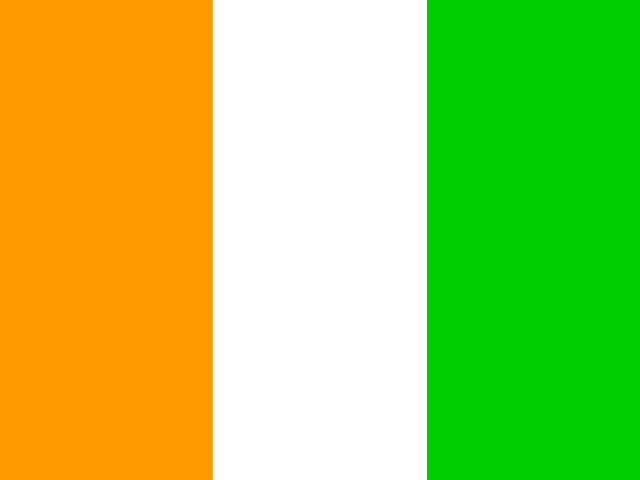
Three vertical bands of orange, white and green. Article 48 of the constitution specifies the colours and the equal vertical bands and assigns them no meaning. The reading Ivorian government publications carry is the one the Minister of State Jean Delafosse gave when he presented the flag in 1959: orange for the country's rich and generous land and for the blood of a young people fighting for emancipation, white for peace, and specifically 'la paix du droit', the peace of law, and green for hope, 'la certitude d'un devenir meilleur', the certainty of a better future. The savannah-of-the-north and forests-of-the-south reading appears in no Ivorian government source.
Ivory Coast FACTS ◢
| Capital | Yamoussoukro |
|---|---|
| Continent | Africa |
| Population | 32,711,547 (2025) |
| Area | 322,463 km² |
| Population density | 101/km² |
| Currency | West African CFA franc (XOF) |
| Official language | French |
| Calling code | +225 |
| Internet TLD | .ci |
| Time zone | UTC±00:00 |
| Drives on the | Right |
| ISO codes | CI / CIV |
DID YOU KNOW? ◢
- It is the world's largest producer of cocoa beans, the raw material for chocolate.
- The Basilica of Our Lady of Peace in Yamoussoukro is one of the largest churches in the world.
- Yamoussoukro is the official capital, though the bigger city of Abidjan is the economic hub.
- The country's name simply means 'Ivory Coast', from the historic ivory trade along its shore.
Ivory Coast QUICK ANSWERS ◢
What is the capital of the Ivory Coast?
The capital of the Ivory Coast is Yamoussoukro.
What is the population of the Ivory Coast?
The Ivory Coast had a population of 32,711,547 in 2025.
What currency does the Ivory Coast use?
The Ivory Coast uses the West African CFA franc (XOF).
What languages are spoken in the Ivory Coast?
The official language of the Ivory Coast is French.
Think you know your flags? Play Flag Daily → · Browse all countries →
MORE ON THE FLAG ◢
Ivory Coast, or Côte d'Ivoire, flies a flag that runs orange, white, green from the flagpole outwards. Ireland's runs green, white, orange. They are the same three colours in opposite order, which is why they get mistaken for each other constantly and why the mistake is so easy to correct once you know where to look.
Neither government's flag publications read for this article mentions the other country. What the Ivorian state has published, though, is a reading of its own colours that almost nothing on the internet repeats.
| Feature | Côte d'Ivoire | Ireland |
|---|---|---|
| Colour at the flagpole | orange | green |
| Colour at the fly | green | orange |
| Ratio | none fixed in any instrument that could be opened | twice as wide as it is high |
| Founding instrument | law number 59-240, 3 December 1959 | Article 7 of the 1937 Constitution, first flown 1848 |
| Stated meaning | Jean Delafosse's 1959 statement, quoted in state publications | inclusion and hoped-for unity between traditions |
Key Takeaways
- Article 48 of the Ivorian constitution specifies the colours, the vertical bands and their equal size, and assigns no meanings at all.
- The flag was created by law number 59-240 of 3 December 1959, months before independence.
- The meaning Ivorian government publications give is the one its Minister of State gave in 1959, not the savannah-and-forest story, which appears in no Ivorian government source that could be read for this article.
- Ireland's flag is fixed at twice as wide as it is high; no Ivorian instrument that could be opened fixes a ratio at all.
- Neither government's flag publications read for this article mentions the other country.
Why does Ivory Coast's flag look like Ireland's?
Because it is the same palette in reverse, and probably because both trace back to the same French model.
Put them side by side and the difference is one rule: green goes next to the pole on the Irish flag, orange goes next to the pole on the Ivorian one. Everything else about the colour scheme matches. That is a mirror image rather than a coincidence of shades, which is why the two are usually confused by people reading the colours instead of the order.
The shapes differ too, and this is the more reliable tell at a distance. Ireland's government sets its flag's proportion at 2 to 1: "The flag is twice as wide as it is high." Côte d'Ivoire's constitution imposes no proportion at all, and the ratio usually quoted for it, 2 to 3, appears in no Ivorian instrument that could be opened for this article. So an Irish tricolour is a distinctly long rectangle by rule, and an Ivorian one is held to no published proportion at all.
The likely shared ancestor is French. Ireland's own flag guidelines record that Irish tricolours "appeared side by side with French ones at meetings held all over the country to celebrate the revolution that had just taken place in France" in March 1848, and that Thomas Francis Meagher brought one from Paris. Côte d'Ivoire was a French territory when its flag was made. Two vertical tricolours descending separately from the same design language is a much better explanation than either country reacting to the other, for which the sources read here show no evidence, though only the Irish half of that descent is documented in them.
What do the colours of the Ivory Coast flag mean?
Not what you have read. The reading Ivorian government publications carry is considerably more pointed.
Start with what the law says, which is nothing. The second paragraph of Article 48 of the constitution reads: "L'emblème national est le drapeau tricolore orange, blanc, vert, en bandes verticales et d'égales dimensions." The national emblem is the tricolour flag of orange, white and green, in vertical bands of equal dimensions. Colours, arrangement, equal sizes, and no symbolism whatsoever. The same sentence appeared as Article 29 of the 2000 constitution, and the 2020 revision left it untouched.
The meaning that Ivorian state publications do carry comes from the presentation of the flag to the territory's legislative assembly in 1959, by the Minister of State Jean Delafosse. Two Ivorian government publications reproduce his words as the meaning of the colours: the Office du Service Civique National's own pages, and a 2018 booklet from the state secretariat responsible for civic service. Both sit in the same civic-service portfolio and carry the same text, so their agreement is not two independent readings. His opening line is that the national emblem "doit être le vivant Symbole de la Patrie", must be the living symbol of the fatherland. Then:
- Orange recalls the colour of the country's rich and generous land. It is "le sens de notre lutte, le sang d'un peuple jeune dans sa lutte pour notre émancipation" - the meaning of the struggle, and the blood of a young people fighting for emancipation.
- White is peace, but specifically "la paix du droit", the peace of law.
- Green is hope, "certes pour d'autres", certainly for others, "mais pour nous, la certitude d'un devenir meilleur" - but for us, the certainty of a better future.
Now compare that with the version in general circulation, which says orange is the savannah of the north, green is the forest of the south and white is unity. That reading appears in no Ivorian government source that could be opened for this article.
Two qualifications. Delafosse's words are a ministerial statement made when presenting the flag, reproduced in state publications as the meaning of the colours; they are not enacted text, so the correct description is "the meaning the Ivorian state publishes", not "the meaning fixed in law". And the savannah reading is not false so much as unsourced. It may well be what many Ivorians understand by the colours. It just is not what the government prints.
When did Ivory Coast adopt its flag?
By law, and eight months before there was a country to fly it over.
Both publications name the instrument: "C'est par la loi n°59-240 du 3 décembre 1959 qu'a été créé l'Emblème National de la République." Law number 59-240 of 3 December 1959 created the national emblem, and Jean Delafosse presented it to the legislative assembly on the government's behalf.
Independence followed on 7 August 1960. The 2018 booklet dates the national anthem to law number 60-207 of 27 July 1960, "soit dix (10) jours avant l'accession du pays à l'Indépendance", ten days before independence, though on the booklet's own dates the interval is eleven. Either way the flag came first, by nearly eight months.
The full text of the 1959 law could not be opened for this article, which is worth saying plainly. It is known here only through the two Ivorian government publications that cite it by number and date, and neither reproduces it.
What does Ireland say about its own flag?
That the white in the middle is the point of the whole design.
Article 7 of the Constitution of Ireland is as terse as its Ivorian counterpart: "The national flag is the tricolour of green, white and orange." The Department of the Taoiseach's guidelines fill in the rest. The flag "is intended to symbolise the inclusion of and the aspiration for unity between people of different traditions on this island", it is twice as wide as it is high, the three colours are equal, and "the green goes next to the flagstaff".
The guidelines also give the line most worth quoting, from Thomas Francis Meagher in April 1848: "The white in the centre signifies a lasting truce between Orange and Green and I trust that beneath its folds the hands of Irish Protestants and Irish Catholics may be clasped in generous and heroic brotherhood."
Neither government mentions the other, incidentally, in anything either publishes about its flag. The Irish guidelines discuss the design's history at length, including its 1848 origins and the unstandardised early arrangements, and contain no reference to Côte d'Ivoire; the Ivorian publications and the constitution contain no reference to Ireland. Two vertical tricolours landed on the same three colours in opposite order, a hundred and eleven years apart, and neither of the flag publications read for this article remarks on it.
Once you know the rule, the pair stops being confusing: green at the pole is Ireland, orange at the pole is Côte d'Ivoire. It is the same kind of single-detail test that separates most of the other look-alike pairs in every country's flag and factsheet, and a daily flag round will find out fairly quickly which pairs you have actually learned. Working a country out from three clues instead takes the flag away for the whole of the guessing, which is a useful check on how much of your geography is really flag recognition.
Frequently asked questions
Is the Ivory Coast flag the Irish flag reversed?
In colour order, yes. Ireland's runs green, white, orange from the flagpole outwards and Côte d'Ivoire's runs orange, white, green, so the two are mirror images. The proportions differ as well: Ireland's government specifies a flag twice as wide as it is high, while the Ivorian constitution sets no proportion at all.
What does the Ivorian government say the colours mean?
Its publications reproduce the statement Minister of State Jean Delafosse made when the flag was presented in 1959: orange for the colour of the rich and generous land, the meaning of the struggle and the blood of a young people fighting for emancipation; white for peace, and specifically the peace of law; green for hope and the certainty of a better future. The constitution itself assigns no meanings, so this is what the state publishes rather than what the law fixes.
Does orange stand for the savannah on the Ivory Coast flag?
No Ivorian government source that could be opened for this article gives that reading. One such source, the Presidency's own symbols page, renders through JavaScript and could not be read at all, so the negative is bounded by that. What the Ivorian state does publish is Jean Delafosse's 1959 statement, in which orange stands for the land, the struggle and the blood of a young people fighting for emancipation.
What law created the Ivory Coast flag?
Law number 59-240 of 3 December 1959 created the national emblem, and it was presented to the territory's legislative assembly by Minister of State Jean Delafosse. That was months before independence on 7 August 1960, and nearly eight months before the national anthem was adopted by law number 60-207 of 27 July 1960.
Which side is green on the Irish flag?
Next to the flagstaff. The Department of the Taoiseach's guidelines are explicit: "The Flag should normally be displayed on a staff, the green being next to the staff, the white in the middle and the orange farthest from the staff." That single rule is what separates it from Côte d'Ivoire's flag, where orange takes the hoist.
Sources
- Constitution of the Republic of Côte d'Ivoire, Article 48, consolidated French text published by the Digithèque MJP, Université de Perpignan, citing the Journal officiel of 9 November 2016 - retrieved 10 August 2026.
- Office du Service Civique National, Côte d'Ivoire, Les 5 symboles de la République - retrieved 10 August 2026.
- Not read: the Ivorian Presidency's own page on the national symbols loads but renders through JavaScript and yields no text to a fetch, so one government source on exactly this subject went unexamined. The negative stated above is bounded by that.
- Secrétariat d'État chargé du Service Civique, Côte d'Ivoire, 5 Symboles de la République, 2018 - retrieved 10 August 2026 via the Internet Archive, the live host refusing traffic from outside Côte d'Ivoire.
- Department of the Taoiseach, The National Flag: Guidelines, September 2025 - retrieved 10 August 2026.
- Constitution of Ireland, Article 7, Irish Statute Book, Office of the Attorney General - retrieved 10 August 2026.
PLAY ANOTHER →
One quote, one scrambled alphabet. Crack it before tomorrow.
CRACK THE QUOTEDAILYOn This DayOne thing that happened today in history. Every day, a new one.
TODAY IN HISTORYDAILYGuess the CountryThree clues, three guesses. Work out where in the world it is.
THREE CLUESDAILYDaily TriviaFive questions a day. Everyone gets the same five.
FIVE QUESTIONS