
Mongolia
The most sparsely populated sovereign country on Earth, Mongolia is a land of open steppe where herders still live in felt tents and horses vastly outnumber people.
WHAT THE FLAG MEANS ◢
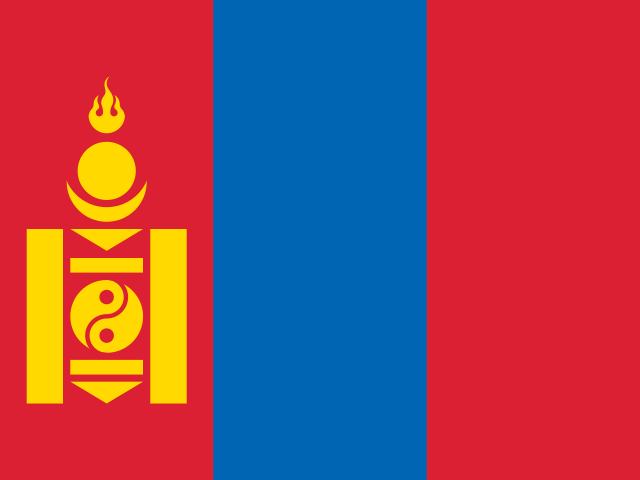
A red-blue-red vertical triband with the golden Soyombo emblem on the hoist-side red band. Article 12(5) of the constitution carries both the design and its reading: the middle third is the blue of the eternal sky, the two red bands either side are the symbol of progress and prosperity, and the Soyombo is placed in gold. Article 11 of the Law on State Symbols repeats that clause word for word, adding only a citation back to it. Neither text reads the Soyombo element by element, so the familiar breakdown into fire, sun, moon, earth, water and the yin-yang is not the law's. Independence, sovereignty and spirit are assigned elsewhere, to the state emblem, where the golden Soyombo and the precious steed express them together.
Mongolia FACTS ◢
| Capital | Ulaanbaatar |
|---|---|
| Continent | Asia |
| Population | 3,568,978 (2025) |
| Area | 1,564,116 km² |
| Population density | 2/km² |
| Currency | Mongolian tögrög (MNT) |
| Official language | Mongolian |
| Calling code | +976 |
| Internet TLD | .mn |
| Time zones | UTC+07:00, UTC+08:00 |
| Drives on the | Right |
| ISO codes | MN / MNG |
DID YOU KNOW? ◢
- It's the most sparsely populated sovereign country in the world.
- Under Genghis Khan, the Mongol Empire grew into the largest contiguous land empire in history.
- Ulaanbaatar is the coldest national capital on Earth by average temperature.
- The two-humped Bactrian camel and the wild Przewalski's horse both roam its landscapes.
- Much of the country is covered by the vast Gobi Desert and endless grassy steppe.
Mongolia QUICK ANSWERS ◢
What is the capital of Mongolia?
The capital of Mongolia is Ulaanbaatar.
What is the population of Mongolia?
Mongolia had a population of 3,568,978 in 2025.
What currency does Mongolia use?
Mongolia uses the Mongolian tögrög (MNT).
What languages are spoken in Mongolia?
The official language of Mongolia is Mongolian.
Think you know your flags? Play Flag Daily → · Browse all countries →
MORE ON THE FLAG ◢
Ask what the Soyombo on Mongolia's flag means and you will usually get a list. Fire, sun, moon, earth, water, and a yin-yang. It is a tidy answer, and it is in neither of the two texts that govern the flag: the constitution of 1992 and the flag statute of 1994.
What those two texts do contain runs the other way. The constitution interprets two thirds of the flag in the same sentence that specifies it, and then puts the Soyombo on the hoist without a word about what the Soyombo is for.
The statute that looks like it should elaborate does not elaborate. Article 11 of the Law on State Symbols reproduces the constitutional clause and adds exactly one thing to it: a pointer back to the constitution.
Key Takeaways
- The colour meanings sit in the constitution itself, at article 12(5), and the flag statute recites that clause rather than adding to it.
- Article 11 of the 1994 Law on State Symbols repeats that clause word for word. Apart from an opening citation back to the constitution, the two texts differ by one capital letter.
- Neither text breaks the Soyombo into parts, so the widely repeated six-element reading appears in neither.
- The only gloss either instrument offers of the golden Soyombo belongs to the article on the state emblem, and it is shared with the precious steed beside it.
- The sign is a character before it is an emblem. It is a head mark in the script Zanabazar built in 1686, the class of sign that stands at the head of a text.
| The claim | Where it is written | What that text actually does |
|---|---|---|
| The middle blue is the eternal sky | Constitution art. 12(5), repeated at Law on State Symbols art. 11 | States it, in the clause that fixes the colours |
| The red bands stand for progress and prosperity | Constitution art. 12(5), repeated at Law on State Symbols art. 11 | States it, in the same sentence |
| The Soyombo is golden | Constitution art. 12(5), repeated at Law on State Symbols art. 11 | Places it and specifies the colour, with no gloss |
| The Soyombo expresses independence, sovereignty and spirit | Constitution art. 12(3), repeated at Law on State Symbols art. 4 | Says it of the state emblem, and of the Soyombo together with the precious steed |
| Fire, sun, moon, earth, water and the yin-yang | Neither instrument | Does not appear |
Where is the Mongolian flag actually described?
In the constitution, and only then in the flag statute.
Article 12 of the Constitution of Mongolia, adopted on 13 January 1992, runs to seven clauses covering the emblem, the ceremonial banner, the flag, the seal and the anthem. Clause 5 is the flag, and it is not a bare description. It fixes the geometry and the reading in one breath: "Далбааны гурав хуваасны нэгийн хэмжээтэй дундах хэсэг нь мөнх тэнгэрийн хөх, түүний хоёр тал нь мандан бадрахын бэлгэдэл улаан өнгөтэй байна." The middle part, one third of the flag, is the blue of the eternal sky, and its two sides are red, the symbol of rising and flourishing.
Then the Soyombo, in a sentence of its own: "Далбааны ишин талын улаан дэвсгэрийн төв хэсэгт алтан соёмбо байрлуулна." A golden Soyombo is placed at the centre of the red field on the hoist side. That is the whole of it. The clause finishes with a 1:2 ratio and stops.
The Law on State Symbols, passed on 20 May 1994 and in force from 1 July 1994, is where a reader would expect the detail to arrive. Its article 11 opens with the words "Үндсэн хуулийн арван хоёрдугаар зүйлийн 5 дахь хэсэгт зааснаар" (Undsen khuuliin arvan khoyordugaar zuiliin 5 dakh khesegt zaasnaar), as provided in article 12(5) of the constitution, and then reproduces the constitutional sentences.
Reproduces is the exact word. Set the two texts side by side and the only difference in what follows that opening phrase is that the law capitalises Төрийн where the constitution writes төрийн. Every other character matches. The statute that governs Mongolia's flag does not interpret anything the constitution left uninterpreted, because its clause is the constitution's clause, retyped.
The constitution's own gloss on the blue and the red
The blue is sky and the red is flourishing, and both readings have constitutional rank.
Мөнх тэнгэр is the eternal sky, and the constitution puts its colour down the middle third of the flag. The emblem gets the same image one clause earlier: article 12(3) gives it a round blue field described as "мөнх тэнгэрийг бэлгэдсэн", symbolising the eternal sky. Two of Mongolia's five state symbols are given the sky by constitutional prescription.
The red is "мандан бадрахын бэлгэдэл" (mandan badrakhyn belgedel). Read literally that is the symbol of rising and flourishing, and the two state-published English translations of the constitution both settle instead on the same freer rendering. The National Legal Institute's text has the red on both sides "symbolizes progress and prosperity", and the Constitutional Court of Mongolia's English version uses the identical phrase.
Those two English texts are worth comparing, because they are not the same document. The Constitutional Court's opens the clause with a shape the Mongolian only implies: "The State Flag is a rectangle divided vertically into three equal parts colored red, blue, and red." The National Legal Institute's has "The State Flag shall be colored with combination of red, blue and red." Same clause, two state publishers, two English sentences.
One term survives neither translation intact. Article 12(2) says that the emblem, the banner, the flag and the anthem express the historical tradition, the aspiration, the unity, the justice and the цог хийморь of the people of Mongolia. Both state-published translations flatten that last term to "the spirit of the people of Mongolia". Хийморь is literally the wind horse, an image neither English text keeps, and the flag is one of four things article 12(2) attaches it to.
The Soyombo is a piece of writing before it is an emblem
It is not a letter. It is a head mark, and the Unicode code chart gives head marks a category of their own, separate from the script's punctuation and from its terminal marks.
The Unicode Standard is blunt about the script it belongs to: "The Soyombo script is an historic script used to write Mongolian, Sanskrit, and Tibetan." The same section, 14.7 of version 17.0, dates it flatly: "It was created in 1686 by Zanabazar", who lived from 1635 to 1723 and who also devised the Zanabazar Square script.
The name is Sanskrit. Anshuman Pandey, who wrote the encoding proposal that brought the script into the standard, derives soyombo from svayambhu, self-existing, and records what the name is attached to: "It refers to the creation of the script by Zanabazar, who according to tradition saw the letterforms appear in the sky." The same proposal describes Zanabazar as "the first spiritual leader of Tibetan Buddhism in Mongolia".
A head mark is a sign that stands at the head of a text. Unicode does not spell that out for Soyombo, and it does not spell it out for the Mongolian mark either: U+1800 MONGOLIAN BIRGA carries no annotation at all, only a cross-reference. What the cross-reference points to is where the job is described, on the Tibetan side - U+0F04 TIBETAN MARK INITIAL YIG MGO MDUN MA, annotated "honorific; marks beginning of text or start of new folio", which points back to the birga in turn. Pandey makes the connection by equivalence, giving the Soyombo head marks the same job as two characters already encoded: U+1800 MONGOLIAN BIRGA, and U+0FD3, whose own name is "TIBETAN MARK INITIAL BRDA RNYING YIG MGO MDUN MA".
Follow the birga's own chart entry across to the Tibetan character it points at, U+0F04, and its annotation calls that character honorific and says it "marks beginning of text or start of new folio". Chapter 14 of the standard says the same of Zanabazar's other script, whose four head marks "occur at the beginning of texts". Section 14.7 supplies the counterpart class as well: Soyombo also has "terminal marks, which appear at the end of text".
Three head marks are encoded, differing only in how much of the sign's upper stack each one shows: one with moon and sun, one with moon and sun and a flame, and one with moon and sun and a triple flame. The last of those is U+11A9E, "SOYOMBO HEAD MARK WITH MOON AND SUN AND TRIPLE FLAME", and it is the one on the flag. Pandey's proposal states that directly rather than leaving it to be inferred: the triple-flame head mark, also known as the Soyombo symbol, "appears on the flag and coat of arms of the country". The standard identifies the same character the same way, as the Svayambhu or Soyombo sign, and says of it that it "is the official symbol of Mongolia". The code chart's annotation on that code point reads "national symbol of Mongolia".
A character name in an international standard is not Mongolian law and does not claim to be. But it does name the top of the sign, and it names three things there, not six. If you want to practise picking the shape out at speed, a daily flag round shows one flag and gives three guesses at the country.
Both texts gloss the Soyombo once, and not on the flag
Each of them glosses it in the article on the state emblem, and each shares that reading with the precious steed.
Article 12(3) of the constitution, and article 4 of the Law on State Symbols after it, describe the state emblem. This is the round device to which article 12(3) gives a white lotus base and a border of what both state-published English texts call the "Never-ending Tumen Nasan" pattern, and its centre is where the constitution says something about the golden Soyombo at last: "Сүлдний төв хэсэгт Монгол Улсын тусгаар тогтнол, бүрэн эрхт байдал, цог хийморийг илтгэсэн алтан соёмбо, эрдэнийн хүлгийг хослуулан дүрсэлсэн байна."
Quoted as the meaning of the flag, that sentence loses two things.
The first is that it is about the emblem. The flag clause is 12(5) and it says nothing of the kind.
The second is that the reading is joint. The National Legal Institute's own English makes this plain: "In the center of the Emblem a combination of the Precious Steed and the Golden Soyombo sign is depicted as an expression of the independence, sovereignty and spirit of Mongolia." The expression belongs to the combination. The precious steed is not on the flag at all.
So there is a whole-symbol gloss in Mongolian constitutional law, it belongs to the emblem, and it is shared. What there is nowhere in either instrument is a reading of the Soyombo's parts.
Соёмбо appears at four points in the whole Law on State Symbols, and one of those is the adjective соёмбот rather than the noun. Article 4 places the sign in the emblem. Article 5(2) fixes its colour there as "алтан шар", golden yellow, in a list of which part of the emblem is painted what. Article 11 places it on the flag. Article 6(1)(4) names the Soyombo Hall of the State Palace. Not one of the four takes the sign apart.
The six-element reading is not the only one in circulation
There is at least one other confident gloss on record, and it reads the emblem as a whole rather than element by element.
The six-part decomposition is repeated so consistently in English that it sounds like an official line. Neither Mongolian instrument contains it. That would be unremarkable on its own. What makes it worth pausing over is what turns up beside it.
The Library of Congress Federal Research Division published Mongolia: A Country Study in 1991, a year before the constitution that specifies today's flag was adopted. Its chapter on government and politics opens with a flag plate whose one-line caption names its subject before interpreting it: the flag of the Mongolian People's Republic, which it says "symbolically proclaims wisdom, liberty, peace, and justice". Four abstractions, none of them fire or water, describing the flag of a state that no longer exists.
One of those readings takes the Soyombo apart into six elements. The other reads a whole flag, that of the Mongolian People's Republic, as four abstractions. They are not glosses of the same object, or even of the same flag, and that difference is the finding rather than a flaw in it. Confident glosses are in circulation at more than one scale and for more than one flag, they do not agree with one another, and the two texts that govern the flag flown today supply none of them.
An honest gap belongs here too. The presidency's host and the foreign ministry's were both tried on 26 August 2026, and neither gave up a page about the symbol. president.mn answers 403 to both its apex and its English section. mfa.gov.mn answers 503, and its www host serves nothing but a redirect instruction pointing at a gov.mn address that returns 404.
The Wayback Machine's URL index was retrieved for both hosts and searched. Neither listing shows a state symbols page, only a logo image file and three news items that happen to use the word flag. mongolia.gov.mn and parliament.mn do load; the government portal uses the Soyombo as its own logo without explaining it on the page saved here, and the parliament's front page does not mention it. Neither site was searched beyond that page.
That is the extent of what was attempted, and it is not a survey of the Mongolian state web. So this article can say what the constitution and the statute contain, and cannot report what a Mongolian government explainer says about the Soyombo's parts.
Plain cloth, a fixed ratio and an annex the online text leaves out
The detail the statute withholds from meaning it spends on manufacture.
Article 12(1) is about fabric: "Төрийн далбааг улаан, хөх өнгийн хээгүй, цулгуй эдээр үйлдэнэ." The flag is to be made of red and blue material that is unpatterned and plain. Article 12(2) then requires that, whatever the size, the maker must strictly observe "Үндсэн хуульд хавсаргасан эх загварт заасан тэг, өргөн уртын 1:2-ын харьцааг", the specification given in the original model annexed to the constitution and the 1:2 width-to-length ratio.
The binding artwork is an annex to the constitution rather than a schedule to the flag law. The consolidated constitutional text published on Mongolia's national legal portal does not reproduce that annex, so the document a manufacturer is told to follow exactly is not in the text a reader can open.
Neither instrument's text gives the colours a numeric value. Улаан is red and хөх is blue, in words, and neither says anything further about the shade. What the annex does with colour cannot be checked here, for the reason just given.
The flag's protocol is short and specific. Article 13 lists where it flies permanently, beginning with the State Palace and the President's residence and running out to diplomatic and consular premises abroad. Article 15 covers mourning, and only mourning: where nationwide mourning has been declared, a flag already flying is inclined by 45 degrees or lowered to two thirds of its staff.
Two provisions in the law's final chapter sit oddly beside each other. Article 25 is headed "Төрийн бэлгэ тэмдэг хэрэглэх эрх чөлөө", freedom to use the state symbols, and confirms that citizens, households, businesses and organisations may fly the flag at festivals and ceremonies. Article 26 runs to one sentence: "Төрийн бэлгэ тэмдгийг гутаан доромжлохыг хориглоно." Defiling the state symbols is prohibited. Free to fly, forbidden to degrade, and nothing in between.
The Mongolian flag and the Great White Banner are two different objects
Two of Mongolia's state symbols are cloth on a pole, and they are not the same object.
Mongolia's constitution names five state symbols, and two of them are flag-like. The далбаа is the red-blue-red cloth. The туг is something else entirely: article 12(4) makes the traditional Great White Banner of the unified Mongolian state a ceremonial attribute of the state.
Article 7(2) of the Law on State Symbols identifies it: "Есөн хөлт Их цагаан туг нь Монгол Улсын Төрийн туг мөн." The Nine-Legged Great White Banner is the State Banner of Mongolia.
Article 8 then specifies how it is made, and the specification is unlike anything in the flag chapter. It is built from the mane and tail hair of white stallions selected from the horse herds of every aimag of Mongolia, at least 80 cm long, and it is made in one copy. The whole banner stands 362 cm including its staff.
Article 9(2) adds a restriction with no equivalent for the flag: "Төрийн тугийг газарт хүргэхийг цээрлэнэ." Letting the State Banner touch the ground is to be avoided. The verb there is цээрлэх, to abstain from or hold taboo, and not the хориглоно the same law uses where it means forbidden, as at articles 17(4) and 26.
One restriction that reads as though it should still apply does not. Article 8(8) once forbade making copies of the State Banner, and the amending law of 5 January 2006 struck that clause out. The equivalent ban survives only for the State Seal, at article 17(4).
So the object these two texts hedge about most carefully is not the one on the flagpole. If working a country out from written clues rather than from its flag appeals more, three clues and three guesses is the version with no flag to lean on.
Frequently asked questions
What does the Soyombo on the Mongolian flag mean?
Mongolia's constitution and its flag law both decline to say. Article 12(5) of the constitution and article 11 of the Law on State Symbols both place a golden Soyombo on the hoist-side red band and give it no interpretation at all. The only gloss either instrument offers is in the article on the state emblem, where the golden Soyombo and the precious steed together are said to express Mongolia's independence, sovereignty and spirit.
The widely repeated breakdown into fire, sun, moon, earth, water and a yin-yang appears in neither text.
What do the colours of the Mongolian flag mean?
The blue centre band is the blue of the eternal sky and the two red bands stand for rising and flourishing, which the two state-published English translations of the constitution both render as progress and prosperity. Those readings are constitutional: they sit inside article 12(5), the same clause that fixes the colours and the 1:2 ratio, rather than in any later booklet or regulation.
Who created the Soyombo symbol, and when?
The date on record belongs to the script it is a character of: Zanabazar, in 1686. The Unicode Standard records that the Soyombo script "was created in 1686 by Zanabazar", who lived from 1635 to 1723 and whom the script's Unicode encoding proposal describes as "the first spiritual leader of Tibetan Buddhism in Mongolia". The sign on the flag is one character of that script, a head mark of the kind used to open a text, encoded as SOYOMBO HEAD MARK WITH MOON AND SUN AND TRIPLE FLAME. No source consulted here dates the sign separately from the script.
Is the Soyombo on the flag the same as Mongolia's coat of arms?
No. The state emblem is a separate device: a circular badge with a blue field, a white lotus base and a border of the endlessly repeating tumen nasan pattern, and its centre holds the golden Soyombo alongside a precious steed. The flag has the Soyombo alone, on red. The emblem is described in article 12(3) of the constitution and the flag in article 12(5).
Can ordinary people in Mongolia fly the state flag?
Yes. Article 25 of the Law on State Symbols is headed freedom to use the state symbols, and it confirms that citizens, households, businesses and organisations may display and hoist the flag at national festivals and ceremonial occasions. The matching restriction is article 26, one sentence prohibiting the defiling of any state symbol. The Law reserves its outright copying prohibition for the State Seal, at article 17(4), so there is no equivalent ban on reproducing the flag - though article 23(1) does hand the Government the power to set the rules for depicting the emblem, standard and flag on badges, posters, labels and other items, and this article has not read whatever the Government made under it.
Sources
- Constitution of Mongolia, article 12, Mongolian text, National Legal Institute of Mongolia, legalinfo.mn - retrieved 26 August 2026.
- Constitution of Mongolia, article 12, English translation published by the National Legal Institute of Mongolia, legalinfo.mn - retrieved 26 August 2026.
- Constitutional Court of Mongolia, The Constitution of Mongolia, English text - retrieved 26 August 2026.
- Law on State Symbols of Mongolia (Төрийн бэлгэ тэмдгийн тухай хууль), 20 May 1994, articles 4 to 29 of the consolidated text as amended, National Legal Institute of Mongolia, legalinfo.mn - retrieved 26 August 2026.
- The Unicode Consortium, The Unicode Standard, Version 17.0, chapter 14, section 14.7 Soyombo, unicode.org - retrieved 26 August 2026.
- The Unicode Consortium, Soyombo code chart, U+11A50 to U+11AAF, head marks at U+11A9E to U+11AA0, unicode.org - retrieved 26 August 2026.
- The Unicode Consortium, Tibetan code chart, U+0F00 to U+0FFF, head marks at U+0F01 to U+0F07, unicode.org - retrieved 26 August 2026.
- The Unicode Consortium, Mongolian code chart, U+1800 to U+18AF, birga at U+1800, unicode.org - retrieved 26 August 2026.
- Anshuman Pandey, Proposal to Encode the Soyombo Script in ISO/IEC 10646, ISO/IEC JTC1/SC2/WG2 N4655, L2/15-004, 26 January 2015, unicode.org - retrieved 26 August 2026.
- Federal Research Division, Library of Congress, Mongolia: A Country Study, edited by Robert L. Worden and Andrea Matles Savada, 2nd edition, 1991, chapter 4 frontispiece caption, at p. 169 of the scan, archive.org - retrieved 26 August 2026.
PLAY ANOTHER →
Three clues, three guesses. Work out where in the world it is.
THREE CLUESDAILYOn This DayOne thing that happened today in history. Every day, a new one.
TODAY IN HISTORYDAILYDaily TriviaFive questions a day. Everyone gets the same five.
FIVE QUESTIONSDAILYDaily CryptogramOne quote, one scrambled alphabet. Crack it before tomorrow.
CRACK THE QUOTE