
Saint Lucia
A volcanic Caribbean island crowned by the twin Pitons - two dramatic peaks rising straight out of the sea - Saint Lucia is one of the few places named after a woman.
WHAT THE FLAG MEANS ◢
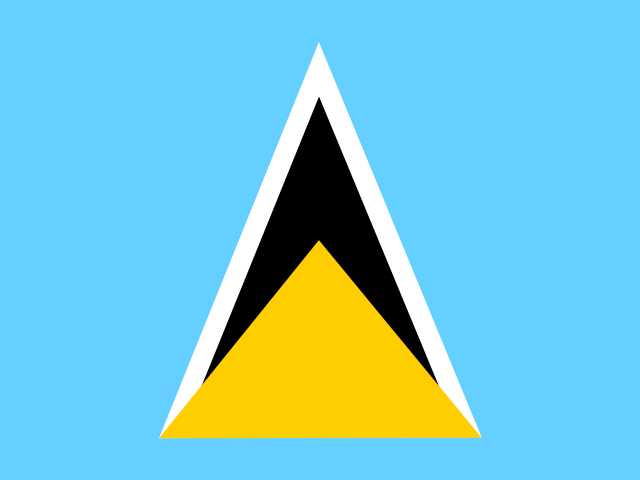
A cerulean-blue field bearing a central device of three superimposed triangles: a white one, a black one laid over the white that reads as a three-pointed star, and a gold one laid over the black. The state publishes the designer's own reading of them, in which the blue stands first for fidelity and then for the tropical sky and the surrounding waters, the gold for sunshine and prosperity, and the black and white for the island's two cultural influences living and working in unity. The triangles are said to recall the twin Pitons at Soufriere.
Source: govt.lc · archive.stlucia.gov.lc · stlucia.gov.lc · attorneygeneralchambers.com · checked 2026-08-27
Saint Lucia FACTS ◢
| Capital | Castries |
|---|---|
| Continent | North America |
| Population | 180,149 (2025) |
| Area | 617 km² |
| Population density | 292/km² |
| Currency | Eastern Caribbean dollar (XCD) |
| Official language | English |
| Calling code | +1758 |
| Internet TLD | .lc |
| Time zone | UTC-04:00 |
| Drives on the | Left |
| ISO codes | LC / LCA |
DID YOU KNOW? ◢
- The Pitons, two towering volcanic spires, are a UNESCO World Heritage Site and the island's most famous landmark.
- It's home to a 'drive-in volcano', where you can drive right up to the bubbling sulphur springs of Sulphur Springs.
- The island changed hands between Britain and France fourteen times before finally becoming British.
- It has produced two Nobel laureates, giving it one of the highest counts of Nobel winners per person of any country.
Saint Lucia QUICK ANSWERS ◢
What is the capital of Saint Lucia?
The capital of Saint Lucia is Castries.
What is the population of Saint Lucia?
Saint Lucia had a population of 180,149 in 2025.
What currency does Saint Lucia use?
Saint Lucia uses the Eastern Caribbean dollar (XCD).
What languages are spoken in Saint Lucia?
The official language of Saint Lucia is English.
Think you know your flags? Play Flag Daily → · Browse all countries →
MORE ON THE FLAG ◢
The short reading of Saint Lucia's flag goes like this: blue for sky and sea, gold for sunshine, black and white for two cultures, triangles for the Pitons. That is the version in general circulation, and it is a compression of something longer.
The Government of Saint Lucia publishes the longer version, and the longer version begins by naming a person rather than a law. "Saint Lucian artist Dunstan St. Omer, designer of the National Flag, has described it as follows", says the flag page on the government's own web portal, and everything after that is presented as the painter's account of his own work.
No law sits underneath it. Saint Lucia's Constitution does not mention the flag at any point, and the Attorney General's Chambers' index of the country's 400 Acts lists no flag statute among them. What the state publishes about what its flag means is what the man who drew it said it meant.
Key Takeaways
- The government's flag page attributes both the description and the meanings to Dunstan St Omer, prefacing them "has described it as follows".
- That text gives the blue for fidelity first, ahead of the sky and the sea.
- It also says the design "impresses the dominance of the Negro culture vis-à-vis that of Europe", which the short reading has no room for.
- The same page calls the triangles "three pitons" and, in the next sentence, the island's famous twin Pitons.
- Saint Lucia's Constitution never mentions the flag, the only statutory mention found is a customs rule on importing goods that bear it, and the only flag rules the government publishes are a Code of Etiquette on the same page, with no instrument named behind it.
| Element | What the government's flag page states |
|---|---|
| Field | "On a plain blue field" |
| Device | A white and black triangular shape with a golden triangle at its base, centrally placed |
| The black shape | "The black ends as a three-pointed star in the centre of the flag" |
| White border | One and a half inches on both sides of the black |
| Peak separation | Four inches between the peaks of the black and white triangles |
| Common base | One third of the full length of the flag |
| Sizes given | 6 feet by 3 feet, and 9 inches by four and a half inches |
| Colour values | None given: no Pantone, hex or percentage figures |
Whose words are on Saint Lucia's flag page
The attribution is explicit and it is doing real work.
Most national flag pages published by a government read as the state speaking: this is our flag, these are its colours, this is what they stand for. Saint Lucia's does not. It introduces its whole account with a named author and a reporting verb, and the account that follows is written in a painter's voice rather than a drafter's.
You can hear it in the description. "On a plain blue field, a device consisting of a white and black triangular shape, at the base of which a golden triangle occupies a central position." Then the geometry: the triangles "are superimposed on one another the black on the white, and the gold on the black", and "The black ends as a three-pointed star in the centre of the flag."
That last sentence names the shape most people never notice. On the flag itself the black reads as a plain triangle at first. Look again and the gold triangle's peak cuts a notch out of its lower edge, leaving the black visible as an apex and two descending legs. Three points.
The description block does not date the flag's adoption, does not record any amendment, and specifies no colours. Apart from one sentence, it describes the flag rather than prescribing it. The exception is the dimensions, which "shall be in the following proportions", and the dimensions turn out to be the part that does not hold together. The rest of the page's prescriptive material sits further down, in a Code of Etiquette.
Fidelity comes before the sky and the sea
The government's gloss on the blue opens with a word that is not about geography at all.
"Cerulean Blue represents fidelity." That is the first sentence of the section headed Meaning of the Flag. The sea and the sky come second, in the sentence after it: "This blue reflects our tropical sky and also our emerald surrounding waters", the Caribbean Sea and the Atlantic Ocean.
The blue has two readings in the state's own text, in a definite order, and the short version keeps the second one. Fidelity is the harder half to illustrate, which is probably why it goes.
The gold is simpler and it survives compression intact. "Gold represents the prevailing sunshine in the Caribbean and prosperity." Sunshine and prosperity, in that order, in six words.
Note that the page says gold, not yellow, in the meaning section, while the description calls the triangle golden. There is no legal word to check either against, because no Act supplies one.
The sentence about the two cultures that changes the reading
The compression does its worst damage here. The government's text on the black and white runs to two sentences, and every short reading keeps only the first. That first sentence gives "Black and white stand for the cultural influences", together with "the white part, the white culture; the black part, the black culture", and "the two races living and working in unity."
What they all drop is the sentence immediately after. "The design impresses the dominance of the Negro culture vis-à-vis that of Europe", set against a background of sunshine and an ever-blue sea.
Those two passages are not saying the same thing. The first is a statement about coexistence. The second is a statement about which of the two the design puts on top, and it is the flag's own geometry restated as an argument: the black triangle sits over the white one, and the white survives only as a border around it.
Read the flag with that sentence in hand and the device stops being decorative. A reader who meets only the unity half meets half of what Saint Lucia publishes.
Two Pitons, or three? The same page says both
The state's own page cannot keep the count of Pitons straight, and it manages the contradiction in the space of two sentences.
The dominance sentence is followed immediately by one that hangs it on the geometry: "This is represented by the three triangles in the centre of the flag, symbolising three pitons." The "This" refers back to the dominance claim, so it is the state's own text, not this article, that ties the argument to the three shapes.
The very next sentence says the triangle is "reminiscent of the island’s famous twin Pitons at Soufriere, rising sheer out of the sea, towards the sky", and calls them "a symbol of the hope and aspirations of the people."
Three pitons, then twin Pitons, in consecutive sentences on the same page, unchanged for a quarter of a century.
Saint Lucia has two Pitons. Gros Piton and Petit Piton are the eroded lava domes above Soufriere that the country is known for. The most likely reading of the first sentence is that it is counting triangles rather than mountains, since the device does have three of them, white and black and gold. The page does not say so, and it is not the writer's job to tidy a state's text on its behalf.
It is the sort of detail that decides whether you get a flag right at a glance, which is the whole task in Flag Daily: one flag a day, three guesses at the country. Three shapes, two mountains.
The flag Saint Lucia turned down
The design was a competition entry, and it was not the entry the painter cared most about.
St Omer told the Saint Lucian newspaper The Voice, in an interview conducted in anticipation of the country's 36th anniversary of independence, that the flag had been in his head before the competition existed. "Even before the competition, the design of the flag was in my mind already."
Then this. "In fact, I submitted two flags. It was the time of Black awareness, so I had a green flag with a black eagle on it. That was too radical for them." His friends told him it was too much. "So the authorities chose to go with the milder flag."
The flag Saint Lucia flies is the second of two, chosen because the first was too pointed for 1967. And the milder one still carries, in the government's own published gloss, a sentence about the dominance of one culture over another. The radical version was rejected; the argument came through anyway, in geometry.
The Voice's fact panel for the same interview records that the competition offered $100 for the best design, and that the flag was made for Saint Lucia's attainment of statehood in 1967.
No Act defines Saint Lucia's flag
The absence is worth stating precisely, because a claim that no law exists is easy to make and awkward to check.
The Constitution of Saint Lucia, Chapter 1.01, is the revised edition consolidating Schedule 1 of the Saint Lucia Constitution Order 1978 as amended, showing the law as at 31 December 2006. Searched end to end, its 190 pages contain no occurrence of flag, emblem, anthem, arms or coat of arms, in any case. The country's founding instrument establishes a Governor General, a Parliament and a Public Service Commission, and says nothing about national symbols at all.
That is the consolidation. The instrument behind it says no more. The Saint Lucia Constitution Order 1978 is published at legislation.gov.uk as a 104-page scan with no usable text layer, so it has to be read as page images rather than searched, and read that way the Order as made runs to three articles: a citation and commencement clause, the revocation of the 1967 Order that had provided the Associated State's constitution, and a clause bringing the Constitution in Schedule 1 into effect on 22 February 1979. None of the three mentions the flag. The Constitution's own arrangement of sections then lists 124 sections across ten chapters, closing with a Miscellaneous chapter that runs from the Integrity Commission to Interpretation, and not one heading in it names a national symbol.
The Revised Laws of Saint Lucia published by the Attorney General's Chambers in 2023 list 400 Acts. None of them is a flag, emblems, anthem or national symbols Act. The nearest thing in that index is one line in a customs schedule.
Schedule 3 to the Customs (Control and Management) Act, made under section 84(1) and headed Prohibitions and Restrictions, sets out restricted imports in its Part 2, and item 15 reads: "Any goods whatsoever which bear the Coat of Arms or the Flag of Saint Lucia or any facsimile, imitation or representation thereof, except with the approval of the Minister."
That is the only statutory mention found: an entry in an import list, between tobacco stalks and trademark infringements, that regulates souvenirs without describing the thing on them.
Be careful about how far that goes. What was searched was 400 Act titles, not 400 Act texts, and item 15 is itself a flag provision buried in the body of a customs Act whose title does not hint at it. Statutory instruments are not in that index at all, and the same schedule shows them at work: item 13 of the list now reads, in its entirety, "( Deleted by S.I. 125/1999 )". So the sound claim is that no Act is about the flag, not that nothing else anywhere mentions it.
The contrast with the coat of arms is sharp. The arms have a formal instrument, and the government publishes it: a Royal Warrant signed at Buckingham Palace "this Eighth day of January 1979", about six weeks before independence, granting arms in full blazon and recorded in the College of Arms in London. It even fixes the motto, "THE LAND-THE PEOPLE-THE LIGHT". The arms are credited on the same page to Sydney Bagshaw. The flag got a competition and a description. The arms got a warrant.
Saint Lucia's flag rules live in a Code of Etiquette
Below the description, the same government page runs a Code of Etiquette for the use of the National Flag of Saint Lucia, in five numbered parts. It is written in the register of rules, and the page does not name any instrument behind it.
Much of it is ordinary protocol, but the Code's first line is one an article like this cannot pass over: "The flag should be of regulation appearance." What follows is about condition, since the flag should not be faded or bleached and a torn one should be repaired before hoisting, but the word is still sitting there on a page that names no regulation and in a statute book that has none. From there it is standard stuff. The flag-mast "should be painted white". No other flag may be flown above the Saint Lucia flag. The flag is flown "every day from 6 a.m. to 6 p.m." and "should not be flown after 6.00 p.m. except inside a building", unless the occasion is an important ceremonial one, when it should be floodlit if possible.
Some of it is stricter than most readers would guess. The Code says the flag "should not be used for purposes of adornment or advertising", and then: "It should not be printed on, or reproduced on, articles of clothing or furniture." On an ordinary day, flying it from a car is not a private decision. "Except on a day of special significance the National Flag shall not be flown on a motorcar without the permission of the Minister."
That is the same backstop as the customs schedule. One of those two texts is an Act and the other is a web page, and both end at the Minister's permission.
The Code's own grammar repays a second look. Flying at half-staff, it says, is a decision that "would rest with the Cabinet of Ministers". That reads more like the conditional of a proposal than the present tense of a rule in force, though a page that elsewhere prints "ill be flown" and "should b floodlit" is thin ground for reading much into one modal verb. Whatever it is, it has been sitting on the government's website in that form since at least 2001.
The published blue changed and the words never did
The colour and the wording have different histories, and keeping them apart is most of the work. The wording on the government's page has said "Cerulean Blue" since at least 20 July 2001, which is the date of the earliest capture of that page in the Internet Archive. Compare that capture with the page served today and the description and meaning block is identical, word for word, apart from two stray spaces. Twenty-five years, no edits.
The pictures on that same site are a different story. The Internet Archive holds the graphic it served in the late 1990s twice over, on 2 December 1998 and 20 February 1999, byte for byte identical, and it is a deep saturated blue. By 16 March 2002 the site was serving a different file at a different address, and that one is pale sky blue.
Measured off the two saved files, the field is about RGB 24, 24, 255 in the December 1998 graphic and about RGB 99, 207, 254 in the March 2002 one. The geometry moved too. In the older graphic the gold triangle's apex sits about 39 percent of the way down the flag and the white triangle's base spans about 40 percent of its length; in the newer one the apex sits about 48 percent down, near the midpoint, and the base spans about 35 percent, close to the one third the description calls for.
Treat all of that as approximate. These are website graphics rather than a legal specification, they are different files in different formats at different resolutions, nothing on the site says one was made to replace the other, and the figures come from a colour threshold applied to a GIF and to a JPEG. What they document is the government's own publishing, not the flag as flown.
No instrument for the change could be found. Saint Lucia's gazette is not published online for that period, the government's flag page does not record an amendment, and there is no Act to amend. The best documented date remains a window rather than a day: the pale blue was already on the government's site by 16 March 2002, and was not there in the archived captures from 1998 and 1999.
The honest summary is that the words never said dark blue, that the government's own graphic was dark blue in every archived copy up to February 1999, and that by March 2002 the site was serving a pale cerulean matching the words. Whether and when the flags themselves changed, and on whose instruction, is not recorded anywhere reachable.
A specification written in inches
The description's numbers are the odd part, and they are odd for a reason.
A flag specification normally works in ratios, so that it scales. Saint Lucia's works in inches. "The width of the white part of the triangle is one-and-a-half inches on both sides of the black." "The distance between the peaks of the black and white triangles is four inches." Only the third measurement is proportional: the triangles "share a common base the length of which is one-third of the full length of the flag."
The page then gives two sizes, 6 feet by 3 feet and 9 inches by four and a half inches, without saying which of them the inch measurements belong to. On the larger flag those figures describe one geometry. On the smaller they describe a wildly different one. It reads as a painter's studio note rather than a drafter's schedule.
The consequence is exactly what you would expect, and the designer said so himself. Asked about the flag in 2015, St Omer said: "I know that many people who make the flag do not use the right colours and proportions to do so." His verdict on the correctly made version was that it is "an absolutely beautiful flag".
That complaint and the customs restriction are the same problem seen from two ends. When the fullest published description omits colour values and states its proportions in inches, there is no document to hand a manufacturer, and what is left is requiring the Minister's approval before flag-bearing goods can be imported at all. If you would rather work a country out from written clues than from a picture, Guess the Country gives you three clues and three guesses.
Frequently asked questions
What does the Saint Lucia flag mean?
According to the Government of Saint Lucia's own flag page, the cerulean blue represents fidelity and reflects the sky and the surrounding waters, the gold represents "the prevailing sunshine in the Caribbean and prosperity", and the black and white stand for two cultural influences, described there as "the two races living and working in unity". The page attributes all of it to the flag's designer, Dunstan St Omer, rather than to any law.
Who designed the flag of Saint Lucia?
Dunstan St Omer, a Saint Lucian painter and muralist, whom the Government Information Service calls Saint Lucia's premier artist. He won a national competition held for the country's attainment of statehood in 1967, and he told The Voice that he had entered two designs, the other being a green flag with a black eagle that was judged too radical.
Do the triangles on Saint Lucia's flag represent the Pitons?
The government's flag page calls the triangle "reminiscent of the island’s famous twin Pitons at Soufriere", so yes, as a resemblance rather than a depiction. The same page also says the three triangles symbolise "three pitons", which does not match the two Pitons that exist. The device has three triangles and the mountains number two.
Is there a law that defines Saint Lucia's flag?
No flag Act was found. The Constitution of Saint Lucia contains no mention of the flag, and none of the 400 Acts in the Attorney General's Chambers' Revised Laws is a flag or national emblems statute. The only statutory reference located is item 15 of Part 2 of Schedule 3 to the Customs (Control and Management) Act, which restricts importing goods bearing the flag or the coat of arms without the Minister's approval. That index lists Act titles rather than Act texts, and no statutory instruments, so it establishes that no Act is about the flag rather than that nothing else mentions it.
Did Saint Lucia's flag change from dark blue to light blue?
The Government of Saint Lucia's own website was serving a deep blue flag graphic in February 1999 and a pale cerulean one by March 2002, while the wording on its flag page said "Cerulean Blue" throughout. No instrument recording a change to the flag itself could be located, so what is documented is the government's publishing rather than the flag as flown.
Sources
- Government of Saint Lucia, Flag of Saint Lucia - retrieved 27 August 2026.
- Government of Saint Lucia, The Flag of Saint Lucia, archived government site - retrieved 27 August 2026.
- Government of Saint Lucia, The Flag of Saint Lucia - read from the Internet Archive capture of 20 July 2001, retrieved 27 August 2026.
- Government of Saint Lucia, Coat of Arms, including the Royal Warrant of 8 January 1979 - retrieved 27 August 2026.
- Government of Saint Lucia, Constitution of Saint Lucia, Chapter 1.01, revised edition (PDF) - retrieved 27 August 2026.
- The Saint Lucia Constitution Order 1978, S.I. 1978 No. 1901, UK Statutory Instruments - the as-made text, read as page images because the scan has no text layer, retrieved 27 August 2026.
- Attorney General's Chambers of Saint Lucia, Customs (Control and Management) Act, Schedule 3, Part 2, Restricted Imports, Revised Laws of Saint Lucia (2023) - retrieved 27 August 2026.
- Attorney General's Chambers of Saint Lucia, Revised Laws of Saint Lucia (2023), index of Acts - retrieved 27 August 2026.
- Government Information Service, Biography of Sir Dunstan: National Cultural Hero, 11 May 2015 - retrieved 27 August 2026.
- Stan Bishop, Sir Dunstan St. Omer, Designer of the National Flag, Reflects, The Voice, 21 February 2015 - retrieved 27 August 2026.
PLAY ANOTHER →
One thing that happened today in history. Every day, a new one.
TODAY IN HISTORYDAILYDaily CryptogramOne quote, one scrambled alphabet. Crack it before tomorrow.
CRACK THE QUOTEDAILYDaily TriviaFive questions a day. Everyone gets the same five.
FIVE QUESTIONSDAILYGuess the CountryThree clues, three guesses. Work out where in the world it is.
THREE CLUES