
Tajikistan
A landlocked knot of high mountains in Central Asia, Tajikistan is so vertical that more than half the country sits above 3,000 metres, with peaks that were once the highest in the Soviet Union.
WHAT THE FLAG MEANS ◢
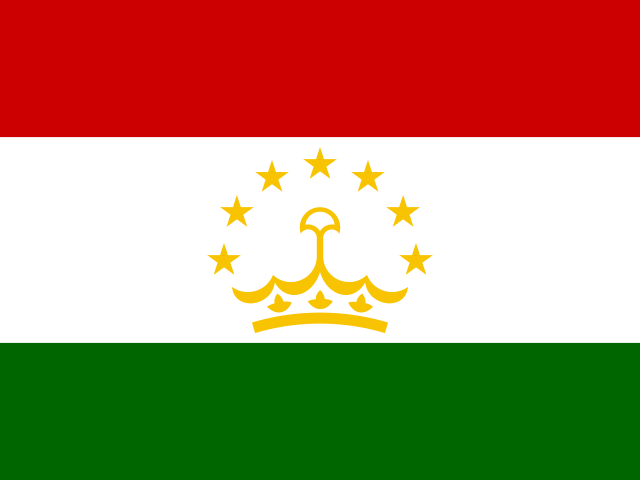
Three horizontal bands of red, white and green, the white one and a half times the width of either coloured band, with a gilt stylised crown centred on the white beneath an arc of seven five-pointed stars. Article 3 of the constitution names the flag among the state symbols and says nothing further, and the description the Assembly of Representatives approved in 2007 fixes the geometry and the colour values without assigning any element a meaning. The state's own readings are not in the instruments at all, and they vary between the speeches and publications that carry them: red for the struggle and sacrifice for freedom and independence, white for fortune and hope, green for flourishing and eternity, and the crown and stars together for the historical roots of Tajik statehood.
Tajikistan FACTS ◢
| Capital | Dushanbe |
|---|---|
| Continent | Asia |
| Population | 10,786,734 (2025) |
| Area | 143,100 km² |
| Population density | 75/km² |
| Currency | Tajikistani somoni (TJS) |
| Official language | Tajik |
| Calling code | +992 |
| Internet TLD | .tj |
| Time zone | UTC+05:00 |
| Drives on the | Right |
| ISO codes | TJ / TJK |
DID YOU KNOW? ◢
- More than 90% of the country is mountainous, dominated by the towering Pamir range.
- Its highest peak, Ismoil Somoni, was the tallest mountain in the entire Soviet Union.
- Tajik is a variety of Persian, making it linguistically close to the languages of Iran and Afghanistan.
- The Pamir Highway that crosses it is one of the highest paved international roads on Earth.
Tajikistan QUICK ANSWERS ◢
What is the capital of Tajikistan?
The capital of Tajikistan is Dushanbe.
What is the population of Tajikistan?
Tajikistan had a population of 10,786,734 in 2025.
What currency does Tajikistan use?
Tajikistan uses the Tajikistani somoni (TJS).
What languages are spoken in Tajikistan?
The official language of Tajikistan is Tajik.
Think you know your flags? Play Flag Daily → · Browse all countries →
MORE ON THE FLAG ◢
Tajikistan specifies its national flag down to two decimal places. The official description fixes the crown's height as a fraction of the white stripe, puts each star inside a circle of a stated diameter, and gives red, white, green and gold as RGB, CMYK and hex values.
It never says what any of that stands for. There is no symbolism clause, in the description or in the constitution or in the law on state symbols. The geometry is fixed and the meaning is not fixed at all.
The readings that circulate are not invented, though. They come from the President's addresses on the flag, from the Presidency's own news pages and from the state news agency, which are real state sources and a very different kind of source from an instrument. Five sets have been published since 2009 and they do not agree with one another.
Key Takeaways
- Article 3 of the constitution names the flag among the state symbols in one sentence and never mentions it again anywhere in the text.
- The flag's description was approved by the Assembly of Representatives on 14 March 2007 and fixes geometry and hex colour values without assigning any element a meaning.
- Five different colour readings have been published by Tajik state sources since 2009, four of them by the Presidency and one by the state news agency, and they do not agree with one another.
- Seven stars have been read as seven historic places of the homeland, as sovereignty and as the historical roots of statehood, and on the state emblem, which shows the same device, as the seven climes.
- Cotton, snow-capped mountains and a rising sun are literal charges of the Tajik state emblem, not readings of the flag's colours.
The constitution names the Tajikistan flag and stops
The constitution, adopted by referendum on 6 November 1994 and amended in 1999, 2003 and 2016, disposes of the subject in Article 3: "Рамзҳои давлатии Тоҷикистон Парчам, Нишон ва Суруди Миллӣ аст." The state symbols of Tajikistan are the Flag, the Emblem and the National Anthem. That is the whole article. Search the articles of the Tajik text for the word Парчам and it appears exactly once, in that sentence, with no colour, no charge and no proportion anywhere in the document.
The Law of the Republic of Tajikistan on the state symbols of the Republic of Tajikistan, No. 254 of 12 May 2007, runs to thirteen articles and is almost entirely about conduct: where the flag is permanently flown, how it is placed beside other flags, how it is half-masted for mourning, whose coffin it covers, and who is liable for disrespecting it. Article 3 of the symbols law requires that the flag and emblem "бо риояи дақиқи ҳаҷму ранги асл бояд тасвир карда шаванд", that they be depicted with exact observance of the original's dimensions and colour. It does not say what the original is.
Article 2 of the symbols law hands the design itself elsewhere: "Парчам, Нишон ва матну оҳанги Суруди Миллиро Маҷлиси намояндагони Маҷлиси Олии Ҷумҳурии Тоҷикистон тасдиқ менамояд." The Flag, the Emblem and the text and melody of the National Anthem are approved by the Assembly of Representatives, which Article 48 of the constitution names as one of the two chambers of the Majlisi Oli, the parliament of Tajikistan.
So the description is a chamber resolution rather than a statute, which is a different category of act from the one the subject invites. The National Legislation Centre's database sorts Tajik acts into types, and Конститутсия, Қонуни конститутсионӣ, Қонуни ҶТ, Қарори Маҷлиси Олии ҶТ and Низомнома are five separate categories: a constitution, a constitutional law, an ordinary law, a resolution of the Majlisi Oli, and a regulation. The list sorts acts rather than ranking them. The symbols instrument titles itself "Қонуни Ҷумҳурии Тоҷикистон", which is the third of those and not the second, and the flag's own description is not in a law at all. The Presidency publishes it on its own state-symbols pages, headed АЛОМАТҲОИ Парчами давлатии Ҷумҳурии Тоҷикистон and attributed to Resolution No. 499 of the Assembly of Representatives, 14 March 2007, on approving the State Flag of the Republic of Tajikistan. Article 12 of the symbols law repealed the instrument that had held the description before it, the Law of 24 November 1992 approving the Regulation on the State Flag. Whether the 2007 text altered anything is not something the sources opened here settle. The Rudaki Institute's page carries a near-identical description and attributes it to a Regulation approved by Resolution No. 892 of the Majlisi Oli on 11 December 1999, which suggests the wording is older than the resolution now in force, and no source opened here records a change to the design itself.
That older Regulation matters for a second reason. As the Institute reproduces it, its first clause is not geometry at all: "Парчами давлатии Ҷумҳурии Тоҷикистон рамзи истиқлолияти давлатии Ҷумҳурии Тоҷикистон мебошад." The State Flag of the Republic of Tajikistan is a symbol of the state independence of the Republic of Tajikistan. That is a meaning clause, and the description approved in 2007 does not have one. If the Institute's reproduction is accurate, something was dropped between the two texts, and no source opened here says why.
The specification, down to the hex code
The top stripe is red, its width equal to the green stripe at the bottom, and "рахи сафеди мобайн якуним баробари паҳнои яке аз рахҳои ранга мебошад", the middle white stripe is one and a half times the width of one of the coloured stripes. On the white, "бо зарҳал рамзи тоҷи тансиқшуда ва дар болои он ҳафт ситора дар шакли нимдоира тасвир шудааст": in gilt, the symbol of a stylised crown, and above it seven stars in a semicircle. The overall ratio of width to length is given as 1:2.
The Russian text published beside it places the device "на расстоянии половины длины полотнища от древка", at half the length of the cloth from the staff, which is what the compressed Tajik phrasing means by putting it in the middle of the flag. The English rendering published by the Border Troops of the State Committee for National Security gives the same clause as "a stylized crown in gold and a semicircle of seven stars above it".
Then the measurements.
| What the description fixes | The figure it gives |
|---|---|
| Overall proportions | 1:2 |
| White stripe | one and a half times the width of a coloured stripe |
| Box containing crown and stars | 0.8 of the white stripe vertically, 1.0 horizontally |
| Each star | inside a circle 0.15 of the white stripe across, five-pointed |
| Arc the stars are set on | radius 0.5 of the white stripe |
| Crown height | 0.55 of the white stripe |
| Crown base arc | radius 1.2 of the white stripe |
| Top of the crown | four arc-shaped elements meeting at a circle segment 0.2 across |
| Red, white, gilt, green | #DC161D, #FFFFFF, #F7BF00, #197B30 |
That table settles two questions people get wrong. The stars are five-pointed as a matter of law: "Ситораҳои панҷгӯша дар доираи қутраш 0,15 акс ёфта", the five-pointed stars fit inside a circle of diameter 0.15. And the crown is built from "Чор унсури камоншакл, ки болои тоҷро ташкил медиҳанд", four arc-shaped elements forming its top, so the shape reads as a stylised diadem rather than a European crown with a cap.
The colour word is worth pausing on too. The metal is зарҳал in Tajik and золотистый in Russian, gilt and golden rather than yellow, and it is pinned to #F7BF00. Anyone describing this flag with a yellow crown has departed from the instrument.
What the description does not contain is one sentence of meaning. Not for the colours, not for the crown, not for the stars.
The colour meanings come from state speech, not from law
The state does answer the question. It answers it in speeches.
Four days before the first Flag Day, on 20 November 2009, the Presidency's account of the President signing the holiday law offered a reading in its own voice: red, green and white as the struggle for freedom and independence, white fortune, the future of life, peace and stability, and effort for the country's verdure and gladness, with "тоҷ ва ҳафт ситораҳо ҳамчун таҷассумгари соҳибдавлатӣ ва соҳибихтиёрӣ", the crown and the seven stars as the embodiment of statehood and sovereignty.
The televised address of 23 November 2009 put it differently. There the three colours together express the Tajik people's struggles for freedom and independence and for building a settled and lasting life, while "тоҷ ва ҳафт ситора ҳамчун рамзҳои барои миллати мо муқаддас соҳибихтиёрии давлати Тоҷикистонро инъикос менамоянд": the crown and seven stars, as symbols sacred to our nation, reflect the sovereignty of the state of Tajikistan.
The address of 23 November 2010 is the one most often reproduced, including by the Rudaki Institute of Language and Literature of the National Academy of Sciences. It breaks the colours out individually. Red is "рамзи муборизаву ҷоннисории халқ барои озодӣ ва истиқлол", a symbol of the people's struggle and self-sacrifice for freedom and independence. White is "нишони бахту саодат, умеду орзу", a sign of fortune and felicity, of hope and aspiration. Green is "нишонаи сарсабзиву шукуфоӣ, сарбаландиву хуррамӣ ва абадият", a sign of verdure and flourishing, of pride and gladness, and of eternity. The crown and the seven stars in the middle are "ишора ба решаҳои таърихии давлатдории Тоҷикистони соҳибистиқлол", a reference to the historical roots of the statehood of independent Tajikistan.
Nine months later, speaking at the raising of the national flag on 30 August 2011, the same head of state gave a fourth version: red for freedom and independence, white for peace and calm, green for prosperity and gladness, and at the centre "рамзи тоҷи зарҳалини соҳибдавлатӣ бо ҳафт ситораи дурахшон", the symbol of the gilded crown of statehood with seven shining stars. The address of 23 November 2013 repeats the 2010 colour sentence word for word apart from one conjunction, and does not mention the crown or the stars at all.
A fifth set comes from outside the Presidency altogether. The state news agency Khovar, writing on Flag Day 2025, gives its own reading in its own voice: red is "рамзи мубориза, шуҷоат, шараф ва ҷоннисорӣ дар роҳи меҳан, сарзамин, мардум, идеяҳои олӣ", a symbol of struggle, courage, honour and self-sacrifice for the homeland, the land, the people and high ideals. White is "рамзи руҳи тавоно, покӣ, муқаддасот ва хушбахтӣ", a symbol of the strong spirit, of purity, of what is held sacred, and of happiness. Green is "рамзи зиндагӣ, ҷавонӣ ва шукуфоӣ", a symbol of life, youth and flourishing. And then a sentence of a kind no presidential text supplies about the flag: "Тоҷ рамзи истиқлолу озодии мамлакат мебошад." The crown is a symbol of the country's independence and freedom, on its own, with the stars not mentioned. Every presidential reading of the flag pairs the two.
None of these is an instrument. Three are the President speaking, on Flag Day or at a flag raising, a fourth is the Presidency's press account of a bill signing, and the fifth is a state news agency. The differences between them are not trivial. White moves from fortune to peace to purity, green from eternity to prosperity to youth, and the crown from a pair with the stars, in every presidential reading of the flag, to a symbol standing alone in the news agency's. A country that specified its flag to two decimal places has never once specified what the flag says.
The seven stars have never had one settled reading
The readings diverge furthest here, and the most specific one is the oldest.
The state news agency Khovar, publishing on Flag Day 2025, quotes academician Muhammad Osimi presenting the winning design on 24 November 1992. The seven stars, he said, stand for seven historic and beautiful places of the homeland, namely "Суғд, Зарафшон, Ҳисор, Рашт, Вахш, Хатлон ва Бадахшон": Sughd, Zarafshon, Hisor, Rasht, Vakhsh, Khatlon and Badakhshan. That is a geographic reading, from the man who chaired the design competition, on the day the flag was adopted, reported by a state news agency thirty-three years later rather than recorded in a 1992 document.
The presidential addresses do not repeat it. They give the stars to sovereignty in 2009 and to the historical roots of statehood in 2010, always paired with the crown rather than counted. The 2013 address does not mention the crown or the stars at all, and Khovar's 2025 reading assigns a meaning to the crown while leaving the stars to Osimi.
A fourth reading exists in a place worth being careful about. Opening the monument to the state emblem in Dushanbe on 25 August 2011, the President described that emblem's charges, and said its "ҳафт ситора гувоҳи ҳафт иқлим ва орзуву омоли нек ба сўи ояндаи ободу осуда мебошанд", its seven stars are witness to the seven climes and to good hopes for a prosperous and peaceful future. Seven climes is the classical Persianate division of the inhabited world. But that sentence is about the emblem, which shows the same crown and the same arc of seven stars, and it has been quoted since as though it were about the flag.
What no Tajik source of any kind says is that the seven stars stand for a number held sacred in Tajik tradition. That reading is common in English reference material and it has no state text behind it.
The cotton and the snow-capped peaks belong to the emblem
The most widely repeated English gloss of this flag gives white to cotton and the mountain snows, red to the sun or to unity, and green to the fertile valleys. Read the Tajik instruments and it becomes clear where three of those images actually belong.
The state emblem's description, approved by the Assembly of Representatives on the same day as the flag's by Resolution No. 500, sets out its charges. The emblem consists of a stylised crown and a semicircle above it made of "ҳафт ситораи бо нурҳои офтоби аз паси кӯҳҳои барфпӯш тулӯъкунанда", seven stars in the rays of the sun rising from behind snow-covered mountains, ringed by a wreath with "аз тарафи рост хӯшаҳои гандум ва аз тарафи чап шохаҳои пахтаи шукуфон", ears of wheat on the right and branches of flowering cotton on the left.
Rising sun, snow-covered mountains, cotton. All three are drawn objects on the emblem, prescribed by the instrument that describes it. The speech at the emblem monument on 25 August 2011 reads them out one by one: the proud peaks pointing to the Tajik highlands, the sun's flame as a sign of the country's sunny climate and as "шаҳодати нури зиё ва равшаниву шукуфоӣ", a testimony of light and of brightness and flourishing, and the wheat and the cotton wrapped in the national flag as a sign of sustenance and blessing and of the endurance of nation and state. It also glosses a crown on its own, which no presidential text does for the flag: "тоҷи зарин рамзи фарру шукўҳ бар сари миллат", the golden crown as a symbol of splendour and majesty over the nation. That crown is the emblem's. The same gloss was reproduced almost verbatim in September 2018 on the presidential website, in a signed article by Абдуфаттоҳ ШАРИФЗОДА, who gives his title as "Доктори илмҳои таърих, Профессор", and Самариддини АЙНИДДИН, who gives his as "Аълочии матбуоти Тоҷикистон". It opens the passage with the same words, "Тасвиру рамзҳои Нишони давлатии мо", the images and symbols of our state emblem, and carries three consecutive paragraphs of the 2011 speech across almost unchanged. That is one gloss published twice rather than two independent readings, and what the reuse shows is that the 2011 wording was still the text being used seven years later.
The flag has none of them. It has three bands, a crown and seven stars, and no Tajik source opened for this article attaches cotton or a mountain or a sunrise to any part of the flag's own design. The tricolour ribbon binding the emblem's wreath is the one place the two touch, and it is the emblem that is borrowing the flag. The images are real, official and specific. They are on the other symbol.
The competition, and the flag woven overnight in Khujand
The design came out of a closed competition. Khovar's account, published on 24 November 2025 and based on the memoirs of one of the winners, says the Supreme Soviet set up a working commission after independence to settle the flag, the emblem and the anthem, that a competition was announced some months before the adoption date, and that academician Muhammad Osimi led it. More than 200 designs were submitted, each studied by the commission, whose work was conducted behind closed doors.
The commission chose the design put forward by the artists Zuhur Habibulloev and Aleksandr Zanevsky (Зуҳур Ҳабибуллоев, Александр Заневский). Habibulloev recorded that in preparing and drawing the flag they took advice from culture scholars including Larisa Dodkhudoeva, N. Ignatushina and M. Saidaliev.
Then it had to be made overnight. Habibulloev's recollection, as Khovar quotes it, is that "ин парчам дар Комбинати абрешими шаҳри Хуҷанд омода гардидааст", this flag was prepared at the silk combine in the city of Khujand, where weavers and craftsmen worked from four in the afternoon until three in the morning. It was carried into the hall of the Arbob Palace on 25 November 1992, and the newly elected chairman of the Supreme Soviet, Emomali Rahmon, and the members of the chamber kissed it and swore an oath on it. That first flag measures 145 by 85 centimetres and is held in the National Museum of Tajikistan, transferred there in June 2007. Those are not the proportions the description fixes, and they are not meant to be: the object was woven in November 1992 and the 1:2 ratio comes from a text approved fifteen years later.
The first meaning attached to the new flag in law is the strangest detail in the story. The resolutions on the flag and the emblem amended articles 169 and 170 of the constitution then in force, and the amended text made the flag a symbol of "рамзи Истиқлоли давлатӣ, иттифоқи вайроннашавандаи коргарон, деҳқонон ва зиёиён, дӯстӣ ва бародарии ҳама халқҳои маскуни ҷумҳурӣ": state independence, the indestructible union of workers, peasants and the intelligentsia, and the friendship and brotherhood of all the peoples inhabiting the republic. A new national flag, glossed in the formula of the Soviet constitution it was replacing.
Why 24 November is Flag Day in Tajikistan
Because that is the date the flag was adopted, at a session held in an emergency.
Tajikistan declared independence on 9 September 1991 and then, in the President's own account of it thirty years later, spent "беш аз як сол рамзҳои давлатдории худ, аз ҷумла Парчами давлатӣ надошт", more than a year without its symbols of statehood, including the state flag. There was no constitution, no anthem and no emblem either, and the country was sliding into civil war.
The sixteenth session of the Supreme Soviet was convened on 16 November 1992 not in Dushanbe but "дар шаҳри Хуҷанди бостонӣ", in the ancient city of Khujand, because deputies and members of the government were being taken hostage in the capital and the session could not sit safely there. It ran a 23-item agenda that included electing a new chairman of the Supreme Soviet, forming a new government, and approving the state symbols. The flag was adopted on 24 November.
The anniversary took another seventeen years to become a holiday. The President proposed the bill using his right of legislative initiative, and the Presidency reported on 20 November 2009 that the law adding 24 November to the Law on holidays as Flag Day had been signed and had taken effect that day on publication in the newspaper Ҷумҳурият. Four days later Tajikistan marked it for the first time.
The 2010 address carried a proposal that one of the capital's squares be named after the national flag. The ceremony beginning construction of the flag tower took place on the second anniversary of Flag Day, and the flag was raised on 30 August 2011, on the eve of the twentieth anniversary of independence. The President gave its height as 165 metres, called it the tallest in the world on the information of specialists, and put the flag itself at 60 metres long and 30 metres wide.
To test how well you can place a flag like this one, Flag Daily shows one flag a day and gives you three guesses at the country. The full set of factsheets is at every country.
Frequently asked questions
What do the colours of the Tajikistan flag mean?
No Tajik instrument assigns the colours a meaning. The description approved by the Assembly of Representatives on 14 March 2007 fixes the stripe widths and the hex values and stops there, and Article 3 of the constitution names the flag among the state symbols and goes no further. The readings come from state speech and state journalism instead, and five sets have been published since 2009 without agreeing: the President's address of 23 November 2010 gives red as the people's struggle and self-sacrifice for freedom and independence, white as fortune, felicity, hope and aspiration, and green as verdure, flourishing, pride, gladness and eternity, while the state news agency Khovar in 2025 gives red as struggle, courage, honour and self-sacrifice, white as strong spirit and purity, and green as life, youth and flourishing.
Those readings vary between addresses. The speech at the raising of the national flag on 30 August 2011 gives red as freedom and independence, white as peace and calm and green as prosperity and gladness instead.
What do the seven stars on the Tajikistan flag represent?
There is no legal answer, and the state's own answers differ. The state news agency Khovar reports academician Muhammad Osimi, presenting the winning design on 24 November 1992, saying the seven stars stood for seven historic places of the homeland: Sughd, Zarafshon, Hisor, Rasht, Vakhsh, Khatlon and Badakhshan. The President's Flag Day addresses pair the stars with the crown instead, as sovereignty in 2009 and as the historical roots of independent Tajik statehood in 2010. The address of 2013 does not mention them at all.
The description does fix one thing about them. They are five-pointed, each inside a circle 0.15 of the white stripe's width, arranged on an arc of radius 0.5 of that width.
Who designed the flag of Tajikistan?
The artists Zuhur Habibulloev and Aleksandr Zanevsky, whose entry was chosen by a commission chaired by academician Muhammad Osimi from more than 200 submissions in a closed competition. Habibulloev recorded that they consulted the culture scholars Larisa Dodkhudoeva, N. Ignatushina and M. Saidaliev while drawing it. The account is the state news agency Khovar's, published on Flag Day 2025 and quoting Habibulloev's memoirs.
When was the flag of Tajikistan adopted?
On 24 November 1992, at the sixteenth session of the Supreme Soviet, held in Khujand because the session could not sit safely in Dushanbe. Tajikistan had been independent since 9 September 1991 and had gone more than a year with no state symbols at all. The first flag was woven overnight at the Khujand silk combine and brought into the Arbob Palace the following day.
The description in force today is later. It was approved by Resolution No. 499 of the Assembly of Representatives on 14 March 2007.
Why is the white stripe on the Tajikistan flag wider than the others?
Because the description says so. The middle white stripe is one and a half times the width of one of the coloured stripes, while the red and green stripes are equal to each other. No Tajik source explains the choice, and the description also fits the whole device inside a box 0.8 of the white stripe deep, so whatever the reason, the extra width is where the crown and the stars go.
Sources
- Маркази миллии қонунгузории назди Президенти Ҷумҳурии Тоҷикистон, Конститутсияи Ҷумҳурии Тоҷикистон, Article 3, Tajik text - retrieved 27 August 2026.
- Маркази миллии қонунгузорӣ, Қонуни Ҷумҳурии Тоҷикистон «Дар бораи рамзҳои давлатии Ҷумҳурии Тоҷикистон», No. 254 of 12 May 2007, Articles 2, 3 and 12 - retrieved 27 August 2026.
- Президенти Ҷумҳурии Тоҷикистон, Парчами давлатӣ, carrying the description approved by Resolution No. 499 of the Assembly of Representatives, 14 March 2007, in Tajik and Russian - retrieved 27 August 2026.
- Президенти Ҷумҳурии Тоҷикистон, Нишони давлатӣ, carrying the description approved by Resolution No. 500 of the Assembly of Representatives, 14 March 2007 - retrieved 27 August 2026.
- Президенти Ҷумҳурии Тоҷикистон, Табрикоти телевизионӣ ба муносибати Рӯзи Парчами давлатӣ, 23 November 2009 - retrieved 27 August 2026.
- Президенти Ҷумҳурии Тоҷикистон, Ба имзо расидани як қатор қонунҳо, 20 November 2009 - retrieved 27 August 2026.
- Президенти Ҷумҳурии Тоҷикистон, Паёми телевизионӣ ба муносибати Рӯзи парчам, 23 November 2010 - retrieved 27 August 2026.
- Президенти Ҷумҳурии Тоҷикистон, Суханронӣ дар маросими ифтитоҳи муҷассамаи Нишони давлатӣ, 25 August 2011 - retrieved 27 August 2026.
- Президенти Ҷумҳурии Тоҷикистон, Суханронӣ ба муносибати барафрохтани Парчами миллӣ, 30 August 2011 - retrieved 27 August 2026.
- Президенти Ҷумҳурии Тоҷикистон, Паёми телевизионӣ ба муносибати Рӯзи Парчами Ҷумҳурии Тоҷикистон, 23 November 2013 - retrieved 27 August 2026.
- Абдуфаттоҳ Шарифзода and Самариддини Айниддин, ТОҶИКИСТОНИ ОЗОДИ МАН!, signed article published on the website of the President of the Republic of Tajikistan, 7 September 2018 - retrieved 27 August 2026.
- Президенти Ҷумҳурии Тоҷикистон, Суханронӣ ба ифтихори 30-юмин солгарди баргузории Иҷлосияи XVI-уми Шӯрои Олии Ҷумҳурии Тоҷикистон, 16 November 2022 - retrieved 27 August 2026.
- АМИТ «Ховар», Аввалин Парчами давлатии Ҷумҳурии Тоҷикистон ёдгории нодир аст, 24 November 2025 - retrieved 27 August 2026.
- Қӯшунҳои сарҳадии Кумитаи давлатии амнияти миллии Ҷумҳурии Тоҷикистон, State symbols, official English text of the law and of both descriptions - retrieved 27 August 2026.
- Институти забон ва адабиёти ба номи Абуабдуллоҳи Рӯдакӣ, Парчами Ҷумҳурии Тоҷикистон - retrieved 27 August 2026.
PLAY ANOTHER →
One thing that happened today in history. Every day, a new one.
TODAY IN HISTORYDAILYGuess the CountryThree clues, three guesses. Work out where in the world it is.
THREE CLUESDAILYDaily CryptogramOne quote, one scrambled alphabet. Crack it before tomorrow.
CRACK THE QUOTEDAILYDaily TriviaFive questions a day. Everyone gets the same five.
FIVE QUESTIONS