
Angola
A vast southern-African nation on the Atlantic coast where Portuguese is the official tongue and the Kwanza River lends its name to the currency in your pocket.
WHAT THE FLAG MEANS ◢
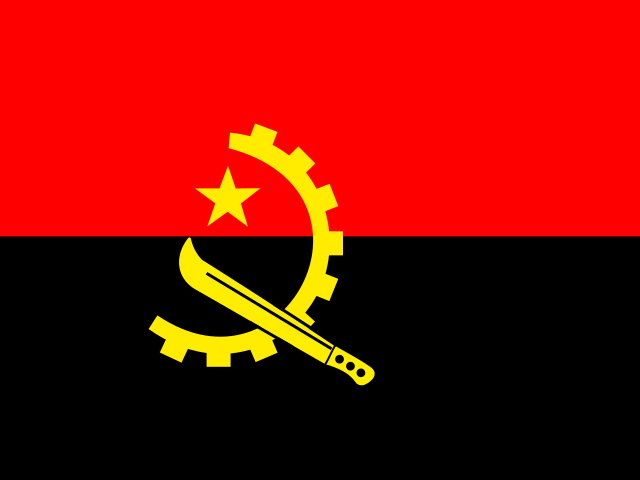
Two horizontal bands, red over black, with a central yellow emblem of a machete crossed by a segment of a cogwheel beneath a star. Annex I to the constitution assigns a meaning to every element: bright red for the blood shed by Angolans under colonial oppression, in the liberation struggle and in defence of the country; black for the African continent; the cogwheel segment for the workers and industrial production; the machete for the peasants, agricultural production and the armed struggle; the star for international solidarity and progress; and the yellow they are drawn in for the country's wealth.
Angola FACTS ◢
| Capital | Luanda |
|---|---|
| Continent | Africa |
| Population | 39,040,039 (2025) |
| Area | 1,246,700 km² |
| Population density | 31/km² |
| Currency | Kwanza (AOA) |
| Official language | Portuguese |
| Calling code | +244 |
| Internet TLD | .ao |
| Time zone | UTC+01:00 |
| Drives on the | Right |
| ISO codes | AO / AGO |
DID YOU KNOW? ◢
- Portuguese is its official language, a legacy that makes it one of the largest Portuguese-speaking nations.
- The Welwitschia plant, found in its arid south, can live for over a thousand years with just two leaves.
- The Kalandula Falls are among the largest waterfalls by volume in all of Africa.
- Its Atlantic coastline stretches for more than 1,600 kilometres.
Angola QUICK ANSWERS ◢
What is the capital of Angola?
The capital of Angola is Luanda.
What is the population of Angola?
Angola had a population of 39,040,039 in 2025.
What currency does Angola use?
Angola uses the Kwanza (AOA).
What languages are spoken in Angola?
The official language of Angola is Portuguese.
Think you know your flags? Play Flag Daily → · Browse all countries →
MORE ON THE FLAG ◢
Ask what a national flag's colours mean and you will usually get folklore. Ask about Angola's and you get a legal text, because the meanings are written into the constitution itself.
Annex I of the 2010 Constitution of the Republic of Angola sets out the design and then assigns a meaning to every element in it: the red band, the black band, the machete, the cogwheel segment, the star and the yellow they are drawn in. There is no guessing to do.
Key Takeaways
- Angola's flag meanings are constitutional text, not tradition. Annex I spells out all six elements.
- The flag was enacted by the MPLA Central Committee on 10 November 1975 and took effect at midnight, as independence began.
- The 1975 and 2010 texts describe the same flag in noticeably different political language.
- Proposals to replace the flag emerged during the 2003 constitutional revision and were not adopted.
- The five points of the star and the nine teeth of the cogwheel come from a 2019 presidential decree, not the constitution.
What does the Angolan flag mean?
Two bands and three objects, each with an assigned meaning.
Annex I of the constitution reads, in the Constitute Project's English translation: "The National Flag shall display two colours in horizontal bands. The upper band shall be bright red and the lower one black." It then attributes them directly. Bright red is "The blood shed by Angolans during the period of colonial oppression and the national liberation struggle and in defence of the country". Black is "The African continent".
The centre carries "a design composed of a segment of a cog wheel, symbolising the workers and industrial production, a machete, symbolizing the peasants, agricultural production and the armed struggle, and a star, symbolizing international solidarity and progress." The final line covers the colour those three are drawn in: they "shall be yellow, symbolizing the country's wealth."
That is the entire official symbolism, and it is unusually complete. The same wording appears verbatim on the government of Angola's own national-symbols page, and Article 18 of the constitution is what makes the annex binding, stating that the flag, the insignia and the anthem are those adopted at the proclamation of independence on 11 November 1975.
Two small points of accuracy follow from reading the text rather than a summary. The constitution says "a segment of a cog wheel", not half a cogwheel, which is the phrase that circulates. And it says only "a star" - it does not say how many points the star has.
Who actually adopted this flag?
A political party's central committee, the day before the country existed.
The Constitutional Law of the People's Republic of Angola, the instrument that created the state, sets out the national symbols in its Title IV, with the flag described at Article 54. Its closing provisions are what make the moment unusual. Article 60 sets commencement at "zero horas do dia 11 de Novembro de 1975", midnight on independence day, and records that the law was approved by acclamation by the Central Committee of the MPLA on 10 November 1975 and signed by António Agostinho Neto in his capacity as President of the MPLA.
Article 57 of the same law goes further. Until an assembly with constituent powers existed, it says, the Constitutional Law could be amended only by the MPLA Central Committee.
People often say Angola's flag "derives from the MPLA party flag", which is true but understates it. The founding instrument that established the flag was itself a party act, passed by a party organ and signed by a party president, hours before there was a republic to have a flag at all.
Did the wording change after independence?
The flag did not. The description of it did.
Setting the 1975 text beside the 2010 one shows a careful rewriting.
| Element | 1975 wording | 2010 wording |
|---|---|---|
| What the red commemorates | a luta de libertação nacional e a revolução | a luta de libertação nacional e a defesa da Pátria |
| The cogwheel stands for | classe operária | trabalhadores |
| The machete stands for | classe camponesa | camponeses |
| The star stands for | internacionalismo | solidariedade internacional |
The revolution is gone, replaced by the defence of the homeland. The working class becomes workers, the peasant class becomes peasants, and internationalism becomes international solidarity.
Not one thread of the cloth changed. Every one of those edits is to the gloss, not the design, and together they take the Marxist register out of the official explanation while leaving the emblem exactly as it was.
A flag's meaning is a document, and documents get revised. A country factsheet will tell you what a flag looks like; only the legal text tells you what the state currently says it is for.
Was Angola's flag nearly replaced?
Yes, and the record of it is thinner than the story deserves.
The firm part comes from Angop, the Angolan state news agency, in a retrospective published on 10 November 2025: proposals to change the flag's design emerged in 2003 in the course of constitutional revision, and "Contudo, as mudanças não foram adoptadas" - the changes were not adopted, and the original flag remained as an authentic expression of the struggle and of national identity. Angop gives no design detail, no date within 2003 and no body.
Everything more specific than that reaches us second hand. Flags of the World, a volunteer vexillological compilation, reproduces what it presents as Angop dispatches of 27 August, 4 September and 6 September 2003, and those dispatches are no longer reachable in Angop's own archive.
On that account, a sub-commission of the National Assembly's Constitutional Commission, the body then drafting Angola's next constitution, ran a public competition and announced a winner in late August 2003. The design was horizontal bands of dark blue, white and a broad central red, carrying a many-rayed sun derived from the ancient rock paintings at Tchitundo-Hulu in Namibe province. No red over black, no machete and no cogwheel, in other words: it would have severed every visual link to 1975.
No source in hand records how the proposal ended. What is documented is where it landed: the constituent process ran on to 2010, and the constitution it eventually produced re-affirmed the symbols adopted in 1975 rather than replacing them.
Where do the exact specifications live?
In an executive instrument from 2019, not in the constitution.
Article 18 of the constitution deliberately hands the technical detail to ordinary law: "A lei estabelece as especificações técnicas", the law shall establish the technical specifications. Presidential Decree 161/19 of 20 May 2019 approved a manual to do exactly that, and the Ministry of Territorial Administration publishes it, in an edition dated 2021.
The manual is where the details everyone assumes are constitutional actually appear. It fixes the flag at a 3:2 proportion, describes the cogwheel segment as having nine teeth and the star as having five points, and specifies where the emblem sits: the fourth tooth of the cogwheel, counted from the top, straddles the centre line, with half of it on the red and half on the black. It also sets the colours, giving Pantone 186 C for the red, 116 C for the yellow and Process Black C for the black.
So the flag has two layers of authority. The constitution says what it means; a 2019 decree says how to draw it. Anyone who tells you the constitution specifies a five-pointed star has not read the annex.
Nothing at that level of detail survives a glance, which is the gap between recognising a flag on a daily flag round and being able to draw one.
Frequently asked questions
What do the machete and the cogwheel on Angola's flag mean?
Annex I of the constitution assigns both. The cogwheel segment symbolises "the workers and industrial production" and the machete symbolises "the peasants, agricultural production and the armed struggle". The star beside them stands for "international solidarity and progress", and the yellow all three are drawn in for "the country's wealth".
Why is the Angolan flag red and black?
Because Annex I of the constitution says what each band is for. Bright red stands for "The blood shed by Angolans during the period of colonial oppression and the national liberation struggle and in defence of the country", and black for "The African continent". That is not folklore but constitutional text.
Is Angola's flag the MPLA flag?
They share a design lineage, and the connection is documentary rather than merely visual. The 1975 Constitutional Law that established the national flag was approved by acclamation by the MPLA Central Committee on 10 November 1975, signed by Agostinho Neto as President of the MPLA, and came into force at midnight as independence began.
Did Angola try to change its flag?
Angop, the Angolan state news agency, reports that proposals to change the flag's design emerged in 2003 during constitutional revision and were not adopted. Accounts reproduced from 2003 agency copy that is no longer reachable at the agency describe a competition run by a sub-commission of the National Assembly's Constitutional Commission, whose winning entry was blue, white and red bands carrying a sun drawn from the Tchitundo-Hulu rock paintings. The 2010 constitution re-affirmed the 1975 symbols instead.
How many points does the star on the Angolan flag have?
Five, but not because the constitution says so. Annex I mentions only "a star". The five points, along with the cogwheel's nine teeth and the 3:2 proportion, are set by the national symbols manual approved by Presidential Decree 161/19 of 20 May 2019.
Reading a constitution is one way to learn a flag. Working a country out from three clues, with no flag shown at all, is the other end of the same problem.
Sources
- Constitution of the Republic of Angola, 2010, Article 18 and Annex I - Portuguese republication published by the National Assembly of Angola; English translation via the Constitute Project - retrieved 10 August 2026.
- Government of Angola, Símbolos Nacionais - retrieved 10 August 2026.
- Lei Constitucional da República Popular de Angola, 1975, Articles 53 to 60, digitised by CEDIS, NOVA School of Law, Lisbon - retrieved 10 August 2026.
- Ministério da Administração do Território, Manual dos Símbolos Nacionais, approved by Presidential Decree 161/19 of 20 May 2019 - retrieved 10 August 2026.
- Angop, Bandeira de Angola, símbolo de resistência e identidade nacional, 10 November 2025 - retrieved 10 August 2026.
- For the 2003 proposal only, and at the reduced confidence described above: Flags of the World, a volunteer vexillological compilation, which reproduces Angop dispatches of 27 August, 4 September and 6 September 2003 that are no longer reachable at the agency - retrieved 10 August 2026.
PLAY ANOTHER →
Three clues, three guesses. Work out where in the world it is.
THREE CLUESDAILYDaily CodeA short message, hidden in a different cipher every day.
ONE CIPHER A DAYDAILYOn This DayOne thing that happened today in history. Every day, a new one.
TODAY IN HISTORYDAILYDaily CryptogramOne quote, one scrambled alphabet. Crack it before tomorrow.
CRACK THE QUOTE