
Armenia
A mountainous country in the South Caucasus that became the first nation on Earth to adopt Christianity as its state religion, back in the early 4th century.
WHAT THE FLAG MEANS ◢
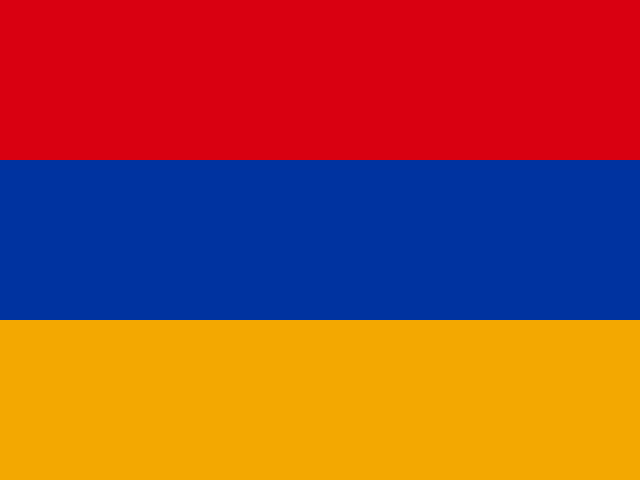
Three equal horizontal bands of red, blue and orange. Article 2 of the 2006 flag law assigns each colour a meaning: red the Armenian Highland and the people's continued struggle for survival, the Christian faith, and independence and freedom; blue the will to live beneath peaceful skies; orange their creative talent and hard-working nature. The law and Article 21 of the Constitution both say orange - 'apricot' is popular usage, not the legal term.
Source: arlis.am
Armenia FACTS ◢
| Capital | Yerevan |
|---|---|
| Continent | Asia |
| Population | 3,086,700 (2025) |
| Area | 29,743 km² |
| Population density | 104/km² |
| Currency | Armenian dram (AMD) |
| Official language | Armenian |
| Calling code | +374 |
| Internet TLD | .am |
| Time zone | UTC+04:00 |
| Drives on the | Right |
| ISO codes | AM / ARM |
DID YOU KNOW? ◢
- It was the first country in the world to adopt Christianity as its official state religion, around 301 AD.
- Mount Ararat, its national symbol, towers over the capital though it now sits across the border in Turkey.
- It has one of the world's oldest alphabets, created in the early 5th century and still in use today.
- Archaeologists found a 5,500-year-old leather shoe in one of its caves, among the oldest ever discovered.
Armenia QUICK ANSWERS ◢
What is the capital of Armenia?
The capital of Armenia is Yerevan.
What is the population of Armenia?
Armenia had a population of 3,086,700 in 2025.
What currency does Armenia use?
Armenia uses the Armenian dram (AMD).
What languages are spoken in Armenia?
The official language of Armenia is Armenian.
Think you know your flags? Play Flag Daily → · Browse all countries →
MORE ON THE FLAG ◢
Most national flags leave their colours to folklore. Armenia does not. The Law of the Republic of Armenia on the Flag, adopted on 15 June 2006, spells out in its own text what each stripe stands for.
That makes the Armenian flag unusually easy to be accurate about, and it makes one popular reading easy to check. The statute never says red is blood.
Key Takeaways
- Article 2 of the 2006 flag law assigns each colour a meaning in the statute itself, not in a commentary.
- Red stands for the Armenian Highland, a continued struggle for survival, the Christian faith, and independence and freedom. Blood appears nowhere in the text.
- Blue is not "the sky". The law makes it the will to live beneath peaceful skies.
- Both the law and Article 21 of the Constitution call the third stripe orange. Apricot is popular usage, not legal wording.
- The design dates from 1918, the meanings from 2006. In Vratsian's account of the 1918 session, Malkhasyants, who proposed the tricolour, attached no meanings to it.
What do the colours on the Armenian flag mean?
The answer is a single paragraph of Armenian statute. Article 2 of the flag law describes a tricolour of red, blue and orange in equal horizontal stripes from top to bottom, then assigns each stripe a meaning.
Two of the three are routinely misreported:
| Stripe | What Article 2 says (official English) | What is usually said instead |
|---|---|---|
| Red | "emblematizes the Armenian Highland, the Armenian people's continued struggle for survival, maintenance of the Christian faith, Armenia's independence and freedom" | bloodshed |
| Blue | "emblematizes the will of the people of Armenia to live beneath peaceful skies" | the Armenian sky |
| Orange | "emblematizes the creative talent and hard-working nature of the people of Armenia" | nothing, popular usage matches |
Red is the one to watch. The Armenian text gives it a մշտական պայքար, a constant struggle for survival, listed alongside the Christian faith, independence and freedom. Blood is not in the sentence.
Blue is not a description of the sky either. The statute makes it a wish about how the people want to live beneath one.
The same article fixes the proportions at 1:2 and allows smaller or larger flags so long as that ratio holds.
Is the third stripe orange or apricot?
Legally, orange. In everyday Armenian, very often apricot.
The word in Article 2 is նարնջագույն, narnjaguyn, which is simply orange, and Article 21 of the Constitution uses the same word.
The rival term is ծիրանագույն, tsiranaguyn, literally apricot-coloured, from ծիրան, apricot. It is a claim of ownership as much as a colour name: the fruit carries the botanical name Prunus armeniaca. The reading gained ground in Armenian and diaspora writing during the 1990s and is now common, but neither the Constitution nor the flag law has ever adopted it.
Who chose red, blue and orange, and when?
The first Republic of Armenia, in the summer of 1918.
The republic's legislature first convened on 1 August 1918, and the philologist Stepan Malkhasyants, best known for his dictionary of Armenian, presented a report proposing a horizontal tricolour of red, blue and orange. The report is lost. What survives is the account in the 1928 memoir of Simon Vratsian, the republic's last prime minister.
The argument was mostly about the third stripe. Some members wanted green, some objected that orange cloth would be hard to get, and the painter Martiros Saryan pushed for a rainbow rather than yet another tricolour. Prime Minister Hovhannes Kajaznuni backed orange.
Here is the part that matters. Vratsian's account records no meanings attached to the three colours by the man who proposed them. The familiar readings, red for Armenian blood, blue for the sky, orange for labour, are reported as what members of that assembly took the colours to mean.
So the popular blood-and-sky version is not a corruption of the official meanings. It is older than them, and on red and blue the 2006 statute answered differently.
There is no clean 1918 adoption date to give. Vratsian recorded that the final decision was left to a Constituent Assembly, which never delivered one, so the earliest date attachable to the tricolour by a named law is 1990.
When did Armenia get this flag back?
The tricolour flew for a little over two years before Soviet rule replaced it, and it came back on the eve of independence.
The Supreme Council adopted a law on the state flag on 24 August 1990, the day after the Declaration of Independence, restoring the tricolour after nearly seventy years of Soviet Armenian flags, the last of them a red field crossed by a horizontal blue stripe with a hammer, sickle and star.
The tidiest evidence sits at the end of the current law. Article 12 repeals exactly two instruments: the Armenian SSR decree of 30 September 1967 that had approved the Soviet republic's flag statute, and the Republic of Armenia law of 24 August 1990. The Soviet-era decree was still formally on the books in 2006, sixteen years after the flag it governed had stopped flying.
What else does the Armenian flag law require?
More than most people expect, and the details are the kind that decide a flag quiz argument.
Article 7 sets three conditions on any raised flag:
- It must be whole, clean and not faded, with its lower edge at least 2.5 metres above the ground.
- Its length against the pole's may be no less than 1:1.7, which caps the pole at about 1.7 times the flag.
- If it is kept permanently raised, it has to be lit at night.
The same article's vertical rule is the one worth knowing. Hung upright, the flag must be turned 90 degrees anticlockwise, so that a viewer facing it still reads red, blue and orange from left to right.
What the law does not carry is a colour code. Article 2 puts a coloured image in an annex and makes it an integral part of the law, but no Pantone or RGB value appears in the text. Those come from a separate 2012 standard issued by the Armenian National Institute of Standards.
Frequently asked questions
When was the Armenian flag adopted?
Three dates matter and only two are laws. The first Republic of Armenia's legislature chose the tricolour in 1918, but no formal adopting instrument from that period survives. The Supreme Council restored it by law on 24 August 1990, and the flag law in force today was adopted on 15 June 2006.
Does red on the Armenian flag mean blood?
Not officially. The 2006 law gives red the Armenian Highland, a continued struggle for survival, the Christian faith, and independence and freedom. It does not mention blood.
The blood reading is genuine but unofficial, and older than the law: it was among the meanings members of the 1918 legislature attached to the colours themselves.
Why do Armenians call the orange stripe apricot?
Because ծիրանագույն, tsiranaguyn, literally means apricot-coloured, and the apricot is closely identified with the country, to the point of carrying the botanical name Prunus armeniaca. The name is widespread in Armenian and diaspora usage. It is not the legal term, though: Article 2 of the flag law and Article 21 of the Constitution both use նարնջագույն, the ordinary word for orange.
Who designed the Armenian flag?
Stepan Malkhasyants, a philologist, proposed the horizontal red, blue and orange tricolour to the first Republic of Armenia's legislature in August 1918. His report is lost and is known through Simon Vratsian's 1928 memoir, which records no meanings attached to the colours by the man who proposed them. Malkhasyants is therefore the source of the design, and the 2006 statute the source of the symbolism.
What are the proportions of the Armenian flag?
One to two. Article 2 of the 2006 flag law sets the ratio of the flag's width to its length at 1:2 and allows smaller or larger flags provided that ratio holds. Article 7 adds that the pole may be no more than about 1.7 times the flag's length.
Sources
- Armenian Legal Information System (ARLIS), Law of the Republic of Armenia on the Flag, HO-149-N, adopted 15 June 2006 - Articles 2, 7 and 12, read in the Armenian original. Retrieved 12 August 2026.
- Armenian Legal Information System (ARLIS), Constitution of the Republic of Armenia - Article 21, symbols of the Republic of Armenia. Retrieved 12 August 2026.
- President of the Republic of Armenia, State symbols of the Republic of Armenia - the official English wording of the colour symbolism. Retrieved 12 August 2026.
- EVN Report, The Symbols of the First Republic of Armenia - the 1918 debate, drawing on Simon Vratsian's 1928 memoir The Republic of Armenia and Hayk Demoyan's 2012 study of Armenian national symbols. Retrieved 12 August 2026.
- Flags of the World, Armenia - the 2012 SARM colour values quoted above. Retrieved 12 August 2026.
A note on limits: Armenia's National Assembly publishes its legislation at parliament.am, but every legislation page there returned 404 from here, so the statute was read on ARLIS instead.
Think you could pick this one out of a line-up? Try Flag Daily, or browse the rest of the country pages.
PLAY ANOTHER →
Five questions a day. Everyone gets the same five.
FIVE QUESTIONSDAILYDaily CodeA short message, hidden in a different cipher every day.
ONE CIPHER A DAYDAILYOn This DayOne thing that happened today in history. Every day, a new one.
TODAY IN HISTORYDAILYGuess the CountryThree clues, three guesses. Work out where in the world it is.
THREE CLUES