
Austria
An Alpine republic of eight land borders, which gave the world Mozart, the waltz and the coffee house. Austria turns mountains and music into a way of life.
WHAT THE FLAG MEANS ◢
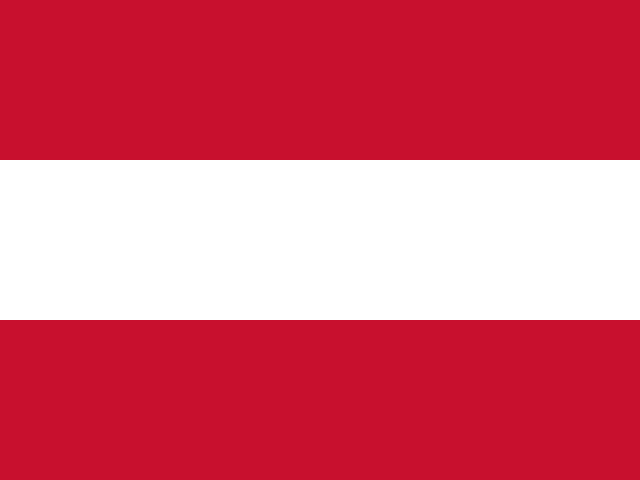
Three equal horizontal bands of red, white and red. Article 8a(1) of the Bundes-Verfassungsgesetz defines the flag as three equally wide horizontal stripes, the middle white and the outer two red, and assigns the colours no meaning; the Wappengesetz 1984 repeats the description and adds none. The red-white-red shield is documented from a seal of 30 November 1230 under Duke Friedrich II, the last Babenberg. The story that Duke Leopold V won the colours at Acre in 1191, his white surcoat blood-soaked but for the band under his sword belt, is a much later legend.
Source: ris.bka.gv.at · checked 2026-08-12
Austria FACTS ◢
| Capital | Vienna |
|---|---|
| Continent | Europe |
| Population | 9,208,163 (2025) |
| Area | 83,879 km² |
| Population density | 110/km² |
| Currency | Euro (EUR) |
| Official language | German |
| Calling code | +43 |
| Internet TLD | .at |
| Time zone | UTC+01:00 |
| Drives on the | Right |
| ISO codes | AT / AUT |
DID YOU KNOW? ◢
- The composers Mozart, Haydn and Schubert were all born here, and Beethoven made Vienna his home.
- The Alps cover roughly two-thirds of the country.
- Vienna has repeatedly been ranked among the world's most liveable cities.
- The croissant traces its ancestry to the Viennese kipferl pastry.
Austria QUICK ANSWERS ◢
What is the capital of Austria?
The capital of Austria is Vienna.
What is the population of Austria?
Austria had a population of 9,208,163 in 2025.
What currency does Austria use?
Austria uses the Euro (EUR).
What languages are spoken in Austria?
The official language of Austria is German.
Think you know your flags? Play Flag Daily → · Browse all countries →
MORE ON THE FLAG ◢
Austria puts its flag in its constitution and then declines to explain it. Article 8a of the Bundes-Verfassungsgesetz names the colours and fixes the stripes, and gives neither a meaning.
So the honest answer is that the Austrian state has never said. Two readings older than the republic fill the silence, and the famous one is a late invention.
Key Takeaways
- Article 8a(1) B-VG sets three equal horizontal stripes, white between two red, and gives the colours no meaning.
- The red-white-red shield is documented from a seal of 30 November 1230, under the last Babenberg duke.
- The bloodied-tunic story about Duke Leopold V at Acre in 1191 is not written down until about 1394. The oldest object behind it is a charter forged around 1260.
- The eagle on the state flag holds a hammer and a sickle and wears a mural crown: workers, farmers, townspeople.
- The broken chain round its talons was added on 1 May 1945, for Austria regaining its independence.
What do the colours on the Austrian flag mean?
Nothing that Austrian law is willing to state. Article 8a(1) of the Bundes-Verfassungsgesetz, inserted into the constitution in 1981, says only: "Die Farben der Republik Österreich sind rot-weiß-rot." The flag, it continues, consists of three equally wide horizontal stripes, the middle one white and the upper and lower ones red.
The Wappengesetz 1984, of 28 March that year, governs Austria's emblems. It repeats those two sentences at § 3(1) and (2) and stops; its § 1 does not even blazon the coat of arms, but points back to the constitution. That is the whole of the current law on the flag, and nothing in it attaches courage to the red or peace to the white.
Two readings circulate, both private. The humanist Johannes Cuspinianus, who died in 1529, read the red field in his Austria as the fertile land and the silver bar as the Danube. The famous one is below.
Where does red-white-red actually come from?
From a rebrand carried out around 1230 by Friedrich II, known as der Streitbare, the last of the Babenberg dukes. Heraldry calls the shield he adopted the Bindenschild.
Austria-Forum's dossier puts the earliest surviving evidence on a wax seal of office, on a charter of 30 November 1230 confirming the privileges of Lilienfeld Abbey. It is damaged and carries no colour, but the triangular horseman's shield is there. A better preserved example of 1236 survives at Heiligenkreuz Abbey, and the colours are attested in accounts of Friedrich's knighting at the Vienna Schottenstift on 2 February 1232.
Earlier Austrian margraves and dukes bore the imperial eagle instead, still visible on Heinrich II Jasomirgott's equestrian seal of 1170; the heraldist Hugo Gerard Ströhl dated the switch flatly to 1230 and to Friedrich.
Peter Diem, writing for the Forum Politische Bildung, reads the switch as politics: Friedrich wanted his duchy less dependent on the Empire, and a shield in the newest heraldic fashion helped make that case.
Is the Leopold V bloodied-tunic story true?
No, and the way it was assembled is better than the story.
The telling everyone knows: at the siege of Acre in 1191, Duke Leopold V fought until his white surcoat was blood-soaked, and unbuckling his sword belt left a clean white band beneath. Diem calls it a legend that refuses to die.
Leopold did not use this shield. For Austrian business he sealed with the imperial eagle borne by his father, Heinrich II Jasomirgott; for Styrian business, with the Styrian panther.
The oldest object behind the legend is a fake, and it says nothing about blood. A charter produced around 1260 was dressed up as an instrument issued at Lorch on 7 May 1178, shield already attached, to make the arms look two generations older. It gives Leopold the title Duke of Styria, which he did not hold until 1192 under the Georgenberger Handfeste.
The story proper turns up about 1394, in the Chronik von den 95 Herrschaften by the Viennese Augustinian Leopold Steinreuter, who introduces it with "Man saget", it is said. Hearsay, two centuries on.
The blood and the belt come later still, in Wolfgang Lazius's Vienna, a history of the city written in 1546. That is 355 years after the siege.
Why does the Austrian eagle carry a hammer and sickle?
Because they are two of three estate symbols, and the third is what separates them from the Soviet device.
The plain national flag carries no emblem. The Dienstflagge, the state flag reserved to public bodies, adds the coat of arms across both red stripes at a height-to-length ratio of 2:3, fixed by § 3(3) of the Wappengesetz 1984.
Article 8a(2) blazons those arms: a single-headed black eagle, gold-armed and red-tongued, a red shield with a silver bar on its breast, a golden mural crown on its head, a golden sickle in the right talon, a golden hammer in the left, a broken iron chain round both.
The constitution describes and stops. The meaning is enacted text, in the Wappengesetz 1945 (StGBl. Nr. 7/1945), Artikel 1(1), which restored the arms first introduced on 8 May 1919 and read them as the cooperation of "der wichtigsten werktätigen Schichten", the most important working strata:
| Element | What Artikel 1(1) says it stands for |
|---|---|
| Hammer | The workers, die Arbeiterschaft |
| Sickle | The farmers, die Bauernschaft |
| Mural crown | The townspeople, das Bürgertum |
| Broken chain | Austria regaining its independence in 1945 |
The crown is the term that settles the reading. Three estates, not a pair. Diem treats the 1945 wording as a legal interpretation, and as proof that Austria's arms carry no hammer-and-sickle emblem.
Red-white-red had become the state colours on 31 October 1918, and the 1919 law that followed described the bird but left the symbolism unsaid. The authoritarian regime of 1934 removed all three symbols and went back to a double-headed, haloed eagle.
What do the broken chains on the Austrian eagle mean?
The end of Nazi rule, and they were law before the war in Europe was over.
Artikel 1(1) of the Wappengesetz 1945, of 1 May, says the restored arms are supplemented "zur Erinnerung an die Wiedererringung der Unabhängigkeit Österreichs und den Wiederaufbau des Staatswesens im Jahre 1945", in memory of Austria regaining its independence and rebuilding the state, by a broken iron chain encircling both of the eagle's talons.
Germany did not surrender for another week. The chain has been on the eagle ever since, and it is the only element the legislature both introduced and explained in the same sentence.
Frequently asked questions
Do the Austrian colours stand for bravery and peace?
No. No Austrian instrument says so. Article 8a(1) B-VG states that the colours of the Republic are red-white-red and describes the stripes; the Wappengesetz 1984 repeats that and adds no symbolism. Readings exist, but they are private and old: Johannes Cuspinianus, who died in 1529, took the red for the fertile land and the silver bar for the Danube.
Is the story of Duke Leopold's blood-soaked tunic true?
Almost certainly not. Leopold V sealed with the imperial eagle for Austrian matters and the Styrian panther for Styrian ones, and the red-white-red shield enters the record only under Friedrich II, thirty-six years after Leopold's death.
The story is not written down until about 1394, and the oldest document behind it is a charter forged around 1260 that gives Leopold a title he did not yet hold.
How old is the Austrian flag?
The shield behind it dates to 1230, from a wax seal on a charter of 30 November that year for Lilienfeld Abbey, and the colours are attested at Friedrich II's knighting in Vienna on 2 February 1232. The republican flag is younger: red-white-red became the state colours on 31 October 1918 and entered the constitution in 1981.
Why is there a hammer and sickle on Austria's coat of arms?
They are estate symbols, not communist ones. Artikel 1(1) of the Wappengesetz 1945 (StGBl. Nr. 7/1945) states that the hammer stands for the workers, the sickle for the farmers and the mural crown on the eagle's head for the townspeople, the three together representing their cooperation.
The crown is what separates the group from the Soviet hammer and sickle, which has no third term.
What is the difference between the Austrian and Latvian flags?
The width of the white stripe. Austria's three stripes are equal thirds; section 2 of Latvia's flag law fixes its stripe ratio at 2:1:2, so the white band is half the depth of each red one, and names the colour carmine. It also sets Latvia's proportions at 1:2, where Austrian law fixes no ratio for the plain national flag.
Sources
- RIS (Austrian federal legal information system), Bundes-Verfassungsgesetz, Art. 8a - retrieved 12 August 2026.
- RIS, Wappengesetz, BGBl. Nr. 159/1984 - retrieved 12 August 2026.
- Staatsgesetzblatt 1945, 2. Stück, Nr. 7, Wappengesetz 1945, Artikel 1 - retrieved 12 August 2026.
- Peter Diem, "Die Entwicklung der Symbole der Republik Österreich", Informationen zur Politischen Bildung Nr. 32, Forum Politische Bildung, 2010 - retrieved 12 August 2026.
- Austria-Forum, Rot Weiß Rot - retrieved 12 August 2026.
- Law On the National Flag of Latvia, section 2 - retrieved 12 August 2026.
Think you could pick red-white-red out of a lineup? Try Flag Daily, or work through the country pages.
PLAY ANOTHER →
One quote, one scrambled alphabet. Crack it before tomorrow.
CRACK THE QUOTEDAILYGuess the CountryThree clues, three guesses. Work out where in the world it is.
THREE CLUESDAILYDaily CodeA short message, hidden in a different cipher every day.
ONE CIPHER A DAYDAILYOn This DayOne thing that happened today in history. Every day, a new one.
TODAY IN HISTORY