
Belarus
A landlocked slice of Eastern Europe where flat plains, thick forests and thousands of lakes stretch out under wide skies. Belarus quietly holds some of the continent's last untouched wilderness.
WHAT THE FLAG MEANS ◢
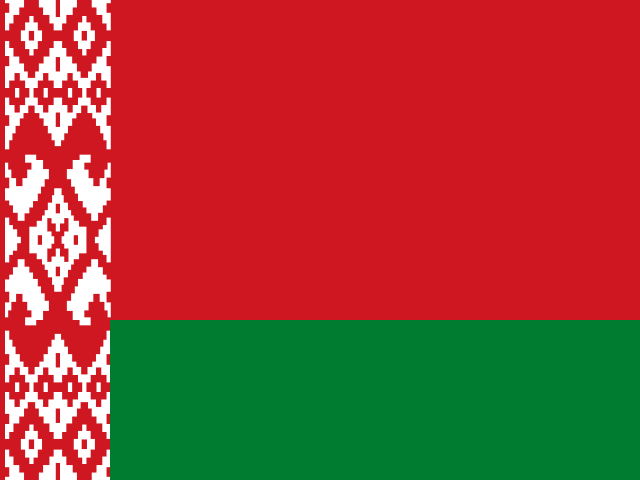
A broad red horizontal band over a narrower green one, with a red-on-white Belarusian national ornament running vertically down the hoist on a white field one ninth of the flag's length. The flag's law gives the colours no meaning; the official reading takes red for strength, courage, nobility and energy, green for hope, health, youth and revival, and the ornament for the people's ancient culture, its content telling of bread and harvest.
Source: president.gov.by
Belarus FACTS ◢
| Capital | Minsk |
|---|---|
| Continent | Europe |
| Population | 9,085,991 (2025) |
| Area | 207,597 km² |
| Population density | 44/km² |
| Currency | Belarusian ruble (BYN) |
| Official languages | Belarusian, Russian |
| Calling code | +375 |
| Internet TLD | .by |
| Time zone | UTC+03:00 |
| Drives on the | Right |
| ISO codes | BY / BLR |
DID YOU KNOW? ◢
- It's home to Belovezhskaya Pushcha, one of the last and largest remnants of primeval forest in Europe.
- That forest shelters the European bison, the continent's heaviest land animal, brought back from the brink of extinction.
- Roughly 40% of the country is covered in forest.
- Its capital, Minsk, was almost entirely rebuilt after being flattened in World War II.
Belarus QUICK ANSWERS ◢
What is the capital of Belarus?
The capital of Belarus is Minsk.
What is the population of Belarus?
Belarus had a population of 9,085,991 in 2025.
What currency does Belarus use?
Belarus uses the Belarusian ruble (BYN).
What languages are spoken in Belarus?
The official languages of Belarus are Belarusian and Russian.
Think you know your flags? Play Flag Daily → · Browse all countries →
MORE ON THE FLAG ◢
Most national flags were designed. The band of ornament down the hoist of the Belarusian flag was made by hand in a peasant household, and the President's official portal names the woman who made it: Matrena Markevich, from the village of Kostelishche in the Senno district, in 1917.
There is a monument to her in Senno. By the state press's account she died without ever learning where her pattern had ended up.
The flag around that pattern is younger, and far more argued over.
Key Takeaways
- The ornament traces to one cloth made by Matrena Markevich in 1917. Two Belarusian state sources disagree on whether she wove it or embroidered it.
- It reached a flag on 25 December 1951, on the Byelorussian SSR flag, in white on red. The 1995 flag reversed that to red on white.
- The 2004 Law on State Symbols assigns no meaning to any colour. The published meanings come from the President's portal instead.
- The change was approved at the referendum of 14 May 1995, with 75.11% of those voting in favour. Decree No. 214 of 7 June 1995 fixed the design.
- It replaced the white-red-white flag, whose 1991 law was repealed in 1996. The US State Department's report for 2024 records that displaying it is prohibited.
What does the pattern on the Belarusian flag mean?
Officially, the ancient culture of the people. The statute itself says nothing of the kind: Article 4 of the Law on State Symbols only places the ornament, in the words "У древка вертикально расположен белорусский национальный орнамент красного цвета на белом поле, составляющем 1/9 длины Государственного флага Республики Беларусь" ("At the staff there is placed vertically a Belarusian national ornament of red colour on a white field constituting 1/9 of the length of the State Flag of the Republic of Belarus").
The meaning comes from the President's official portal, which calls the ornament a "символ древней культуры народа, его духовного богатства" ("a symbol of the people's ancient culture, of its spiritual wealth") and says its content "повествует о хлебе, урожае и продолжении рода" ("tells of bread, harvest and the continuation of the line").
That is the state's reading of the pattern. The pattern itself came from one household.
Belarusian accounts trace it to a rushnik, a ceremonial cloth, carrying a design called "Восходящее солнце", the Rising Sun.
What it looks like is harder to find than what it stands for. Sielskaja Hazieta, published by the Presidential Administration's press house, reads the pattern element by element. At its centre is a rhombus with hooks running off it, the ones called oars or horns, and of those the paper says "Эти детали символизируют движение и вечность" ("these details symbolise movement and eternity"). The rhombus is a sown field and a sign of the goddess of fertility. The marks around it are there to call up luck and a rich harvest, and the small rhombuses stand for bread.
No element in that list is a sun. Iva Shubko, who directs the Senno museum, reconciles it in the same article by reading the design whole rather than piece by piece: every element carries a symbolic meaning, but the Rising Sun taken together stands for a person's striving for happiness and a better life through work.
The two state sources describing that cloth disagree on how Markevich made it. The presidential portal names her and says the ornament "был вышит в 1917 г. крестьянкой из деревни Костелище Сенненского района Витебской области Матреной Маркевич" ("was embroidered in 1917 by a peasant woman from the village of Kostelishche in the Senno district of the Vitebsk region, Matrena Markevich"). Sielskaja Hazieta says she wove it.
What happened next is better documented. Sielskaja Hazieta has the rushnik collected on an ethnographic expedition and deposited in the archive of Belpromsovet, the republic's industrial council. In 1951 the president of the Academy of Sciences set the ethnographer Mikhail Katser, who ran its ethnography and folklore section, the task of finding a distinctive detail for a new Byelorussian SSR flag, and Katser found the cloth in that archive. He was Markevich's brother: she was born Katser and took her husband's name on marrying.
That she never heard about it has an explanation in the same account. The family was dekulakised in 1933 and her husband taken away, and she was treated as the wife of an enemy of the people, so she kept almost no contact with her scholar brother for fear of harming his career.
An artist surnamed Gusev worked the pattern into the design; the sources disagree on his first name too, the state press calling him Mikhail and a district executive committee's published history of the state symbols crediting an N. Gusev who lived from 1899 to 1965.
The portal adds a claim of priority. Belarus, it says, was "первая в мире страна, которая использовала национальный орнамент в качестве элемента государственного флага" ("the first country in the world to use a national ornament as an element of a state flag"). The state press hedges the same claim to one of the first.
What do the colours of the Belarusian flag mean?
Not what the law says, because the law says nothing. Article 4 is pure geometry: a red band over a green one at 2:1, a flag of 1:2, the ornament's white field at one ninth of the length, and a staff painted golden ochre. No sentence in the statute assigns red or green a meaning.
The meanings come from elsewhere. The President's official portal lists them:
- Red ("сила, мужество, благородство, энергия") for strength, courage, nobility and energy.
- Green ("надежда, здоровье, молодость, возрождение, трудолюбие, созидание, природная гармония") for hope, health, youth, revival, industriousness, creation and natural harmony.
- White ("чистота, непорочность, примирение, мудрость, знания") for purity, innocence, reconciliation, wisdom and knowledge.
Two things stand out. White gets a meaning of its own rather than serving as blank backing for the ornament. And forests are absent from the list, although the green is commonly read as standing for Belarusian woodland.
When was the current Belarusian flag adopted?
By referendum, on 14 May 1995, and the Central Commission's protocol records both the question and the count.
The second of the four questions read: "Поддерживаете ли Вы предложение об установлении новых Государственного флага и Государственного герба Республики Беларусь?" ("Do you support the proposal to establish new State Flag and State Emblem of the Republic of Belarus?").
Of 7,445,820 citizens entitled to take part, 4,823,482 voted, a turnout of 64.78%. The result was 3,622,851 for and 988,839 against, with 211,792 ballots invalid.
That is 75.11% of those voting and 48.66% of the whole electorate; both figures get quoted, and they are the same vote.
Presidential Decree No. 214 of 7 June 1995 then fixed the flag's description in law, which is why the design dates from June rather than May. The 2004 statute replaced that decree nine years later.
Has the flag changed since 1995?
The ornament has, twice, and neither change went through parliament. The table sets both against the 1995 design they altered, and the 1951 flag that design came from.
| Dated | The band at the hoist |
|---|---|
| 25 December 1951 | White ornament on a red field one ninth of the flag's length |
| 7 June 1995 | Red ornament on white, the ornament itself one twelfth of the flag's length, centred in the white field |
| 27 November 2009 | Red ornament on white, the ornament widened to one ninth of the flag's length |
| 10 February 2012, in force 1 May | Red ornament on white without its white framing, with a red stripe at the hoist one twenty-first of the ornament's width |
How the flag is made is set by a state standard, STB 911-2008, approved by the standards committee on 19 March 2008 and amended in November 2009 and February 2012.
The first amendment resized the ornament. Until then it was one twelfth of the flag's length and sat centred in the white field, with white showing either side; a decision of 27 November 2009 took it to one ninth, the width the statute gives the field.
The second redrew the pattern rather than the strip. A decision of 10 February 2012, in force from 1 May that year, changed the ornament "в части отсутствия обрамления белого цвета" ("in respect of the absence of white framing"), the white edging the earlier drawing had carried, and put a vertical red stripe at the point of attachment to the staff, one twenty-first of the ornament's width, to hold the pattern together.
The statute took longer to catch up with its own flag. An amending law of 4 January 2021 added a reference image to the law itself, which until then carried none; the physical reference flag is kept, under Article 3, in the "Национальный архив Республики Беларусь", the National Archive of the Republic of Belarus, in Minsk.
Anyone who learned this flag from a picture published before 2012 learned a slightly different one. Flag Daily shows one flag a day and gives you three guesses at the country.
What is the white-red-white flag?
The flag Belarus flew before this one, and the flag a lot of Belarusians still fly.
Its law was a sentence of description. The Law of 19 September 1991, No. 1090-XII, made the state flag "трех горизонтально расположенных цветных полос равной ширины: верхней и нижней белого, а средней красного цвета" ("three horizontally placed coloured bands of equal width: the upper and lower white, and the middle red"). That law outlived the referendum and was formally repealed only on 28 June 1996.
The design is far older. The Belarusian state archive service, in its biography of the architect and diplomat Klawdziy Duzh-Dushewski, says he is considered the author of the official flag of the Belarusian People's Republic, which declared independence by its Third Charter on 25 March 1918. The archives hold that charter.
It did not disappear in 1995. The US State Department's human rights report for 2024 records that the authorities "prohibited displaying certain historical flags and symbols, including the historic white-red-white-striped flag adopted by the democratic movement", and that security forces detained demonstrators carrying red and white flags, symbols "generally identified with the opposition".
So Belarus is a country where the answer to "what is the flag" depends on who is answering. The country pages hold the rest, and the geography quiz tests whether any of it stuck.
Frequently asked questions
Who made the ornament on the Belarusian flag?
Matrena Markevich, a peasant woman from Kostelishche in the Senno district of the Vitebsk region, who put the pattern into a ceremonial cloth in 1917. The President's official portal names her, and a monument to her stands in Senno.
The state press reports she died in 1957, aged 71, without ever learning the pattern had reached a flag.
What do the red and green on the Belarusian flag mean officially?
The President's portal gives red as strength, courage, nobility and energy, and green as hope, health, youth, revival, industriousness, creation and natural harmony. The 2004 Law on State Symbols assigns them no meaning, so these are published government readings rather than statutory definitions.
Why does the Belarusian flag look like the Soviet-era one?
Because it is the same design with the Soviet emblems removed and the ornament's colours reversed. The Byelorussian SSR flag approved on 25 December 1951 had the same field, two thirds red over one third green, with a gold hammer, sickle and star in the upper hoist and, in the decree's words, a "белорусский национальный орнамент белого цвета на красном поле, составляющем 1/9 длины флага" ("Belarusian national ornament of white colour on a red field constituting 1/9 of the length of the flag").
When is Belarus's flag day?
The second Sunday in May. The President's portal gives that day for the Day of the State Flag, State Emblem and State Anthem, and that district history traces the holiday to Presidential Decree No. 157 of 26 March 1998.
Is the white-red-white flag banned in Belarus?
It has no standing as a state symbol, and the US State Department's human rights report for 2024 records that Belarusian authorities prohibited displaying it. The same report notes a law on preventing the rehabilitation of Nazism that treated symbols denoting support for the opposition as "Nazi symbols and attributes".
Sources
- National Legal Internet Portal of Belarus, Law No. 301-Z of 5 July 2004 on the State Symbols of the Republic of Belarus, Articles 3 and 4 - retrieved 12 August 2026.
- Official Internet Portal of the President of the Republic of Belarus, The State Flag - retrieved 12 August 2026.
- Central Commission on Elections and Republican Referendums, Protocol on the referendum of 14 May 1995, question 2 - retrieved 12 August 2026.
- Hantsavichy District Executive Committee, History of the state symbols of the Republic of Belarus, pages 1-5 - retrieved 12 August 2026.
- Archives of Belarus, On the reference images of the state symbols - retrieved 12 August 2026.
- Archives of Belarus, Duzh-Dushewski Klawdziy - retrieved 12 August 2026.
- ETALON-ONLINE, Law of 19 September 1991 No. 1090-XII on the State Flag of the Republic of Belarus, clause 1 - retrieved 12 August 2026.
- Wikisource transcription of the Decree of the Presidium of the Supreme Soviet of the BSSR, 25 December 1951, on the State Flag, clause 1, from the 1956 collection of BSSR laws - retrieved 12 August 2026.
- "The Risen Sun of Matrena Markevich", Sielskaja Hazieta, 9 April 2019 - retrieved 12 August 2026.
- US Department of State, Belarus 2024 Human Rights Report, freedom of expression - retrieved 12 August 2026.
PLAY ANOTHER →
Five questions a day. Everyone gets the same five.
FIVE QUESTIONSDAILYOn This DayOne thing that happened today in history. Every day, a new one.
TODAY IN HISTORYDAILYDaily CodeA short message, hidden in a different cipher every day.
ONE CIPHER A DAYDAILYDaily CryptogramOne quote, one scrambled alphabet. Crack it before tomorrow.
CRACK THE QUOTE