
Bulgaria
A Balkan country of mountains, Black Sea beaches and rose fields, with an alphabet it helped invent. Bulgaria gave the world the Cyrillic script now used across much of Eastern Europe.
WHAT THE FLAG MEANS ◢
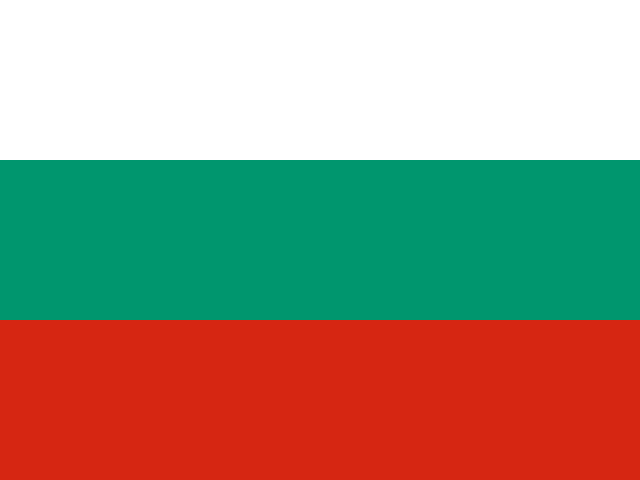
Three equal horizontal bands of white, green and red. Article 166 of the constitution gives the tricolour and its order and nothing else, and article 23 of the 1879 Tarnovo Constitution before it did the same, so no Bulgarian law has ever said what the colours mean. The reading repeated almost everywhere - white for peace, green for the land and its forests, red for the courage and blood of those who fought for the country - is not official.
Bulgaria FACTS ◢
| Capital | Sofia |
|---|---|
| Continent | Europe |
| Population | 6,433,302 (2025) |
| Area | 110,994 km² |
| Population density | 58/km² |
| Currency | Euro (EUR) |
| Official language | Bulgarian |
| Calling code | +359 |
| Internet TLD | .bg |
| Time zone | UTC+02:00 |
| Drives on the | Right |
| ISO codes | BG / BGR |
DID YOU KNOW? ◢
- The Cyrillic alphabet was developed in the Bulgarian Empire in the 9th century.
- It's one of the world's leading producers of rose oil, a key ingredient in perfume.
- Bulgaria is one of Europe's oldest states, founded in 681 AD and keeping its name ever since.
- The Thracians who lived here left behind some of the finest ancient gold treasures ever found.
Bulgaria QUICK ANSWERS ◢
What is the capital of Bulgaria?
The capital of Bulgaria is Sofia.
What is the population of Bulgaria?
Bulgaria had a population of 6,433,302 in 2025.
What currency does Bulgaria use?
Bulgaria uses the Euro (EUR).
What languages are spoken in Bulgaria?
The official language of Bulgaria is Bulgarian.
Think you know your flags? Play Flag Daily → · Browse all countries →
MORE ON THE FLAG ◢
The object Bulgaria treats as the ancestor of its national flag was embroidered by a girl of fourteen, took her almost six months, and was turned down.
Stiliyana Paraskevova made it to her father Ivan Paraskevov's design, and on 8 May 1877 it was presented to Grand Duke Nikolai, commander-in-chief of the Russian Danube Army, for the Bulgarian volunteer corps then forming. The Russian command did not want the volunteers flying anything other than the Samara flag. So it never reached the corps it was made for, and it went into a museum instead, where it still is.
Key Takeaways
- The flag regarded as the tricolour's prototype dates from 1877, two years before Bulgaria had a constitution.
- The National Museum of Military History brought it out for one day in March 2026 and otherwise keeps it in storage.
- Article 23 of the 1879 Tarnovo Constitution set the three colours and said nothing about their meaning.
- Article 166 of the current constitution fixes the same colours in the same order, and is equally silent.
- The Pantone values and the 3 to 5 ratio come from a law promulgated in 1998 and twice changed in 1999, not from either constitution.
Is there an official meaning to the colours?
Not in any of the texts checked for this article. Each one gives the colours and their order and stops.
This is worth stating plainly, because the question returns a confident answer almost everywhere you look: white stands for peace, green for the land and its forests, red for the courage and the blood of the people who fought for the country. That reading is widely repeated online. What it is not is official.
The President of the Republic's own page on the symbols of state power quotes the governing law at length, giving the description, the proportions, the exact Pantone references and the approved sizes. It carries no statement of what the individual colours signify. The current constitution does not supply one either, and neither did the constitution of 1879.
Three texts stand behind that, and they are not equally well seen: the two constitutions were read in full, while the flag law was read only so far as the President's office reproduces it.
What does the constitution actually say?
One sentence, and then a delegation.
Chapter Ten of the Constitution of the Republic of Bulgaria opens with the coat of arms at Article 164, a gold lion rampant on a dark red shield, and the state seal at Article 165. Then Article 166: "The flag of the Republic of Bulgaria shall be a tricolor: white, green, and red from top, placed horizontally." That is the whole of it.
Article 167 hands everything else downwards: "The rules for the placing of the state seal and the raising of the national flag shall be established by law." Three articles, arms then seal then flag, with the detail pushed out to ordinary legislation.
Where did Bulgaria's white, green and red come from?
From the first constitution Bulgaria ever had, which fixed the same three colours in the same order.
The Tarnovo Constitution, dated at Tarnovo on 16 April 1879, is where the tricolour enters Bulgarian law. Its text, as transcribed at Bulgarian Wikisource, heads Chapter IV in the orthography of the day: "За гербътъ на Княжеството, за печата и за Народното Знаме" - on the arms of the Principality, the seal, and the national flag.
Article 21 gives the arms, "златенъ коронованъ левъ на тъмночървенъ щитъ", a gold crowned lion on a dark red shield. Article 22 gives the seal. Article 23 reads: "Българското народно знаме е трицвѣтно и състои отъ бѣлъ, зеленъ и червенъ цвѣтове, поставени хоризонтално." The Bulgarian national flag is tricolour and consists of white, green and red colours, placed horizontally.
| What the text fixes | 1879, Article 23 | Today, Article 166 |
|---|---|---|
| Colours | white, green, red | white, green, red |
| Arrangement | placed horizontally | placed horizontally |
| Position in the chapter | third, after arms and seal | third, after arms and seal |
| Meaning assigned | none | none |
A century and a half, two monarchies, a people's republic and a democratic transition later, the same three colours sit in the same order in the same place in the chapter, and the silence is identical too. Set that beside every country's flag and factsheet and both halves of it look unusual.
One caveat on the comparison. Both articles were read at one remove from the original, the 1879 text in a transcription and the modern one in a translation. Neither is a reason to doubt the reading, but both are reasons not to inflate it into a claim about the whole of Bulgarian law.
What is the prototype flag, and where is it?
In a strongroom in Sofia, and almost never on public view.
The National Museum of Military History treats it as the първообраз, the prototype, of the Bulgarian tricolour. Its deputy director Deyana Kostova has described the making of it, and the detail that stays with you is the scale of the undertaking against the age of the person doing it: Stiliyana was 14, and the embroidery took almost six months. Her father chose the order of the three colours deliberately.
The museum keeps it in its storage under strictly controlled conditions, which is why the flag is close to 150 years old and exceptionally well preserved. BTA reported on 3 March 2026 that the museum was bringing it out that day and that day only, for the national holiday, and described it as an object that rarely leaves the store at all.
The flag it was passed over for was the Samara flag, the banner associated with the Russian city of that name.
A daily flag round gives you three guesses to name one flag, which is a quick way to find out whether you would place this one at all.
Kostova makes one further claim about the tricolour, and it is a large one: it is, she says, the only state symbol that has never been changed across Bulgaria's long and fairly turbulent history.
Worth reading that precisely rather than loosely. The claim is about the three colours and their order, which is not the same as a claim about the flag as a whole: a national flag can gain and lose emblems in its field without the tricolour underneath it changing at all. On the narrow reading her claim holds, and the narrow reading is the one the constitutional texts support.
Who decides Bulgaria's exact shade of green?
A law promulgated in 1998, twice changed in 1999, and it is specific.
The Law on the State Seal and the National Flag of the Republic of Bulgaria is the statute Article 167 anticipated. The President's office cites it as promulgated in the State Gazette, issue 47 of 24 April 1998, supplemented by issue 33 of 9 April 1999 and amended by issue 69 of 3 August 1999, and quotes it directly: the national flag is tricolour, white, green and red fields placed horizontally from the top downwards, rectangular, with the fields equal in size.
Then it gets precise. The ratio of width to length is 3 to 5. The white must have a degree of whiteness of not less than 80 per cent. The green is number 17-5936 TC on the Pantone textile scale and the red is number 18-1664 TC on the same scale. Standard sizes are set at 18 by 30 centimetres, 24 by 40, 90 by 150 and 129 by 215.
Bulgaria will name the precise textile dye reference for its green and will not say what the green is there for. How a flag is drawn and what it is said to stand for turn out to be two separate questions with two separate kinds of answer, and only the first one reliably has a statute behind it.
None of that detail survives a glance at a flag, of course. Working a country out from three clues, with no flag to look at while you guess, removes the picture from the problem altogether.
Frequently asked questions
What do white, green and red mean on the Bulgarian flag?
Nothing, in the three texts checked for this article. The 1879 Tarnovo Constitution and the current constitution were read in full, and the flag law only so far as the President's office reproduces it; all three specify the colours and their order without assigning a meaning to any of them. The popular reading of white for peace, green for the land and red for courage turns up almost everywhere you look, but has no basis in any of those texts.
When was the Bulgarian flag adopted?
The white, green and red tricolour was fixed in Article 23 of the Tarnovo Constitution, dated at Tarnovo on 16 April 1879. The current constitution fixes the same three colours in the same order in Article 166, and the Law on the State Seal and the National Flag, promulgated in the State Gazette of 24 April 1998, supplies the technical specification.
What is the oldest Bulgarian tricolour?
The National Museum of Military History in Sofia treats a flag designed by Ivan Paraskevov and embroidered by his 14-year-old daughter Stiliyana as the prototype of the national tricolour. Presented on 8 May 1877 to Grand Duke Nikolai, commander-in-chief of the Russian Danube Army, it was turned down and never reached the volunteer corps it was made for. BTA reported that the museum brought it out of storage for the national holiday on 3 March 2026, and described it as an object that rarely leaves the store.
What colours is the Bulgarian flag officially?
Under the Law on the State Seal and the National Flag, as quoted by the President's office, the white must have a whiteness of not less than 80 per cent, the green is Pantone textile 17-5936 TC and the red is Pantone textile 18-1664 TC. The flag's ratio of width to length is 3 to 5.
Why was the prototype Bulgarian flag turned down?
Because the Russian command did not want the Bulgarian volunteer corps carrying it. Deyana Kostova of the National Museum of Military History puts it directly: for one reason or another, the Russian command did not want a flag flying over the Bulgarian volunteers that was different from the Samara flag. The prototype was presented on 8 May 1877 and went into a museum collection instead of to the corps it was made for.
Sources
- Constitution of the Republic of Bulgaria, Articles 164 to 167, English text via the Constitute Project - retrieved 10 August 2026.
- President of the Republic of Bulgaria, Символи на държавната власт - retrieved 10 August 2026.
- Constitution of the Bulgarian Principality, 1879, Chapter IV, Articles 21 to 23, transcription at Bulgarian Wikisource - retrieved 10 August 2026.
- Bulgarian News Agency (BTA), Първообразът на българския трибагреник е единственият държавен символ, който никога не е бил променян, interview with Deyana Kostova, deputy director of the National Museum of Military History, 3 March 2026 - retrieved 10 August 2026.
- Bulgarian News Agency (BTA), Оригиналният първообраз на българския трибагреник ще бъде показан днес във Военноисторическия музей, 3 March 2026 - retrieved 10 August 2026.
PLAY ANOTHER →
One quote, one scrambled alphabet. Crack it before tomorrow.
CRACK THE QUOTEDAILYOn This DayOne thing that happened today in history. Every day, a new one.
TODAY IN HISTORYDAILYGuess the CountryThree clues, three guesses. Work out where in the world it is.
THREE CLUESDAILYDaily CodeA short message, hidden in a different cipher every day.
ONE CIPHER A DAY