
Burundi
A small, green and mountainous country in the African Great Lakes, Burundi is one of the most densely populated nations on the continent.
WHAT THE FLAG MEANS ◢
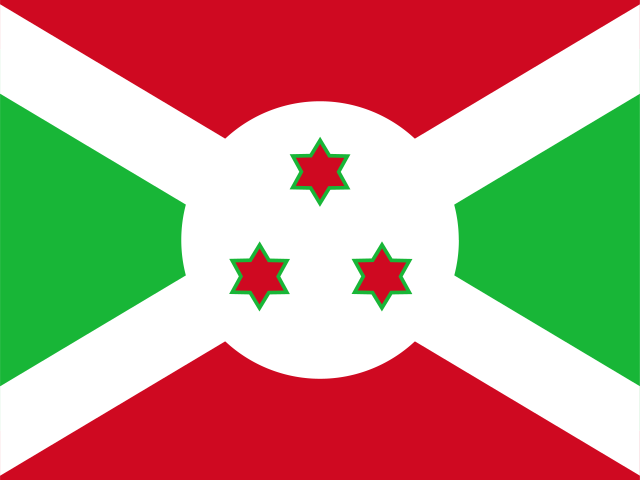
A white saltire divides the field into red panels top and bottom and green ones at the sides, with a white disc in the centre bearing three green-edged red six-pointed stars. The constitution gives the colours and the stars no meaning; the stars are commonly read as the motto 'Unity, Work, Progress' or as the Hutu, Tutsi and Twa.
Burundi FACTS ◢
| Capital | Gitega |
|---|---|
| Continent | Africa |
| Population | 14,390,003 (2025) |
| Area | 27,834 km² |
| Population density | 517/km² |
| Currency | Burundian franc (BIF) |
| Official languages | English, French, Kirundi |
| Calling code | +257 |
| Internet TLD | .bi |
| Time zone | UTC+02:00 |
| Drives on the | Right |
| ISO codes | BI / BDI |
DID YOU KNOW? ◢
- It borders Lake Tanganyika, one of the deepest and oldest freshwater lakes in the world.
- A spot in Burundi is considered one of the southernmost sources of the Nile.
- UNESCO inscribed Burundi's 'Ritual dance of the royal drum' on its intangible cultural heritage list in 2014.
- It's one of the smallest and most densely populated countries in mainland Africa.
Burundi QUICK ANSWERS ◢
What is the capital of Burundi?
The capital of Burundi is Gitega.
What is the population of Burundi?
Burundi had a population of 14,390,003 in 2025.
What currency does Burundi use?
Burundi uses the Burundian franc (BIF).
What languages are spoken in Burundi?
The official languages of Burundi are English, French and Kirundi.
Think you know your flags? Play Flag Daily → · Browse all countries →
MORE ON THE FLAG ◢
Burundi's flag carries three red six-pointed stars in a white disc, and there are two standard answers to what they stand for. One says the motto, "Unité, Travail, Progrès" - Unity, Work, Progress. The other says the country's three ethnic groups, the Hutu, the Tutsi and the Twa.
Burundi's constitution says neither. It describes the flag in a single paragraph of geometry and stops.
That paragraph is Article 10 of the constitution promulgated on 7 June 2018, and reading it is the quickest way to see how much of the usual explanation is somebody's gloss rather than the state's own position.
Key Takeaways
- Article 10 of the 2018 constitution fixes the flag's colours and layout and assigns no meaning to any colour or star.
- The motto arrives one article later, in Article 11, attached to the coat of arms rather than to the flag.
- The same constitution names the Hutu, Tutsi and Twa repeatedly in its seat and quota articles. It does not name them in the flag article.
- The 1962 kingdom constitution named the same three colours and made a drum, sorghum, spears and a lion the arms of the Kingdom. The drum and the sorghum were off the flag by 1967.
- The colour meanings quoted everywhere trace to a vexillology archive, not to Burundian law.
| Constitution | Article | What it fixes | Meaning assigned |
|---|---|---|---|
| Kingdom, 16 October 1962 | Article 113 | national colours and the arms of the Kingdom, not the flag | none |
| Republic, 11 July 1974 | Article 2 | tricolour, white disc, three red stars | none |
| 20 November 1981 | Article 5 | the saltire geometry, with the motto as its last sentence | none |
| 13 March 1992 | Article 6 | the same geometry, motto moved to Article 7 | none |
| 18 March 2005 | Article 10 | the same geometry | none |
| 7 June 2018 | Article 10 | the same geometry | none |
What does Article 10 of Burundi's constitution say about the flag?
It says what the flag looks like, in the register of a technical drawing.
"Le drapeau du Burundi est tricolore : vert, blanc et rouge. Il a la forme d'un rectangle partagé par un sautoir, comportant en son centre un disque blanc frappé de trois étoiles rouges à six branches qui forment un triangle équilatéral fictif inscrit dans un cercle fictif ayant le même centre que le disque et dont la base est parallèle à la longueur du drapeau."
"The flag of Burundi is tricolour: green, white and red. It has the form of a rectangle divided by a saltire, bearing at its centre a white disc charged with three red six-pointed stars which form a notional equilateral triangle inscribed in a notional circle having the same centre as the disc, and whose base is parallel to the length of the flag."
One sentence follows, and it is the last word the constitution has on the subject: "La loi précise les dimensions et les autres détails du drapeau." The law specifies the dimensions and the other details of the flag.
The promulgated text runs in French and Kirundi side by side, because Article 5 requires a Kirundi version of every legislative text. The Kirundi Article 10 is just as descriptive, opening "Ibendera ry'Uburundi rigizwe n'amabara atatu", the flag of Burundi is made up of three colours. Neither version offers a symbol, a cause or a group.
Article 10 also leaves out something the flag visibly has. The Presidency of the Republic describes the stars on its own national-symbols page as "trois étoiles rouges à six branches, bordées de vert" - three red six-pointed stars, edged in green. The constitution does not mention the green edging at all.
Where symbolism really is documented, a government tends to publish it somewhere. Australia's flag booklet, from its Department of the Prime Minister and Cabinet, sets out which points of the Commonwealth Star stand for states and which for territories. Burundi's two government sites publish a description and stop.
Do Burundi's three stars stand for the national motto?
The motto is in the next article, and it is attached to something else.
Article 11 reads: "La devise du Burundi est «Unité, Travail, Progrès». L'emblème de la République du Burundi est un écu frappé de la tête du lion ainsi que de trois lances, le tout entouré de la devise nationale." The emblem of the Republic of Burundi is a shield charged with a lion's head and three spears, the whole encircled by the national motto.
So the constitution does bind the motto to a national symbol, explicitly, in one clause. It has never done it for the flag.
Nor has proximity ever made the link. The 1974 constitution put the motto in Article 1 and the flag in Article 2. The 1981 constitution is the one text that brought them together, and it is worth seeing how: Article 5 runs colours, saltire geometry, "La loi précise les dimensions et les autres détails du drapeau", and then, last, "La devise du Burundi est : Unité, Travail, Progrès." The motto arrives after the dimensions clause and refers to nothing above it.
Every constitution since has separated them again, and in none of the six texts does the flag article cross-refer to the motto.
None of that makes the motto reading wrong. Three stars beside a three-word motto is a natural thing to notice, and it may well be what the designer intended. It does mean the state has not adopted the reading in the text where it had every opportunity to.
What about the three ethnic groups?
Here the silence is louder, because this constitution is entirely willing to name them.
Article 169 sets the National Assembly at 60 percent Hutu and 40 percent Tutsi, plus "trois députés issus de l'ethnie Twa cooptés conformément au code électoral" - three deputies drawn from the Twa ethnic group, co-opted under the electoral code. Article 180 gives the Senate "Trois personnes issues de l'ethnie Twa". Articles 148 and 213 apply the same 60/40 split to public enterprises and to the magistracy.
The drafters name all three groups, in four separate articles, with percentages attached. They did not name them in Article 10.
Burundi's other founding text on this question is silent too. The Charter of National Unity, adopted by decree-law on 9 February 1991 after a referendum four days earlier, is the document that made national unity state doctrine. It turns on ethnicity, using the word "ethnie" throughout, and it names no group and never once mentions the flag.
Where do the colour meanings come from?
Not from a statute, and not from either of the two government sites that publish the flag.
The version in circulation almost everywhere - red for the independence struggle, green for hope, white for peace - can be traced to Flags of the World, the long-running vexillology archive, where the contributor Stuart Notholt posted it in March 1996 together with the claim that the stars "officially refer to the three words in the national motto" and "are also said to represent the three ethnic groups". A great many of the flag pages a search returns are descended from that posting.
The clearest sign these are readings rather than definitions is that they do not agree. Take red alone. Flags of the World has it as the independence struggle, and the Burundi Travel site as the blood shed in that struggle. The Burundian outlet Yaga calls it patriotic love, and IRIS NEWS love of the nation. Green is hope in all four, and in one of them the country's natural wealth as well.
Four accounts, two incompatible reds - a war or an affection - and no Burundian government page that settles it. The Presidency and the Ministry of Foreign Affairs each publish a description of the flag, and it is the same description word for word, down to the arrangement of the stars: "disposées en triangle (une étoile en haut, deux étoiles en bas)", set in a triangle, one star at the top and two below. Neither site adds a word of meaning to it.
What was on Burundi's flag before the three stars?
A drum and a sorghum plant, standing together inside the same white disc that now holds the stars. Flags of the World's historical-flags page records that design and the sequence that dismantled it.
The 1962 constitution of the Kingdom does not describe the flag at all: across its 117 articles the word "drapeau" never appears, and neither does a star, a disc or a saltire. Its Article 113 names colours and arms, and leaves the flag to be inferred from them: "La nation murundi adopte les couleurs verte, blanche et rouge et pour armes du Royaume le tambour, le sorgho, les lances et le lion." The Murundi nation adopts the colours green, white and red, and for arms of the Kingdom the drum, the sorghum, the spears and the lion. The same article gave the kingdom a motto, and it was not the present one: "Dieu, le Roi et le Burundi", God, the King and Burundi.
The drum in that list is the Karyenda, the dynastic drum of the Burundian monarchy. Royal drumming outlived the throne it belonged to: UNESCO inscribed Burundi's "Ritual dance of the royal drum" in 2014, its performers drawn from drum sanctuaries around the country.
Michel Micombero proclaimed the republic on 28 November 1966. The drum, unmistakably royal, went almost at once: IRIS NEWS dates its removal to the following day, leaving the sorghum alone in the disc. The three stars replaced the sorghum on 28 March 1967, and the design was formally adopted on 28 June 1967. IRIS NEWS credits the design to a photographer, Pamphile Gasuku; no Burundian government page names a designer at all.
Which leaves a strange asymmetry. The republic dropped the king's drum and his sorghum, rewrote his motto, and kept the rest. The colours are the same three. So are the lion and the three spears, which moved onto the Republic's own shield in Article 11 and are still there.
Which law fixes Burundi's flag dimensions?
The one Article 10 hands the job to, and it has been used twice.
Flags of the World's construction sheets quote both instruments. Décret-loi no. 1/227 of December 1968 set the flag at 2:3 and worked in centimetres on one 135 cm wide by 90 cm high: a 45 cm disc, saltire arms 11 cm wide, each star inside its own 11 cm circle, the three enclosed by a notional 24 cm circle, and a 5 mm edging. A later decree-law moved to the 3:5 in use today, specifying a flag 2.50 m by 1.50 m with an 85 cm disc, 20 cm saltire arms, 20 cm star circles and a 0.9 cm edging.
The dates are not settled. The 1968 instrument is cited as both 26 and 28 December; the proportion change is dated 27 September 1982 by Yaga and 27 September 1983 on the archive's own construction sheet. The character of the texts is not in dispute, though. Like Article 10, they specify measurements, and nothing in them says what any of it means.
Whether all that geometry makes the flag recognisable is a fair question, and the daily flag round is a three-guess test of it. Guess the Country is the version with no flag to lean on.
Frequently asked questions
What do the three stars on Burundi's flag mean?
There is no official answer. Article 10 of Burundi's 2018 constitution defines the three red six-pointed stars purely by position and geometry, and assigns them no meaning. The two readings in circulation are that they stand for the motto "Unity, Work, Progress" or for the Hutu, Tutsi and Twa, and both are interpretations rather than definitions.
Does Burundi's constitution explain what the flag's colours mean?
No. Every Burundian constitution since 1962 has named the flag's three colours as green, white and red, and not one of them has said what any colour represents. The Presidency's own national-symbols page is the same: it describes the layout in detail and stops there.
Why was the drum taken off Burundi's flag?
Because it belonged to the monarchy. The Karyenda was the sacred royal drum, and Article 113 of the 1962 kingdom constitution had listed it among the arms of the Kingdom of Burundi. It came off the flag within days of the republic being proclaimed in November 1966, leaving the sorghum plant alone in the central disc until the stars replaced it.
When did Burundi's flag take its current form?
The three stars arrived on 28 March 1967, replacing the sorghum plant that had been left alone in the central disc after the royal drum came off in November 1966, and the design was formally adopted on 28 June 1967. The proportions changed later, from 2:3 to the 3:5 flown today, on 27 September in either 1982 or 1983 depending on which account is followed.
Are the stars on Burundi's flag outlined in green?
Yes, and the constitution does not mention it. The Presidency of the Republic describes the stars as "bordées de vert", edged in green, while Article 10 calls them only red six-pointed stars. The decree-law on the flag's dimensions gives that edging a width; the constitution leaves it out entirely.
Sources
- Presidency of the Republic of Burundi, Constitution de la République du Burundi, promulguée le 7 juin 2018 (official French and Kirundi text; Articles 5, 10, 11, 148, 169, 180, 213) - retrieved 12 August 2026.
- Presidency of the Republic of Burundi, Symboles Nationaux - retrieved 12 August 2026.
- Ministry of Foreign Affairs of Burundi, Carte nationale et symboles - retrieved 12 August 2026.
- Presidency of the Republic of Burundi, Charte de l'Unité Nationale, 5 février 1991 - retrieved 12 August 2026.
- Digithèque MJP, Université de Perpignan, Royaume du Burundi, Constitution du 16 octobre 1962 (Article 113) - retrieved 12 August 2026.
- Digithèque MJP, Université de Perpignan, Burundi constitutions of 11 July 1974, 20 November 1981, 13 March 1992 and 18 March 2005 - retrieved 12 August 2026.
- Flags of the World, Burundi, Burundi historical flags and Burundi flag construction sheets - retrieved 12 August 2026.
- Franck Arnaud Ndorukwigira, Trois choses que vous ignorez sur le drapeau national du Burundi, Yaga Burundi, 1 July 2019 - retrieved 12 August 2026.
- IRIS NEWS, Le drapeau du Burundi au fil du temps, 26 January 2025 - retrieved 12 August 2026.
- Burundi Travel, Le drapeau du Burundi : symbole d'identité et d'unité nationale - retrieved 12 August 2026.
- UNESCO Intangible Cultural Heritage, Ritual dance of the royal drum (Representative List, Burundi, inscribed 2014, ref. 00989) - retrieved 12 August 2026.
PLAY ANOTHER →
Five questions a day. Everyone gets the same five.
FIVE QUESTIONSDAILYGuess the CountryThree clues, three guesses. Work out where in the world it is.
THREE CLUESDAILYDaily CryptogramOne quote, one scrambled alphabet. Crack it before tomorrow.
CRACK THE QUOTEDAILYOn This DayOne thing that happened today in history. Every day, a new one.
TODAY IN HISTORY