
Australia
A continent pretending to be a country - Australia is the only nation that fills an entire continent, with most of its 27 million people clinging to the coast while the red-dirt interior does its own thing.
WHAT THE FLAG MEANS ◢
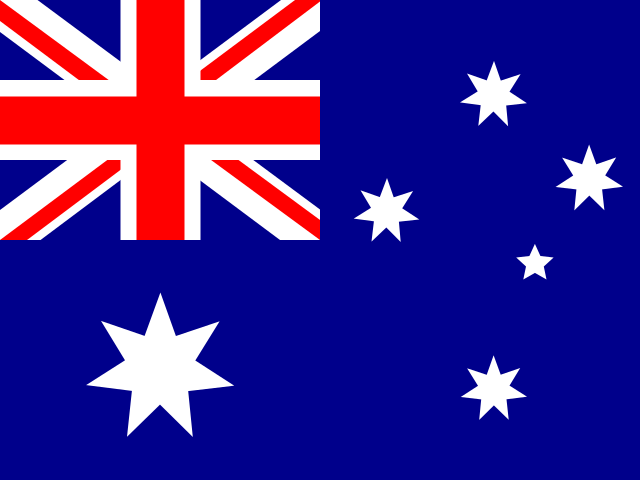
A blue field with the Union Jack in the canton, a large white seven-pointed Commonwealth Star below it, and the five white stars of the Southern Cross at the fly. Six of the big star's points stand for the states and the seventh for the territories; the Southern Cross marks Australia's place in the southern sky.
Australia FACTS ◢
| Capital | Canberra |
|---|---|
| Continent | Oceania |
| Population | 27,614,411 (2025) |
| Area | 7,692,024 km² |
| Population density | 4/km² |
| Currency | Australian dollar (AUD) |
| Main language | English |
| Calling code | +61 |
| Internet TLD | .au |
| Time zones | UTC+08:00, UTC+08:45, UTC+09:30, UTC+10:00, UTC+10:30 |
| Drives on the | Left |
| ISO codes | AU / AUS |
DID YOU KNOW? ◢
- It's home to the Great Barrier Reef, the largest living structure on Earth.
- Around 80% of its mammals, including the kangaroo and koala, live nowhere else on the planet.
- Canberra was purpose-built as a compromise capital because Sydney and Melbourne couldn't stop arguing over the honour.
- It has more kangaroos than people.
Australia QUICK ANSWERS ◢
What is the capital of Australia?
The capital of Australia is Canberra.
What is the population of Australia?
Australia had a population of 27,614,411 in 2025.
What currency does Australia use?
Australia uses the Australian dollar (AUD).
What languages are spoken in Australia?
Australia designates no official language. The language of government and education is English.
Think you know your flags? Play Flag Daily → · Browse all countries →
MORE ON THE FLAG ◢
Australia's flag was not handed down by a committee. It was chosen by public competition in 1901, drew 32,823 entries, and ended in a five-way tie. Among the joint winners were a 14-year-old schoolboy and a ship's officer who worked for a New Zealand shipping company.
Both of those details are in the Commonwealth's own account of the competition.
Key Takeaways
- The 1901 federal flag design competition drew 32,823 entries. Five people submitted substantially the same design and split the prize.
- The Commonwealth Star had six points until 1908, when a seventh was added for the territories.
- The Southern Cross on the flag is four seven-pointed stars plus one smaller five-pointed star, not five identical ones.
- The design was first flown on 3 September 1901, but it took until the Flags Act to put it in legislation.
- "Australia's three flags" is government shorthand for the National, Aboriginal and Torres Strait Islander Flags. It is not a count: several more are proclaimed or appointed.
Who designed the Australian flag?
Five people did, jointly, after a competition that anyone could enter. The Commonwealth announced it on 29 April 1901, and 32,823 entries arrived from all over the world and from people of every age and background.
Five entries were substantially the same design, so the judges split the prize between all of them. The Department of the Prime Minister and Cabinet names them: Annie Dorrington of Perth, who went on to become a noted artist; Ivor Evans of Melbourne, a 14-year-old schoolboy whose father ran a flag-making business; Leslie Hawkins of Leichhardt in New South Wales, also a teenager; Egbert Nuttall of Prahran in Victoria; and William Stevens, a First Officer with the Union Steamship Company of New Zealand.
The prize was £200, put together from £75 from the Review of Reviews, £75 from the government, and a donation from the Havelock Tobacco Company. Divided five ways, that is £40 each, in 1901, for the national flag.
The winning design was first flown on 3 September 1901 at the Exhibition Building in Melbourne, where Prime Minister Edmund Barton announced the result. That date is now Australian National Flag Day.
What do the stars on the Australian flag mean?
There are two separate star systems on the flag and they are doing different jobs.
The Commonwealth Star sits below the Union Jack and has seven points. Six of them stand for the six states. The seventh was added in 1908 to recognise the territories, which means that for its first seven years the flag carried a six-pointed star instead. If you ever see an early Australian flag that looks slightly wrong, that is usually why.
The Southern Cross occupies the fly, and this is where most people misremember it. It is not five matching stars. It is four seven-pointed stars arranged in a cross plus one smaller five-pointed star. The five are named for the constellation itself: Alpha Crucis, Beta Crucis, Gamma Crucis, Delta Crucis, and the small one, Epsilon Crucis.
So the flag distinguishes between the states and the sky using point-count as well as position. Once you know that, redrawing it from memory gets considerably easier, which is the whole point of learning what makes a flag memorable.
When did it actually become the national flag?
Later than you would think. Flying first is not the same as being law.
The design and its uses were proclaimed in the Commonwealth of Australia Gazette, but no legislation prescribed the form and use of the flag until the Flags Act. King George VI approved the recommendation in 1951, Parliament passed the Act in December 1953, and Queen Elizabeth II signed it into law on 14 February 1954.
Half a century between the competition and the statute. The flag was doing the job the entire time; the paperwork simply took its own view of urgency.
Why is it so easy to confuse with New Zealand's?
Because both are blue ensigns carrying the Union Jack and the Southern Cross, and that is genuinely most of the flag.
The reliable test is the stars, and there are two things to look at:
- Colour. Australia's stars are white. New Zealand's are red with white borders.
- Count. Australia has six stars: the Commonwealth Star below the canton, plus five for the Southern Cross. New Zealand has four, all Southern Cross, and no Commonwealth Star at all.
Either one settles it on its own. The count is the faster check at a distance because the extra star sits in an obviously different place.
This pair turns up constantly in flag quizzes for exactly this reason. The two countries are entangled further back than the design, too: one of the five joint winners of the Australian competition was an officer of a New Zealand shipping company.
Australia has more than one flag, and three are usually meant
"Australia's three flags" is the government's own shorthand, and it means the Australian National Flag alongside the Australian Aboriginal Flag and the Torres Strait Islander Flag, which were proclaimed together on 14 July 1995.
It is shorthand rather than a count. The Department of the Prime Minister and Cabinet also lists the Australian Defence Force Ensign, the Australian Red Ensign and the Centenary Flag as proclaimed flags, and the Australian White Ensign and RAAF Ensign are appointed under section 5 of the Flags Act. The department's own booklet gives them a section headed "Other official flags of Australia".
The Australian Aboriginal Flag was designed by Harold Thomas. The black upper half symbolises Indigenous people, the red lower half represents the earth and the colour of ochre with its ceremonial significance, and the yellow circle represents the sun. The Commonwealth now owns the copyright in the design.
The Torres Strait Islander Flag was designed by Bernard Namok, and came from a competition run by the Island Coordinating Council. Green panels top and bottom represent the land, the blue panel between them represents the sea, and the black lines represent Torres Strait Islander people. The white Dhari headdress at the centre is a symbol for all Torres Strait Islanders, and the white five-pointed star stands for the island groups of the strait, with white for peace.
Frequently asked questions
How many entries were there in the Australian flag competition?
32,823 entries were received from all over the world after the Commonwealth announced the competition on 29 April 1901. Five substantially similar designs were selected as joint winners and shared the £200 prize, £40 each.
Why does the Commonwealth Star have seven points?
Six points stand for the six Australian states. The seventh was added in 1908 to recognise Australia's territories. Before that change the star had six points.
How many stars are on the Australian flag?
Six. One Commonwealth Star below the Union Jack, and five making up the Southern Cross: four seven-pointed stars and one smaller five-pointed star.
What is the difference between the Australian and New Zealand flags?
Australia's Southern Cross stars are white and there are five of them, plus a separate seven-pointed Commonwealth Star. New Zealand's are red with white borders, there are four, and there is no Commonwealth Star.
When was 3 September chosen as Australian National Flag Day?
3 September marks the date in 1901 when the winning design was first flown at the Exhibition Building in Melbourne and Prime Minister Edmund Barton announced the competition result.
Sources
- Department of the Prime Minister and Cabinet, How the Australian National Flag was chosen - retrieved 29 July 2026.
- Department of the Prime Minister and Cabinet, The Australian National Flag - retrieved 29 July 2026.
- Department of the Prime Minister and Cabinet, Australian flags - retrieved 29 July 2026.
PLAY ANOTHER →
Five questions a day. Everyone gets the same five.
FIVE QUESTIONSDAILYDaily CryptogramOne quote, one scrambled alphabet. Crack it before tomorrow.
CRACK THE QUOTEDAILYDaily CodeA short message, hidden in a different cipher every day.
ONE CIPHER A DAYDAILYOn This DayOne thing that happened today in history. Every day, a new one.
TODAY IN HISTORY