
New Zealand
A pair of long, green islands adrift in the South Pacific, New Zealand has more sheep than people and a habit of doing things first, from votes for women to summiting Everest.
WHAT THE FLAG MEANS ◢
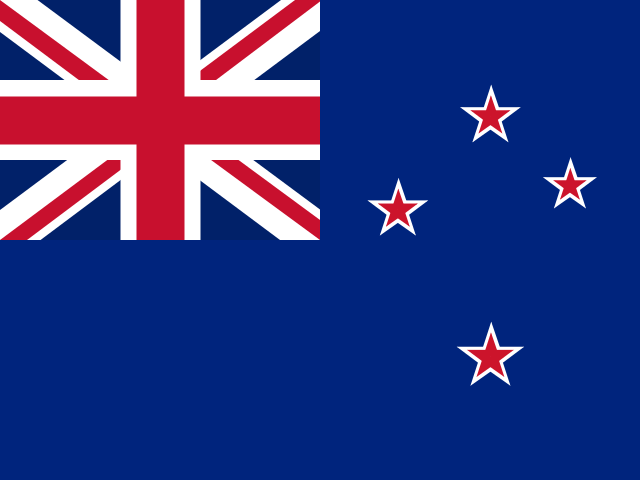
A Blue Ensign with the Union Jack in the canton and four red, white-edged stars of the Southern Cross on the fly. The Union Jack marks historic ties to Britain and the Southern Cross the nation's place in the South Pacific.
New Zealand FACTS ◢
| Capital | Wellington |
|---|---|
| Continent | Oceania |
| Population | 5,324,700 (2025) |
| Area | 268,021 km² |
| Population density | 20/km² |
| Currency | New Zealand dollar (NZD) |
| Official languages | English, Māori, New Zealand Sign Language |
| Calling code | +64 |
| Internet TLD | .nz |
| Time zones | UTC+12:00, UTC+12:45 |
| Drives on the | Left |
| ISO codes | NZ / NZL |
DID YOU KNOW? ◢
- In 1893 it became the first self-governing country in the world to grant women the right to vote.
- It's home to the kiwi, a flightless nocturnal bird found nowhere else on Earth.
- For much of its history it has had significantly more sheep than people.
- New Zealander Edmund Hillary was, with Tenzing Norgay, among the first confirmed climbers to reach the summit of Everest in 1953.
New Zealand QUICK ANSWERS ◢
What is the capital of New Zealand?
The capital of New Zealand is Wellington.
What is the population of New Zealand?
New Zealand had a population of 5,324,700 in 2025.
What currency does New Zealand use?
New Zealand uses the New Zealand dollar (NZD).
What languages are spoken in New Zealand?
The official languages of New Zealand are English, Māori and New Zealand Sign Language.
Think you know your flags? Play Flag Daily → · Browse all countries →
MORE ON THE FLAG ◢
New Zealand is one of very few countries to have put its national flag to a public vote in the modern era, and it did it twice inside five months. The country shortlisted challengers, ran a preferential vote to pick one, then held a binding runoff against the existing flag. The old flag won, 1,208,702 votes to 921,876.
That is 56.6% to 43.2%, on a turnout of 67.78%, which is a higher participation rate than a lot of countries manage for general elections.
Key Takeaways
- Two referendums: 20 November to 11 December 2015 to choose a challenger, then 3 to 24 March 2016 to run it against the existing flag.
- The public submitted 10,292 designs. A longlist of 40 became a shortlist of four, then five after a petition.
- Kyle Lockwood's black, white and blue silver fern won the first vote and lost the second.
- The current flag has four red stars with white borders. Australia's are white, and there are six.
- New Zealand's first national flag was chosen by rangatira at Waitangi in 1834, nearly seventy years before this one existed.
What happened in the New Zealand flag referendums?
Two separate postal votes, run back to back, with the second one binding.
The first ran from 20 November to 11 December 2015 and asked voters to rank alternative designs by preference. Getting to that ballot took a public design call that produced 10,292 suggestions, cut to a longlist of 40 and then a shortlist of four.
The shortlist became five after a public campaign. A petition backing Aaron Dustin's "Red Peak" design gathered tens of thousands of signatures, and Parliament passed a bill adding it as a fifth option. Kyle Lockwood's silver fern design in black, white and blue won the preferential count.
The second referendum ran from 3 to 24 March 2016 and was a straight choice between that design and the flag already flying. The Electoral Commission's official result:
- Option B, the current New Zealand flag: 1,208,702 votes (56.6%)
- Option A, the Silver Fern flag: 921,876 votes (43.2%)
- Informal votes: 5,044 (0.2%)
That is 2,135,622 valid votes, on a turnout of 67.78%. The Electoral Commission received 2,140,895 in total; 5,273 were invalid. The flag stayed.
What do the stars on the New Zealand flag mean?
They are the Southern Cross, the constellation that identifies the southern sky, rendered as four five-pointed red stars with white borders on a blue ensign.
Four is the number to remember. New Zealand shows the four principal stars of the cross and stops there. Each red star sits inside a slightly larger white one, which is what produces the white border, and all of them are five-pointed. That is the single most useful fact for telling the flag apart from its neighbour.
The Union Jack in the first quarter records the country's constitutional history with Britain, the same convention used across the blue ensigns of the former British colonies.
How do you tell it apart from Australia's flag?
Two checks, either of which is decisive.
- Star colour. New Zealand's are red with white borders. Australia's are plain white.
- Star count. New Zealand has four. Australia has six, because it adds a large seven-pointed Commonwealth Star below the Union Jack that New Zealand has no equivalent of.
The count is the quicker check when the flag is small or moving, because the extra Australian star sits in an obviously different position rather than requiring you to judge a colour. This pair is a fixture of flag quizzes precisely because the layout is shared and only the details differ.
When did New Zealand actually adopt this flag?
The blue ensign became the legal national flag through the New Zealand Ensign Act 1901, whose long title is "An Act to establish and define an Ensign for New Zealand". The Bill was reserved for the Sovereign's pleasure, so it carried no force in New Zealand until the King had seen it. Governor Ranfurly proclaimed on 9 June 1902 that the Bill "has been laid before His Majesty in Council, and that His Majesty has been pleased to assent to the same", and that proclamation ran in the New Zealand Gazette on 12 June 1902.
The specifications followed in the Gazette of 27 June 1902, under the heading "Description of New Zealand Ensign". It reprints section 2 of the Act, which makes the ensign "the blue ensign of the Royal Naval Reserve, having on the fly thereof the Southern Cross as represented by four five-pointed red stars with white borders", then sizes every star in sixtieths of the flag's height, measured across its red points: five-sixtieths for the star nearest the fly edge, six for the star at the top and the one nearest the Union Jack, seven for the star at the bottom, with each white border one one-hundred-and-twentieth. A drawing to match was deposited with the Marine Department in Wellington and marked M.D. 2534.
Today the flag sits under the Flags, Emblems, and Names Protection Act 1981, administered by Manatū Taonga, the Ministry for Culture and Heritage. That Act declares the New Zealand Ensign to be the national flag and governs how it is used.
The flag that came first
Before any of that, there was a flag adopted at Waitangi in 1834, and it exists because of a customs problem.
The 400-ton barque Sir George Murray was built at the Te Hōreke shipyard in the Hokianga and sailed into Port Jackson, Sydney, in November 1830, where Customs seized it on arrival. A vessel built outside territory "subject to His Majesty or to any European power or state" could not obtain a British register, and without one it had no standing in a foreign port. Two rangatira, Patuone and Te Taonui, were aboard when it was taken.
On 20 March 1834 northern rangatira gathered at the British Resident James Busby's residency at Waitangi, where three designs, delivered days earlier on HMS Alligator, flew from short poles outside a marquee run up from the ship's sails. The winning design took 12 votes. It carries a St George's cross on white, with a canton of blue bearing a second St George's cross and a white eight-pointed star in each of that cross's quarters.
Te Papa, the national museum, records it as Te Kara, "The Colour", and notes that the name "United Tribes of New Zealand" comes from the declaration of independence signed by northern chiefs the following year. The museum's own note is that the flag "continues to have a special relevance to Māori and to the Treaty of Waitangi". It predates the current flag by nearly seventy years.
A note on the detail here: the eyewitnesses differ on how many rangatira attended - William Williams counted 26 principal chiefs, Busby 25, and the Alligator's surgeon William Marshall about thirty - and on how the losing votes split, Busby recording 10 and three where Marshall recorded 10 and six with two abstentions. Both men put 12 votes on the winning flag. Where sources disagree, this page states only what they agree on.
Frequently asked questions
Did New Zealand change its flag?
No. Two referendums were held in 2015 and 2016. The second, held from 3 to 24 March 2016, was a binding vote between the existing flag and a challenger, and the existing flag won with 1,208,702 votes (56.6%) against 921,876 (43.2%).
Who designed the flag New Zealand voted against?
Kyle Lockwood. His silver fern design in black, white and blue won the first referendum's preferential count in December 2015 and then lost the runoff against the existing flag in March 2016.
How many stars are on the New Zealand flag?
Four. They are five-pointed, red with white borders, and represent the Southern Cross. Australia's flag shows six stars in total and colours them white.
What was the United Tribes flag?
New Zealand's first national flag, adopted by northern rangatira at Waitangi in 1834 after the New Zealand-built ship Sir George Murray was seized by Customs in Sydney for want of a British register. The winning design took 12 votes. Te Papa records it as Te Kara, "The Colour".
What law governs the New Zealand flag today?
The Flags, Emblems, and Names Protection Act 1981, administered by Manatū Taonga, the Ministry for Culture and Heritage. It declares the New Zealand Ensign to be the national flag and governs its use.
Sources
- New Zealand Electoral Commission, Official result of the second referendum on the New Zealand flag - retrieved 29 July 2026.
- Elections New Zealand, 2015 and 2016 referendums on the New Zealand flag - retrieved 29 July 2026.
- Museum of New Zealand Te Papa Tongarewa, United Tribes flag - retrieved 29 July 2026.
- New Zealand Legislation, Flags, Emblems, and Names Protection Act 1981 - retrieved 29 July 2026.
- New Zealand Gazette No 44, 12 June 1902, p 1253, Proclamation: "The New Zealand Ensign Act, 1901," assented to by His Majesty in Council - New Zealand Gazette Archive, Victoria University of Wellington Library, retrieved 22 August 2026.
- New Zealand Gazette No 49, 27 June 1902, p 1348, Description of New Zealand Ensign - New Zealand Gazette Archive, Victoria University of Wellington Library, retrieved 22 August 2026.
- Waitangi Tribunal, He Whakaputanga me te Tiriti / The Declaration and the Treaty: The Report on Stage 1 of the Te Paparahi o Te Raki Inquiry (Wai 1040, 2014), section 3.9.3 "The selection of a national flag", pp 128-134 - retrieved 22 August 2026.
PLAY ANOTHER →
One quote, one scrambled alphabet. Crack it before tomorrow.
CRACK THE QUOTEDAILYOn This DayOne thing that happened today in history. Every day, a new one.
TODAY IN HISTORYDAILYDaily TriviaFive questions a day. Everyone gets the same five.
FIVE QUESTIONSDAILYDaily CodeA short message, hidden in a different cipher every day.
ONE CIPHER A DAY