
Cambodia
A Southeast Asian country built around the ruins of a lost empire and the pulse of a river that flows backwards. Cambodia's Angkor Wat is one of the largest religious monuments ever built.
WHAT THE FLAG MEANS ◢
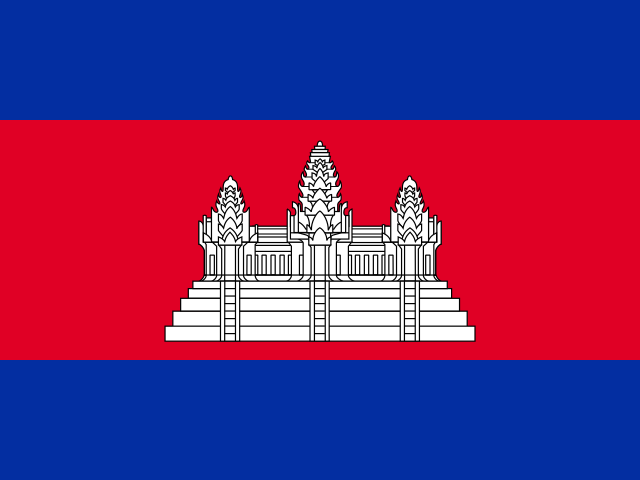
Three horizontal bands of blue, red and blue, the red one double-width and bearing a white, three-towered image of Angkor Wat temple. The constitution defines the flag only by a drawing in Annex 1 and assigns the colours no meaning; blue is commonly read as royalty, red as the nation and white as religion, after the national motto 'Nation, Religion, King'.
Cambodia FACTS ◢
| Capital | Phnom Penh |
|---|---|
| Continent | Asia |
| Population | 17,847,982 (2025) |
| Area | 181,035 km² |
| Population density | 99/km² |
| Currency | Riel (KHR) |
| Official language | Khmer |
| Calling code | +855 |
| Internet TLD | .kh |
| Time zone | UTC+07:00 |
| Drives on the | Right |
| ISO codes | KH / KHM |
DID YOU KNOW? ◢
- Angkor Wat is one of the largest religious monuments ever constructed.
- The Tonlé Sap river reverses its flow twice a year as the seasons change.
- The Khmer Empire that built Angkor was once one of the most powerful in Southeast Asia.
- Angkor Wat is the only building that is the central design of a national flag; San Marino's towers and Portugal's castles sit inside a coat of arms.
Cambodia QUICK ANSWERS ◢
What is the capital of Cambodia?
The capital of Cambodia is Phnom Penh.
What is the population of Cambodia?
Cambodia had a population of 17,847,982 in 2025.
What currency does Cambodia use?
Cambodia uses the Riel (KHR).
What languages are spoken in Cambodia?
The official language of Cambodia is Khmer.
Think you know your flags? Play Flag Daily → · Browse all countries →
MORE ON THE FLAG ◢
Cambodia's flag is three horizontal bands, blue over red over blue, with the red band twice the width of each blue one and a white temple standing in the middle of it. The temple is Angkor Wat, and no other current national flag makes a building its own central charge. The nearest cases reach the cloth inside a coat of arms or an emblem.
Almost every account then adds that blue stands for royalty, red for the nation and white for religion. Cambodia's constitution says none of that. It assigns the colours nothing at all.
Article 6 sits in Chapter I of the 1993 Constitution of the Kingdom of Cambodia, the chapter headed Sovereignty, and reads in full: "Phnom Penh is the capital city of the Kingdom of Cambodia. The national flag, anthem and coat of arms are defined in Annex 1, 2, and 3." Annex 1 is a picture of the flag. There is no text beside it.
Key Takeaways
- Article 6 defines the flag by pointing at Annex 1, an uncaptioned drawing. The constitution assigns the colours no meaning.
- The royalty-nation-religion reading maps onto Article 4's motto, "Nation, Religion, King". The constitution never connects the two.
- Cambodia's embassy in Jakarta gave the ASEAN Secretariat a different reading in 2015: red for courage and bravery, blue for territory, white for purity.
- Annex 1 shows three towers. Angkor Wat's central group has five, set in a quincunx, and three is what a front elevation of five gives you.
- The 1976 Democratic Kampuchea constitution did spell its flag's colours out in words. The 1993 constitution does not.
| The claim | Where it comes from | What that source actually is |
|---|---|---|
| Blue for royalty, red for the nation, white for religion | The vexillological literature, following Article 4's motto | A national motto the constitution never attaches to the flag |
| Red for courage, blue for territory, white for purity | Royal Embassy of Cambodia, Jakarta, note to the ASEAN Secretariat, 10 November 2015 | An official specification written for a protocol guide, not a law |
| Red for revolution, the yellow temple for national tradition | Constitution of Democratic Kampuchea, Article 16, in force 5 January 1976 | A different flag, a different state, and a text that spells its meanings out |
| Three towers on the flag | Annex 1 of the 1993 constitution | A drawing: three towers, white with red interior lines |
| Five towers on the temple | Angkor Wat's central sanctuary | Five towers in quincunx, of which a frontal view shows three |
| The temple "symbolizes the soul of the Khmer people" | APSARA National Authority, the body that manages the Angkor park | The nearest thing to an official reading, and it is about the temple, not the colours |
What does Cambodia's constitution say about the flag?
Two sentences, and one of them is about Phnom Penh.
The 1993 constitution was adopted by the Constituent Assembly on 21 September 1993 and promulgated on 24 September 1993, dates the Constitutional Council of Cambodia gives in its own account of the country's constitutional history. The French text published alongside the English by the Secretariat General of the Senate is as bare as the English: "Le drapeau national, l'hymne national et les armoiries nationales sont définis dans les annexes 1, 2 et 3."
Turn to Annex 1 in the Constitutional Council's published edition and you find a heading, National Flag, and a colour drawing. No proportions in words, no colour references, no description of the temple. The flag is a picture the constitution incorporates by reference.
Compare that with Article 4, two articles earlier, which does put a meaning into words: "The motto of the Kingdom of Cambodia is 'Nation, Religion, King'." The motto is legislated. The flag's symbolism is not.
The closest thing to an official statement about the temple comes from elsewhere in government. The APSARA National Authority, which manages the Angkor park, says the temple "symbolizes the soul of the Khmer people, and the lasting grandeur of their past". Note what that is not about: the colours.
The same page says "Angkor Wat has always figured on Cambodia's national flag", which is very nearly true. Every Cambodian flag from the French protectorate onward has carried a temple, with one exception, the pale blue flag with a white map flown under the United Nations transitional authority. It is also more than the Khmer Rouge would claim: their own constitution called the thing on their flag a temple and nothing more. APSARA also records that the building was "originally dedicated to the god Vishnu" and became a Buddhist sanctuary only in the latter half of the 16th century, three centuries before it first appeared on a flag. The thing on the flag is a Hindu foundation that has been in Buddhist use for far longer than it has been a national emblem.
Where does "blue for royalty, red for the nation, white for religion" come from?
From the motto in Article 4, read backwards onto the flag.
The three-part reading is old and genuinely Cambodian in spirit. Flags of the World records the standard account, which reads the blue as royalty, the red as the nation and the white as religion, "at the beginning Brahmanism, and now with the majority of Buddhism", then states the connection outright: the flag "reflects the trilogy of Nation, Religion and King, motto of the Khmer monarchy".
That is coherent. Three colours, three words in a motto the 1993 constitution puts in Article 4, alongside the restored monarchy. It is also the kind of tidy correspondence that gets repeated until it sounds like law.
The gap worth noticing is that the correspondence runs through the motto, and the constitution makes the link in neither direction. The popular reading is not wrong so much as unofficial, and calling it official is the mistake almost every summary makes.
Cambodia's own diplomats gave the colours a different meaning
In 2015 a Cambodian mission sent the ASEAN Secretariat the flag's specification for the ASEAN protocol guide. The note is dated 10 November 2015 and numbered 1304/REC-JKT/2015, and gives its sender as "The Royal Embassy of Cambodia and Permanent Mission of the Kingdom of Cambodia to ASEAN in Jakarta". ASEAN's own protocol guide does not reproduce the specifications, deferring to an ASEAN website page that no longer serves them; the note's text is available through Flags of the World, which transcribes it in full.
The specification is precise. Width equal to two thirds of length, meaning the hoist is two thirds of the fly. Two blue areas of equal size. The middle red area double the size of each blue area. And "a white image in the middle of the red area represents Angkor-Wat Temple with 3 towers".
Then it gives the colours meanings, and they are not the familiar ones:
"Red represents courage and bravery; Blue represents territory; and White represents purity."
No royalty. No religion. No nation. A serving Cambodian mission, writing officially about its own flag, produced a reading that does not overlap with the popular one at a single point. That is what happens when meanings live in custom rather than in a statute: they vary by who is asked, and both answers can be quoted in good faith.
Three towers on the flag, five on the temple
Three on the flag, five on the temple's central group. Both are correct, which is why the count is so often reported wrongly.
Angkor Wat carries the towers of its central sanctuary in a quincunx. The United Nations, describing the model of the temple Cambodia presented to it in March 2020, puts them at the heart of the complex as "the great, conical towers laid out in quincunx, an earthly reflection of the five heavenly peaks of Mount Meru". A catalogue record for a photographic plate of the temple in the University of Notre Dame's collections states the arrangement plainly: "The five towers are arrayed in quincunx form; four at the corners and one in the center."
Four of the five stand at the corners of a square. Face the temple and two of those hide behind the two nearer ones, leaving three in view. Annex 1 draws that front elevation, so the flag shows three.
The count has never been decorative. It is what separated the two revolutionary flags from each other: Democratic Kampuchea's temple had three towers, the People's Republic that replaced it in 1979 raised the number to five, and five it stayed until 1993.
The Khmer Rouge constitution did explain its flag's colours
Article 16 of the Constitution of Democratic Kampuchea, in force from 5 January 1976, sits in a chapter of its own headed The National Flag. Its opening line announces that it will do the thing the 1993 constitution declines to do: "The design and significance of the Kampuchean national flag are as follows."
The text, in the translation held by the Documentation Center of Cambodia, then delivers both:
"The background is red, with a yellow three-towered temple in the middle. The red background symbolises the revolutionary movement, the resolute and valiant struggle of the Kampuchean people for the liberation, defence, and construction of their country. The yellow temple symbolises the national traditions of the Kampuchean people, who are defending and building the country to make it ever more prosperous."
Two details repay a second look. The article never names Angkor Wat. It says "temple", and the shape it describes was a heavy stylisation rather than a portrait. And the towers are three, the same count the royal flag uses, on a design that was otherwise its opposite in every particular.
The regime that replaced it in January 1979 kept the red field and the yellow temple and raised the count to five. Five it stayed for fourteen years, through the 1981 constitution of the People's Republic of Kampuchea and on into the State of Cambodia's flag of 1989, which moved the same yellow temple onto a red-over-blue bicolour.
Is Cambodia's flag really the only one with a building on it?
Among current national flags it is the only one where a building is the flag's own central charge. Put it any more strongly and it stops being true.
San Marino's state flag is two horizontal stripes, white over blue, with the republic's emblem in the centre, and that emblem is described by the State Office for Tourism as "a shield with three silver towers, on a blue background". Towers are buildings, and they are on a national flag. Portugal's shield carries seven castles and Spain's the castle of Castile, so architecture on flags is not rare. Afghanistan's tricolour, flown until 2021, went further and put a mosque's own furniture on the cloth: Article 19 of its 2004 constitution places a prayer niche and a pulpit inside the national insignia.
The difference is structural rather than pedantic. Every one of those buildings sits inside a coat of arms or an emblem that is then applied to a flag. Cambodia has no arms on its flag at all: the temple is the design, drawn at flag scale, standing across the double-width red band. Next door, Laos uses the same one-two-one geometry with a white moon where Cambodia puts a building - and moon is the Lao constitution's own word for it, not a later reading laid over a plain disc.
So the careful version of the claim is the more interesting one. Architecture usually reaches a flag heraldically, at the size of a badge. Cambodia draws the building itself, and the rest of the field bears that out.
When did the 1948 flag become the flag again?
On the day the constitution carrying Annex 1 took effect, which is the neatest illustration of how thin the flag's legal life is.
The blue-red-blue arrangement with a white Angkor Wat dates from October 1948, published accounts differing on whether the day was the 20th or the 29th. It flew until the monarchy fell in 1970, and then five further designs stood for Cambodia over twenty-three years: the Khmer Republic's blue field with a red canton, Democratic Kampuchea's red and yellow, the People's Republic of Kampuchea's five-towered version, the State of Cambodia's red-over-blue bicolour, and the pale blue flag with a white map of the country flown under the United Nations Transitional Authority.
The Constitutional Council's list of the constitutions behind them has one telling gap: 6 May 1947, then 30 April 1972 for the Khmer Republic, then 1981, 1989 and September 1993. Democratic Kampuchea's 1976 text, the one with the flag article in it, does not appear.
The 1948 design's only legal home is the annex, so it returned the way it is defined. Promulgate the constitution and Annex 1 is law. A Flags of the World contributor who went looking for a Cambodian flag law reports finding none, which is why anyone hunting for the statute that explains the colours will come away empty too.
If you would rather test whether you can pick the flag out of a line-up, a daily flag round settles that in three guesses.
Frequently asked questions
What do the colours on the Cambodian flag mean?
The constitution does not say. Article 6 of the 1993 constitution defines the flag only by a drawing in Annex 1, with no words about the colours anywhere in the text, and no separate Cambodian flag law has been traced. The widely repeated reading of blue for royalty, red for the nation and white for religion is a gloss on the national motto in Article 4, "Nation, Religion, King", rather than an official assignment.
Has Cambodia ever stated an official meaning for the colours?
The Royal Embassy of Cambodia in Jakarta did, in a note to the ASEAN Secretariat dated 10 November 2015, and it does not match the familiar version: "Red represents courage and bravery; Blue represents territory; and White represents purity." That note is a specification supplied for a protocol guide, so it records an official position without being law.
How many towers of Angkor Wat are on the Cambodian flag?
Three. The temple's central group has five, arranged in a quincunx with four at the corners and one at the centre, so a frontal view of it hides two behind the others. Annex 1 of the constitution draws that frontal view, and Cambodia's 2015 specification for ASEAN describes the charge as "Angkor-Wat Temple with 3 towers".
Which Cambodian flag had five towers?
The People's Republic of Kampuchea's, from January 1979, and the State of Cambodia's, from 1989. Both kept the Khmer Rouge flag's yellow temple and raised its tower count from three to five; the People's Republic kept the plain red field, while the State of Cambodia set the temple on a red-over-blue bicolour.
Why is Angkor Wat on Cambodia's flag rather than a coat of arms?
Because the flag was never built around arms. The temple is the design itself, drawn at full flag scale across the double-width red band, and the constitution's Annex 1 shows it that way with no shield or crest involved. Cambodia has a separate coat of arms, defined by its own drawing in Annex 3, and it does not appear on the flag.
Sources
- Secretariat General of the Senate, Kingdom of Cambodia, Constitution of the Kingdom of Cambodia (English and French, with amendments) - Chapter I, Articles 4 and 6 - retrieved 12 August 2026.
- Constitutional Council of Cambodia, Constitution of the Kingdom of Cambodia - Annex 1, National Flag - retrieved 12 August 2026.
- Constitutional Council of Cambodia, History - adoption 21 September 1993, promulgation 24 September 1993, and the constitutions of 1947, 1972, 1981 and 1989 - retrieved 12 August 2026.
- Documentation Center of Cambodia, Constitution of Democratic Kampuchea - Chapter Eleven, Article 16 - retrieved 12 August 2026.
- APSARA National Authority, Angkor Wat - the temple on the national flag, its dedication to Vishnu, and its 16th-century conversion - retrieved 12 August 2026.
- Flags of the World, Cambodia - the Royal Embassy of Cambodia's note 1304/REC-JKT/2015 to the ASEAN Secretariat, and the royalty-nation-religion reading - retrieved 12 August 2026.
- Flags of the World, Cambodian Flag History - the 1948, 1970, 1976, 1979, 1989 and 1993 flags and their tower counts - retrieved 12 August 2026.
- United Nations, UN Gifts, Angkor Wat Temple - the quincunx of towers and the five peaks of Mount Meru - retrieved 12 August 2026.
- University of Notre Dame, Marble, Angkor Wat: Central temple mountain with quincunx of towers - retrieved 12 August 2026.
- State Office for Tourism, Republic of San Marino, Coat of Arms and Flag - retrieved 12 August 2026.
- Comparative Constitutions Project, Constitution of Afghanistan 2004 - Article 19, the flag and the national insignia - retrieved 12 August 2026.
- Comparative Constitutions Project, Lao People's Democratic Republic's Constitution of 1991 with Amendments through 2015 - the flag article, "a white moon in the middle of the flag" - retrieved 31 August 2026.
PLAY ANOTHER →
One thing that happened today in history. Every day, a new one.
TODAY IN HISTORYDAILYGuess the CountryThree clues, three guesses. Work out where in the world it is.
THREE CLUESDAILYDaily TriviaFive questions a day. Everyone gets the same five.
FIVE QUESTIONSDAILYDaily CryptogramOne quote, one scrambled alphabet. Crack it before tomorrow.
CRACK THE QUOTE