
Croatia
A crescent along the Adriatic with more than a thousand islands, Croatia gave the world the necktie and the dog breed known as the Dalmatian.
WHAT THE FLAG MEANS ◢
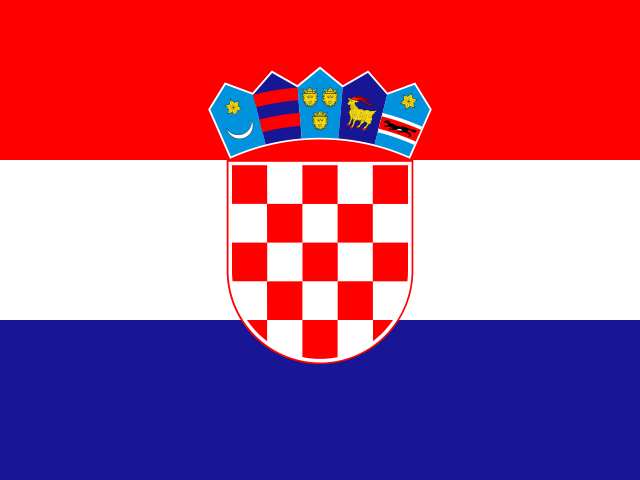
Three horizontal bands of red, white and blue, charged with the historic Croatian coat of arms. Its shield is a chequerboard of 25 red and white fields with the upper left field red, both fixed in law. The crown above carries five smaller shields in a statutory left-to-right order: a golden six-pointed star over a silver crescent, which the statute calls the oldest known arms of Croatia, then the Republic of Dubrovnik, Dalmatia, Istria and Slavonia, so only three of the five stand for historic regions. Neither the Constitution nor the flag act gives the colours a meaning; red, white and blue are conventionally called the Pan-Slavic colours.
Croatia FACTS ◢
| Capital | Zagreb |
|---|---|
| Continent | Europe |
| Population | 3,876,200 (2025) |
| Area | 56,594 km² |
| Population density | 68/km² |
| Currency | Euro (EUR) |
| Official language | Croatian |
| Calling code | +385 |
| Internet TLD | .hr |
| Time zone | UTC+01:00 |
| Drives on the | Right |
| ISO codes | HR / HRV |
DID YOU KNOW? ◢
- The necktie originates from Croatian soldiers, whose name gave French the word 'cravate'.
- It has over a thousand islands scattered along its Adriatic coast.
- Its walled city of Dubrovnik is a UNESCO World Heritage Site and a famous filming location.
- The Dalmatian dog breed takes its name from the Croatian region of Dalmatia.
Croatia QUICK ANSWERS ◢
What is the capital of Croatia?
The capital of Croatia is Zagreb.
What is the population of Croatia?
Croatia had a population of 3,876,200 in 2025.
What currency does Croatia use?
Croatia uses the Euro (EUR).
What languages are spoken in Croatia?
The official language of Croatia is Croatian.
Think you know your flags? Play Flag Daily → · Browse all countries →
MORE ON THE FLAG ◢
Most national flags are described loosely enough that a careful drawing can go several ways. The Croatian flag is not one of them. Its chequerboard has a field count written into the Constitution, its top-left square has a colour written into statute, and the five small shields in the crown above it are named individually, in an order the law fixes from left to right.
Two of those details are the ones people get wrong. The chequerboard, the šahovnica, has twenty-five fields, not sixteen and not sixty-four, and the first field is red, not white. The count really has been sixteen and sixty-four before now, and the corner really has been white, which is exactly why the 1990 legislation pinned both down.
What Croatian law does not do, anywhere, is say what red, white and blue stand for.
Key Takeaways
- Article 11 of the Constitution fixes the chequerboard at 25 alternating red and white (silver) fields.
- The 1990 flag act adds that the first field in the upper left corner of the shield is red, which makes it 13 red squares to 12 white.
- The crown holds five smaller shields in a legally fixed left-to-right order, and the first of them is not a region.
- Neither the Constitution nor the act assigns red, white or blue any meaning. The courage-purity-loyalty readings in circulation are somebody's, not the state's.
- Croatia's own national encyclopaedia says the heraldic record does not support the label the statute gives that first shield.
| Position in the crown | What the statute calls it | The statute's own blazon |
|---|---|---|
| 1 (far left) | The oldest known coat of arms of Croatia | Blue field, a yellow (golden) six-pointed star with a white (silver) crescent moon |
| 2 | Republic of Dubrovnik | Dark blue field, two red bars |
| 3 (centre) | Dalmatia | Blue field, three yellow (golden) crowned leopard heads |
| 4 | Istria | Dark blue field, a yellow (golden) goat facing left, with red hooves and horns |
| 5 (far right) | Slavonia | Blue field, two transverse white (silver) bars, a red field between them with a marten walking left, and a yellow (golden) six-pointed star above |
How many squares are on the Croatian flag, and why does it start with red?
Twenty-five, and the count is constitutional rather than conventional. Article 11 of the Constitution of the Republic of Croatia opens: "Grb Republike Hrvatske povijesni je hrvatski grb čija je osnovica 25 naizmjeničnih crvenih i bijelih (srebrenih) polja." That is: "The coat of arms of the Republic of Croatia is the historical Croatian coat of arms whose base is 25 alternating red and white (silver) fields."
The Constitution then hands the detail to statute, and the statute is where the corner colour lives. Article 7 of the act passed on 21 December 1990 describes a shield "dvostruko podijeljen vodoravno i okomito u dvadesetpet crvenih i bijelih (srebrnih) polja", divided horizontally and vertically into twenty-five red and white (silver) fields, and continues: "tako da je prvo polje u gornjem lijevom kutu štita crvene boje" - "so that the first field in the upper left corner of the shield is red".
Fix the count at twenty-five and the corner at red and the whole board is determined: a five by five grid, thirteen red squares and twelve white ones, red in all four corners. Nothing is left to the artist, which is unusual in flag law.
Why the law had to say it
Because both numbers had moved before.
Croatia's national encyclopaedia, published by the Leksikografski zavod Miroslav Krleža, records the chequered shield as settled today at five by five but previously inconsistent, most often four by four, four by six, five by six, six by six and eight by eight, and also with differing colours of the initial field. The oldest depiction it knows is a four by four version on a fresco in the Dominican monastery at Bolzano, painted between 1490 and 1494. The better-known one, from 1495, survives on the vaulted ceiling of the house of the city judge Walter Zeller in Innsbruck. The pattern got its documentary confirmation as a state symbol on 1 January 1527 at Cetin, on the seal attached to the charter electing Ferdinand I as Croatian king, and that seal carries eight rows of eight.
The twentieth century then flipped the corner colour back and forth, all of it in the encyclopaedia's account. The shield that stood for Croatia in the arms of the Kingdom of Serbs, Croats and Slovenes, sanctioned by the Vidovdan Constitution of 1921, was silver-and-red with 25 fields, so white came first. The Banovina Hrvatska took a shield of 25 red-and-silver squares with an initial red field, by a legal provision of 10 September 1940. The Independent State of Croatia in 1941 went back to a silver first field. The constitution of the People's Republic of Croatia of 18 January 1947 put it back to a first red square, inside a wreath of wheat with an anvil, a sea, a rising sun and a red star.
Strip those surroundings away and the plain chequered shield is what circulated unofficially, notably during the Croatian Spring. From the constitutional amendments of 25 July 1990 until today's arms were adopted on 21 December 1990, that bare shield was itself the first official coat of arms of the Republic of Croatia.
So a Croatian chequerboard with sixteen or sixty-four fields, or one starting on white, is not a mistake in the abstract. Each is an attested version of the same emblem. The 1990 act simply stopped the question being open.
What are the five small shields above the chequerboard?
The crown is not decoration and its contents are not left to the artist either. Article 7 says: "Iznad štita se nalazi kruna sa pet šiljaka" - above the shield is a crown with five points - and then: "U krunu je smješteno pet manjih štitova s povijesnim hrvatskim grbovima koji su poredani od lijeve na desnu stranu štita u ovom redu: najstariji poznati grb Hrvatske, grbovi Dubrovačke Republike, Dalmacije, Istre i Slavonije."
In English: "Placed in the crown are five smaller shields with historical Croatian coats of arms, which are arranged from the left to the right side of the shield in this order: the oldest known coat of arms of Croatia, the coats of arms of the Republic of Dubrovnik, Dalmatia, Istria and Slavonia."
That order is the law, not a preference. Rearranging the five would put the arms outside Article 7 as surely as changing the field count would. The act fixes the proportions too: the ratio of a field's height on the main shield to the height of the smaller shields in the crown is 1 : 2,5, where the comma is the statute's decimal mark, and their widths are 1 : 1. It closes with "Grb je obrubljen crvenom crtom" - the coat of arms is bordered with a red line.
Now notice what the list is and is not. Three of the five are historic Croatian lands: Dalmatia, Istria and Slavonia. The second, Dubrovnik, was a sovereign city-republic until the republic was abolished in 1808, not a region of anything. And the first is not a place at all. It is an emblem, a golden six-pointed star over a silver crescent, which the statute labels only as the oldest known coat of arms of Croatia.
The Dubrovnik shield carries the mark of that separate history in its own design. Its bars descend from the arms of the Angevin dynasty which Dubrovnik undertook to display from 1358, as a city that had won wide autonomy while remaining formally subject to the Hungarian crown of the day. The original there had four red and four silver bars. The version in the Croatian crown was cut down to two red bars on blue, the encyclopaedia says, for visual consistency with the other parts of the arms, so the one shield in the group that stands for a former state is also the one most altered to fit.
Anyone who describes the crown as five shields for the historic regions has therefore compressed the statute into something it does not say, and lost the most interesting shield in the process.
Is the first shield really the oldest Croatian coat of arms?
Croatia's own national encyclopaedia doubts it on two separate grounds, and the second is the one that actually settles the superlative: it awards "oldest" to a different shield in the same crown.
Its account is that the crescent and star appear only towards the end of the 16th century, in the heraldry of the early modern Illyrian ideology, on arms attributed to a notional Illyria rather than to Croatia. What made the emblem ancient was Ljudevit Gaj's reading in the 19th century, tying it to Slavic mythology, reinforced by connecting it to figures on the frizatici of Duke Andrew and on Slavonian banovci. Of those readings the encyclopaedia writes: "Takva su tumačenja danas uglavnom odbačena" - "such interpretations are today largely rejected". The earliest of those coin symbols, it adds, are now recognised as taken from money already being struck by the Archbishop of Salzburg in the Austrian town of Friesach.
That is the first ground, and the encyclopaedia states it without softening it: "Premda stoga heraldički razvoj i uporaba motiva polumjeseca i zvijezde ne upućuju na njihovu povezanost s hrvatskom vladarskom ili državnom heraldikom" - "although the heraldic development and use of the crescent and star motif therefore do not point to their connection with Croatian dynastic or state heraldry". The same sentence goes on to record that the emblem entered official use on the arms of the Republic of Croatia in 1990 regardless, under exactly the label the statute gives it.
Read narrowly, that says the motif has no demonstrated link to Croatian state heraldry. It stops short of saying some other emblem is older. The second ground does say it. Of the Dalmatian arms, the third shield in the same crown, the encyclopaedia writes: "Kao samostalni grb i ujedno najstariji simbol hrvatske državnosti pojavio se u grbovniku Gelre" - "as an independent coat of arms, and at the same time the oldest symbol of Croatian statehood, it appeared in the Gelre armorial", compiled between 1370 and 1414, and on the seals of King Sigismund of Luxembourg of 1406 and 1411.
So the superlative is not merely unproven for the first shield. It is spent, on the third. The statute reserves "oldest known" for a motif the encyclopaedia dates to the end of the 16th century, while the encyclopaedia gives "oldest symbol of Croatian statehood" to a coat of arms attested about two hundred years earlier. Both readings are printed on every Croatian flag, a few millimetres apart. Once you know that, picking Croatia out of a daily flag round stops being a memory test and starts being an argument.
What do red, white and blue mean on the Croatian flag?
Nothing, as far as any Croatian instrument is concerned, and this is the part worth being precise about.
Article 11 of the Constitution says: "Zastava Republike Hrvatske sastoji se od tri boje: crvene, bijele i plave, s povijesnim hrvatskim grbom u sredini." - "The flag of the Republic of Croatia consists of three colours: red, white and blue, with the historical Croatian coat of arms in the centre." That is the whole of it. Three colours, named, and no gloss.
Article 10 of the 1990 act is longer and no more forthcoming. The width to length ratio is 1 : 2. "Boje zastave su položene vodoravno i to ovim redom s gornje strane: crvena, bijela i plava. Svaka boja čini jednu trećinu širine zastave." - "The colours of the flag are laid horizontally, in this order from the top: red, white and blue. Each colour makes up one third of the width of the flag." The arms sit in the middle "tako da gornji dio grba (kruna) zalazi u crveno polje zastave, a donji dio grba zalazi u plavo polje zastave", so that the crown reaches up into the red band and the base of the shield down into the blue, with the centre point of the arms on the intersection of the flag's diagonals.
Geometry, order, proportion, placement. No meaning. The Croatian Parliament's own state symbols page is the same: it sets out the legal basis, publishes the graphic standards and prints the words of the anthem, and nowhere tells a reader what a colour stands for.
That makes the widely repeated red-for-courage, white-for-purity, blue-for-loyalty set an unattributed popular reading. It may be a pleasant one. It is not Croatia's, and no Croatian text reachable for this article carries it.
The label "Pan-Slavic colours" is a different kind of claim and survives better, because it describes a palette rather than assigning a meaning. The same encyclopaedia, in its general article on flags, lists "crvena, bijela i plava kao dominantne slavenske boje" - "red, white and blue as the dominant Slavic colours" - among the ways a flag can signal belonging to a wider community.
Where did the Croatian tricolour come from?
From 1848, and from two older flags rather than from an idea about Slavdom.
The encyclopaedia's entry on flags says of the Croatian tricolour that it arose "u ozračju francuskog revolucionarnoga duha", in the atmosphere of the French revolutionary spirit, and that it came into significant use after 1848 through the joining of the red and white Croatian flag with the blue and white flag of Slavonia. Red and white from the historical arms of the Kingdom of Croatia; blue from Slavonia's. On that account the palette is a merger of coats of arms, not a borrowing from abroad.
The Croatian History Museum dates the first official use exactly. On 5 June 1848, on St Catherine's Square in Zagreb, Josip Jelačić was ceremonially installed as ban, and among the insignia handed to him was a flag which was "prvi puta u povijesti bila trobojnica crven-bijeli-plavi s grbom Kraljevine na aversu" - "for the first time in history a red-white-blue tricolour with the coat of arms of the Kingdom on the obverse".
The museum is careful about what that does and does not establish, and so should anyone quoting it: "Hrvatske trobojnice s istim rasporedom boja, kao oznakama narodnosti, pojavile su se u ozračju te Revolucionarne 1848. godine nekoliko mjeseci ranije." - "Croatian tricolours with the same arrangement of colours, as marks of nationality, appeared in the atmosphere of that revolutionary year of 1848 a few months earlier." So 5 June is the first official appearance, not the first appearance.
That flag still exists. It survived because Jelačić left instructions in his will that his mementoes of 1848 and 1849 be preserved, and it is held today in the collection of the Croatian History Museum. In 2018 four institutions, among them the museum and the Croatian Heraldic and Vexillological Association, jointly proclaimed 5 June the Day of the Croatian Flag in memory of the installation, describing Jelačić's banner as "prva službeno uporabljena hrvatska trobojnica", the first officially used Croatian tricolour. That is a proclamation by four bodies rather than a statutory holiday, and the distinction is worth keeping.
The law names two blues, and the state's own artwork prints both
Read Article 7's blazons closely and a detail appears that no popular description carries. The statute uses two different words for blue. The oldest known arms, Dalmatia and Slavonia sit on a plavo field; Dubrovnik and Istria sit on a modro field.
The Croatian Parliament's published graphic standard for the flag treats those as two separate inks. Its colour table lists plava as cyan, CMYK 100-0-0-0, RGB 0-147-221, and modra as reflex blue, CMYK 100-82-0-2, RGB 23-23-150. Set side by side in the artwork, shields one, three and five are the lighter cyan and shields two and four the deep navy, exactly as Article 7 divides them.
The same table settles the question that catches out flag writers elsewhere, where a statute says yellow and a description says gold. Croatian law writes both words at once, "žutu (zlatnu)", yellow (golden), and the standard resolves them into a single ink: Pantone 108. Red is Pantone 186 C, and white is given as transparent white.
One curiosity falls out of reading the standard against the act. Article 10 calls the bottom band of the flag plava, but the band in Parliament's own artwork is the darker reflex blue that the same document labels modra. The law and the artwork are using the two shades differently, and it is the artwork that everybody copies.
Parliament's page is also explicit about who made all this: "Autor svih državnih obilježja je akademik Miroslav Šutej, a digitalnu obradu učinio je dizajner Božo Kokan." - "The author of all the state symbols is academician Miroslav Šutej, and the digital processing was done by the designer Božo Kokan." Šutej, who lived from 1936 to 2005, was an op-art painter and printmaker, and the same hand designed Croatia's kuna banknotes in 1993. If you would rather work a country out with no flag in front of you at all, three written clues is the harder version of the same game.
Frequently asked questions
How many squares are on the Croatian flag?
Twenty-five. Article 11 of the Croatian Constitution fixes the chequerboard at 25 alternating red and white (silver) fields, and the 1990 flag act describes the same shield as divided horizontally and vertically into twenty-five fields. Because the act also makes the top-left field red, the split is 13 red squares to 12 white ones.
Which colour is the first square on the Croatian coat of arms?
Red. Article 7 of the act on the coat of arms, flag and anthem, passed on 21 December 1990, requires that the first field in the upper left corner of the shield be red. Earlier versions of the same chequerboard did begin on white, including the Croatian component of the arms of the Kingdom of Serbs, Croats and Slovenes under the 1921 Vidovdan Constitution, which is why the statute states the colour rather than leaving it to the artist.
What are the five shields on the Croatian flag?
Five smaller shields sit in the crown above the chequerboard, and Article 7 names them in a fixed left-to-right order: the oldest known coat of arms of Croatia, then the Republic of Dubrovnik, Dalmatia, Istria and Slavonia. Only three of the five are historic regions. Dubrovnik was a sovereign city-republic until 1808, and the first shield is an emblem of a star above a crescent rather than a place.
Do the colours of the Croatian flag have an official meaning?
No. Article 11 of the Constitution names red, white and blue and stops there, and Article 10 of the flag act specifies only their order, their proportions and the placement of the arms. The Croatian Parliament's state symbols page assigns the colours nothing either. The courage, purity and loyalty readings in wide circulation come from none of those three: not the Constitution, not the 1990 act, and not Parliament's own page.
Who designed the Croatian flag and coat of arms?
Parliament credits all of them to one named artist, academician Miroslav Šutej, with the designer Božo Kokan responsible for the digital artwork that Parliament now publishes as the official standard. Šutej worked mainly in op art and died in 2005.
Sources
- Narodne novine, Ustav Republike Hrvatske (pročišćeni tekst), NN 85/2010, Article 11 - retrieved 12 August 2026.
- Narodne novine, Zakon o grbu, zastavi i himni Republike Hrvatske te zastavi i lenti predsjednika Republike Hrvatske, NN 55/1990 of 21 December 1990, Articles 7 and 10 - retrieved 12 August 2026.
- Hrvatski sabor, Obilježja državnosti, including the published graphic standards for the coat of arms and the flag and their colour table - retrieved 12 August 2026.
- Leksikografski zavod Miroslav Krleža, Hrvatska enciklopedija, grb, hrvatski - retrieved 12 August 2026.
- Leksikografski zavod Miroslav Krleža, Hrvatska enciklopedija, zastava - retrieved 12 August 2026.
- Leksikografski zavod Miroslav Krleža, Hrvatska enciklopedija, Šutej, Miroslav - retrieved 12 August 2026.
- Hrvatski povijesni muzej, 170. obljetnica hrvatske državne zastave - retrieved 12 August 2026.
- Hrvatsko grboslovno i zastavoslovno društvo, Objavljena Spomenica proslave 170. obljetnice hrvatske trobojnice - retrieved 12 August 2026.
PLAY ANOTHER →
Five questions a day. Everyone gets the same five.
FIVE QUESTIONSDAILYGuess the CountryThree clues, three guesses. Work out where in the world it is.
THREE CLUESDAILYOn This DayOne thing that happened today in history. Every day, a new one.
TODAY IN HISTORYDAILYDaily CryptogramOne quote, one scrambled alphabet. Crack it before tomorrow.
CRACK THE QUOTE