
Hungary
A landlocked Central European country with a language unlike almost any of its neighbours, Hungary sits on so many hot springs that Budapest is dotted with grand thermal baths and calls itself a city of spas.
WHAT THE FLAG MEANS ◢
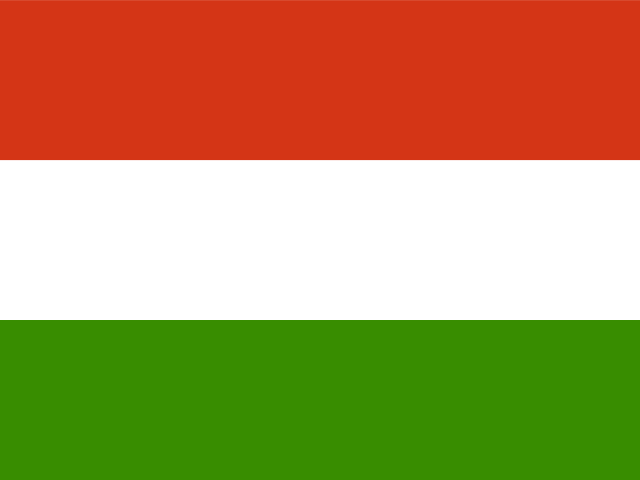
Three equal horizontal bands of red, white and green. Article I)(2) of the Fundamental Law assigns the meanings in the same sentence that describes the flag: the bands run red, white and green from top to bottom as the symbols of strength, loyalty and hope respectively. That clause is recent. The constitution the Fundamental Law replaced described the same three bands and assigned them nothing, and neither did the bill that became the Fundamental Law.
Hungary FACTS ◢
| Capital | Budapest |
|---|---|
| Continent | Europe |
| Population | 9,514,251 (2025) |
| Area | 93,011 km² |
| Population density | 102/km² |
| Currency | Forint (HUF) |
| Official language | Hungarian |
| Calling code | +36 |
| Internet TLD | .hu |
| Time zone | UTC+01:00 |
| Drives on the | Right |
| ISO codes | HU / HUN |
DID YOU KNOW? ◢
- Hungarian is unrelated to the languages of its neighbours, belonging instead to the Uralic family alongside Finnish and Estonian.
- Budapest sits on a network of thermal springs and is famous for its historic public bathhouses.
- Lake Balaton is the largest lake in Central Europe.
- The ballpoint pen was invented by Hungarian journalist Laszlo Biro, which is why many call it a 'biro'.
- The Rubik's Cube was created by Hungarian architect Erno Rubik in 1974.
Hungary QUICK ANSWERS ◢
What is the capital of Hungary?
The capital of Hungary is Budapest.
What is the population of Hungary?
Hungary had a population of 9,514,251 in 2025.
What currency does Hungary use?
Hungary uses the Forint (HUF).
What languages are spoken in Hungary?
The official language of Hungary is Hungarian.
Think you know your flags? Play Flag Daily → · Browse all countries →
MORE ON THE FLAG ◢
The Hungarian flag is three horizontal bands, red over white over green, and the constitution says what each of them stands for. Red is the symbol of strength, white of loyalty, green of hope. That is not a tradition or a popular reading. It sits in the same sentence of the Fundamental Law that describes the bands.
The short "what the flag means" summary further up this page is quoting that sentence, and quoting it correctly. What it cannot show you in one paragraph is how recent it is. The clause has been binding since 1 January 2012 and not one day earlier. The bill that became the Fundamental Law of Hungary did not contain it. The constitution it replaced did not contain it. Neither did the 1848 Act that put the national colours into Hungarian law in the first place.
So Hungary is a country where the answer to "what do the colours mean" really is official. It is also a much younger answer than the colours it explains.
Key Takeaways
- Article I)(2) of the Fundamental Law of Hungary describes the flag and assigns its colours meanings in the same sentence: red for erő, white for hűség, green for remény.
- That sentence has been in force since 1 January 2012. Bill T/2627, the draft that became the Fundamental Law, set out the same three bands and gave them no meanings at all.
- The Hungarian state's own English translations disagree about the middle word. A National Assembly text says fidelity, and the Ministry of Justice text in force in 2026 says loyalty.
- Section 76(1) of the previous constitution described the flag in almost identical words to the Fundamental Law's description and interpreted nothing. Act XXI of 1848 did not even name the three colours.
- Neither the Fundamental Law nor Act CCII of 2011 on using the flag states the flag's proportions or its exact shades. The 1:2 ratio is the shape of every size a government decree permits on public buildings.
Which article of the Fundamental Law describes the flag of Hungary?
Article I) of the Foundation, the chapter that opens the Fundamental Law. Its second paragraph reads:
"Magyarország zászlaja három, egyenlő szélességű, sorrendben felülről piros, fehér és zöld színű, vízszintes sávból áll, amelyben a piros szín az erő, a fehér szín a hűség, a zöld szín a remény jelképe."
The grammar is the point. The relative clause that begins amelyben, meaning in which, hangs off the description rather than following it as a separate sentence. Hungarian constitutional law does not describe the flag and then gloss it. It does both at once.
Getting the citation right takes some care, because the Fundamental Law has two Article Is. The opening chapter numbers its articles with letters, from A) to U), so the flag clause is I) cikk, the ninth. The chapter on Freedom and Responsibility numbers its articles with Roman numerals, and its Article I is about fundamental rights. In Hungarian the two are visibly different, I) cikk against I. cikk. In English they collide, and the National Assembly translation that circulated for years prints both as "Article I". The Ministry of Justice translation now in force writes the first as "Article I)" and keeps the second bare.
Read the paragraph for what it withholds and it gets more interesting. There is no ratio. There are no shades, no colour standard, no reference to one. The only measurement in the sentence is that the three bands are of equal width. Everything a flag manufacturer would actually need is somewhere else, or nowhere.
Is the white fidelity or loyalty? Hungary's own English has said both
The Hungarian word is hűség. It is one word covering a range that English splits between faithfulness, fidelity and loyalty, and the Hungarian state has published translations settling on two different points in that range.
The National Assembly's English text, a translation of the version consolidated to 1 October 2013, gives the clause as:
"The flag of Hungary shall feature three horizontal bands of equal width coloured red, white and green from top to bottom as the symbols of strength, fidelity and hope, respectively."
The Ministry of Justice text of the same paragraph, published as in force on 19 July 2026, is identical except for one word:
"The flag of Hungary shall feature three horizontal bands of equal width coloured red, white and green from top to bottom as the symbols of strength, loyalty and hope, respectively."
Neither is a slip, because hűség appears twice in the Fundamental Law and both translations are internally consistent. The National Avowal, the preamble, ends one of its articles of belief with "összetartozásunk alapvető értékei a hűség, a hit és a szeretet". The older English renders that as fidelity, faith and love; the newer one as loyalty, faith and love. A house choice was made and then remade.
The choice matters more than a translator's preference usually would, because Article R)(3) of the Fundamental Law requires its provisions to be read in accordance with the National Avowal. The word in the flag clause is the same word the preamble uses for what holds the community together. The Ministry of Justice document prints a note saying it has been produced for informational purposes only, which is the honest position: the binding text is the Hungarian, and the Hungarian says hűség.
The bill that became the Fundamental Law had no colour meanings in it
Bill T/2627 was laid before the National Assembly on 14 March 2011. Its Article I(2) read:
"Magyarország zászlaja három, egyenlő szélességű piros, fehér és zöld színű vízszintes sávból áll."
Three bands of equal width, red, white and green. No order from the top. No meanings.
The explanatory memorandum attached to the bill is equally quiet. Its note on Article I says the bill contains the description and the pictorial representation of the two most important symbols of Hungarian statehood, that those symbols express belonging to the nation as well as sovereignty, and that the detailed rules of their use are left to a cardinal Act. It says nothing about strength, nothing about hope, and nothing about why a constitution would interpret a colour.
The Fundamental Law was adopted on 18 April 2011 and promulgated in Magyar Közlöny number 43 of 25 April 2011, five and a half weeks after the bill was tabled. The promulgated text has both additions: the words sorrendben felülről, fixing the order from the top, and the whole amelyben clause. The gazette text and the consolidated text on the national legislation database agree word for word, and the paragraph has no amendment footnote, so it has not been touched since.
Which amendment inserted the clause during those five and a half weeks is a question this article cannot answer. The National Assembly's document server answers a security challenge, and the archived copies of the relevant committee papers would not transfer completely. What is documented is the before and the after, and they are not the same.
Set the four texts side by side and the shape of the change is easy to see.
| Instrument | What it says the flag looks like | What it says the colours mean |
|---|---|---|
| Act XXI of 1848 | Restores the national colour and the country's arms to their ancient rights; the tricolour rosette resumes as a civic emblem | Nothing. It does not name the three colours at all |
| Constitution (Act XX of 1949), s. 76(1), as it stood at its repeal | Three horizontal bands of equal width, red, white and green | Nothing |
| Bill T/2627 as tabled, 14 March 2011, Art. I(2) | Three horizontal bands of equal width, red, white and green | Nothing |
| Fundamental Law, Art. I)(2), in force 1 January 2012 | Three horizontal bands of equal width, red, white and green from top to bottom | Strength, loyalty and hope, in the same sentence |
What Hungarian law said about the flag before 2012
Section 76(1) of Act XX of 1949, the constitution the Fundamental Law replaced, stood at its repeal in these words:
"A Magyar Köztársaság zászlaja három, egyenlő szélességű, piros, fehér és zöld színű, vízszintes sávból áll."
That is the bill's sentence almost exactly, with the name of the state where Magyarország now stands. Three equal bands, red, white and green, and no interpretation of any of them. Iván Halász and Gábor Schweitzer, writing the entry on national symbols for the Hungarian legal encyclopaedia Internetes Jogtudományi Enciklopédia, put the change plainly: an important difference from the pre-2012 rules, they write, is that the Fundamental Law does not merely list the state and national symbols but, in the case of the flag, also attaches an explanation of its meaning.
Section 76(1) still read that way in 2011, and it is not what the 1949 constitution originally said. The provision as first enacted, then numbered section 68, required the state's coat of arms in the middle of the tricolour, which from 1949 meant the communist arms. In the 1956 revolution the emblem was removed from the flag, and the lyukas zászló, the flag with a hole in it, became one of the revolution's chief symbols. Act II of 1957 then rewrote section 68 to say only that the flag of the People's Republic was red, white and green in colour. The reasoning printed with that amendment is drily bureaucratic. It abolishes the obligation to show the coat of arms on the flag, on the ground that the flag is itself an official emblem of the state, so there is no need to display the other one on it. Halász and Schweitzer connect the two events directly and record that the Kádár leadership decided to use the flag without the arms.
The 1848 Act restored the national colours without naming them
Act XXI of 1848 is where the tricolour enters Hungarian statute law, and it is shorter than its reputation. Its title is "a nemzeti szinről és ország czimeréről", on the national colour and the country's coat of arms, and its first section is a single line:
"A nemzeti szin, és ország czimere ősi jogaiba visszaállíttatik."
The national colour and the country's coat of arms are restored to their ancient rights. Section 2 goes on to say that the tricolour rosette is accordingly taken up again as a civic emblem, and that the national flag and the country's arms may be used at every public building and public institution, on the occasion of every public celebration, and on every Hungarian vessel.
Note what is missing. The Act never says which colours. It refers to "a háromszínű rózsa", the three-coloured rosette, and leaves the reader to know which three. Halász and Schweitzer make the same observation, that the statute did not name the national colours but referred instead to the rosette that contained them. And the phrase doing all the work, ősi jogaiba, into its ancient rights, does something a modern drafter would never do: it asserts a restoration without saying what is being restored to what.
The claim is also hard to reconcile with the dates. The earliest recorded instance of a Hungarian tricolour on the French model, in the same encyclopaedia entry, is from 1801, when the Palatine Joseph and his wife Alexandra Pavlovna decorated the flag of Nógrád county with a national-coloured ribbon. Pest shipmasters used such ribbons on their guild flag in 1814. General use came only with the parliamentary elections of 1847, a matter of months before the Act. The tricolour arrangement itself was an import, spread from the French Revolution. The Cispadane Republic's decree of 7 January 1797 gave Italy its tricolour.
Where the red, the white and the green came from
The colours are far older than the arrangement, and they came from the coat of arms rather than from any assigned symbolism.
Halász and Schweitzer state it in one line: "A háromszínű magyar zászló színeit a címerből nyerte." The three-coloured Hungarian flag derived its colours from the coat of arms. The red and silver bars of the Árpád dynasty appear on early flags as red and white. Green joined them later, from the hármas halom, the triple mound on which the arms' patriarchal cross stands. Their entry dates green's joining to the sixteenth century, as Kumorovitz does, while noting in passing that an isolated red, white and green combination had appeared as early as the fourteenth.
Bernát L. Kumorovitz, whose two-part study of the Hungarian flag and the national colours appeared in Hadtörténelmi Közlemények in 1954, dates that arrival to the middle of the sixteenth century and traces it through unglamorous evidence, none of it a flag. The silk cords of pendant seals come first, and under Matthias I they are already predominantly in the three colours. A tournament picture of 1557 shows a hussar beating a kettledrum whose cover is red, white and green. At the coronation of Matthias II in 1608 the wooden bridge between the coronation church and the Franciscan church in Pozsony was covered with a red, white and green carpet. At the coronation of Leopold I's consort, the church steps were covered with what an eighteenth-century Latin account of the ceremony calls Pannonicus tricolor pannus, Hungarian three-coloured cloth.
At no point in that story does anyone assign the colours a meaning. They accumulated because they were the colours of the shield.
Where the strength, loyalty and hope reading came from
The reading was in circulation long before it was in the constitution, and Hungarian legal writing has not treated it as a finding.
The Halász and Schweitzer entry, closed on 30 June 2020, still writes about it that way, nine years after it became constitutional text. The same entry says that, as with the coat of arms, there exist in the case of the national colours too "érdekes, de misztikus magyarázatok", interesting but mystical explanations, according to which red symbolises strength, white fidelity and green hope. Their footnote for that sentence points at a 2003 commentary on the old Constitution by Zsolt Balogh, András Holló, István Kukorelli and János Sári, so the reading was already in the constitutional-law literature nearly a decade before it was in the constitution.
Constitutional scholarship has not entirely warmed to the promotion either. Reviewing the symbols provisions in a 2014 working paper for the Hungarian Academy of Sciences, Péter Smuk called the decoding of the colours in the text of a legal norm unusual, "ugyanis ennek tisztán szimbolikus értéke van, normatív nincs", since it has purely symbolic value and no normative value.
That is the honest shape of the answer. The meanings are official, in the highest instrument Hungary has. They are also an old popular gloss that was written up rather than worked out, and no Hungarian state source found for this article traces it to anything earlier.
What the Fundamental Law and Act CCII of 2011 do not fix
Quite a lot, and one of those gaps is the flag's proportions.
The Fundamental Law leaves the detailed rules of use to an Act, which is Act CCII of 2011 on the use of the coat of arms and the flag of Hungary and on state decorations. That Act says who may fly the flag and where it must be flown permanently, down to a requirement that the flags on the buildings of Parliament, the Constitutional Court, the Kúria and the offices of the President and the Prime Minister be lit from sunset to sunrise. On the colours it says nothing. Its one interpretive line is a duty owed to the symbols rather than a meaning drawn from them: "A címer és a zászló (lobogó) használata során mindenki köteles megőrizni azok tekintélyét és méltóságát." Everyone using the coat of arms or the flag must preserve their authority and dignity.
Hungarian also distinguishes two words that English collapses into one. A zászló is fixed to a staff along its hoist, while a lobogó flies from a halyard. The 2011 Act uses both throughout, and it is the lobogó that is raised before the Parliament building on national holidays with military honours, and the lobogó that Hungarian ships fly.
The proportions are the interesting absence. No instrument read for this article states a ratio for the flag in the abstract, the Fundamental Law and Act CCII of 2011 included. The commonly cited 1:2 is the shape of every size an annex to Government Decree 132/2000 on flying flags on public buildings permits: 100 by 200, 150 by 300 and 200 by 400 centimetres, each with its matching pole or mast height. The table binds only the public buildings the decree covers, and it fixes those three sizes rather than a ratio.
The same decree is the closest thing Hungarian law has to a colour specification, and it is a textile rule rather than a colorimetric one. The flag must be sewn from woven red, white and green fabric conforming to the national standard on the colour characteristics and colourfastness of flag fabrics, MSZ 1361 of 1988. It must be cleaned at least every three months and replaced at least once a year, sooner if fading or fraying has visibly taken it outside the standard.
One recent change is worth recording because it touches the flag's legal status rather than its design. As promulgated, Article I)(4) required the rules on using the arms and the flag to be laid down in a cardinal Act, meaning one passed by a two-thirds majority. The Seventeenth Amendment to the Fundamental Law, of 13 July 2026, repealed the word sarkalatos in that paragraph. Its explanatory memorandum gives the reason as a general review of the subject matters reserved to cardinal Acts, of which the Fundamental Law had thirty-six. The flag clause in Article I)(2) was not touched.
So the meanings are constitutional and very little else is. The contrast with Bulgaria is worth drawing, because its flag law runs the other way round: neither the 1879 constitution nor the current one says what the colours mean, while a separate flag law fixes the proportions and the exact Pantone references that Hungary has never legislated. If you want to test how much of any of this you have actually retained, Flag Daily shows you one flag a day and gives you three guesses at the country.
Frequently asked questions
What do the colours of the Hungarian flag officially mean?
Article I)(2) of the Fundamental Law of Hungary says the red is the symbol of erő, the white of hűség and the green of remény. The Hungarian state's English translations render those as strength, hope, and either fidelity or loyalty depending on which translation you read: a National Assembly text consolidated to 2013 says fidelity, and the Ministry of Justice text in force in 2026 says loyalty.
The Hungarian original is the binding text, and it has not changed since the Fundamental Law was promulgated on 25 April 2011.
Are the Hungarian flag's colour meanings actually in the constitution?
Yes, and in the same sentence that describes the flag. Article I)(2) sets out three horizontal bands of equal width running red, white and green from the top, then continues with a relative clause assigning each band its symbol. The clause has been in force since 1 January 2012, when the Fundamental Law took effect.
Cite it carefully. The opening chapter of the Fundamental Law letters its articles rather than numbering them, so the flag provision is Article I), the ninth, while a different Article I in the chapter on Freedom and Responsibility deals with fundamental rights.
Did the Hungarian constitution always say what the colours mean?
No. Section 76(1) of the previous constitution, Act XX of 1949, described the flag as three horizontal bands of equal width in red, white and green and assigned them nothing. Bill T/2627, the draft of the Fundamental Law tabled on 14 March 2011, used almost the same wording and also assigned them nothing.
Both the top-to-bottom order and the meanings were added between the bill being tabled and the Act being adopted on 18 April 2011.
Why is the Hungarian flag red, white and green?
The colours come from the coat of arms rather than from any assigned symbolism. Red and white are the colours of the Árpád dynasty's barred shield, and green is the colour of the hármas halom, the triple mound on which the arms' patriarchal cross rests. Kumorovitz's 1954 study of the national colours traces green joining the other two from the middle of the sixteenth century, through seal cords, a drum cover and ceremonial cloth.
The horizontal tricolour arrangement is much later, spread from the French Revolution, and the earliest recorded Hungarian example dates from 1801.
What are the official proportions of the Hungarian flag?
Neither the Fundamental Law nor Act CCII of 2011 on using the flag states a ratio for it. The 1:2 shape usually quoted is the shape of every size an annex to Government Decree 132/2000 permits on public buildings: 100 by 200, 150 by 300 and 200 by 400 centimetres.
The same decree requires the fabric to meet the national standard on the colour characteristics and colourfastness of flag fabrics, MSZ 1361 of 1988, and requires the flag to be cleaned at least every three months and replaced at least once a year.
Sources
- Nemzeti Jogszabálytár (National Legislation Database), Magyarország Alaptörvénye, consolidated Hungarian text, Article I), as in force 19 July 2026 - retrieved 27 August 2026.
- Ministry of Justice, The Fundamental Law of Hungary, English translation as in force on 19 July 2026 - retrieved 27 August 2026.
- Országgyűlés (National Assembly), The Fundamental Law of Hungary, English translation of the version consolidated to 1 October 2013, parlament.hu - read from the Internet Archive capture of 24 September 2017, because the live host answers a security challenge. retrieved 27 August 2026.
- Magyar Közlöny 2011, number 43, 25 April 2011, the promulgated text of the Fundamental Law, kozlonyok.hu - read from the Internet Archive capture of 17 May 2011, because the live host refuses non-Hungarian addresses. Its PDF text layer substitutes o-tilde and u-circumflex for the Hungarian double-acute letters, so it was used to confirm the wording and nothing is quoted from it - retrieved 27 August 2026.
- Jogkódex, A Magyarország Alaptörvényéről szóló T/2627. számú törvényjavaslat indokolása, the bill as tabled on 14 March 2011 with its explanatory memorandum - retrieved 27 August 2026.
- Nemzeti Jogszabálytár, 1949. évi XX. törvény, a Magyar Köztársaság Alkotmánya, section 76, final consolidated text - retrieved 27 August 2026.
- Wolters Kluwer Jogtár, Ezer év törvényei, 1848. évi XXI. törvénycikk a nemzeti szinről és ország czimeréről - retrieved 27 August 2026.
- Nemzeti Jogszabálytár, 2011. évi CCII. törvény Magyarország címerének és zászlajának használatáról, valamint állami kitüntetéseiről - retrieved 27 August 2026.
- Nemzeti Jogszabálytár, 132/2000. (VII. 14.) Korm. rendelet a középületek fellobogózásának egyes kérdéseiről - retrieved 27 August 2026.
- Nemzeti Jogszabálytár, Magyarország Alaptörvényének tizenhetedik módosítása and its indokolás - retrieved 27 August 2026.
- Iván Halász and Gábor Schweitzer, Nemzeti jelképek, Internetes Jogtudományi Enciklopédia, entry closed 30 June 2020, hosted in the Hungarian Academy of Sciences repository - retrieved 27 August 2026.
- Péter Smuk, A szuverenitás jelképei és alkotmányos védelmük, MTA Law Working Papers 2014/37 - retrieved 27 August 2026.
- Bernát L. Kumorovitz, A magyar zászló és nemzeti színeink múltja, I. közlemény, Hadtörténelmi Közlemények 1954, in the National Széchényi Library's electronic periodicals archive - retrieved 27 August 2026.
- Act II of 1957 amending the Constitution, section 4 and its explanatory memorandum, published in Magyar Közlöny number 57 of 23 May 1957, read from the Hungarian Wikisource transcription; the gazette scan itself could not be reached - retrieved 27 August 2026.
- The comparisons with Italy and Bulgaria are taken from Clickidy's own explainers on those two flags, linked in the body, and from the sources those articles cite. No Italian or Bulgarian instrument was read for this article.
PLAY ANOTHER →
A short message, hidden in a different cipher every day.
ONE CIPHER A DAYDAILYOn This DayOne thing that happened today in history. Every day, a new one.
TODAY IN HISTORYDAILYDaily TriviaFive questions a day. Everyone gets the same five.
FIVE QUESTIONSDAILYGuess the CountryThree clues, three guesses. Work out where in the world it is.
THREE CLUES