
Italy
A boot-shaped peninsula that gave the world the Roman Empire, the Renaissance and pizza. Italy holds more UNESCO World Heritage sites than any other country.
WHAT THE FLAG MEANS ◢
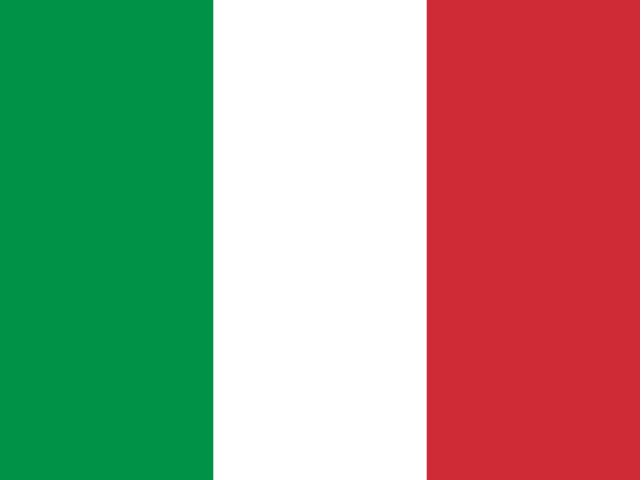
Three equal vertical bands of green, white and red, decreed at Reggio Emilia on 7 January 1797 as the flag of the Cispadane Republic. By popular tradition the colours are read as the land, the snow of the Alps and the blood shed for the nation.
Source: quirinale.it
Italy FACTS ◢
| Capital | Rome |
|---|---|
| Continent | Europe |
| Population | 58,915,656 (2025) |
| Area | 302,068 km² |
| Population density | 195/km² |
| Currency | Euro (EUR) |
| Official language | Italian |
| Calling code | +39 |
| Internet TLD | .it |
| Time zone | UTC+01:00 |
| Drives on the | Right |
| ISO codes | IT / ITA |
DID YOU KNOW? ◢
- It has more UNESCO World Heritage sites than any other nation.
- Rome is home to Vatican City, the smallest independent country in the world.
- Italy has three of Europe's most active volcanoes: Etna, Vesuvius and Stromboli.
- The pizza Margherita was created in Naples, the city where pizza was born.
- The University of Bologna, founded in 1088, is the oldest university in continuous operation.
Italy QUICK ANSWERS ◢
What is the capital of Italy?
The capital of Italy is Rome.
What is the population of Italy?
Italy had a population of 58,915,656 in 2025.
What currency does Italy use?
Italy uses the Euro (EUR).
What languages are spoken in Italy?
The official language of Italy is Italian.
Think you know your flags? Play Flag Daily → · Browse all countries →
MORE ON THE FLAG ◢
Ask what the Italian flag means and you will usually be offered a meaning. Green for hope, white for faith, red for charity. Or green for the land, white for the snow of the Alps, red for blood shed for the nation.
The Presidency of the Republic answers the same question differently, and its answer is not a meaning at all. It is a regimental standard, a city's very old coat of arms, and the colour somebody chose for a militia uniform in 1782.
Italy has written a great deal down about its flag. The order of the bands is in the Constitution and the exact shade of each colour is in a ceremonial decree. Other instruments fix the height of the pole beside the European Union's, the days the flag goes up, the days it flies at half mast, and a rule against writing anything on it. Across all of it, no Italian instrument opened for this article says what green, white or red stand for.
Key Takeaways
- Article 12 of the Constitution is one sentence about the flag, and every word of it is specification.
- The tricolour was decreed at Reggio Emilia on 7 January 1797, and the decree names the three colours without explaining them.
- The Presidency of the Republic traces the colours to the standards of the Lombard Legion: white and red from the arms of Milan, green from the uniforms of the city's civic guard.
- The exact shades are fixed by a state ceremonial decree recording a 2004 circular, not by the Constitution and not by the flag law.
- 7 January is the national day of the flag by a 1996 law, and the same law requires the celebrations to keep the day itself non festive.
| Instrument | What it fixes | Meaning it assigns |
|---|---|---|
| Constitution, Article 12 | Green, white and red in three vertical bands of equal size | None |
| Law 22 of 5 February 1998 | Which public bodies fly the flag, and when | None |
| Presidential Decree 121 of 7 April 2000 | Poles, order, mourning, hours, the nine dates, and what may not be applied to a flag | None |
| Prime Ministerial Decree of 14 April 2006, Article 31 | The three colours, as Pantone textile codes, plus a physical reference | None |
| Law 671 of 31 December 1996 | 7 January as the national day of the flag | None |
Article 12 of the Italian Constitution, in full
Here is the entire constitutional law of the Italian flag:
"La bandiera della Repubblica è il tricolore italiano: verde, bianco e rosso, a tre bande verticali di eguali dimensioni."
In English that runs roughly: the flag of the Republic is the Italian tricolour, green, white and red, in three vertical bands of equal size.
That is a drawing instruction. It names the three colours, it puts them in an order, it makes the bands vertical, and it makes them equal to one another. Then it stops.
Two things are worth noticing about where the sentence sits. It is Article 12, the last of the twelve articles the 1947 Constitution groups under Principi fondamentali, its fundamental principles. The articles around it are about sovereignty, work, equality, minorities and the renunciation of war. The flag article is set among them and given no gloss at all, while the articles beside it are nothing but statements of value.
The other thing is what "eguali dimensioni" is measuring. It is the bands that are equal to each other. The sentence says nothing about how tall or how long the flag itself should be, a gap that runs through every later instrument as well.
The Presidency of the Republic reproduces the moment the wording was adopted, from the minutes of the Constituent Assembly sitting of 24 March 1947. The minute labels the speaker PRESIDENTE [Ruini] and has him put to the vote what it calls "la nuova formula proposta dalla Commissione", the new formula proposed by the Commission: "La bandiera della repubblica è il tricolore italiano: verde, bianco e rosso, a bande verticali e di eguali dimensioni". The minute then records, in brackets, what the room did: "(E' approvata. L'Assemblea e il pubblico delle tribune si levano in piedi. Vivissimi, generali, prolungati applausi.)" Approved, and the Assembly and the public galleries rose to their feet.
That formula is not quite the text in force. The minute has "La bandiera della repubblica" and "a bande verticali e di eguali dimensioni"; Article 12 as it stands has "La bandiera della Repubblica" and "a tre bande verticali di eguali dimensioni". The article in force adds the word tre, drops the conjunction e, and capitalises Repubblica. No source opened here explains when or by whom, so this article reports the difference and stops.
Reggio Emilia, 7 January 1797, and why these three colours
The tricolour is older than the Republic that flies it, and its adoption has a date, a place and a text.
On 7 January 1797 the parliament of the Cispadane Republic, meeting at Reggio Emilia, decreed on the proposal of the deputy Giuseppe Compagnoni "che si renda universale lo Stendardo o Bandiera Cispadana di Tre Colori Verde, Bianco, e Rosso, e che questi tre Colori si usino anche nella Coccarda Cispadana, la quale debba portarsi da tutti". That the Cispadane standard or flag of three colours, green, white and red, be made universal, and that these three colours be used also in the Cispadane cockade, which everyone is to wear.
The Cispadane Republic was a new state formed by representatives of four cities, Reggio Emilia, Modena, Bologna and Ferrara, which the Comune di Reggio Emilia describes as "il nuovo stato sorto sotto la protezione delle armi francesi", risen under the protection of French arms. The room is still in use: the hall of the Reggio Emilia town hall, built to Lodovico Bolognini's design between 1772 and 1787 to hold the Duchy's general archive, later renamed the Sala del Tricolore, and now the seat of the city council.
The Museo del Tricolore, the municipal museum beside that hall, reports the same record in the same terms: in the acts of the congress the flag is simply "di tre colori verde, bianco e rosso", of three colours, green, white and red. Congress is the museum's word and the Comune's, which has the four cities "riuniti in Congresso"; parliament is the Presidency of the Republic's. The body is the same one either way.
Read the decree again and notice what it does not do. It orders the colours used. It does not say why they are those colours.
The Presidency of the Republic asks that question directly on its own page, in those words: "Ma perché proprio questi tre colori?" And the answer it gives is a lineage rather than a symbolism.
In the Italy of 1796, it says, the Jacobin republics that had displaced the old absolutist states almost all adopted flags of three equal bands, "chiaramente ispirate al modello francese del 1790", clearly inspired by the French model of 1790. The military units raised to fight alongside Bonaparte's army carried standards in the same shape. The page calls them "i reparti militari" and puts the word "italiani" in quotation marks of its own, since these units were not yet Italian in any national sense. The regimental colours of the Lombard Legion were white, red and green, and here the account gets specific:
"il bianco e il rosso, infatti, comparivano nell'antichissimo stemma comunale di Milano (croce rossa su campo bianco), mentre verdi erano, fin dal 1782, le uniformi della Guardia civica milanese"
White and red appeared in the very old civic arms of Milan, a red cross on a white field. Green had been the colour of the Milanese civic guard's uniforms since 1782. The Italian Legion, which gathered soldiers from Emilia and Romagna, took the same colours, and the account concludes that this was "probabilmente" the reason the Cispadane Republic confirmed them in its own flag.
That is the Presidency of the Republic's published answer to why the flag is green, white and red. It contains no hope, no faith, no charity, no snow and no blood. It contains a heraldic charge and a uniform. The same page does use the word hope, of the Risorgimento, and that sentence is taken up at the end of this article.
One detail from the same page shows how much the 1797 flag differed from today's. At the centre of the white band sat the arms of the Republic: "un turcasso contenente quattro frecce, circondato da un serto di alloro e ornato da un trofeo di armi". A quiver holding four arrows, ringed by a laurel wreath and dressed with a trophy of weapons.
Italy's colours are three Pantone numbers and one piece of cloth in Rome
The exact shades are settled, and they are settled somewhere unexpected: not in the Constitution, not in the flag law, but in the decree that codifies Italian state ceremonial and the order of precedence among public offices.
The Prime Ministerial Decree of 14 April 2006 carries a section headed Bandiera della Repubblica, inno nazionale, feste nazionali ed esequie di Stato. Its Article 31 is titled "Definizione cromatica dei colori della bandiera della Repubblica", and its first paragraph reads:
"I toni cromatici dei colori della bandiera della Repubblica, indicati dall'art. 12 della Costituzione, sono definiti dalla circolare della Presidenza del Consiglio dei Ministri del 2 giugno 2004, UCE 3.3.1/14545/1, con i seguenti codici Pantone tessile, su tessuto stamina (fiocco) di poliestere:"
Then the three values, which are the whole of the Italian state's colour specification:
Verde 17-6153. Bianco 11-0601. Rosso 18-1662.
Note what the article is doing. It does not define the colours itself. It records that they were defined by a circular of the Presidency of the Council two years earlier and gives that circular's file reference, and it scopes the codes to one material, which it names as "tessuto stamina (fiocco) di poliestere".
Which leaves the obvious question of every other fabric, and the second paragraph answers it in a way no colour space can:
"L'utilizzazione di altri tessuti deve produrre lo stesso risultato cromatico ottenuto sull'esemplare custodito presso il Dipartimento del Cerimoniale di Stato della Presidenza del Consiglio dei Ministri, nonché presso ogni Prefettura e ogni Rappresentanza diplomatica italiana all'estero."
Other fabrics have to match a sample. Not a number, an object: the exemplar kept at the Department of State Ceremonial, and at every Prefecture, and at every Italian diplomatic mission abroad. For anything outside that one cloth, the final authority on the colour of the Italian flag is a flag.
This is a different instinct from the one next door. Spain fixed its two colours in CIELAB coordinates with a stated tolerance, so that any dyer anywhere can compute the answer. Italy published three Pantone codes for one fabric and distributed physical copies for everything else.
What Italy's 1998 flag law is actually about
Italy does have a flag law, and its own first article says what it is for:
"disposizioni generali in materia di uso ed esposizione della bandiera della Repubblica italiana e di quella dell'Unione europea"
General provisions on the use and display of the flag of the Italian Republic and that of the European Union. Law 22 of 5 February 1998 was passed to implement Article 12 of the Constitution, and what it implements is the flying of the flag, not its design.
Its Article 2 lists the bodies that must fly the national and European flags outside their headquarters while they are doing their work: the constitutional organs and bodies of constitutional standing, and the seat of government whenever the Council of Ministers is sitting; the ministries; regional, provincial and municipal councils when they meet; the judicial offices; and state schools and universities. A second paragraph adds polling stations during a vote and Italian diplomatic and consular missions abroad.
The law also cleared away what came before it. Its Article 4 repeals the Royal Decree-Law of 24 September 1923, on the use of the national flag, and the law of 24 June 1929 on the display of foreign flags, and stops the application of a 1986 prime ministerial decree. All three fall away from the date the regulation the law calls for comes into force, which is what Presidential Decree 121 of 2000 turned out to be.
One limit is stated up front, in the same sentence that sets the law's scope: "fatte salve le disposizioni particolari sull'uso delle bandiere militari". Special provisions on the use of military flags are unaffected. It is a boundary worth remembering when reading any claim about what Italian law says about flags in general.
The rule that nothing may be written on the Italian flag
The details sit in the regulation the 1998 law called for, Presidential Decree 121 of 7 April 2000, and it is where the flag stops being a design and starts being an object with a protocol around it.
Its Article 2 puts the national and European flags on poles of the same height, in equal size and equal material, and then gives the order: "La bandiera nazionale è alzata per prima ed ammainata per ultima ed occupa il posto d'onore". Raised first, lowered last, in the place of honour, which the same paragraph puts on the right, or in the centre when an odd number of flags is flying. Where three fixed poles are available and only two flags are to be flown, the middle pole is left empty. Article 3 handles mourning: flags outside are kept at half mast, and two strips of black veil may be fitted to the top of the hoist.
Article 9 is the one that reads like a prohibition, and it is short:
"Le bandiere sono esposte in buono stato e correttamente dispiegate; né su di esse, né sull'asta che le reca, si applicano figure scritte o lettere di alcun tipo."
Flags are displayed in good condition and correctly unfurled, and neither on them nor on the staff carrying them may any figures, writing or letters of any kind be applied. The next paragraph adds that only one flag goes on each staff.
The regulation ends its general provisions by preserving the same carve-out the law made, in Article 11: "Sono fatte salve le disposizioni particolari riguardanti le bandiere militari e di altri corpi ed organizzazioni dello Stato, nonché le regole, anche consuetudinarie, del cerimoniale militare e di quello internazionale."
The shield the Italian flag carried, and lost
That ban on adding anything to the flag is newer than the practice it rules out. For about a century, on the Presidency of the Republic's own dates, the Italian tricolour carried the shield of Savoy.
The Presidency of the Republic dates the addition precisely. On 23 March 1848 Carlo Alberto issued the proclamation announcing the first war of independence, and it ended with an instruction that his troops "portino lo Scudo di Savoia sovrapposto alla Bandiera tricolore italiana", carry the shield of Savoy superimposed on the Italian tricolour. A practical adjustment followed: "Allo stemma dinastico fu aggiunta una bordatura di azzurro, per evitare che la croce e il campo dello scudo si confondessero con il bianco e il rosso delle bande del vessillo." A blue border was added to the dynastic arms so that the shield's cross and field would not be confused with the white and red of the flag's own bands.
After the Kingdom of Italy was proclaimed on 17 March 1861 the flag carried on by custom. No law stood behind it beyond the one covering military standards, and the same account blames that gap for flags of a shape different from the original and sometimes frankly arbitrary. "Soltanto nel 1925 si definirono, per legge, i modelli della bandiera nazionale e della bandiera di Stato." Only in 1925 were the models of the national flag and the state flag defined by law, the second adding the royal crown to the arms.
The shield went when the monarchy did. The same account records that "un decreto legislativo presidenziale del 19 giugno 1946 stabilì la foggia provvisoria della nuova bandiera", that a presidential legislative decree of 19 June 1946 established the provisional form of the new flag, and the Constituent Assembly confirmed it on 24 March 1947.
Italy's flag day, and the law that keeps it non festive
Italy marks the anniversary, and the law that created the celebration is oddly firm about how far it may go.
Law 671 of 31 December 1996 is titled "Celebrazione nazionale del bicentenario della prima bandiera nazionale", the national celebration of the bicentenary of the first national flag. Its Article 1 opens:
"Il giorno 7 gennaio, anniversario della nascita del primo tricolore d'Italia, è dichiarato giornata nazionale della bandiera."
7 January, the anniversary of the birth of Italy's first tricolour, is declared the national day of the flag. The next sentence hands the arrangements to a prime ministerial decree and then constrains it: the annual celebrations must in any case "prevedere il carattere non festivo del giorno stesso", provide for the non festive character of the day itself. A national flag day, created by statute, with a statutory instruction that the day itself is not to be a holiday.
Both halves of that arrangement are visible in the rules. Presidential Decree 121 of 2000, Article 1, paragraph 2, letter a, lists nine dates on which flags go up on public offices and institutions beyond the buildings that fly them as a matter of course. The list opens with "7 gennaio (festa del tricolore)", then runs through 11 February, 25 April, 1 May, 9 May, 2 June, 28 September, 4 October and 4 November. Letter b adds a tenth, 24 October, flown alongside the flag of the United Nations.
The holidays are a shorter list, set out in the 2006 ceremonial decree, whose Article 35 names the feste nazionali civili: 2 June, the anniversary of the founding of the Republic; 4 November, the festa dell'Unità nazionale and day of the armed forces; 25 April, the anniversary of the Liberation; and 1 May, the festa del Lavoro. 7 January is not among them. The state raises the flag for the flag's own anniversary and sends everyone to work.
None of these instruments fixes the flag's own proportions
Italian law is exact about the bands and quiet about the rectangle they sit in.
Article 12 of the Constitution makes the three bands equal to one another and says nothing about the flag's height against its length. The 1998 law never describes the design at all. The 2000 regulation comes closest without ever getting there: its Article 2 requires the national and European flags flown together to be "di uguali dimensioni e materiale", of equal dimensions and material, which fixes them against each other rather than against any absolute. Article 7 says the same for the pair standing behind a desk indoors. The 2006 ceremonial decree gives colour codes and does not touch shape at all, and where it does point elsewhere on flags, in Article 32, the reference is expressly about "esposizione" and "modalità d'uso", display and manner of use, and points back to the 1998 law and the 2000 regulation.
So the familiar two by three rectangle is not written into any of the five instruments in the table above. Two bodies of rules sit outside that finding and neither was opened here. Both the law and the regulation expressly leave military flag provisions untouched, and those are separate. And the Presidency of the Republic records that the models of the national and state flags were defined by law in 1925, which is the closest thing to an answer and is a law this article did not reach.
The two readings the record does not support
The two accounts this article opened with are the ones people actually repeat. One is theological: green for hope, white for faith, red for charity. The other is geographic and martial: green for the plains or the countryside, white for the snow of the Alps, red for the blood shed for the nation.
Neither appears in the Constitution, in Law 22 of 1998, in Presidential Decree 121 of 2000, in the ceremonial decree of 14 April 2006, or in Law 671 of 1996. None of those five attaches a meaning to any of the three colours.
More telling, neither appears on the page where the Italian state does explain its flag to the public. The Presidency of the Republic's history runs from 1797 to the present and answers the why question head on, and its answer is Milan's arms and a militia uniform. The nearest it comes to symbolism is a sentence about the Risorgimento, and it is a collective one rather than a colour by colour code: "Dovunque in Italia, il bianco, il rosso e il verde esprimono una comune speranza", everywhere in Italy the white, the red and the green express a shared hope.
So the honest position is narrower than the folk answer and more interesting than it. The founding decree of 1797 lists the colours and does not explain them. The Constitution repeats them and does not explain them. The one modern text that specifies them exactly does so in Pantone codes and a reference sample. And the state's own account of where they came from is a story about a red cross on a white field and a green coat.
Curious how much of a flag you can place at a glance? Flag Daily puts up one flag a day and gives you three guesses. Italy is one of 197 country factsheets here, each with its flag, its capital and the rest of the numbers.
Frequently asked questions
What do the colours of the Italian flag mean?
No Italian instrument read for this article assigns green, white or red any meaning, and the Presidency of the Republic's own history of the flag does not either, beyond one collective sentence about the Risorgimento in which the three colours together express "una comune speranza", a shared hope. That is a collective statement, not a colour by colour code. Article 12 of the Constitution names the three colours and the arrangement of the bands and stops there. The 1998 flag law is about display, the 2000 regulation is about protocol, and the 2006 ceremonial decree gives only Pantone codes.
The popular readings, green for hope with white for faith and red for charity, or green for the land with white for the Alpine snow and red for blood shed, are tradition rather than law. They have no standing in any of those texts.
Why is the Italian flag green, white and red?
The Presidency of the Republic traces the combination to the regimental standards of the Lombard Legion, raised to fight alongside Bonaparte's army. Its account says white and red appeared in the old civic arms of Milan, a red cross on a white field, and that green had been the colour of the Milanese civic guard's uniforms since 1782.
The Italian Legion, drawn from Emilia and Romagna, carried the same colours, and that account gives it as the probable reason the Cispadane Republic confirmed them in its flag of 7 January 1797. The three band layout itself it attributes to the French model of 1790.
When was the Italian tricolour first adopted?
On 7 January 1797, by the parliament of the Cispadane Republic meeting at Reggio Emilia, on the proposal of the deputy Giuseppe Compagnoni. The decree ordered that the Cispadane standard of three colours, green, white and red, be made universal, and that the same three colours be used in a cockade everyone was to wear.
That is the date Italian law now commemorates. Law 671 of 31 December 1996 declares 7 January the national day of the flag, and requires that the day itself remain non festive.
Is there a coat of arms on the Italian flag?
Not on the flag of the Republic. Article 12 of the Constitution describes three vertical bands of green, white and red and no device of any kind, and none of the later instruments read here adds one.
It was not always so. The 1797 Cispadane flag carried the young republic's arms on the white band, and from Carlo Alberto's proclamation of 23 March 1848 the tricolour carried the shield of Savoy, given a blue border so it would not blur into the white and red. The shield went with the monarchy, by a presidential legislative decree of 19 June 1946.
What are the official proportions of the Italian flag?
None of the five instruments read for this article fixes them. Article 12 of the Constitution makes the three bands equal to one another and says nothing about the shape of the flag as a whole. The 2000 regulation requires the national and European flags flown together to be of equal dimensions and material, which is a comparison rather than a measurement.
Two bodies of rules sit outside that finding and neither was opened here: military flags keep their own separate provisions, expressly preserved by both the 1998 law and the 2000 regulation, and the Presidency of the Republic records that the models of the national and state flags were defined by law in 1925.
Sources
- Costituzione della Repubblica Italiana, Article 12 - Normattiva, Presidenza del Consiglio dei Ministri, consolidated text. Retrieved 14 August 2026.
- I Simboli della Repubblica: il Tricolore - Presidenza della Repubblica. The live page answered every request with a security check, so it was read from the Internet Archive capture of 8 January 2026. Source of the 1797 decree text, the account of the colours' origin, the 1848, 1925 and 1946 dates, and the Constituent Assembly minute. Retrieved 14 August 2026.
- Legge 5 febbraio 1998, n. 22, Disposizioni generali sull'uso della bandiera della Repubblica italiana e di quella dell'Unione europea - Normattiva, consolidated text, Gazzetta Ufficiale n. 37 of 14 February 1998. Retrieved 14 August 2026.
- Decreto del Presidente della Repubblica 7 aprile 2000, n. 121 - Normattiva, consolidated text, Gazzetta Ufficiale n. 112 of 16 May 2000. Articles 1, 2, 3, 7, 9 and 11. Retrieved 14 August 2026.
- Decreto del Presidente del Consiglio dei Ministri 14 aprile 2006, Disposizioni generali in materia di cerimoniale e di precedenza tra le cariche pubbliche - Gazzetta Ufficiale della Repubblica Italiana, Serie generale n. 174 of 28 July 2006. The annex carrying Articles 31 to 35 is published as a scanned image. Retrieved 14 August 2026.
- Disposizioni generali in materia di cerimoniale e disciplina delle precedenze tra le cariche pubbliche, testo coordinato, June 2008 - Presidenza del Consiglio dei Ministri, Dipartimento del Cerimoniale di Stato. Typeset coordinated text of the decrees of 14 April 2006 and 16 April 2008, used to verify the scanned annex. Retrieved 14 August 2026.
- Legge 31 dicembre 1996, n. 671, Celebrazione nazionale del bicentenario della prima bandiera nazionale - Normattiva, consolidated text, Gazzetta Ufficiale n. 1 of 2 January 1997. Retrieved 14 August 2026.
- Reggio Emilia città del Tricolore - Comune di Reggio Emilia. Source of the four cities, the French protection, and the Sala del Tricolore's construction dates. Retrieved 14 August 2026.
- Bandiera della Repubblica Cispadana - Musei Civici di Reggio Emilia, Museo del Tricolore. Retrieved 14 August 2026.
PLAY ANOTHER →
Five questions a day. Everyone gets the same five.
FIVE QUESTIONSDAILYDaily CryptogramOne quote, one scrambled alphabet. Crack it before tomorrow.
CRACK THE QUOTEDAILYDaily CodeA short message, hidden in a different cipher every day.
ONE CIPHER A DAYDAILYOn This DayOne thing that happened today in history. Every day, a new one.
TODAY IN HISTORY