
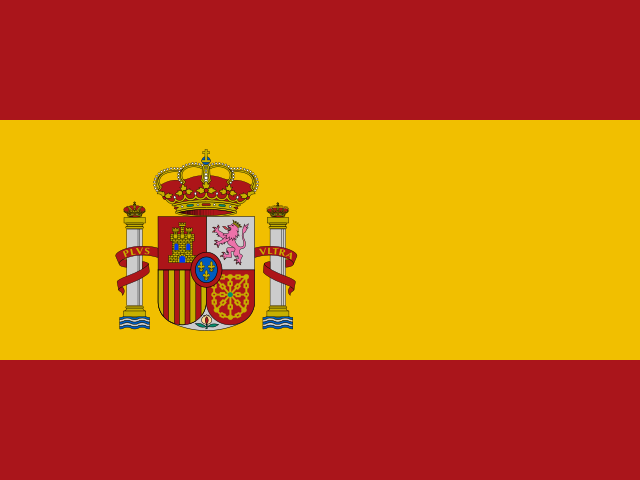
Spain
Home to flamenco, siestas and more UNESCO World Heritage sites than almost anywhere, Spain holds one of the largest collections of them on the planet. Madrid sits almost exactly at its centre.
WHAT THE FLAG MEANS ◢
Three horizontal bands of red, yellow and red, the yellow band double width, which is the whole of what Article 4.1 of the 1978 constitution says about it. The coat of arms is optional rather than part of the flag: Ley 39/1981 allows it on the yellow band and requires it only on official flags, meaning those of the public administration at every level, the constitutional organs, the armed forces and security forces, and diplomatic and consular premises, where on a flag of normal proportions it stands toward the hoist rather than at the centre. No Spanish instrument now in force gives the colours a meaning, and the blazon in Ley 33/1981 gives the arms none either.
Source: boe.es
Spain FACTS ◢
| Capital | Madrid |
|---|---|
| Continent | Europe |
| Population | 49,355,143 (2025) |
| Area | 505,990 km² |
| Population density | 98/km² |
| Currency | Euro (EUR) |
| Official language | Spanish |
| Calling code | +34 |
| Internet TLD | .es |
| Time zones | UTC±00:00, UTC+01:00 |
| Drives on the | Right |
| ISO codes | ES / ESP |
DID YOU KNOW? ◢
- It has one of the highest numbers of UNESCO World Heritage Sites of any country.
- La Tomatina festival sees the town of Buñol stage a massive tomato-throwing fight every year.
- Antoni Gaudí's Sagrada Família in Barcelona has been under construction since 1882 and is still unfinished.
- Spanish is the world's second-most spoken native language, after Mandarin Chinese.
- Madrid sits almost exactly in the geographic centre of the country.
Spain QUICK ANSWERS ◢
What is the capital of Spain?
The capital of Spain is Madrid.
What is the population of Spain?
Spain had a population of 49,355,143 in 2025.
What currency does Spain use?
Spain uses the Euro (EUR).
What languages are spoken in Spain?
The official language of Spain is Spanish.
Think you know your flags? Play Flag Daily → · Browse all countries →
MORE ON THE FLAG ◢
Ask what the Spanish flag means and there is an answer in the statute book, written out in so many words.
Spain's flag law opens with a sentence about what the flag is for, before a word about stripes or widths. This is the whole of Article 1 of Law 39/1981:
"La bandera de España simboliza la nación; es signo de la soberanía, independencia, unidad e integridad de la patria y representa los valores superiores expresados en la Constitución."
In English that runs roughly: the flag of Spain symbolises the nation; it is a sign of the sovereignty, independence, unity and integrity of the fatherland, and it represents the superior values expressed in the Constitution. Three clauses, in the statute book, at the top of the page.
And then the law moves on to geometry. It names the two colours again in the very next article, and it never says what either of them stands for.
Key Takeaways
- Article 1 of Law 39/1981 states what the flag means, and says nothing at all about the colours.
- The meaning it assigns is partly a cross-reference. The superior values it says the flag represents are named in Article 1.1 of the Constitution as liberty, justice, equality and political pluralism.
- The Constitution describes the flag in one sentence, and that sentence is pure geometry.
- The coat of arms is optional. Law 39/1981 says it may be added, and the next article of the same law lists the flags that must carry it.
- The blazon of those arms never identifies a single charge with a kingdom. It names a castle, a lion, four pales, a chain and a pomegranate. Castile, Aragon and Navarre are not mentioned at all; Granada appears only as a fruit and Leon only as an animal.
| Instrument | What it fixes | Meaning it assigns |
|---|---|---|
| Constitution of 1978, Article 4.1 | Three horizontal stripes, red, yellow, red, the yellow twice the width of each red one | None |
| Law 39/1981, Article 1 | Nothing about the design | The nation, sovereignty, independence, unity, integrity, and the Constitution's superior values |
| Law 39/1981, Article 2 | That the design stands as the Constitution sets it, and that the arms may be added to the yellow stripe | None |
| Royal Decree 441/1981 | The two colours in CIELAB coordinates, with a tolerance | None |
| Law 33/1981, Articles 1 and 2 | The blazon of the arms, charge by charge | None |
| Royal Decree 2964/1981, Article 3 | Where on the flag the arms sit, and how big they are | None |
The sentence of the flag law that gives the flag a meaning
Article 1 of Law 39/1981 is doing something unusual, and it is worth being precise about what.
It does not say that red means anything. It does not say that yellow means anything. It treats the flag as a single object and gives that object a job: to symbolise the nation and to stand for sovereignty, independence, unity and integrity.
Then it does something rarer still. It hands part of the answer to another document. The flag, it says, represents "los valores superiores expresados en la Constitución". Those superior values are not left vague, and they are not a loose phrase either. They are a defined constitutional term. Article 1.1 of the 1978 Constitution sets them out as the "valores superiores de su ordenamiento jurídico", the superior values of the legal order, and names them: "la libertad, la justicia, la igualdad y el pluralismo político". Liberty, justice, equality and political pluralism.
So a complete legal answer to what the Spanish flag stands for is available, and it is not a folk reading. It is the nation, four qualities of the patria, and four constitutional values, assembled from two articles in two instruments.
What is missing from all of it is any account of the two colours.
What the Constitution of Spain actually says about the flag
Article 4 of the Spanish Constitution has two paragraphs. The second is about the flags of the autonomous communities. The first is the whole of what the Constitution says about the flag of Spain itself, and here it is:
"La bandera de España está formada por tres franjas horizontales, roja, amarilla y roja, siendo la amarilla de doble anchura que cada una de las rojas."
That is a drawing instruction, and nothing more. It fixes the count, the order and the proportion, and it stops.
This is worth holding next to the article before it in the same document. The framers of 1978 wrote out the superior values of the legal order in Article 1.1 and wrote out the flag in Article 4.1, and they did not connect the two. The connection was made three years later, by an ordinary law.
Red and gualda: the Spanish flag's colours are exact and unexplained
Spain has specified its flag colours in exact colorimetric coordinates, and the specification is silent on symbolism in a way that is almost pointed.
Royal Decree 441/1981 sets the colours in the CIELAB system. The red is given a hue of 35.0 degrees, a chroma of 70.0 and a lightness of 37.0. The yellow is given 85.0, 95.0 and 80.0. The decree then adds a line that quietly tells you what kind of document it is: "Tolerancia: Cinco Unidades CIELAB." A second article converts both into CIE 1931 coordinates under illuminant C.
The names in that table are the interesting part. The red is not called red. It is called "Rojo bandera", flag red. The yellow is "Amarillo gualda bandera".
Gualda is where the flag's Spanish nickname, la rojigualda, comes from, and Spanish law is not consistent about whether to use the word. The Constitution says amarilla, plain yellow. The flag and standards regulation approved in 1977 says something else: "La bandera nacional es la compuesta por tres franjas horizontales, roja, gualda y roja, la gualda de doble anchura que las rojas." Same flag, same proportions, different word for the same stripe.
Neither text, and no other Spanish instrument in force, says why the stripes are those colours rather than any others. The colours are defined to within five CIELAB units and explained nowhere.
If that pattern feels familiar, it is the normal one. France's constitution names its three colours in a single clause and assigns them nothing either.
What the documents do not say about the colours
The usual account traces the red and yellow to a Spanish naval decree of 1785, issued under Carlos III so that Spanish ships would stop being mistaken at sea for the ships of other Bourbon states, whose ensigns on that telling were mostly white. On the same account the colours were chosen for contrast at distance rather than for meaning, which would explain neatly why no later instrument ever supplies one.
The text of that decree could not be opened here. The Gaceta de Madrid's historical collection was searched across the whole reign of Carlos III, by title and by document text, for both bandera and pabellon, and it returns only news dispatches. Spain's naval and defence library sites did not respond, and the national library's digital newspaper archive refused the request.
So the 1785 story is reported here as the received account and not as a sourced one. What can be said from documents that were opened is narrower and still useful: no Spanish instrument now in force offers any origin for the colours at all.
The coat of arms is optional, and the everyday flag has none
The arms are not part of the flag. They are an addition the law permits, and in a defined set of cases requires, and the distinction is settled in one clause.
Law 39/1981, Article 2, says of the arms: "En la franja amarilla se podrá incorporar, en la forma que reglamentariamente se señale, el escudo de España." It may be incorporated. The next sentence of the same clause then makes it compulsory in a defined set of cases: "El escudo de España figurará, en todo caso, en las banderas a que se refieren los apartados uno, dos, tres y cuatro del artículo siguiente."
Those four cases are broad. They cover the buildings and establishments of the state administration at every level, central, institutional, autonomous, provincial or insular and municipal; the seats of the constitutional organs and the central administration; the military public buildings, barracks, ships, aircraft and other establishments of the armed forces and the state security forces; and the premises of diplomatic missions and consular offices. Article 3's fifth case, which covers Spanish vessels of every type, class and activity, is outside that list. Royal Decree 2964/1981 restates the same list and extends the arms to the laws the King sanctions and promulgates, to seals, credentials, official publications and letterheads.
Everywhere else, including the flag hanging off a balcony, the plain three stripes are the flag of Spain, complete and correct with no arms on them at all.
Spain's blazon names charges, not kingdoms
Law 33/1981 describes the arms. It is a blazon, written in heraldic Spanish, and it reads as a list of charges with no commentary:
"El escudo de España es cuartelado y entado en punta."
Quartered, with a point enté at the base. The first quarter carries "un castillo de oro, almenado, aclarado de azur o azul y mazonado de sable o negro". The second carries a rampant lion. The third carries "cuatro palos, de gules o rojo", four red pales. The fourth carries "una cadena de oro, puesta en cruz, aspa y orla, cargada en el centro de una esmeralda de su color". The point at the base carries "una granada al natural".
Read that list again and notice what is absent. Castile is not mentioned, nor Aragon, nor Navarre. Granada appears only as a fruit, described in its natural colours, and Leon only as an animal. Not one charge is identified with a kingdom anywhere in the text. The identification of each with a historic kingdom is entirely conventional and entirely reasonable, and it is not in the law.
The two columns get the same treatment. The statute has "dos columnas, de plata, con base y capitel, de oro, sobre ondas de azur o azul y plata", wrapped in a red ribbon lettered in gold, "en la diestra «Plus» y en la siniestra «Ultra»". Two silver columns on waves, with a motto. The word Hercules does not appear anywhere in the text.
Article 2 of the same law adds the small shield at the centre, azure with three gold fleurs-de-lis and a plain red border, and describes it in five words as "propio de la dinastía reinante" - proper to the reigning dynasty. Not the Bourbons by name. The reigning dynasty, whoever that happens to be.
Why the arms look off-centre
They are off-centre, and the decree that put them there is unusually specific about it.
Royal Decree 2964/1981 sets the height first: "El Escudo de España tendrá una altura de dos quintos de la anchura de la bandera y figurará en ambas caras de ésta en el centro de la franja amarilla." Two fifths of the flag's hoist, on both faces, centred vertically within the yellow.
Horizontally it is a different rule. On a flag of normal proportions, meaning a length of three halves of its hoist, "el eje del Escudo se colocará a una distancia de la vaina de media anchura de la bandera". The axis sits half a hoist from the sleeve. On a normal flag the true horizontal centre is three quarters of a hoist from the sleeve, so the arms are placed a third of the way along and visibly toward the hoist.
There is an exception, and it is the reason square flags look different: "Si la longitud fuere menor a la normal o la bandera tuviera la forma cuadrada, el Escudo se situará en el centro de la enseña."
The one thing the flag law forbids on the flag itself
Article 8 of Law 39/1981 is the flag law's only prohibition on the design, and it is a short one: "Se prohíbe la utilización en la bandera de España de cualesquiera símbolos o siglas de partidos políticos, sindicatos, asociaciones o entidades privadas." No symbols or initials of parties, unions, associations or private bodies.
The flag whose meaning the law does define is also the flag the law refuses to let anyone add to.
Want to see how much of this you can recognise at a glance? Flag Daily puts up one flag a day and gives you three guesses. Spain is one of 197 country factsheets here, each with its flag, its capital and the rest of the numbers.
Frequently asked questions
What do the colours of the Spanish flag mean?
No Spanish instrument now in force assigns red or yellow any meaning. The Constitution names the colours and their arrangement in one sentence of Article 4.1, and Royal Decree 441/1981 defines them to within five CIELAB units, but neither text says why they were chosen. The law does state what the flag as a whole means: Article 1 of Law 39/1981 gives it the nation, sovereignty, independence, unity, integrity and the Constitution's superior values.
Popular readings that give red to blood and yellow to sunshine or to the land are folk symbolism. They have no standing in any Spanish instrument.
Why is the yellow stripe twice as wide as the red ones?
Because Article 4.1 of the 1978 Constitution says so, and the flag and standards regulation of 1977 said so before it. Neither document explains the choice, which makes the answer to why a historical question rather than a legal one. The 1785 naval decree usually credited with the choice of colours could not be consulted, which is why it is reported here as the received account rather than a sourced one.
The practical effect is that the arms have somewhere to sit. The yellow band is deep enough to carry a device two fifths of the flag's hoist without overflowing into the red.
Does the Spanish flag always have the coat of arms on it?
No. Article 2 of Law 39/1981 says the arms may be incorporated into the yellow stripe, and then makes them compulsory only for specific official flags: the state administration at every level, the constitutional organs, military and security force establishments including their ships and aircraft, and diplomatic and consular premises.
A plain red-yellow-red flag with no arms is the flag of Spain and is entirely correct for everyone else.
What do the two columns on the Spanish coat of arms mean?
Law 33/1981 does not say. Its blazon describes two silver columns with gold bases and capitals, standing on blue and silver waves, one topped by an imperial crown and the other by a royal crown, with a red ribbon around them lettered Plus on the dexter column and Ultra on the sinister, which is the viewer's left and right respectively.
The columns are universally identified as the Pillars of Hercules and the motto as a claim to the world beyond them, but that identification is convention rather than statute. The word Hercules appears nowhere in the law.
What are the official colours of the Spanish flag?
Royal Decree 441/1981 gives them in CIELAB. Flag red is hue 35.0 degrees, chroma 70.0, lightness 37.0. Flag gualda yellow is hue 85.0, chroma 95.0, lightness 80.0. The permitted tolerance is five CIELAB units, and a second article converts both to CIE 1931 coordinates under illuminant C.
The decree names them as well as measuring them, and the names are the older Spanish ones: Rojo bandera and Amarillo gualda bandera.
Sources
- Constitución Española, 1978, Articles 1 and 4 - Agencia Estatal Boletín Oficial del Estado, consolidated text. Retrieved 13 August 2026.
- Ley 39/1981, de 28 de octubre, por la que se regula el uso de la bandera de España y el de otras banderas y enseñas - Agencia Estatal Boletín Oficial del Estado, consolidated text, BOE núm. 271 of 12 November 1981. Retrieved 13 August 2026.
- Ley 33/1981, de 5 de octubre, del Escudo de España - Agencia Estatal Boletín Oficial del Estado, consolidated text. Retrieved 13 August 2026.
- Real Decreto 441/1981, de 27 de febrero, por el que se especifican técnicamente los colores de la bandera de España - Agencia Estatal Boletín Oficial del Estado, consolidated text. Retrieved 13 August 2026.
- Real Decreto 2964/1981, de 18 de diciembre, por el que se hace público el modelo oficial del Escudo de España - Agencia Estatal Boletín Oficial del Estado, consolidated text. Retrieved 13 August 2026.
- Real Decreto 1511/1977, de 21 de enero, por el que se aprueba el Reglamento de Banderas y Estandartes, Guiones, Insignias y Distintivos - Agencia Estatal Boletín Oficial del Estado, consolidated text, Título I, regla número 1. Retrieved 13 August 2026.
- Gazeta: Colección Histórica - Agencia Estatal Boletín Oficial del Estado. Searched across the reign of Carlos III for the 1785 naval flag decree, without result. Retrieved 13 August 2026.
PLAY ANOTHER →
A short message, hidden in a different cipher every day.
ONE CIPHER A DAYDAILYGuess the CountryThree clues, three guesses. Work out where in the world it is.
THREE CLUESDAILYOn This DayOne thing that happened today in history. Every day, a new one.
TODAY IN HISTORYDAILYDaily CryptogramOne quote, one scrambled alphabet. Crack it before tomorrow.
CRACK THE QUOTE