
France
The world's most-visited country, where Paris pulls the crowds but the real France is 27 regions of vineyards, alps, sea coast and cheese counters, all held together by the euro and an unshakeable belief in the lunch break.
WHAT THE FLAG MEANS ◢
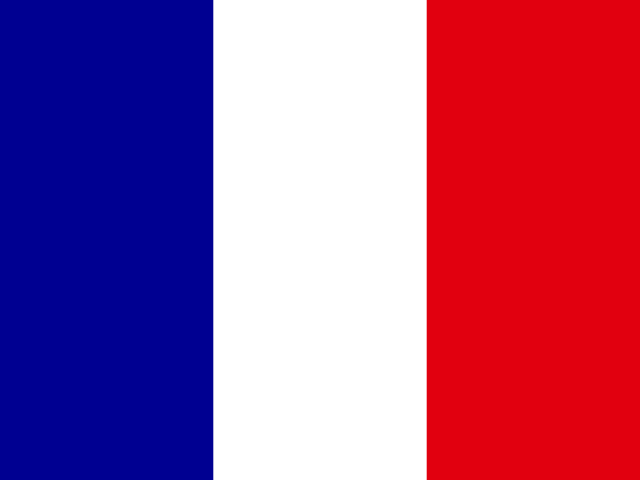
Three vertical bands of blue, white and red. Article 2 of the 1958 constitution names the emblem in nine words and assigns the colours no meaning at all; the Republic's motto is a separate sentence of the same article. The presidency's own account traces white to the king and blue and red to the city of Paris, joined in the 1789 cockade as a sign of alliance between monarch and people.
Source: elysee.fr · conseil-constitutionnel.fr · drapeaux-sfv.org
France FACTS ◢
| Capital | Paris |
|---|---|
| Continent | Europe |
| Population | 68,720,337 (2025) |
| Area | 643,801 km² |
| Population density | 107/km² |
| Currency | Euro (EUR) |
| Official language | French |
| Calling code | +33 |
| Internet TLD | .fr |
| Time zone | UTC+01:00 |
| Drives on the | Right |
| ISO codes | FR / FRA |
DID YOU KNOW? ◢
- It's the most visited country on Earth, drawing more international tourists than any other nation.
- The Louvre in Paris is the world's largest and most-visited art museum, home to the Mona Lisa.
- France produces hundreds of distinct cheeses, and Charles de Gaulle once joked a country with that many was impossible to govern.
- Mont Blanc, on its border with Italy, is the highest mountain in the Alps.
- The metric system was invented in France in the wake of its 1789 Revolution.
France QUICK ANSWERS ◢
What is the capital of France?
The capital of France is Paris.
What is the population of France?
France had a population of 68,720,337 in 2025.
What currency does France use?
France uses the Euro (EUR).
What languages are spoken in France?
The official language of France is French.
Think you know your flags? Play Flag Daily → · Browse all countries →
MORE ON THE FLAG ◢
Look up the French flag in the text that defines it and there is almost nothing there. Article 2 of the constitution of 4 October 1958 says: "L'emblème national est le drapeau tricolore, bleu, blanc, rouge." The national emblem is the tricolour flag, blue, white, red. Nine words in French. No meaning, no shade, no width, and no statement of which colour goes at the staff.
In the Conseil constitutionnel's published text of that constitution, the word drapeau appears exactly once, in that sentence.
Two sentences below it, past the line naming the anthem, comes the one most people are thinking of: "La devise de la République est « Liberté, Égalité, Fraternité »." Two symbols, two sentences, one article. The most repeated claim about this flag, that its colours stand for those three ideas, is a splice of those two lines.
Key Takeaways
- Article 2 of the 1958 constitution defines the flag in nine words and gives the colours no meaning. The motto is a separate sentence in the same article.
- The presidency traces white to the king and blue and red to Paris, joined in a 1789 cockade that stood for an alliance between monarch and people, not for the Revolution's ideals.
- Robespierre proposed in December 1790 that the motto be written on the flags. It was not adopted.
- The colours had no fixed order for more than four years: the cockade was adopted without one in October 1789, and the first naval flag put red at the staff.
- The 1946 constitution required three vertical bands of equal size. The 1958 text dropped the words, and the naval ensign has been unequal since 1838.
- No French text has ever fixed the shade, which is how the blue could be lightened in the 1970s and darkened again around 2020 with no law changing.
What do the colours on the French flag mean?
Nothing in law. Article 2 names the three colours and stops, which makes every confident sentence you have read about them interpretation rather than citation.
There is an official account, and it is an account of where the colours came from rather than of what they stand for. The Élysée describes the tricolour as born of the Revolution from the joining of the colours of the king, white, and of the city of Paris, blue and red. That is the whole assignment: one colour for the monarchy, two for a municipality. A provenance is not a meaning, and the presidency does not offer it as one.
It began as a rosette. The Société française de vexillologie records that Parisian insurgents, the city guard among them, wore cockades of blue and red ribbon on 13 July 1789, those being the colours of Paris, and that a white ribbon was added once word spread that the king was coming to the capital. The same account has the mayor, Bailly, giving the new cockade to Louis XVI on the 17th, and Lafayette making it official for the National Guard on the 31st, with the king ratifying it on 2 August.
The Élysée tells the episode differently, with Lafayette handing Louis XVI a tricolour cockade at the Hôtel de Ville three days after the Bastille fell, and it prefaces the story with on raconte, the French for "it is said". Its account of what the colours signified is quoted from the mayor of the city: a sign of "l'alliance auguste et éternelle entre le monarque et le peuple", the august and eternal alliance between the monarch and the people.
That is close to the opposite of the reading attached to these colours now. It is also as far as the presidency will go. Its page opens by saying the tricolour has not yet found its historian, and that the historical haze around its birth leaves the field to the legends that crown it with poetry.
Where did liberty, equality and fraternity come into it?
Separately, and later. The three words first brush against the flag in a rejection. In a December 1790 speech on the organisation of the national guards, Robespierre proposed that the words "Le Peuple Français" and "Liberté, Égalité, Fraternité" be inscribed on uniforms and on flags. The Élysée records, in one clause, that his plan was not adopted. In the two constitutional texts and the two presidency pages read for this article, that is the only formal proposal to write the motto onto the flag, and it failed.
The motto then travelled its own road. From 1793 Parisians, quickly copied elsewhere, painted their house fronts with "Unité, indivisibilité de la République; liberté égalité ou la mort". The last part of the formula, too closely associated with the Terror, disappeared quickly. The Élysée records the motto falling out of use under the Empire, returning with the Revolution of 1848, which made it a principle of the Republic written into the constitution, and being inscribed on the fronts of public buildings on 14 July 1880. It reached the constitution of 1946 and stayed in 1958.
So the flag and the motto arrive in Article 2 from different directions, and nothing in either constitutional text read here connects one to the other. They are neighbours in a list of symbols, which is a weaker relationship than almost every page about this flag implies.
Why is blue at the staff rather than red?
Because the first design was the other way round, and because for more than four years there was no settled order at all. The Société française de vexillologie records that the cockade was officially adopted on 4 October 1789 sans ordre défini, with no defined order, and that streamers at the Fête de la Fédération of 14 July 1790 ran white, red, blue. The same page gives that Fédération order differently further down, as blue, red, white, which is itself a measure of how unsettled the sequence was. The blue, white, red order came into ceremonial use afterwards as the more harmonious one.
In the autumn of 1790 the Constituent Assembly decided that French warships and merchant ships would fly three vertical bands: red at the staff, white in the centre and wider than the other two, blue outside. The Élysée says the upright arrangement is what distinguished the French flag from the Dutch one, whose red, white and blue had been lying horizontally across every sea for a century already; it does not say the Assembly chose it for that reason. The test still works, and it is the quickest way to tell this flag from the Netherlands.
Sailors disliked a flag that was so largely white. A law of 31 October 1790 gave them a white stern flag carrying that composition in a canton, which did not settle it either.
On 15 February 1794, the 27th of pluviôse in year II, the Convention decreed that the national flag "sera formé des trois couleurs nationales, disposées en bandes verticalement, de manière que le bleu soit attaché à la gaule du pavillon, le blanc au milieu et le rouge flottant dans les airs": formed of the three national colours, arranged in vertical bands, so that the blue is attached to the staff, the white in the middle and the red flying in the air. That text is quoted here from the Élysée's reproduction of it rather than from the original decree, and franceinfo reproduces the same wording independently. It is the form the flag has had ever since, interruptions aside.
Read that sentence for what it does not say. It fixes an order and nothing else: no width, no shade, and no word about the three bands being equal.
Vertical tricolours are ordinary now. Italy and Belgium both fly one.
Do the three bands have to be equal?
Not under the constitution in force, and not at sea since 1838.
Under Louis-Philippe the navy asked for unequal widths for practical reasons of visibility, and in 1838 obtained bands of 30, 33 and 37 parts in 100 for blue, white and red. A Marine regulation of 17 May 1853 confirmed those widths at 0.30, 0.33 and 0.37 of the total length, and the Société française de vexillologie records that the Marine nationale has kept its unequal bands.
The word "equal" enters the constitutional text only in 1946, and leaves it again in 1958. The five texts side by side:
| Text | Date | What it prescribes |
|---|---|---|
| Constituent Assembly decision, as related by the Élysée | Autumn 1790 | Three vertical bands on ships: red at the staff, white in the centre and wider, blue outside |
| Decree of the National Convention, as reproduced by the Élysée | 15 February 1794 | Vertical bands: blue at the staff, white middle, red flying. No width, no shade |
| Marine regulation, as recorded by the Société française de vexillologie | 17 May 1853 | Ensign bands of 0.30, 0.33 and 0.37 of the total length |
| Constitution of the Fourth Republic, Article 2 | 1946 | The tricolour, blue, white, red, "à trois bandes verticales d'égales dimensions" |
| Constitution of the Fifth Republic, Article 2 | 1958 | "L'emblème national est le drapeau tricolore, bleu, blanc, rouge" |
The 1946 wording spelled the geometry out. The 1958 wording kept the colours and dropped it, a change the Société française de vexillologie describes in as many words: the tricolour was confirmed with vertical bands of equal dimensions in 1946, then without any mention of verticality or of dimensions in 1958. So as of August 2026 nothing in the constitution requires the bands of the French flag to be vertical or equal. Equal vertical bands on land are custom carried forward, not prescription.
Even so, the same account carries a cependant, a however, in its next sentence: the Marine nationale keeps its unequal bands all the same. Read against the 1838 widths it gives earlier, that puts the ensign flying off French warships outside the equal-band description for the whole period the constitution carried it.
Has France ever come close to losing the tricolour?
Three times in the accounts read here, and a fourth week in 1848 when Paris flew the colours in the wrong order.
The first was the restored monarchy. The Élysée records that the flag lost its blue and its red from 1814 to 1830, which kept only royal white, and reappeared on the barricades of the Trois Glorieuses on 27, 28 and 29 July 1830, carried as a republican rallying sign against Charles X. Louis-Philippe accepted its return, proclaiming that the nation was taking back its colours; the Société française de vexillologie dates the restoring ordinance to 1 August 1830.
The second was February 1848. When the Republic was proclaimed, insurgents wanted an entirely red flag. Lamartine talked them out of it at the Hôtel de Ville on the 25th, in a speech the Élysée quotes at length, and a compromise on the 26th put a red rosette at the staff instead.
Then came the oddest week in the flag's history. On 28 February 1848 Marc Caussidière, the Republic's delegate at the police department, ordered that a blue, red and white flag be hoisted without delay on public monuments and buildings. The Société française de vexillologie explains the mistake: among the documents he consulted, he had picked the painter David's 1794 project, which it describes as unproven and never carried out. A decree of 5 March and a circular of 7 March put the settled order back.
The third attempt was the Paris Commune's, in the spring of 1871, and it also failed.
Why did the blue on the French flag get darker?
Because a president decided it should, and because no text stands in the way. The flags at the Élysée changed from a bright cobalt to navy. Franceinfo reported it on 14 November 2021, confirming a story from Europe 1, and said the decision had been taken for 14 July 2020; the France 2 evening bulletin of the same date puts the decision on 13 July 2020. The Société française de vexillologie dates the return to the traditional tone, roughly Pantone 282C, to July 2021, which is a date for the change of the flags rather than for the decision behind it. Franceinfo notes that the Élysée never announced the change.
The new blue is the one used by the Marine nationale, and, franceinfo notes, the one the Convention chose in 1794. It replaced a lighter blue introduced by Valéry Giscard d'Estaing, and here the two sources disagree again. Franceinfo puts that change in 1976 and notes that the blue thereby moved closer to the European flag's; the France 2 bulletin gives that as the reason for it. The Société française de vexillologie puts the change in May or June 1974, gives the lightened blue as roughly Pantone 286C and a brighter red as roughly Pantone 185C, and gives the reason as making the flag more legible, or more telegenic.
None of it needed a legal act, because the shade of the colours, as the Société française de vexillologie states, has never been specified in any text. In the France 2 report the historian Jean Garrigues put the change down to the privileges of a presidency he describes as a sort of republican monarchy. There was no war of the blues in it, the president's circle told franceinfo.
Frequently asked questions
Does the French constitution say what the colours mean?
No. Article 2 of the constitution of 4 October 1958 reads "L'emblème national est le drapeau tricolore, bleu, blanc, rouge" and adds nothing: no meaning, no shade, no proportion, not even which colour goes at the staff. The motto is a separate sentence in the same article, two sentences further down.
In the Conseil constitutionnel's published French text the word drapeau appears once. In the Constitute Project's English text of the same constitution, "flag" appears only in Article 2.
Who designed the French tricolour?
Nobody has proved it. The Élysée presents the painter Louis David's role as legend, and the Société française de vexillologie treats a David design of 1794 as unproven and never made. Franceinfo, reporting the change of blue in November 2021, states flatly that the flag was drawn by the painter Jacques-Louis David, which is the assertion the presidency itself declines to make.
The unrealised David project did fly once, by accident. A police official reached for it in February 1848 and Paris flew blue, red and white for about a week.
Has the order of the colours ever changed?
Yes. The cockade was officially adopted in October 1789 with no defined order, the naval flag of 1790 put red at the staff, and the Convention reversed it on 15 February 1794. A police order of 28 February 1848 then sent a blue, red and white flag up on public buildings, until a decree of 5 March restored the settled order.
What is the difference between the French and Dutch flags?
The axis. France sets blue, white and red in vertical bands; the Netherlands sets red, white and blue in horizontal ones. The Constituent Assembly settled on the vertical layout for French ships in 1790, and the Élysée says that upright arrangement is what distinguished them from Dutch ones, which had been flying those colours horizontally for a century.
Is there an official shade of blue for the French flag?
No. The Société française de vexillologie states that the shade has never been specified in any French text, which is how it could move twice in about fifty years with no law changing: lightened under Giscard d'Estaing towards the European flag's blue, then returned to navy under Macron.
The sources differ on the dates. Franceinfo gives 1976 for the lightening and the Société française de vexillologie gives May or June 1974. For the return, franceinfo and France 2 date the decision to July 2020, while the Société française de vexillologie dates the change of the presidency's flags themselves to July 2021.
Sources
- Conseil constitutionnel, Constitution du 4 octobre 1958, texte en vigueur - retrieved 14 August 2026.
- Conseil constitutionnel, Constitution de 1946, IVe République - retrieved 14 August 2026.
- Constitute Project, France 2008, Article 2 in English - retrieved 14 August 2026.
- Présidence de la République, Le drapeau français - retrieved 14 August 2026.
- Présidence de la République, Liberté, Égalité, Fraternité - retrieved 14 August 2026.
- Société française de vexillologie, Histoire du drapeau français - retrieved 14 August 2026.
- Franceinfo, Macron a changé la couleur bleue du drapeau tricolore de l'Élysée, 14 November 2021 - retrieved 14 August 2026.
- France 2 via franceinfo, Élysée: pourquoi Emmanuel Macron a changé le bleu du drapeau, 14 November 2021 - retrieved 14 August 2026.
PLAY ANOTHER →
A short message, hidden in a different cipher every day.
ONE CIPHER A DAYDAILYOn This DayOne thing that happened today in history. Every day, a new one.
TODAY IN HISTORYDAILYDaily CryptogramOne quote, one scrambled alphabet. Crack it before tomorrow.
CRACK THE QUOTEDAILYDaily TriviaFive questions a day. Everyone gets the same five.
FIVE QUESTIONS