
Belgium
A small, densely packed country that punches absurdly above its weight in chocolate, beer and bureaucracy. Belgium is the de facto capital of the European Union and takes its fries very seriously.
WHAT THE FLAG MEANS ◢
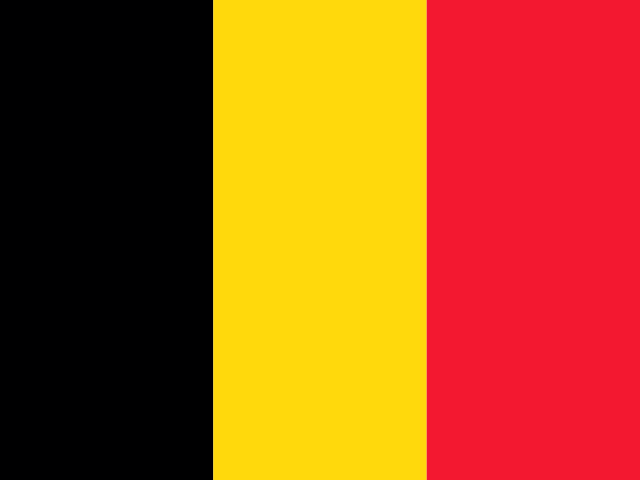
Three equal vertical bands of black, yellow and red. The colours are taken from the arms of the Duchy of Brabant - a gold lion with red claws and tongue on a black shield.
Source: focusonbelgium.be
Belgium FACTS ◢
| Capital | Brussels |
|---|---|
| Continent | Europe |
| Population | 11,941,781 (2025) |
| Area | 30,688 km² |
| Population density | 389/km² |
| Currency | Euro (EUR) |
| Official languages | Dutch, French, German |
| Calling code | +32 |
| Internet TLD | .be |
| Time zone | UTC+01:00 |
| Drives on the | Right |
| ISO codes | BE / BEL |
DID YOU KNOW? ◢
- Brussels hosts the headquarters of the European Union and NATO, making it a political capital of the continent.
- Belgium has produced hundreds of distinct beer styles, and its beer culture is recognised by UNESCO.
- The Belgian coast runs a single tram line over 65 km, one of the longest tram routes in the world.
- The saxophone was invented by a Belgian, Adolphe Sax, in the 1840s.
- It went a record 589 days without an elected government between 2010 and 2011.
Belgium QUICK ANSWERS ◢
What is the capital of Belgium?
The capital of Belgium is Brussels.
What is the population of Belgium?
Belgium had a population of 11,941,781 in 2025.
What currency does Belgium use?
Belgium uses the Euro (EUR).
What languages are spoken in Belgium?
The official languages of Belgium are Dutch, French and German.
Think you know your flags? Play Flag Daily → · Browse all countries →
MORE ON THE FLAG ◢
The three colours of the Belgian flag are not three ideas. They are one coat of arms pulled apart into stripes.
The shield is that of the old Duchy of Brabant, and insurgents were flying its three colours four decades before there was a Belgium.
That leaves a stranger question with a documented answer. Article 193 of the Constitution names the national colours in the order red, yellow, black. The flag flies black, yellow, red.
Key Takeaways
- Black is the Brabant shield, yellow the lion on it, red the lion's claws and tongue. One device, three stripes.
- No Belgian legal text gives the colours separate meanings. The Constitution names them and stops.
- Article 193 lists them red, yellow, black. The sentence has survived from 1831 with only capitals and a plural altered; the flag has flown the other way round since later that year.
- The stripes were horizontal in 1830. A decree of 23 January 1831 turned them vertical, in an article about the merchant flag, though horizontal flags went on flying for years.
- The official proportions are 13:15, close to square, and come from protocol dimensions, not a statute.
Where do the Belgian flag's colours come from?
From heraldry, and from one shield in particular.
Belgium.be, the federal portal run by the Chancellery of the Prime Minister, gives the derivation in a line: the flag's colours are those of the escutcheon of the old Duchy of Brabant, "un lion d'or (jaune) sur fond de sable (noir)", a gold lion on a black field. Focus on Belgium, the federal foreign ministry's magazine, completes the blazon: the lion is "armé (griffes) et lampassé (langue) de gueules", armed and langued in red. Armed is the claws, langued the tongue.
The Royal Palace puts it without the vocabulary: "These are the colours of the heraldry of the Duke of Brabant".
So each stripe is part of one medieval device, not a symbol in its own right. Focus on Belgium dates the colours' first outing to the Brabant Revolution against Austrian rule, 1789-1790.
Do black, yellow and red stand for anything?
Not in law, which is worth saying plainly, because plenty of pages say otherwise.
Article 193, in the Chamber of Representatives' official English text, reads in full: "The Belgian Nation adopts red, yellow and black colours, and as arms of the kingdom the Lion of Belgium with the motto: UNION IS STRENGTH." That is the whole provision: three colours, an animal and a motto, and no meaning attached to any colour.
Readings do exist, and the government page publishing one also dates it. Focus on Belgium writes that the events of 1830 "ont changé la signification des couleurs" (changed what the colours meant). Black, it goes on, "a fini par représenter" (ended up representing) the sacrifice of those who fought for independence, yellow the nation's wealth, and red the blood they shed.
Ended up representing is not the same as was chosen to represent. On the state's own account, the meanings arrived after the flag did.
Why does the Constitution list the colours the other way round?
Because the text was written in February 1831, the flag was settled in practice later that year, and the text was never brought along.
The Belgian Official Gazette's legal database holds both versions. The Constitution of 7 February 1831 put the colours in article 125, under Titre VI, Dispositions générales: "La Nation Belge adopte les couleurs rouge, jaune et noire." The coordination of 17 February 1994 renumbered it 193 and changed five things, all of them capitals or a plural: Nation Belge to Nation belge, royaume to Royaume, lion belgique to Lion Belgique, arme to armes, and the motto to full capitals.
Neither version says which colour goes against the pole. Departments settled that, not Parliament: Flags of the World records the Navy putting black at the hoist, yellow in the middle and red at the fly on 15 September 1831, and the Interior repeating it on 12 October. Focus on Belgium notes that this was done "sans pour autant modifier la Constitution" (without amending the Constitution). Its conclusion is that Belgians are "sans doute les seuls" (probably the only people) who do not follow the colour order their own founding act sets out.
Whether the article was ever meant as a hoist-to-fly sequence is argued. Karel Rimanque, a constitutional lawyer at the University of Antwerp, told De Standaard in 1999, in a passage Flags of the World translates, that in 1830 a flag was described starting from the pole, so the list is an order and the flag is reversed. Either the article should be corrected or the flag should be, he said. Neither has happened.
When did the stripes turn vertical?
They were horizontal first, and the change took years to stick.
Focus on Belgium dates the first Belgian tricolour to 26 August 1830, when the journalist Édouard Ducpétiaux replaced a French tricolour with a red, yellow and black one sewn by Marie Abts-Ermens. Its bands ran horizontally, as did those of the flag the Provisional Government adopted that 30 September, mid-revolt against the Netherlands.
The decree that turned them through ninety degrees was not, on its face, about the national flag. Flags of the World reproduces the Provisional Government's decision of 23 January 1831, whose recital says it is time to settle the merchant flag. Article 1 then reads: "The Belgian merchant flag is red, yellow, and black. These colours are placed vertically." No reason is given for the ninety degrees.
Adoption was untidy. The same page cites Roger Harmignies, who in a study of the honour flags of 1830 found horizontal and vertical flags flying side by side for years, the last official horizontal ones in Brussels on 24 September 1838.
Why is the Belgian flag almost square?
Because its official proportions are 13:15, closer to square than almost any other national flag.
The number comes from a pair of dimensions rather than a ratio anybody chose. Flags of the World credits the vexillologist Michel Lupant with tracing an official flag of 2.60 metres high by 3.00 metres wide to a nineteenth-century directive of the Belgian Ministry of Foreign Affairs, which he could not date. 260 to 300 reduces to 13:15. The Constitution says nothing about proportions and no decree fixing the ratio has surfaced, so it is a protocol dimension that hardened into a specification.
You will rarely see it. Nearly every Belgian flag flown is the ordinary 2:3, and the royal palaces, often named as the one place the official ratio survives, are not an example of it: a letter from the Commander of the Royal Palaces gives the flag over the Brussels palace as 4 by 3 metres and the one over Laeken as 3.2 by 2.4. Both are taller than they are wide, which 13:15 is not. The first official drawing of the vertical flag, in 1831, was a third thing again.
Four ratios circulate, then, all recorded by Flags of the World, and only the first is official:
| Ratio (height:width) | Where it applies |
|---|---|
| 13:15 | the official flag, 2.60 m by 3.00 m |
| 2:3 | nearly every flag actually flown, public and private |
| 4:3 | the palace flags, 4 m by 3 m at Brussels and 3.2 by 2.4 at Laeken |
| 3:4 | the first official drawing of the vertical flag, 1831 |
If you want to see how much of that sticks under pressure, Flag Daily gives you one flag a day and three guesses.
Frequently asked questions
What do the colours on the Belgian flag mean?
Officially, nothing individually. The black, yellow and red come from the arms of the Duchy of Brabant, a gold lion with red claws and tongue on a black shield, so each stripe is part of one heraldic device rather than a symbol of its own. Article 193 of the Constitution names the three colours and gives them no meanings.
Why does the Belgian Constitution say red, yellow and black?
Because it has said so since 1831, and nothing but capitals and one plural has changed since. The colours entered the Constitution of 7 February 1831 as article 125, in that order, and the same sentence is now article 193. Black went to the hoist later in 1831, on departmental instructions from the Navy and the Interior, neither of which touched the constitutional text.
What is the ratio of the Belgian flag?
Officially 13:15, from a flag 2.60 metres high by 3.00 metres wide, which makes it nearly square. No decree fixes it; the dimensions trace to a nineteenth-century Ministry of Foreign Affairs directive. Most Belgian flags flown are the ordinary 2:3.
How do you tell the Belgian flag from the German one?
By the direction of the stripes. Belgium's run vertically, black at the pole; Germany's run horizontally, black on top, then red, then gold. They share a colour family and nothing else, so the axis settles it at any distance.
What is the motto on Belgium's coat of arms?
It sits in Article 193 beside the Lion of Belgium, where the coordinated French text prints "L'UNION FAIT LA FORCE" and the Chamber's official English translation gives "UNION IS STRENGTH". The Royal Palace lists the three national languages as "l'union fait la force", "Eendracht maakt macht" and "Einigkeit macht stark", and translates them "unity makes strength".
Sources
All retrieved 12 August 2026.
- Belgian Official Gazette, Justel database: La Constitution coordonnée, 17 February 1994, Titre VII, article 193, and Constitution de la Belgique, 7 February 1831, Titre VI, article 125.
- Belgian Chamber of Representatives, The Belgian Constitution, official English text, Article 193.
- Belgium.be, FPS Chancellery of the Prime Minister, Drapeaux: the Brabant escutcheon.
- FPS Foreign Affairs, Focus on Belgium, Quelle est l'origine de notre drapeau tricolore ?: the blazon, 1789-1790, 1830, the colour readings, the unamended article.
- The Belgian Monarchy, Symbols: the arms of the Duke of Brabant and the motto.
- Flags of the World, Belgium: the 1831 decree, the departmental instructions, Lupant, Harmignies, the palace letter, Rimanque via De Standaard. Every claim it carries is attributed to it in the body, because it is the only non-government source here and it gets adjacent facts wrong: it dates the 1831 Constitution to 4 February and numbers the colours article 124, where the Official Gazette gives 7 February and 125.
PLAY ANOTHER →
A short message, hidden in a different cipher every day.
ONE CIPHER A DAYDAILYOn This DayOne thing that happened today in history. Every day, a new one.
TODAY IN HISTORYDAILYDaily TriviaFive questions a day. Everyone gets the same five.
FIVE QUESTIONSDAILYDaily CryptogramOne quote, one scrambled alphabet. Crack it before tomorrow.
CRACK THE QUOTE