
Kingdom of the Netherlands
A country that argued with the sea and won, reclaiming a sixth of its land from the water. The Netherlands runs on bicycles, canals and an unshakeable belief that flat is beautiful.
WHAT THE FLAG MEANS ◢
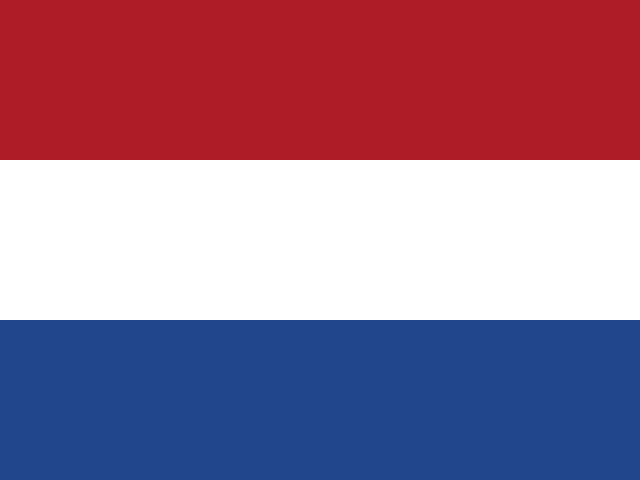
Three horizontal bands of red, white and blue, flown as the national flag in one form or another since the sixteenth-century revolt against Spain. A royal decree of 1937 fixes only that its colours are red, white and blue, and assigns them no meaning; the constitution says nothing about the flag at all. An orange, white and blue form of the flag was flown alongside the red one for generations; whether either descends from the other, and why the red form prevailed, have never been agreed.
Kingdom of the Netherlands FACTS ◢
| Capital | Amsterdam |
|---|---|
| Continent | Europe |
| Population | 18,087,633 (2025) |
| Area | 41,543 km² |
| Population density | 435/km² |
| Currency | Euro (EUR) |
| Official language | Dutch |
| Calling code | +31 |
| Internet TLD | .nl |
| Time zone | UTC+01:00 |
| Drives on the | Right |
| ISO codes | NL / NLD |
DID YOU KNOW? ◢
- About a quarter of the country sits below sea level, kept dry by an elaborate system of dikes and pumps.
- Amsterdam is the constitutional capital, but the government and royal family are based in The Hague.
- It's one of the flattest countries on Earth, with its highest point barely reaching 322 metres.
- There are more bicycles in the country than people.
- It's the world's second-largest exporter of agricultural goods despite its small size.
Kingdom of the Netherlands QUICK ANSWERS ◢
What is the capital of the Kingdom of the Netherlands?
The capital of the Kingdom of the Netherlands is Amsterdam.
What is the population of the Kingdom of the Netherlands?
The Kingdom of the Netherlands had a population of 18,087,633 in 2025.
What currency does the Kingdom of the Netherlands use?
The Kingdom of the Netherlands uses the Euro (EUR).
What languages are spoken in the Kingdom of the Netherlands?
The official language of the Kingdom of the Netherlands is Dutch.
Think you know your flags? Play Flag Daily → · Browse all countries →
MORE ON THE FLAG ◢
It is easy to write that no formal meaning is assigned to the Dutch flag's colours. What is startling is how little the document that fixes them says about anything at all.
The whole of its decision is one sentence: "De kleuren van de vlag van het Koninkrijk der Nederlanden zijn rood, wit en blauw." The colours of the flag of the Kingdom of the Netherlands are red, white and blue. That is Royal Decree no. 93 of 19 February 1937, dated at Zell am See in the Austrian Alps, where Queen Wilhelmina was spending a winter holiday, and it is still the only instrument that fixes any part of the flag's appearance.
It does not say what the colours stand for. It does not say how many bands there are, which order they run in, or how wide the flag should be. The Dutch government said exactly that three months later, and then spent almost fifteen years failing to pass the law that would have said the rest.
Key Takeaways
- Royal Decree no. 93 of 19 February 1937 fixes only that the colours are red, white and blue. It assigns them no meaning.
- The Dutch constitution contains no flag provision at all: the Dutch word for flag, vlag, does not appear in it once.
- The government's own 1937 memorandum called the decree provisional and said the Dutch flag had still not been legally established.
- The bill that would have fixed the bands, the proportions and the exact shades was introduced in May 1937 and withdrawn on 9 January 1952 without ever reaching a vote.
- The government and the Tweede Kamer's committee published flatly opposed accounts of how orange became red, six months apart in 1937, and neither was ever withdrawn.
| Instrument | Date | What it fixes | What it says the colours mean |
|---|---|---|---|
| Resolution of the States-General of the United Netherlands | 14 February 1796 | Three parallel horizontal bands of equal width, red over white over blue | Nothing |
| Law of 7 August 1806 and royal decree of 21 September 1806 | 1806 | That the former flag of the State is kept | Nothing |
| Royal Decree no. 93 | 19 February 1937 | That the colours of the flag of the Kingdom are red, white and blue | Nothing |
| Bill 456, withdrawn 9 January 1952 | 1937 to 1952 | Would have fixed the bands and a 3:2 rectangle, and provided for the shades | Nothing, and it was never enacted |
| Statuut voor het Koninkrijk, article 3 | in force | That the flag is an affair of the Kingdom | Nothing, and it does not describe the flag |
| Grondwet | in force | Nothing. It has no flag provision | Nothing |
What does the 1937 decree actually say?
It decides one thing, and the government itself has printed that sentence. The memorandum of May 1937 renders it verbatim, citing "het Koninklijk besluit van 19 Februari 1937, n°. 93, waarbij werd bepaald, dat de kleuren van de vlag van het Koninkrijk der Nederlanden zijn rood, wit en blauw", the royal decree of 19 February 1937, no. 93, by which it was determined that the colours of the flag of the Kingdom of the Netherlands are red, white and blue. That is an official document, printed three months later, and it is what the wording quoted here rests on.
No scan of the Staatscourant of 24 February 1937 could be reached for this article, so the rest of the decree is quoted from the press, which the memorandum confirms word for word on the sentence that matters. It went into the Staatscourant in the evening edition of the 24th, and four Dutch papers reprinted the text in full across the 24th and the 25th, agreeing with one another throughout. In the Netherlands Indies the same decision arrived as a short Aneta wire report, in four papers within two days, and one of those, the Deli courant, misdated the decree to 12 February.
The decree itself opens with Wilhelmina's style. It records that it comes on the proposal, dated 5 February 1937, of the Minister of State, Minister of Colonies and Chairman of the Council of Ministers. Then it decides one thing, in the one sentence naming red, white and blue.
Everything after that is machinery. The ministers who head departments of general administration are charged with executing the decree, which is to be placed in the Staatscourant. Then the place and date, and the signature.
The place is the one thing the four reprints do not agree on, because the OCR of every one of them damages it: they read Zeil am Sec, Zei am See, Zeil am See and Zeil aan See. Zell am See is a reconstruction from those four. It is also the spelling the Dutch press used, elsewhere and cleanly, for the Austrian resort the Queen was staying at from her arrival on 30 January 1937 until her departure on the morning of 22 February.
Three weeks later the Minister of Finance sent a copy to the Tweede Kamer. The record of the sitting of 10 March 1937 lists it among the incoming papers and notes that it was taken for information. There was no debate, because a royal decree does not need one.
Nothing has superseded the decree since, and the government still cites it. Explaining a 2017 bill on the nationality of seagoing vessels, the ministry noted that various Dutch statutes say the Nederlandse vlag while the official name is de vlag van het Koninkrijk der Nederlanden, and gave the decree as its authority for that: "Dit blijkt uit het koninklijk besluit van 19 februari 1937, nr. 93, waarin is bepaald dat rood, wit en blauw de kleuren zijn van de vlag van het Koninkrijk." This appears from the royal decree of 19 February 1937, no. 93, in which it is determined that red, white and blue are the colours of the flag of the Kingdom. Eighty years on, what the government reaches for the decree to settle is the flag's name.
That matters because a great deal has since been hung on this document. The Royal House's own page states that in 1937 the flag was established by royal decree, and continues: "Hierin zijn de drie kleuren van de vlag omschreven: helder vermiljoen (rood), helder wit en kobaltblauw." In it the three colours of the flag are described, as bright vermilion for the red, bright white, and cobalt blue. The decree contains none of those words.
Why did the Netherlands need a decree in 1937?
Because until that February it was unclear whether the country had ever settled in law what its flag looked like.
The government explained this itself in the memorandum accompanying the flag bill it introduced three months afterwards. Before the decree, it wrote, it was highly doubtful whether any valid provision existed at all concerning the appearance of the national flag. The last express fixing had been in 1806, in the law of 7 August of that year and the royal decree of 21 September 1806, both of which simply preserved the flag that the States-General of the United Netherlands had set on 14 February 1796.
The 1796 resolution is the oldest text in this story that describes the thing rather than just naming colours. It declared that the national flag of this State would from then on be "de gewoone en altoos in gebruik geweest zijnde Bataafsche of zoogenaamde Hollandsche Vlag", the usual and always-in-use Batavian or so-called Hollandsche flag, consisting of "drie evenwijdige en horizontaale Banden, van gelijke breedte", three parallel and horizontal bands of equal width, of which the top one is red, the middle white or uncoloured, and the bottom one blue.
Then the 1806 arrangement ceased to have force in 1810, when the Kingdom of Holland was absorbed into the French Empire. Whether it revived on independence in 1813 has been argued both ways, and the government was blunt about where it stood: the very fact that it had gone to the trouble of procuring the 1937 decree, it said, shows it did not find the revival argument plausible.
So the decree was a patch on a gap that had been open for 127 years. And the government was equally blunt about how small a patch it was: "Overigens bevat dit besluit alleen een voorloopige voorziening ten aanzien van de kleuren van de nationale vlag, omtrent haar verdere kenmerken bepaalt het niets." The decree contains only a provisional provision as to the colours of the national flag. About its further characteristics it determines nothing.
The next sentence is the one worth keeping. "Men kan dus ook thans nog niet volhouden, dat de Nederlandsche vlag rechtens is vastgesteld." So one cannot maintain even now that the Dutch flag has been legally established.
That is the Dutch government describing its own decree, three months after issuing it.
So do red, white and blue stand for anything?
Not officially, and the search is short because there is so little to search.
The decree assigns no meaning. The constitution assigns none and cannot, because it has no flag provision: a search of the consolidated text of the Grondwet for the Dutch word for flag returns nothing whatsoever. The Charter for the Kingdom does mention the flag, in article 3, first paragraph, which lists among the affairs of the Kingdom "de regeling van de ridderorden, alsmede van de vlag en het wapen van het Koninkrijk", the regulation of the orders of knighthood and of the flag and coat of arms of the Kingdom. That makes the flag a matter for the Kingdom as a whole rather than for the Netherlands alone. It does not describe it, and it does not interpret it.
The bill meant to fill the gap assigned no meanings either. Its article 1 would have described three horizontal bands, red over white over blue, in a rectangle whose length stands to its height as three to two, with the three bands of equal width, and left the exact shades to a later order in council. Ten articles, and not one of them says what a colour is for.
What the Dutch state does offer is an account of where the colours came from, which is a different question. The Royal House traces the white and the blue to the livery colours of the Principality of Orange, and the orange to the principality itself. The red is not among them; the page accounts for the red separately, by the story that orange showed badly at sea. Either way that is an origin rather than a symbolism, and the page leaves it as one.
Readings of the meaning do circulate, in guidebooks and flag lore. None of them appears in any Dutch state source read for this article. What the Dutch flag means, on the evidence, is red, white and blue, and the country has been comfortable with that for nearly ninety years.
Was the Dutch flag orange before it was red?
Here the story is contested, and most short accounts quietly pick a side.
The familiar version says the flag began as orange, white and blue, the Prinsenvlag of the revolt against Spain, and that orange gave way to red because the dye was unstable or because orange showed badly at sea. The Royal House's page carries the sea-visibility explanation and is careful to label it: "Het verhaal gaat dat het oranje op zee minder goed zichtbaar was." The story goes that orange was less clearly visible at sea.
The Dutch government's 1937 memorandum tells it differently. The tricolour, it says, has been used as the national flag since the revolt of the Netherlands against Spanish rule. At first it showed orange, white and blue, "doch zeer waarschijnlijk al dadelijk daarnaast ook rood, wit en blauw", but very probably red, white and blue alongside it from the very start.
That distinction is easy to miss and it changes everything. The government was not describing a red flag descended from an orange one. It was describing two colour forms of one flag running in parallel: "Zij moeten beschouwd worden als variëteiten van eenzelfde vlag, die als Prinsevlag werd aangeduid." They must be regarded as varieties of one and the same flag, the one that was called the Prinsevlag, which is how the memorandum spells it, dropping the n of Prinsenvlag. The difference in colours, it added, did not change what the flag meant.
On timing it is specific: "sedert ongeveer 1630 krijgt het rood bepaaldelijk de overhand, niet lang daarna is het oranje geheel verdwenen." From about 1630 red decidedly gains the upper hand, and not long after that orange has vanished entirely.
On cause it declines to be specific at all: "Wat van dit verschijnsel de oorzaak is geweest, is onzeker". What caused this phenomenon is uncertain. Purely practical reasons are probable, the memorandum says, and then it knocks down the political explanation: "Bepaaldelijk onhoudbaar is de theorie gebleken, dat de verdwijning van het oranje in de vlag een gevolg zou zijn geweest van anti-stadhouderlijke gezindheid." The theory that orange disappeared from the flag as a consequence of anti-stadholder sentiment has proved definitely untenable.
The memorandum does not stop at not knowing, and the part usually left out is the part where the government decides. It records that a number of Dutch people would prefer "de kleuren oranje, wit en eventueel lichter blauw", the colours orange, white and possibly a lighter blue, and says it can find in that no occasion whatever to propose a flag of that combination. What it calls decisive is length of use: whatever the flag's origin and its early changeable colours, "het rood, wit en blauw gedurende ongeveer 300 jaren practisch de nationale vlag is geweest", the red, white and blue has been practically the national flag for about 300 years, and is besides the flag of the tradition of the generation now living.
Then one sentence closes it. "Bij dezen stand van zaken ziet de Regeering geenerlei aanleiding om voor te stellen de Nederlandsche vlag te veranderen." With matters standing so, the Government sees no occasion whatever to propose changing the Dutch flag.
So the state's position is that the two flags were always one flag, that red won around 1630, that nobody knows why, and that three hundred years of use are reason enough to leave it alone.
The Tweede Kamer committee's reply on orange and red, December 1937
The Tweede Kamer's committee took that half-page of history apart, and its report is by a wide margin the most heavily documented thing anyone in this story wrote.
No political party is named anywhere in the report's three pages, and no Dutch state source read for this article supplies the party politics behind the bill. The members supply their own frame. Some opposed the bill outright, holding that only the Crown and the people may decide about the flag. Others asked why the representative bodies of the overseas territories had not been consulted on a bill that closely concerned them, and then asked the government whether it knew "welke motieven het vorige Kabinet hebben bewogen het ontwerp vlak vóór de verkiezingen", what motives had moved the previous Cabinet to bring the bill forward just before the elections, at which that Cabinet would be placing its portfolios at the Queen's disposal. So the timing was queried on the report's first page, before a word of the history was argued.
The committee then began by measuring the government's argument. "Van de ruim 4 bladzijden is slechts ongeveer een halve bladzijde (blz. 3, tweede en derde alinea) gewijd aan de kernvraag: zullen oranje, wit, blauw dan wel rood, wit, blauw de kleuren van de Nederlandsche vlag zijn." Of the four-and-a-bit pages, only about half a page is devoted to the core question of which three colours the Dutch flag's are. The facts the memorandum had presented as settled arrived, the committee noted, "zonder dat een zweem van bewijs wordt aangevoerd of verwezen wordt naar onderzoekingen van historici", without a shred of evidence being adduced or any reference to historians' research, and with not so much as a mention of the literature.
Then it supplied the literature: Fruin, the state archivist De Jonge, the Utrecht archivist Vermeulen, and De Waard, whom the committee called the most detailed and best documented writer on the flag.
Against the varieties-of-one-flag reading, its objection was structural. Nowhere in the world, the members pointed out, has an orange variety ever developed out of a red flag, "noch omgekeerd", nor the other way round. For the Dutch case they had a different explanation, from Cleirac's Les us et coutumes de la mer, first published in 1634 and in a third edition in 1671: the United Provinces reduced their flag to three bands and put the orange in place of the red "ter eere en uit liefde voor den Prins van Oranje", in honour of and out of love for the Prince of Orange.
Against the date, they counted. "Vóór 1630 wordt er maar éénmaal rood, wit, blauw vermeld", before 1630 red, white and blue is mentioned only once, and on that occasion the flag had to be changed to orange, white and blue on the instruction of the admiral of Holland. Orange, white and blue is recorded very many times between 1572 and 1630.
And they kept counting past 1630. In 1655 or 1656 the Amsterdam admiralty was still ordering its captains, to avoid confusion and disorder, to fly nothing but the admiralty's own flag or the ordinary colours of the generality, orange, white and blue. In 1653 Cromwell was told that the Dutch were everywhere flying "orange, white and blue" in defiance of the regent government, and that children paraded in The Hague in those colours. In 1689 a vice-admiral's ship needed fifty ells of orange-white-blue ribbon.
The memorandum had cited nothing, so the committee supplied the documents on its behalf and then took them away again. The proof-texts, it wrote, "waarop gaarne een beroep wordt gedaan, wanneer men rood, wit, blauw als opvolger of variant van oranje, wit, blauw wil voorstellen", which are readily appealed to when one wants to present red, white and blue as the successor or variant of orange, white and blue, are an account of 1630 for a delivery on behalf of captain Bastiaan Thijssen and a small fragment of an Indies purchase order of 1634.
The 1634 order got the sharpest treatment. It is named only by an anonymous contributor to a supplement of the journal De Navorscher in 1855, the committee wrote, and "dit stuk is nooit door een historicus gecontroleerd", this document has never been checked by a historian. It is worth being clear that the government had not put the 1634 order forward. It put nothing forward, which is the complaint.
The conclusion: the foregoing suffices to show "dat het oranje allerminst kort na 1630 uit de vlag is verdwenen", that orange did not by any means disappear from the flag shortly after 1630.
Orange had a practical argument behind it as well, and it is the one a reader today will recognise. It would tell the Dutch flag apart from other nations' flags more easily, the members said, "zooals b.v. de Fransche, die aanhoudend met de onze verward wordt", such as the French, which is constantly confused with ours. Another flag has the same three colours in the same order today, with a lighter blue: Luxembourg's.
Other members had heard enough. "Aan een vlaggenstrijd hebben wij in dit tijdsgewricht minder dan ooit behoefte." A flag war is the last thing we need at this juncture. The report was adopted on 2 December 1937.
So the question has an official answer and a documented objection to it, printed in the same series of parliamentary papers six months apart, dated 22 May and 2 December 1937, with neither ever withdrawn. If you have noticed that nobody will tell you flatly when Dutch orange became Dutch red, that is why.
The Netherlands flag bill that was withdrawn in 1952
The bill all of this was written about never became law, and the way it ended is the strangest thing in the file.
Wilhelmina sent it to the Tweede Kamer from Het Loo on 22 May 1937. It ran to ten articles. It would have fixed the bands and the 3:2 rectangle, left the precise shades to an order in council, allowed rules to be made about flying an orange pennant with the flag, and made it an offence punishable by a fine of up to a hundred and fifty guilders to fly a flag matching the general description but altered in shape or model, or by additions.
That last provision had a specific target. Some years earlier, the memorandum records, serious offence had been caused both at home and abroad when a Dutch flag was flown with an advertising slogan across the white band.
One thing the bill deliberately did not do was outlaw the orange, white and blue. Flags that are not red, white and blue fell outside its scope entirely, the memorandum explained, and so "Hieruit volgt, dat deze laatste nimmer als een onwettige zal kunnen worden beschouwd." It follows that the latter can never be regarded as unlawful.
After the committee's report of December 1937, the government never replied to it. The withdrawal letter of 1952 lists every paper printed in the dossier, and the list runs to the bill and its memorandum, the committee's report, and two bare covers. No reply was ever printed, and members of the Eerste Kamer were still saying so in 1960. Reporting that chamber's voorlopig verslag on the Algemene Zaken budget, a parliamentary correspondent attributed the point to "een aantal Eerste-Kamerleden", a number of members rather than the chamber, and set out their account of the 1937 bill and the Tweede Kamer's report on it: "De regering heeft er nimmer op geantwoord en in 1952 werd het wetsontwerp ingetrokken", the government never answered it and in 1952 the bill was withdrawn.
The bill moved from session to session under a new number each time, so one file appears in the sources below under three different numbers. The withdrawal letter's own header note lists the sequence: 456 in the session of 1936 to 1937, 150 in 1937 to 1938, then 34 and 54 in the two sessions after that, each of those only a cover. By the time it was withdrawn it was 45. It survived the war on the books, until on 9 January 1952 the Minister of Justice wrote to the Speaker that "ingevolge machtiging van Hare Majesteit de Koningin, intrek het ontwerp van wet", by authorisation of Her Majesty the Queen, he was withdrawing the bill. He signed it H. Mulderije. Fourteen years and seven months after it was introduced, it went away without a vote.
When those members pressed for a replacement in 1960, the government's written answer called the 1937 decree the "summiere regeling", the summary arrangement, and said the need for a statutory settlement had not been generally recognised. The Dutch government still says the same thing today, in plainer language: "Nederland kent geen wettelijke regels voor het gebruik van de vlag." The Netherlands has no statutory rules for the use of the flag.
Where bright vermilion and cobalt blue come from
The Royal House gives the shades as helder vermiljoen and kobaltblauw. If the decree does not name them, where does that specification come from?
Not from the decree, and the government's memorandum makes clear they could not have. Commenting on article 1 of its own draft bill, the memorandum said that the words there for red, white and blue cover "alle tinten, welke het gewone spraakgebruik onder die aanduidingen begrijpt", all shades that ordinary usage understands by those terms. Pinning down the correct tints, it went on, was a technical question best left to an order in council. That order in council was never made, because the bill it belonged to was never passed.
What did happen was standardisation. A column in the newspaper Trouw of 13 June 1958 sets out a colorimetric formula for the flag, specifying the red as bright vermilion and the blue as cobalt blue by their trichromatic coordinates under a defined light source, and credits the formula to the Hoofdcommissie voor de Normalisatie in Nederland, the country's standards committee. By 1970 the same two colour names were reaching the public through a flag manufacturer's guidelines, alongside the note that no rules exist about the flag's dimensions, only about its proportions.
The 1958 piece is a newspaper column rather than a standard, and the standard itself could not be obtained for this article. And the column's own attribution is demonstrably unreliable: it credits the formula's official status to a royal decree of 19 December 1937 numbered 93, a date that cannot be right, since decree no. 93 is of 19 February.
What can be said with confidence is narrower than the colour names themselves, and more interesting. The only attribution found for the formula credits a standards committee rather than the Crown, and it comes from a column that misdates the decree by ten months. The state page that credits the shades to the 1937 decree is crediting a document that does not contain them.
The flag instruction, and the four days of the orange pennant
In law, nobody decides when the Dutch flag flies. "Er is geen wet die vlaggen verbiedt of bepaalt hoe u moet vlaggen", there is no law forbidding the flying of flags or determining how you must do it, and the government adds that you can never commit an offence by flying one.
What exists instead is the vlaginstructie, and its status is worth getting right, because it is routinely reported as a rule. Answering a parliamentary question in September 2023, the Prime Minister described it as "een algemene vlaginstructie die door de Minister-President wordt uitgevaardigd", a general flag instruction issued by the Prime Minister, and explained that provinces, municipalities and other authorities are asked to align themselves with it rather than obliged to. For private individuals, institutions and companies there is no instruction at all, only an invitation to follow the one written for state buildings. The current general instruction dates from 2013.
The orange pennant is the same kind of thing: custom, formalised into guidance. The Council of Ministers agreed guidelines for it in 1948, and the press reporting of that July sets them out. The pennant goes up for the birthdays of members of the Royal House and at festive occasions expressing the twin idea of the Netherlands and Orange. It stays down for the national commemoration of 5 May, and it is never flown when the flag is at half mast.
Today the Royal House lists the four days on which state buildings fly the pennant with the flag: King's Day, and the birthdays of the Princess of Orange, Queen Máxima and Princess Beatrix. On every other occasion the flag goes up alone.
Which is a quietly elegant end to the argument the 1937 committee could not win. The country never did choose between the orange and the red. It flies both, on four days a year, one above the other.
If you want to find out whether you could actually pick the Dutch tricolour out of a line-up, a daily flag round gives you three guesses at the country. Working a country out from three written clues instead takes the flag out of the problem altogether.
Frequently asked questions
What do the colours of the Dutch flag mean?
Officially, nothing at all. Royal Decree no. 93 of 19 February 1937 states only that the colours of the flag of the Kingdom of the Netherlands are red, white and blue, and assigns them no meaning. The Dutch constitution has no flag provision, and the Charter for the Kingdom names the flag without describing or interpreting it. The symbolic readings in circulation appear in none of the Dutch state sources read for this article.
Was the Dutch flag originally orange?
That is disputed in print by the Dutch state itself. The government's 1937 memorandum held that orange, white and blue and red, white and blue were varieties of one flag, both very probably in use from the start, with red gaining the upper hand from about 1630 for reasons it called uncertain. The Tweede Kamer's committee replied in December 1937 with dated evidence of orange, white and blue still in official use in 1653, 1655 and 1689, and concluded that orange had not disappeared shortly after 1630. Neither account was ever withdrawn.
Is there a Dutch flag law?
No. The Netherlands has never enacted one. A bill was introduced on 22 May 1937 that would have fixed the flag's bands, proportions and shades and created offences for defacing it, but the government never answered the Tweede Kamer's report on it and the Minister of Justice withdrew it on 9 January 1952. The Dutch government states that there are no statutory rules for the use of the flag, and that flying it can never be an offence.
What are the exact colours of the Dutch flag?
The commonly cited answer is bright vermilion, bright white and cobalt blue, but that specification comes from a standards committee rather than from law. The 1937 decree names only red, white and blue, and the government's memorandum of that year said those words cover every shade ordinary usage includes. The colorimetric formula naming vermilion and cobalt was credited to the Hoofdcommissie voor de Normalisatie in Nederland in a 1958 newspaper column that misdates the decree by ten months, and no other attribution for it was found in any source read for this article.
When is the orange pennant flown with the Dutch flag?
The Royal House lists four occasions on which state buildings fly the flag with the orange pennant: King's Day, and the birthdays of the Princess of Orange, Queen Máxima and Princess Beatrix. On all other occasions the flag flies without it. The practice was formalised in guidelines agreed by the Council of Ministers in 1948, which also fixed that the pennant is never used when the flag is at half mast.
Sources
- Tweede Kamer der Staten-Generaal, Bepalingen omtrent de vlag van het Koninkrijk der Nederlanden: Koninklijke Boodschap, ontwerp van wet en memorie van toelichting, wetsontwerp 456, zitting 1936-1937 - page scans read directly, retrieved 26 August 2026.
- Tweede Kamer der Staten-Generaal, Voorloopig verslag on the flag bill, wetsontwerp 150, zitting 1937-1938, adopted 2 December 1937 - the three page scans read directly, retrieved 26 August 2026.
- Tweede Kamer der Staten-Generaal, Brief van de Minister van Justitie withdrawing the flag bill, Bijlagen 45, zitting 1951-1952, 9 January 1952 - page scan read directly, retrieved 26 August 2026.
- Eerste Kamer der Staten-Generaal, memorie van antwoord, hoofdstuk II A (Algemene Zaken), rijksbegroting voor het dienstjaar 1960, zitting 1959-1960, nr. 15a - retrieved 26 August 2026.
- Tweede Kamer der Staten-Generaal, Handelingen, sitting of 10 March 1937 - the tabling of the royal decree, retrieved 26 August 2026.
- Overheid.nl, Statuut voor het Koninkrijk der Nederlanden - article 3, retrieved 26 August 2026.
- Overheid.nl, Grondwet - consolidated text, searched for any flag provision, retrieved 26 August 2026.
- Tweede Kamer der Staten-Generaal, Aanpassingswet Rijkswet nationaliteit zeeschepen, memorie van toelichting, kamerstuk 34836 nr. 3 - the government's 2017 citation of the 1937 decree for the flag's official name, retrieved 26 August 2026.
- Aanhangsel van de Handelingen 2023-2024, nr. 105, answer of the Minister-President received 28 September 2023 - the status of the vlaginstructie, retrieved 26 August 2026.
- Het Koninklijk Huis, Nederlandse vlag - retrieved 26 August 2026.
- Het Koninklijk Huis, Vlaginstructie - retrieved 26 August 2026.
- Rijksoverheid, Wanneer kan ik de Nederlandse vlag uithangen? - retrieved 26 August 2026.
- Nieuwe Tilburgsche Courant, De Nederlandsche vlag. Rood, wit en blauw - the decree reprinted in full, 25 February 1937, via Delpher, retrieved 26 August 2026.
- Arnhemsche courant, Onze driekleur rood-wit-blauw - a second full reprint, 24 February 1937, via Delpher, retrieved 26 August 2026.
- Sumatra-bode, Onze vlag, 25 February 1937, and Deli courant, Rood wit blauw is officieel, 25 February 1937 - two of the four Netherlands Indies wire reports, the second misdating the decree, via Delpher, retrieved 26 August 2026.
- Het Vaderland, H. M. de Koningin in Zell aangekomen, 31 January 1937, and De banier, H.M. de Koningin uit Zell am See vertrokken, 22 February 1937 - the Queen's stay at Zell am See, which began three weeks before the date of the decree and ended three days after it, via Delpher, retrieved 26 August 2026.
- Het vrije volk, Maak voor driekleur regeling - the Eerste Kamer's voorlopig verslag of 1960 on the unanswered report and the 1952 withdrawal, 2 March 1960, via Delpher, retrieved 26 August 2026.
- Trouw, Formule and Bij K.B. 1937 - the 1958 colour formula and its attribution, 13 June 1958, via Delpher, retrieved 26 August 2026.
- De Nederlander, Gebruik van onze vlag en wimpel - the 1948 Council of Ministers guidelines on the orange pennant, 14 July 1948, via Delpher, retrieved 26 August 2026.
- De Telegraaf, Zo vlagt u goed! - the colour names and proportions in a manufacturer's guidelines, 28 April 1970, via Delpher, retrieved 26 August 2026.
PLAY ANOTHER →
Five questions a day. Everyone gets the same five.
FIVE QUESTIONSDAILYDaily CryptogramOne quote, one scrambled alphabet. Crack it before tomorrow.
CRACK THE QUOTEDAILYOn This DayOne thing that happened today in history. Every day, a new one.
TODAY IN HISTORYDAILYGuess the CountryThree clues, three guesses. Work out where in the world it is.
THREE CLUES