
Luxembourg
A tiny, wealthy grand duchy wedged between France, Germany and Belgium, Luxembourg is the world's only remaining sovereign grand duchy. It made all public transport free and speaks three languages at once.
WHAT THE FLAG MEANS ◢
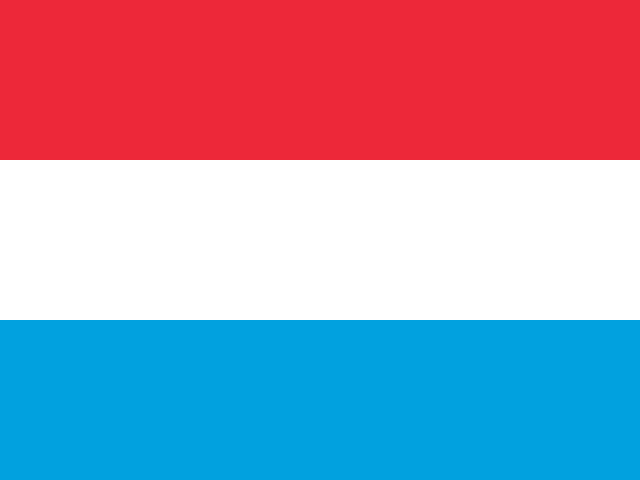
Three horizontal bands of red, white and light blue, the colours drawn from the medieval arms of the counts of Luxembourg, a red lion on a blue-and-white striped field. A 1993 regulation fixes the red at Pantone 032 C and the blue at Pantone 299 C without saying what either stands for. The resemblance to the Dutch tricolour is a coincidence of two unrelated heraldries rather than a shared descent.
Luxembourg FACTS ◢
| Capital | Luxembourg |
|---|---|
| Continent | Europe |
| Population | 686,970 (2025) |
| Area | 2,586 km² |
| Population density | 266/km² |
| Currency | Euro (EUR) |
| Official languages | French, German, Luxembourgish |
| Calling code | +352 |
| Internet TLD | .lu |
| Time zone | UTC+01:00 |
| Drives on the | Right |
| ISO codes | LU / LUX |
DID YOU KNOW? ◢
- It's the world's only remaining sovereign grand duchy, ruled by a grand duke.
- In 2020 it became the first country to make all public transport free nationwide.
- It has three official languages: Luxembourgish, French and German.
- Its capital's fortifications and old quarters are a UNESCO World Heritage Site.
Luxembourg QUICK ANSWERS ◢
What is the capital of Luxembourg?
The capital of Luxembourg is Luxembourg.
What is the population of Luxembourg?
Luxembourg had a population of 686,970 in 2025.
What currency does Luxembourg use?
Luxembourg uses the Euro (EUR).
What languages are spoken in Luxembourg?
The official languages of Luxembourg are French, German and Luxembourgish.
Think you know your flags? Play Flag Daily → · Browse all countries →
MORE ON THE FLAG ◢
The Luxembourg flag and the Dutch flag really are close enough to cause trouble, and the resemblance is a coincidence. Two unrelated sets of heraldry arrived at the same three colours by separate routes, roughly three centuries apart.
Luxembourg has been living with the consequences ever since. The confusion is the stated reason its boats fly a completely different flag, and in 2006 it came within one parliamentary bill of costing the tricolour its job.
Key Takeaways
- The resemblance is not shared ancestry. Luxembourg's colours come from the arms of its medieval counts; the Dutch Royal House dates its own flag's first mention to 1572.
- The Law of 23 June 1972 was the first statute to define the national flag. The arrêté grand-ducal of 29 June 1923 had gone no further than naming the colours and their orientation.
- That law allows two shapes: proportions of 5 to 3, or 2 to 1.
- A 1993 regulation fixes the red at Pantone 032 C and the blue at Pantone 299 C. Neither text says what the colours stand for.
- Luxembourg's inland shipping and aviation fly the Red Lion instead, and the 1972 bill's own reasoning gives avoiding confusion with Dutch vessels as the cause.
- A bill to make the Red Lion the national flag was filed on 5 October 2006 and stayed on the books until it was struck off in 2014.
What is the difference between the Luxembourg flag and the Dutch flag?
Both are three equal horizontal bands of red, white and blue. What separates them is the exact blue and the shape of the cloth.
| Attribute | Luxembourg | Netherlands |
|---|---|---|
| Red | Pantone 032 C | helder vermiljoen, bright vermilion |
| Blue | Pantone 299 C, a pale sky blue | kobaltblauw, cobalt, a deep dark blue |
| Proportions | 5 to 3, or 2 to 1 | not specified by the Royal House |
| Set by | Law of 23 June 1972, colours by a regulation of 27 July 1993 | Royal Decree of 1937 |
The blue is the reliable test, because Luxembourg's is written down to a reference number and is a good deal paler. The shape is the faster test at a distance: article 3 of the Luxembourg law specifies cloth "aux proportions de 5 à 3 ou de 2 à 1", and at 2 to 1 the flag is noticeably longer and thinner than the Dutch one usually looks.
Why does the Luxembourg flag resemble the Dutch one at all?
Because two separate heraldic traditions landed on the same three colours, and then a century of shared monarchy made the collision worse.
Luxembourg's colours are the tinctures of its medieval counts, in use since the thirteenth century: silver and blue bars with a crowned red lion. The Dutch flag has a different ancestry entirely. The Royal House dates its first mention to 1572, when it was orange, white and blue, the white and blue taken from the livery colours of the Principality of Orange. Orange was gradually replaced by red around the seventeenth century, the story being that it showed up less well at sea.
Nothing connects those two lines. The overlap is chance.
What turned chance into a problem was the arrangement of 1815, under which the Grand Duchy was held by the King of the Netherlands in personal union. Through that period the orange flag and the Luxembourg red, white and blue flew alongside each other, and the state heraldry commission records that the choice did not settle in favour of red, white and blue until the last quarter of the nineteenth century. Even then it was not finished: on 31 March 1923 the government was still writing to the Belgian ambassador to refute what it called the erroneous opinion that the Luxembourg tricolour was identical to the Dutch flag.
Why does Luxembourg fly a different flag on its boats?
Because a flag on a hull has to be read from far away by people who do not care about Pantone numbers.
Article 4 of the same 1972 law creates a second official flag, the ensign of inland shipping and aviation, at proportions of 7 to 5. It is not a tricolour at all. It is the state arms on cloth: ten horizontal bars of silver and blue with a crowned red lion rearing towards the hoist, its tail forked and crossed. Luxembourgers call it the Roude Léiw, the Red Lion.
The reasoning survives in the bill's explanatory memorandum, quoted by the state heraldry commission. International practice, it says, is that merchant ensigns are preferably in the national colours, but following it would have exposed Luxembourg's boatmen to "être confondue avec la batellerie néerlandaise", to being confused with Dutch shipping. The memorandum then concedes that the boatmen had already adopted the lion themselves, and that the bill only ratified existing practice.
So the confusion with the Netherlands is not folk trivia. It is a stated premise of the statute.
Who tried to replace the Luxembourg flag with the Red Lion?
A sitting member of parliament, and he got further than you would expect.
Michel Wolter filed proposition de loi number 5617 on 5 October 2006, proposing that the national flag become the Red Lion outright. The Chamber of Deputies declared it admissible on 24 October 2006 and sent it to the Committee on Institutions and Constitutional Revision.
The government referred the question to the Commission héraldique de l'Etat, the body created by article 8 of the very law the bill wanted to amend. Its opinion of 14 March 2007 runs to seventeen pages of archival history and ends in a deliberate refusal to take a side: it is not for the historian, it says, to pronounce on a proposal belonging purely to the political domain, and more precisely to the politics of identity. What it would say was that a proposal of this kind could not fail to polarise Luxembourg society.
On 6 July 2007 the Government Council settled it in the middle. The tricolour keeps its status as the national flag; the Red Lion may be flown on Luxembourg soil alongside it. Prime Minister Jean-Claude Juncker put it in Luxembourgish: the two flags have no quarrel with each other, they belong together.
The bill was never voted down. It stopped moving. The Council of State reported on 8 April 2008, the committee met once on 6 May 2008, and the file went back to committee twice before being taken off the order paper. The Chamber's public dossier records a last update of 27 March 2014 and the status Retiré.
Nor was Wolter the first to try. A National Flag Committee created on 4 November 1938 reported on 3 February 1939 and also came out for the Red Lion, before falling back on a compromise: keep both, and add the national arms to the white band of the tricolour so nobody could mistake it for the Dutch one. A draft decree adopting the lion survives in the foreign ministry archives. It was never issued. Within eighteen months the country was occupied, and the lion became a resistance symbol instead of a state one.
What do the colours on the Luxembourg flag mean?
Officially, nothing, and that is worth stating plainly because most flag pages will tell you otherwise.
The 1972 law describes the cloth, sets the proportions, names the colours in order and creates a criminal penalty for misusing them. It assigns no meaning to any of the three. The 1993 regulation adds two Pantone numbers for the national flag and stops. Neither text contains a word about liberty, blood, sky or purity.
What the record supports is an origin rather than a symbolism, and you can watch it form. In 1787, when Emperor Joseph II withdrew a set of unpopular edicts, people in Luxembourg City celebrated by wearing "des cocardes de la couleur des Armoiries de ce Duché, bleues, blanches et rouges", cockades in the colours of the duchy's arms, and that 24 June the city magistrate banned every other kind. Even the order of the bands took time: in 1841 the state councillor Charles Munchen was still calling a flag of three plain colours an innovation, unknown until then, and recommending red at the top on the grounds that it would look best.
The heraldry commission's own summary is blunter than any meaning quoted elsewhere: the origins of the Luxembourg tricolour are imprecise, undatable, and to be located in a long, slow evolution.
To test how well you can tell the pair apart, Flag Daily is one flag a day, with factsheets for every country behind it.
Frequently asked questions
Which flag is which when you see them side by side?
Look at the blue. Luxembourg's is Pantone 299 C, a pale sky blue; the Dutch Royal House describes its own as cobalt, which is markedly darker. If they are not adjacent, judge the shape instead: Luxembourg's law permits 5 to 3 or 2 to 1, so its flag is often the longer of the two.
Why does Luxembourg have two flags?
The 1972 law creates two: the national tricolour, and a separate ensign for inland shipping and aviation carrying the Red Lion. The second exists so Luxembourg vessels are not taken for Dutch ones, which the bill's explanatory memorandum says in as many words.
Did Luxembourg ever change its flag?
No, but it came close twice. A National Flag Committee recommended the Red Lion in February 1939, and a bill to adopt it was filed in October 2006. The first was overtaken by the war; the second was struck off the parliamentary roll in 2014 without coming to a vote.
When did the Luxembourg flag become official?
On 23 June 1972, when the law on national emblems was passed. The colours had been in use for well over a century by then, and the arrêté grand-ducal of 29 June 1923 had gone no further than saying the flag was red, white and blue, placed horizontally.
What do the red, white and blue on the Luxembourg flag stand for?
No Luxembourg law assigns them a meaning. Both the 1972 statute and the 1993 colour regulation describe the flag without interpreting it. The colours come from the arms of the medieval counts of Luxembourg, which is an origin rather than a symbolism.
Sources
- Legilux, Loi du 23 juin 1972 sur les emblèmes nationaux - article 3 for the tricolour and its proportions, article 4 for the shipping and aviation ensign, article 6 for the penalty. Retrieved 10 August 2026.
- Legilux, Règlement grand-ducal du 27 juillet 1993 précisant la composition chromatique des couleurs du drapeau national - article 1 for Pantone 032 C and 299 C. Retrieved 10 August 2026.
- Commission héraldique de l'Etat, Avis sur la proposition de loi n. 5617, 14 March 2007 (full opinion, PDF) - the thirteenth-century comital tinctures, the 1787 cockades, the personal union of 1815 and the settling of the colours in the last quarter of the nineteenth century, the 1923 letter to the Belgian ambassador, the arrêté grand-ducal of 29 June 1923, Munchen's 1841 advice, the 1972 explanatory memorandum, the 1938 committee, and the conclusion on the tricolour's origins. Retrieved 10 August 2026.
- Chambre des Députés du Grand-Duché de Luxembourg, Dossier parlementaire 5617 - the filing date, committee referral, Council of State opinion, and the withdrawn status. Retrieved 10 August 2026.
- Het Koninklijk Huis, Nederlandse vlag - the Dutch colours, the 1937 Royal Decree, and the flag's descent from the Principality of Orange. Retrieved 10 August 2026.
- Le gouvernement luxembourgeois, Jean-Claude Juncker sur la question du drapeau national, 6 July 2007 - the Government Council decision and the Juncker quotation. Retrieved 10 August 2026.
PLAY ANOTHER →
One quote, one scrambled alphabet. Crack it before tomorrow.
CRACK THE QUOTEDAILYGuess the CountryThree clues, three guesses. Work out where in the world it is.
THREE CLUESDAILYDaily TriviaFive questions a day. Everyone gets the same five.
FIVE QUESTIONSDAILYDaily CodeA short message, hidden in a different cipher every day.
ONE CIPHER A DAY