
Germany
Europe's most populous nation and the engine of its economy, Germany runs on precision engineering, 1,500-odd breweries and an autobahn network where some stretches still have no speed limit.
WHAT THE FLAG MEANS ◢
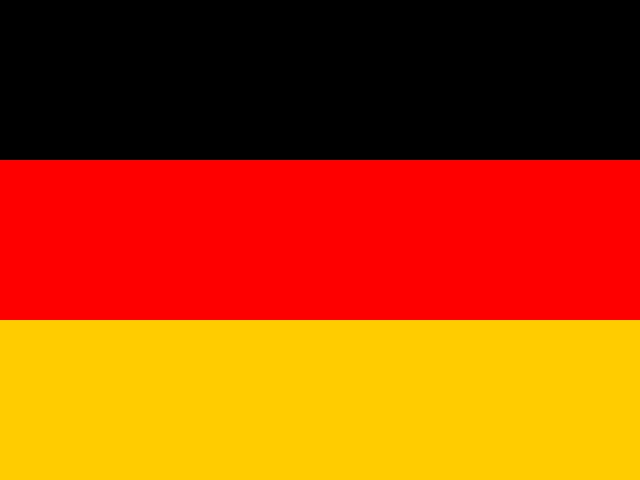
Three horizontal bands of black, red and gold, in one line of the Basic Law: article 22 provides that the federal flag shall be black, red and gold. The colours were declared those of the German Confederation by the Frankfurt parliament in 1848 and have stood for a unified, democratic Germany since, through Bismarck's black, white and red and back again. Where they came from before that is not settled, and the Bundestag treats the popular Lutzow Volunteer Corps explanation as an attribution rather than a fact.
Germany FACTS ◢
| Capital | Berlin |
|---|---|
| Continent | Europe |
| Population | 83,491,249 (2025) |
| Area | 357,588 km² |
| Population density | 233/km² |
| Currency | Euro (EUR) |
| Official language | German |
| Calling code | +49 |
| Internet TLD | .de |
| Time zone | UTC+01:00 |
| Drives on the | Right |
| ISO codes | DE / DEU |
DID YOU KNOW? ◢
- It has stretches of autobahn with no official speed limit.
- Germany was a patchwork of separate states until it unified into a single country in 1871.
- Munich's Oktoberfest is the world's largest folk festival, drawing around six million visitors a year.
- The country is home to more than 20,000 castles, from fairytale Neuschwanstein to medieval ruins.
- Johannes Gutenberg's printing press, invented in Germany around 1440, kicked off the age of mass communication.
Germany QUICK ANSWERS ◢
What is the capital of Germany?
The capital of Germany is Berlin.
What is the population of Germany?
Germany had a population of 83,491,249 in 2025.
What currency does Germany use?
Germany uses the Euro (EUR).
What languages are spoken in Germany?
The official language of Germany is German.
Think you know your flags? Play Flag Daily → · Browse all countries →
MORE ON THE FLAG ◢
Germany's flag is one sentence of constitutional law. Article 22, paragraph 2 of the Basic Law reads, in the official English translation: "The federal flag shall be black, red and gold."
That sentence is short because the argument behind it was long. Germany has had two competing national colour schemes for most of the past two centuries, and the choice between them was never about aesthetics. It was about which Germany was being represented.
Key Takeaways
- The Bundestag says the origin of the three colours is uncertain, and names the popular Lützow Volunteer Corps explanation as an attribution rather than a fact.
- In 1848 the Frankfurt Federal Diet and the German National Assembly declared black, red and gold the colours of the German Confederation.
- Bismarck replaced them with black, white and red from 1866. Those were the empire's colours until 1918.
- The Weimar National Assembly split so badly over it that it legislated two different flags at once.
- The current flag's proportions are fixed at 3 to 5 by an order dated 13 November 1996.
| Period | Flag | Adopted by | Status now |
|---|---|---|---|
| 1848 to 1849 | Black, red, gold | Frankfurt Federal Diet and German National Assembly | Revolution failed, colours survived |
| 1866 to 1918 | Black, white, red | Bismarck, then the North German Confederation and the German Empire | Historic |
| 1919 to 1933 | Black, red, gold at home; black, white, red at sea | Weimar National Assembly, as a compromise | Superseded |
| 1949 to 1990 | Black, red, gold, with the hammer, compasses and wreath of grain added in 1959 | German Democratic Republic | Ended at reunification |
| 1949 to now, then all of Germany | Black, red, gold | Parliamentary Council, Article 22 of the Basic Law | In force |
Why is Germany's flag black, red and gold?
Because a 19th-century movement for a unified and constitutional Germany adopted them, and every German democracy since has claimed the inheritance.
The German Bundestag, which publishes its own history of the flag, is careful about the origin story. It says the exact origins remain uncertain, then gives the popular account as an attribution rather than a finding: "After the wars of liberation in 1815, the colours were attributed to the black uniforms with red piping and golden buttons worn by the Lützow Volunteer Corps."
The colours spread through the student fraternity movement. The Jena fraternity's black-and-red flag with gold ornament made them visible, helped by the fact that its members included Lützow veterans. And the Bundestag notes a detail most short accounts drop: Germans of the period believed these had been the historic colours of the old empire. They had not been. The belief did the work anyway, which is the usual way with national symbols. The colours were carried at the Hambach Festival of 1832, and the Bundestag records that they "became a symbol of national unity and bourgeois freedom, and were almost omnipresent during the 1848/49 Revolution."
What happened in 1848?
The colours went from a protest banner to an official one.
In 1848 the Frankfurt Federal Diet and the German National Assembly declared black, red and gold to be the colours of the German Confederation and of the German empire the revolutionaries intended to create. That is the moment the tricolour stopped being the property of a movement and became the property of a parliament.
The revolution failed. The parliament that sat at the Paulskirche in Frankfurt never produced the state it was designing, and the colours went back to being an opposition symbol rather than a governing one. But the association had been made, and it is why the same three colours were available to be picked up twice more, in 1919 and in 1949, by people who wanted to say something specific about the state they were founding.
Germany's colours were adopted by a parliament before the state existed, and then adopted again in 1949 by a second parliament deliberately reclaiming the choice of the first, which had failed. The rest are in every country's flag and factsheet.
Where did the black-white-red flag come from?
From Prussia and the Hanseatic ports, and from a deliberate decision to displace the revolutionary colours.
The Bundestag's account is direct: from 1866, in the course of Prussian-led unification, Bismarck replaced black, red and gold with black, white and red, combining Prussia's traditional black and white with the red of the Hanseatic cities. Those colours were carried by the North German Confederation and then by the German Empire from 1871 until 1918.
They were not popular at first. The Bundestag records that they met resistance and only gradually gained acceptance, particularly under Wilhelm II.
Why did the Weimar Republic legislate two flags?
Because the National Assembly could not agree, and wrote the disagreement into law.
After the First World War the question of the colours split the Weimar National Assembly, and the public with it. The Bundestag records broad sections of opinion opposed to abandoning the imperial colours, and quotes the compromise the Assembly adopted: "The Reich colours shall be black, red and gold, the ensign shall be black, white and red with the Reich colours in the upper hoist quarter."
The republic's national colours were therefore black, red and gold, while its ensign was black, white and red carrying the national colours in the corner nearest the mast. The flag at home and the flag at sea deliberately said different things, and every ship leaving a German port carried the argument with it. The Bundestag's verdict on the result is short: black, red and gold struggled to gain widespread acceptance in that period.
What does the Basic Law say?
One line, adopted almost unanimously.
When the Parliamentary Council drew up the Basic Law in 1949 it decided, in the Bundestag's words, nearly unanimously that black, red and gold should be the colours of the Federal Republic's flag. The decision is recorded in Article 22, and the Bundestag explains the choice as representing the movement for unity and freedom, which reads as a claim on the 1848 inheritance rather than the imperial one.
The physical specification came later and is separate from the constitution. The Anordnung über die deutschen Flaggen, dated 13 November 1996, sets it out: "Die Bundesflagge besteht aus drei gleich breiten Querstreifen, oben schwarz, in der Mitte rot, unten goldfarben, Verhältnis der Höhe zur Länge des Flaggentuches wie 3 zu 5." Three equal horizontal bands, black at the top, red in the middle, gold at the bottom, in a ratio of three to five.
There were two German flags for most of the Federal Republic's first four decades, and this is the point where most short accounts skip a step. The Bundestag records that "The GDR also chose to adopt black, red and gold, but from 1959 added the hammer and compasses emblem and the surrounding wreath of grain ears to the flag." East Germany did not reject the colours; it accepted them and then marked them, which made the two flags identical at any distance where the emblem could not be read.
That ended in one line: "On 3 October 1990, the Basic Law was adopted in the eastern federal states too, and the black-red-gold flag became the official flag of the reunified Germany." The emblem went and the three bands stayed.
Does black, white and red still mean something in Germany?
Yes. Germany's domestic intelligence service documents the colours' use by right-wing extremists.
This is where a flag article usually gets vague, so it is worth quoting the responsible body. The Bundesamt für Verfassungsschutz, the Federal Office for the Protection of the Constitution, publishes a guide to extremist symbols; its February 2022 edition states that right-wing extremists make use of the colour combination black-white-red, which it identifies as the national colours of the German Empire and of the "Third Reich", instrumentalised for their own purposes. It then draws the contrast explicitly: these stand in opposition to black-red-gold, which symbolises democratic Germany.
The legal position is more precise than the political one, and the same edition sets it out. Flying the Reichskriegsflagge, the German Empire's war ensign, which the guide illustrates with an example captioned 1867 to 1921, is neither a criminal offence nor a regulatory one. Police may nonetheless seize one under general police and public-order law, where that is the necessary and proportionate step to avert a concrete danger in a specific case. The version used by the Nazi state from 1935 to 1945, carrying a swastika, is a different matter: using or distributing that one is a criminal offence under sections 86 and 86a of the criminal code.
So the German Empire's war flag is not in itself an offence to fly; the Nazi version is. The colours meanwhile carry a meaning the Bundesamt für Verfassungsschutz thinks worth documenting, while the Bundestag says black, red and gold is today regarded nationally and internationally without controversy. Both statements are true at once, which is the point of a two-hundred-year argument.
Frequently asked questions
What do the colours of the German flag mean?
Neither Article 22 of the Basic Law nor the 1996 flag order assigns a meaning to any individual colour. The Bundestag explains the flag as a whole, describing black, red and gold as the colours of the movement for German unity and freedom, adopted by the Frankfurt Federal Diet and the German National Assembly in 1848 and chosen again by the Parliamentary Council in 1949. Anyone offering a fixed meaning for each stripe is going beyond the official account.
Is the German flag black-red-gold or black-red-yellow?
Black, red and gold. The Anordnung über die deutschen Flaggen of 13 November 1996 uses the word "goldfarben", gold-coloured, for the bottom band. Article 22 of the Basic Law uses "gold" too, rendered in the official English translation as "The federal flag shall be black, red and gold."
What was the flag of East Germany?
Black, red and gold, the same three colours as the Federal Republic. The Bundestag records that the GDR "also chose to adopt black, red and gold, but from 1959 added the hammer and compasses emblem and the surrounding wreath of grain ears to the flag". The emblem was dropped on 3 October 1990, when the Basic Law was adopted in the eastern federal states and black, red and gold became the flag of the reunified country.
Is the German imperial war flag banned?
Flying the German Empire's Reichskriegsflagge is not in itself a criminal or regulatory offence, according to the Federal Office for the Protection of the Constitution in its February 2022 guide, though police can seize one under general public-order law to avert a concrete danger in a specific case. The version used from 1935 to 1945, bearing a swastika, is prohibited under sections 86 and 86a of the German criminal code.
What are the official proportions of the German flag?
Three to five, height to length, under the Anordnung über die deutschen Flaggen of 13 November 1996. The same order sets three equal horizontal bands, black at the top, red in the middle and gold at the bottom.
Three equal horizontal bands is one of the most crowded design spaces there is, which makes naming a flag from a single day's puzzle harder than it sounds and working a country out from three clues, with no flag shown at all a different exercise entirely.
Sources
- Deutscher Bundestag, The Federal Flag - retrieved 10 August 2026.
- Basic Law for the Federal Republic of Germany, Article 22, official English translation - retrieved 10 August 2026.
- Anordnung über die deutschen Flaggen of 13 November 1996, paragraph 1 - retrieved 10 August 2026.
- Bundesamt für Verfassungsschutz, Rechtsextremismus: Symbole, Zeichen und verbotene Organisationen, February 2022. The passages quoted are in the PDF the page carries, in the section on the Reichskriegsflagge and in the closing survey of extremist symbols - retrieved 10 August 2026.
PLAY ANOTHER →
Three clues, three guesses. Work out where in the world it is.
THREE CLUESDAILYDaily TriviaFive questions a day. Everyone gets the same five.
FIVE QUESTIONSDAILYDaily CryptogramOne quote, one scrambled alphabet. Crack it before tomorrow.
CRACK THE QUOTEDAILYOn This DayOne thing that happened today in history. Every day, a new one.
TODAY IN HISTORY