
Grenada
A tiny Caribbean island nicknamed the 'Isle of Spice', Grenada grows so much nutmeg it put the seed on its national flag. Volcanic peaks, rainforest and beaches pack into an island you can drive across in an afternoon.
WHAT THE FLAG MEANS ◢
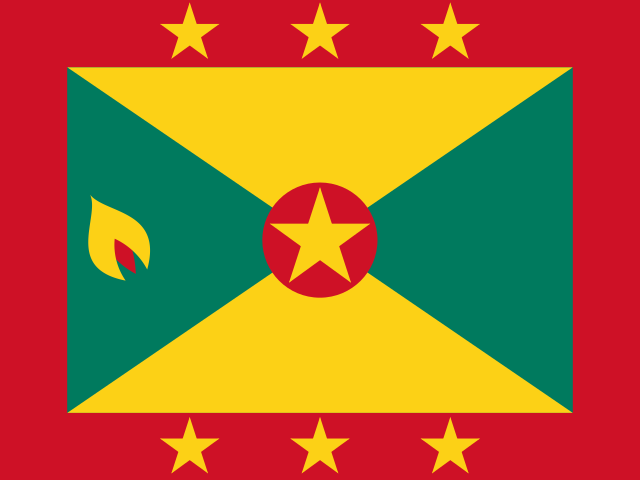
A red border carries six gold stars, with a seventh in a red disc at the centre; green and gold triangles fill the field, and a nutmeg sits at the hoist. The National Emblems Act of 1999 describes the flag in pure geometry and assigns no element a meaning; its word for the colour is gold, not yellow. The government reads the red for the fervour and courage of the people and the border for harmony and unity of spirit, the gold for wisdom and the sun, the green for the fertility of the land, and the nutmeg for the reputation as the Isle of Spice; it gives the seven stars to the seven parishes, although Grenada's parish boundaries law defines six.
Source: laws.gov.gd · gov.gd · nowgrenada.com · britannica.com · checked 2026-08-27
Grenada FACTS ◢
| Capital | St. George's |
|---|---|
| Continent | North America |
| Population | 117,303 (2025) |
| Area | 348 km² |
| Population density | 337/km² |
| Currency | Eastern Caribbean dollar (XCD) |
| Official language | English |
| Calling code | +1473 |
| Internet TLD | .gd |
| Time zone | UTC-04:00 |
| Drives on the | Left |
| ISO codes | GD / GRD |
DID YOU KNOW? ◢
- It's one of the world's largest producers of nutmeg and mace, earning it the nickname 'Isle of Spice'.
- A nutmeg features on the national flag, one of the few flags to show a food crop.
- It's home to an underwater sculpture park, one of the first of its kind in the world.
- The island was formed by volcanoes, and its crater lake, Grand Etang, sits high in the interior.
Grenada QUICK ANSWERS ◢
What is the capital of Grenada?
The capital of Grenada is St. George's.
What is the population of Grenada?
Grenada had a population of 117,303 in 2025.
What currency does Grenada use?
Grenada uses the Eastern Caribbean dollar (XCD).
What languages are spoken in Grenada?
The official language of Grenada is English.
Think you know your flags? Play Flag Daily → · Browse all countries →
MORE ON THE FLAG ◢
Red for courage, gold for wisdom and the sun, green for the land, a nutmeg for the Isle of Spice, seven stars for the seven parishes. That is the Government of Grenada's reading of its own flag, published on its national symbols page. It is worth knowing where it comes from, because it does not come from the law.
Grenada has exactly one statute describing its national flag. That statute is the National Emblems and National Anthem of Grenada (Regulation) Act, Chapter 203A of the Revised Laws, and its description of the flag runs to about seventy-five words of geometry. It does not say what the red means. It does not say what the gold means, or the green, or the nutmeg. It does not even add the stars up.
Everything anyone tells you about what Grenada's flag means was written somewhere else, by someone the Act does not mention. Two of those somewhere elses disagree with each other, and one of them disagrees with a different Grenadian statute.
Key Takeaways
- The only Grenadian law describing the flag is the National Emblems Act, in force since 23 July 1999. Its Second Schedule is pure geometry and assigns no element a meaning.
- The Act says gold three times. It never says yellow, and it never fixes how many points a star has.
- The Government of Grenada gives the seven stars to "the seven parishes". The Parish Boundaries Act defines six parishes; the seventh place, Carriacou and Petit Martinique, is a county.
- The account of the designer's memoir published by NOW Grenada gives the centre star to sovereignty and the others to mariners, with no mention of parishes.
- The flag was first hoisted at independence on 7 February 1974. Its designer, Anthony Conrad George, died on 7 February 2024.
| Element | The 1999 Act | The government's symbols page | The designer's account |
|---|---|---|---|
| Red border | "Red border with three gold stars at the top and three at the bottom" | dedication "to preserve harmony and unity of spirit" | "love, fervour, courage, aspiration and a burning desire to be free" |
| Gold | "two equilateral triangles coloured gold" | wisdom, and the sun | warmth of character, friendliness, wisdom, fortitude |
| Green | "two isosceles triangles coloured green" | "the fertility of the land, the lush vegetation" | "the richness of our soil, the fertility of our land" |
| Seven stars | never counted, never explained | "the seven parishes" | centre star for sovereignty, the others for mariners' navigation |
| Nutmeg | "a nutmeg imposed on the triangle pointing west" | "the reputation as the Isle of Spice" | not glossed in the memoir passage NOW Grenada published |
Why the seven stars and the seven parishes do not add up
The Government of Grenada's national symbols page is unambiguous. Under the heading for the flag it lists "The Seven Gold Stars" and says they represent "the seven parishes and the hopes and aspirations and ideas upon which the nation was founded". The same page repeats the count for the coat of arms, whose crest it describes as "seven roses, representative of the seven parishes".
Grenada does not have seven parishes. It has six, and they are defined by name and by boundary in the Parish Boundaries Act, Chapter 224, which has been in force since 19 August 1908 and describes itself as "An Act to define and declare the boundaries of the several parishes". The Act's section 3 works through them in order: St. George, St. David, St. Andrew, St. Patrick, St. Mark and St. John. There is no seventh subsection, and no subsidiary legislation adds one.
The seventh place everybody is counting is Carriacou and Petit Martinique, the two islands north of the mainland. Grenadian law is specific about what they are, and it is not a parish. The Constitution provides at Article 107 that "There shall be a Council for Carriacou and Petit Martinique, which shall be the principal organ of local government in those islands". The Carriacou and Petit Martinique County Council Act of 1995 then takes the district of that name and provides that it "is hereby constituted a County". The government's own Fast Facts page calls the pair "Dependencies".
So the state publishes a gloss that its own statute book contradicts. Six parishes plus one county is seven places, and seven places is not seven parishes. If the stars stand for anything administrative, they stand for six parishes and a county, which is a less quotable sentence and a more accurate one. Grenada is not the only state in the region whose territory outruns its name; Saint Vincent and the Grenadines put the problem in the title instead.
What Grenada's flag law actually says
The Act's Second Schedule is headed "The Flag of GRENADA" and then, under "Description", gives three numbered points.
The first is "Rectangular in shape." The second is "Red border with three gold stars at the top and three at the bottom of border and facing each other." The third divides the inner rectangle into four triangles: "two equilateral triangles coloured gold and pointing north and south", "two isosceles triangles coloured green with a nutmeg imposed on the triangle pointing west", and then all four triangles "converge at the centre of the flag on a single gold star on a red background".
That is the whole of it. No colour is given a meaning, no star is given a point count, and no proportion is fixed anywhere in the Act. Two things about the drafting are worth pausing on.
The first is the compass. A flag has no north or south; it has a hoist, a fly, a top and a bottom, and it faces whichever way the wind and the pole put it. Describing one by cardinal direction describes it as it sits on a page rather than as it flies, and it leaves the nutmeg's position open to two readings: "the triangle pointing west" could name the triangle whose apex faces west, which is the fly-side one, or the triangle occupying the western side, which is the hoist-side one where the nutmeg actually sits.
The second is the word "equilateral". Divide a rectangle by its diagonals and the top and bottom triangles are equilateral only if the rectangle is taller than it is wide by a factor of about 1.73. Grenada's flag is wider than it is tall, and a border of even width cannot turn a landscape flag into a portrait inner rectangle. The government's own page gives the proportions as "Flown on land: five to three (5:3)" and "Flown on Sea: two to one (2:1)", and at either of those the gold triangles are isosceles, exactly like the green ones the Act distinguishes them from.
Where the colour readings come from
Two Grenadian accounts exist, they were written by different people for different purposes, and they do not quite agree.
The government's is on the national symbols page. Red "represents the fervour of the people, their courage and vitality - their burning aspiration to be free", and the border specifically is "indicative of their dedication to preserve harmony and unity of spirit". Gold is "the colour representative of wisdom", and also the sun, "their islands in the sun", warmth and friendliness. Green "symbolises the fertility of the land, the lush vegetation" and the island's agriculture. The stars go to the parishes, and the nutmeg to the Isle of Spice.
The designer's account is in his 2013 memoir, and the passage NOW Grenada published from it reads differently. George gave red a wider brief: the "red border represents love, fervour, courage, aspiration and a burning desire to be free". He gave green "the richness of our soil, the fertility of our land", which is the government's reading in the designer's words. And he gave the stars something the government does not mention at all.
On that account George placed the central star to stand for the sovereignty of a new nation, and the other stars refer to mariners, who navigated by them. That is a maritime reading rather than an administrative one, and it comes from a man born across the water in Carriacou. Neither reading has any standing in the Act, which is silent on both.
Gold is the word the law uses
The Second Schedule uses the word gold three times and never once uses "yellow".
This is not a quibble about shades. The two words carry different registers, and the drift between them is how a flag description quietly stops matching its source. The government's symbols page heads the colour "Gold" and describes it as "the colour representative of wisdom". Its account of the coat of arms says "The National colours of Red, Gold and Green, which comprise the National Flag, are used on the shield with the same symbolism attached to them."
The designer noticed the substitution himself. In the passage from his memoir published by NOW Grenada, Anthony George wrote that "The colour gold, in which yellow is sometimes substituted in (flag reproductions), represents the warmth of our character and friendliness", and went on to give the colour "our wisdom and fortitude, and of course, the beautiful sunshine we enjoyed all year round in Grenada, Carriacou and Petite Martinique". The man who drew it was already, by 2013, watching his gold be reproduced as yellow.
Where does "yellow" come from? Britannica's entry on the flag, written by Whitney Smith of the Flag Research Center and read here from an Internet Archive capture of 22 August 2026, gives "a diagonally divided background of green for vegetation and yellow for wisdom and the sun", and says "The seven yellow stars stand for the original administrative subdivisions of Grenada." That is a foreign vexillologist's reading rather than the Grenadian state's, and two of its departures from the Act are the colour word and the administrative gloss on the stars.
The designer the state names, and the committee a newspaper adds
The government names one man. Its symbols page says the flag "was designed by Anthony C. George" of "Soubise in the Parish of St. Andrew", and that Grenada took independence from the United Kingdom on 7 February 1974 and adopted the flag that day. Britannica dates the first hoisting to "midnight, February 6/7, 1974".
Anthony Conrad George was born in Carriacou on 7 January 1938, the second of five children, and moved to the Grenadian mainland with his parents in 1948 for school. He was awarded the British Empire Medal in the 2007 New Year Honours for services to art and culture, received the Diamond Jubilee Medal in 2012, and had a road in Soubise named A C George Road for him the same year. He published a memoir, Beyond Belief, in 2013.
The Grenadian Voice gives a fuller account of how the design was arrived at, and it sits awkwardly beside the single-designer line: George worked within a committee led by Gert Protain, a first attempt having already been made during the Associated States period, and the paper adds that "George, being the lone artist in the group, was the one who documented the concept on paper." Treat that as a newspaper's account rather than the state's, which credits George alone.
He died in the United Kingdom on 7 February 2024, the fiftieth anniversary of the day his flag was first raised. Reporting his death, NOW Grenada quoted a tribute by the lawyer Jacqueline McKenzie describing a country "adorned by thousands of flags of red, green and gold, of the nutmeg, and of the stars representing the 7 parishes". The gloss the flag's own law never made was in the air on the day its designer died.
Why is there a nutmeg on Grenada's flag?
Because it was already on the last one. Grenada entered associated statehood with Britain in 1967 and flew an interim design in the meantime: Britannica describes "horizontal stripes of blue-yellow-green with a central representation of a nutmeg", and records that the nutmeg was the element carried over when the independence flag was drawn.
The crop's standing in Grenadian law is older than either flag. The Nutmeg Industry Act, in force since 8 March 1947, establishes the Grenada Co-operative Nutmeg Association as a body corporate and invests it with authority for "the marketing and control of all nutmegs produced in Grenada and intended for export". A second chapter, the Nutmeg (Regulation of Export) Act, regulates nutmeg exports on its own. Two chapters of the Revised Laws are given over to one spice.
The emblems Act says only "a nutmeg", with nothing about the split fruit, the seed or the red mace. Grenadian drafting elsewhere makes that shorthand less bare than it looks: the nutmeg Act, for its own purposes rather than for the flag's, defines nutmegs as nutmegs "whether in shell or separated from the shell or whether cured or uncured, and includes mace". Whether the emblems Act's drafters had that in mind is not something either text says.
The government's gloss follows the economics rather than the botany: the nutmeg "represents the reputation as the Isle of Spice and its traditional link with the economy". If you want to test whether you would know the flag from the nutmeg alone, Flag Daily shows one flag and gives three guesses at the country.
The flag code with no regulations behind it
Grenada's symbols page carries a detailed code of flag etiquette. The flag "is to be regarded as the sacred emblem of the nation to be paid due reverence and devotion by all its citizens". It "should not be flown after sunset, except inside a building", unless floodlit for a ceremonial occasion. No other flag may be placed above it or to its right, except at foreign missions.
None of that is regulation. Section 9 of the emblems Act lets the Minister, who is the Prime Minister, make regulations including ones "providing for the proper use of the National Emblems and the National Anthem on all occasions". The published text of Chapter 203A ends with a subsidiary legislation page that reads, in full, "No Subsidiary Legislation". The power exists and has not been used, so the etiquette is guidance the government publishes, not law it enforces.
Ownership is the part the emblems Act does enforce. Its section 3 declares that copyright in the design of the national emblems "is vested in the Crown in perpetuity". Anyone importing, making or selling goods carrying the flag, or using it in connection with a business, has to apply to the Prime Minister for a licence, and doing so without one is an offence carrying a fine of five thousand dollars or a year's imprisonment. Defacing an emblem is a separate offence. The definition of "National Emblems" reaches further than the flag itself: it includes "any of the National colours when used together".
So Grenadian law has a great deal to say about who may print the flag, and nothing whatever to say about what it means. If you enjoy working a country out from written clues rather than from its flag, Guess the Country gives three of them and three guesses.
Frequently asked questions
What does the flag of Grenada mean?
No Grenadian law assigns the flag any meaning. The National Emblems and National Anthem of Grenada (Regulation) Act of 1999 describes the design and stops there, and the Constitution does not mention the flag at all. The readings in circulation are the Government of Grenada's, published on its national symbols page: red for the fervour and courage of the people, with the border for harmony and unity of spirit; gold for wisdom and the sun; green for the fertility of the land, and the nutmeg for the island's reputation as the Isle of Spice.
What do the seven stars on Grenada's flag represent?
The Government of Grenada says they represent "the seven parishes and the hopes and aspirations and ideas upon which the nation was founded", but Grenada has six parishes, defined in the Parish Boundaries Act, and the seventh place is the county of Carriacou and Petit Martinique. The flag Act itself never counts the stars or explains them, and NOW Grenada's account of the designer's memoir gives the centre star to sovereignty and the other stars to mariners who navigated by them.
Is Grenada's flag gold or yellow?
Gold. The Second Schedule to the National Emblems Act uses "gold" three times, for the two triangles, the six border stars and the centre star, and never uses "yellow". The designer noted that yellow "is sometimes substituted" in reproductions. Britannica's entry by the vexillologist Whitney Smith calls the stars yellow, but that is a reference work's wording rather than a Grenadian source's.
Who designed the flag of Grenada?
Anthony Conrad George, whom the Government of Grenada names as the designer and places at Soubise in the parish of St. Andrew. He was born in Carriacou in 1938, received the British Empire Medal in 2007, and died on 7 February 2024, fifty years to the day after the flag was first hoisted. A Grenadian newspaper's account has him working as the only artist on a committee led by Gert Protain.
How many points do the stars on Grenada's flag have?
Grenadian law does not say. The Second Schedule calls them simply "gold stars" and "a single gold star", and fixes no point count, no size and no placement measurement. It fixes no proportion for the flag either. The 5:3 ratio on land and 2:1 at sea come from the government's symbols page rather than from the Act.
Sources
- Government of Grenada, National Symbols - retrieved 27 August 2026.
- Government of Grenada, Fast Facts - retrieved 27 August 2026.
- Government of Grenada, The Grenada Constitution, Article 107 - retrieved 27 August 2026.
- Laws of Grenada, the full chapter map of the Revised Laws, in which Chapter 203A is the only national emblems chapter - retrieved 27 August 2026.
- Laws of Grenada, Chapter 203A, National Emblems and National Anthem of Grenada (Regulation) Act, Act No. 17 of 1999 - retrieved 27 August 2026.
- Laws of Grenada, Chapter 224, Parish Boundaries Act - retrieved 27 August 2026.
- Laws of Grenada, Chapter 42A, Carriacou and Petit Martinique County Council Act, Act No. 20 of 1995 - retrieved 27 August 2026.
- Laws of Grenada, Chapter 215, Nutmeg Industry Act, and Chapter 216, Nutmeg (Regulation of Export) Act, in the same chapter index - retrieved 27 August 2026.
- NOW Grenada, Linda Straker, Designer of Grenada's National Flag has died, 8 February 2024, quoting A. C. George's 2013 memoir Beyond Belief - retrieved 27 August 2026.
- The Grenadian Voice, National flag designer passes on - retrieved 27 August 2026.
- Encyclopaedia Britannica, Whitney Smith, Flag of Grenada - read from the Internet Archive capture of 22 August 2026 - retrieved 27 August 2026.
PLAY ANOTHER →
One thing that happened today in history. Every day, a new one.
TODAY IN HISTORYDAILYGuess the CountryThree clues, three guesses. Work out where in the world it is.
THREE CLUESDAILYDaily TriviaFive questions a day. Everyone gets the same five.
FIVE QUESTIONSDAILYDaily CryptogramOne quote, one scrambled alphabet. Crack it before tomorrow.
CRACK THE QUOTE