
Saint Vincent and the Grenadines
A single main island plus a string of tiny Grenadine isles, Saint Vincent and the Grenadines has beaches so untouched that Hollywood filmed 'Pirates of the Caribbean' along its shores.
WHAT THE FLAG MEANS ◢
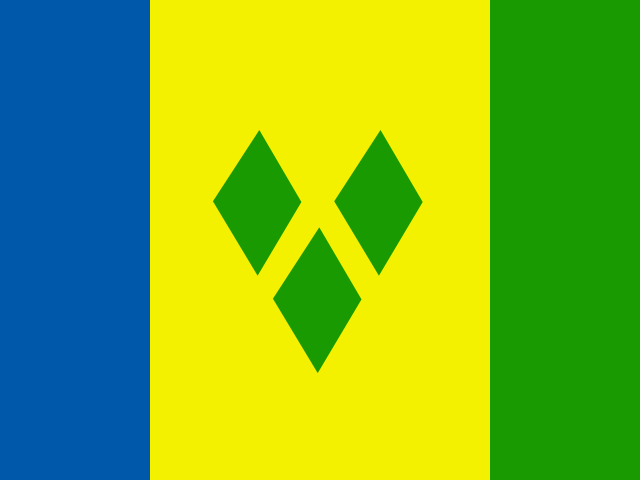
Three vertical bands of blue, gold and green, the wider gold centre bearing three green diamonds arranged in a V. The constitution does not mention the flag. The government's own account reads the blue for the sky and sea, the gold for warmth, the bright spirit of the people and the golden sands of the Grenadines, and the green for the lush vegetation of St. Vincent's agriculture and the enduring vitality of the people. It shapes the diamonds into a V for Vincent, reads them as reflecting the many islands, and makes the country the gem of the Antilles, which is where the flag's nickname, The Gems, comes from.
Saint Vincent and the Grenadines FACTS ◢
| Capital | Kingstown |
|---|---|
| Continent | North America |
| Population | 99,924 (2025) |
| Area | 389 km² |
| Population density | 257/km² |
| Currency | Eastern Caribbean dollar (XCD) |
| Official language | English |
| Calling code | +1784 |
| Internet TLD | .vc |
| Time zone | UTC-04:00 |
| Drives on the | Left |
| ISO codes | VC / VCT |
DID YOU KNOW? ◢
- Parts of the 'Pirates of the Caribbean' films were shot on its islands, including Wallilabou Bay.
- Its highest point, La Soufrière, is an active volcano that has erupted several times in the past century.
- The nation is made up of one larger island and a chain of smaller Grenadine islands stretching to the south.
- The Tobago Cays offer a marine park where visitors can snorkel alongside sea turtles.
Saint Vincent and the Grenadines QUICK ANSWERS ◢
What is the capital of Saint Vincent and the Grenadines?
The capital of Saint Vincent and the Grenadines is Kingstown.
What is the population of Saint Vincent and the Grenadines?
Saint Vincent and the Grenadines had a population of 99,924 in 2025.
What currency does Saint Vincent and the Grenadines use?
Saint Vincent and the Grenadines uses the Eastern Caribbean dollar (XCD).
What languages are spoken in Saint Vincent and the Grenadines?
The official language of Saint Vincent and the Grenadines is English.
Think you know your flags? Play Flag Daily → · Browse all countries →
MORE ON THE FLAG ◢
The flag of Saint Vincent and the Grenadines is not in the country's constitution, and no Vincentian statute describing it could be reached for this article. So there is no legal text here to quote, either for what the flag means or for what it looks like.
The constitution runs to some 34,000 words of operative text across nine chapters and never uses the word flag. Neither does the revised final report of the Constitutional Review Commission, 119 pages published in 2006 after two years of public consultation, which considered the head of state, the legislature, the executive, citizenship and fundamental rights, and not the national symbols.
So the answer comes from somewhere else: short passages of prose published by the government on its own websites. There are three of them, they were not all written by the same hand, and on the two colours a reader is most likely to ask about they disagree.
Key Takeaways
- The flag is not mentioned in the constitution of Saint Vincent and the Grenadines, which never uses the word.
- Three Vincentian government accounts of the flag exist. Two of them were on the same government domain in the same year, giving the blue different meanings.
- One account calls the middle band yellow and reads it as sunshine. The other two call it gold and read it as warmth, the bright spirit of the people and the golden sands of the Grenadines.
- Two of the three date the flag's adoption to 12 October 1985. None of the three names who designed it.
- Not one of the three explains why there are three diamonds. Every account that touches the point reads them as plurality rather than as a count.
Three government accounts of the same flag, and where they part
The three passages are these.
The Agency for Public Information published one on the government's own site, captured in December 2007. It is two sentences: "The blue is symbolic of the sky, yellow for the almost constant sunshine and green for abundant vegetation. The Gems of Antilles (centered), are placed in the shape of a V, one that represents St. Vincent."
The government's National Emblems page, on the same domain and captured in April 2007 and again in January 2009, published a longer one. That is the passage that survived.
The Ministry of Foreign Affairs publishes the third, live today, reproducing the emblems passage almost exactly with an adoption date added at the front and two words changed further in.
| Element | Agency for Public Information, 2007 | National Emblems page, 2007 and 2009 | Ministry of Foreign Affairs, live |
|---|---|---|---|
| Blue | The sky | The sky and sea | The sky and sea |
| Middle band | Yellow, for the almost constant sunshine | Gold, for warmth, the bright spirit of the people and the golden sands of the Grenadines | Gold, in the same words |
| Green | Abundant vegetation | The lush vegetation of St. Vincent's agriculture and the enduring vitality of the people | The same, in the same words |
| The diamonds | The Gems of Antilles, in the shape of a V for St. Vincent | Shaped in a V for St. Vincent, reflecting the plural nature of the many islands, and making the country the gems of the Antilles | The same, except the gem of the Antilles |
| Adoption date | 12 October 1985 | Not given | 12 October 1985 |
Two disagreements in that table are substantive rather than editorial.
The blue is the sky in one account and the sky and the sea in the other two. For an island state whose territory is mostly water, dropping the sea is not a small edit.
And the middle band is yellow in one account and gold in the other two, with entirely different readings attached. Sunshine is a fact about the climate. Warmth, the bright spirit of the people and the golden sands of the Grenadines is three things, one of them about people and one of them about a specific part of the country.
Both of those were on the same government website in 2007, and they coexisted: the Agency for Public Information page is captured in December 2007, between the emblems page's April 2007 capture and its January 2009 one.
The constitution of Saint Vincent and the Grenadines never mentions the flag
Read the constitution end to end and the flag is simply not there.
The instrument is Schedule 1 to the Saint Vincent Constitution Order 1979, and it is organised into nine chapters: fundamental rights and freedoms, the Governor-General, Parliament, the executive, finance, the public service, citizenship, judicial provisions, and a short miscellaneous chapter. The word flag does not appear in any of them, and neither does emblem, anthem or national symbol.
That is not unusual for a constitution of this vintage and this family, and it is not a defect. Plenty of countries leave their flag to a statute instead. What makes it worth stating here is that no Vincentian statute on the flag could be reached either.
No searchable Vincentian statute book was found on any host tried for this article: the government portal, the House of Assembly site, the legal affairs and financial services domains, and an Internet Archive sweep of five thousand government URLs. What the government does publish, and what it has published for at least nineteen years, is the prose above.
So the position is this. There is a government description of the flag, and it is a description of what the flag means rather than a specification of what it is. Nothing found for this article fixes the flag's proportions, the shade of any of its three colours, the size of the diamonds or their spacing.
Saint Vincent and the Grenadines reviewed its constitution and never reached the flag
Saint Vincent and the Grenadines did examine its constitution, at length, and the exercise never reached the flag.
The Constitutional Review Commission worked for two years, took public submissions, and delivered a final report in February 2005 and a revised final report on 28 September 2006. That revised report runs to 119 pages. It uses the word Constitution more than two hundred times.
It uses the word flag zero times. Also symbol zero times, and anthem zero times.
Its contents page shows what it did cover: general comments, the head of state, a proposed National Advisory Council of Elders, the legislature, the executive, finance, the public service, citizenship, judicial provisions, fundamental rights and freedoms, concluding observations, and four appendices, three of them minority submissions and one a note on the members-at-large formula used in the British Virgin Islands. The Commission describes itself as working "Within the broad mandate of the Constitutional Review exercise" and names three overriding objectives, all of them about democratic practice and the involvement of civil society.
The Commission's terms of reference sit on the inside front cover of the printed report and are not in the file that can be read here, so whether the symbols were formally outside its remit cannot be settled from the document itself. The document does show that a broad, two-year, publicly consulted review of the country's constitution produced 119 pages without the national flag appearing once.
That is the strongest available evidence of how this flag is held. It is not a thing the country's constitutional lawyers were arguing about.
Gem or gems, and may be or is: the two words the versions do not share
The Foreign Affairs passage and the National Emblems passage are the same paragraph. Set them side by side and the differences are almost all capitalisation and typography, plus two words. Both of the two do work.
The emblems page says the diamonds "define St. Vincent and the Grenadines as the gems of the Antilles". The Foreign Affairs page says they "define St. Vincent and the Grenadines as the gem of the Antilles".
Plural, the gems are the islands, and the sentence is saying that the country is made of jewels. Singular, the country itself is the jewel and the Antilles are the setting.
Those are different claims, and the sentence that makes them is the one that hands the flag its nickname. Which is where the second changed word sits. The emblems page closes by saying the flag may be called "The gems". Foreign Affairs closes by saying it is sometimes called "The Gems".
Read those two closings as a lawyer would and they are not the same sentence either. May be called is permissive: it grants a name. Is sometimes called is descriptive: it reports one. The first reads like a government conferring a nickname and the second like a government noticing that people use one, and the second is what replaced the first.
Which came first is knowable from the captures. The plural version is the one on the government's emblems page in April 2007 and still there in January 2009. The singular version is on the Foreign Affairs site in October 2017 and unchanged there today. The emblems page is gone. The government site was rebuilt and the National Emblems section did not survive the rebuild.
So the version now in front of any reader who looks it up is the later one. The flag's own nickname sits one letter away from a different reading of itself, and one verb away from a different account of where the nickname came from.
Another Eastern Caribbean vertical triband in blue and gold, with one device on the centre band, is Barbados, and the comparison is worth having for how differently the two flags are documented.
No government account says why there are three diamonds
Count the diamonds and there are three. Read the government's accounts and none of them tells you why.
The Foreign Affairs and emblems passages say the diamonds "reflect the plural nature of the many islands of St. Vincent and the Grenadines". That reads the diamonds as standing for there being more than one island. It leaves the number three alone. The Agency for Public Information passage does not address the count at all. It calls them the Gems of Antilles and says they are placed in the shape of a V.
This matters because a reader who wants three of something will find candidates. Saint Vincent and the Grenadines is not made of three islands. It is one main island and a chain of smaller ones, and the Grenadines alone run to more than thirty.
The V is the other half of the answer and it is the half all three accounts agree on. The diamonds are arranged in a V, and the V is for Vincent. That is the only element of this flag's design that every government account explains the same way.
Which leaves the shape itself unexplained too. Why diamonds rather than stars, which is what most flags reach for when they want to stand for islands, is not something any of the three passages says.
The flag the government does credit to a named designer
There was an earlier flag, and the government's account of it is more detailed than its account of the current one.
The Agency for Public Information page describes the coat of arms and then says what happened at independence: "At independence on October 27, 1979, however, a national flag designed by Elaine Liverpool was introduced. The arms were shown on a green breadfruit leaf, recalling the introduction of breadfruit in Saint Vincent by Captain William Bligh. The background of the flag consisted of vertical stripes of blue, yellow, and green separated by narrow white stripes."
So the 1979 flag had the same three colours in the same order, separated by white stripes, with the national arms on a breadfruit leaf where the diamonds now sit. The same page explains the arms: two women, one holding an olive branch for peace and the other making a sacrifice over an altar for justice, under the Latin motto Pax et justitia, a design that had served as the flag badge on the British Blue Ensign while Saint Vincent was an associated state of the United Kingdom from 1969 to 1979.
That is a fuller provenance than the current flag gets from any government source. The 1979 designer is named. The 1985 designer is not named on any of the three pages.
Both dated accounts put the current flag's adoption at 12 October 1985, which is a fortnight before the sixth anniversary of independence rather than on it.
Flags that carry a British ensign badge into independence are a large family, and some countries kept the ensign itself: Fiji still flies the Union Jack in its canton. Saint Vincent and the Grenadines took the badge out of the ensign in 1979 and then took it off the flag altogether in 1985.
Frequently asked questions
What do the colours of the Saint Vincent and the Grenadines flag mean?
Vincentian government sources give two answers. The Ministry of Foreign Affairs and the government's former National Emblems page both say blue is the sky and sea, gold is warmth, the bright spirit of the people and the golden sands of the Grenadines, and green is the lush vegetation of St. Vincent's agriculture and the enduring vitality of the people. An Agency for Public Information page published on the same government domain in 2007 says blue is the sky, calls the middle band yellow rather than gold and reads it as the almost constant sunshine, and gives green as abundant vegetation.
What do the three diamonds on the Saint Vincent and the Grenadines flag mean?
They are arranged in a V for Vincent, and the government reads the diamonds themselves as gems. No Vincentian government source explains why there are three: the accounts that address the point say the diamonds reflect the plural nature of the many islands, which is a reading of there being more than one rather than of the number.
Does the constitution of Saint Vincent and the Grenadines describe the flag?
No. The constitution, which is Schedule 1 to the Saint Vincent Constitution Order 1979, runs to some 34,000 words of operative text in nine chapters and never uses the word flag, emblem, anthem or national symbol. The 119-page revised final report of the country's Constitutional Review Commission, published in 2006, does not use them either.
When was the flag of Saint Vincent and the Grenadines adopted?
Two Vincentian government pages give 12 October 1985. The flag it replaced had been introduced at independence on 27 October 1979 and carried the national arms on a green breadfruit leaf between vertical stripes of blue, yellow and green separated by narrow white stripes.
Why is the Saint Vincent and the Grenadines flag called The Gems?
Because of the diamonds. The government's own account says the gems define Saint Vincent and the Grenadines as the gem of the Antilles, and adds that the flag is sometimes called "The Gems". The earlier version of that same government paragraph said the gems of the Antilles, plural, which reads the islands rather than the country as the jewels.
Sources
- Ministry of Foreign Affairs, Foreign Trade, Commerce and Information, Saint Vincent and the Grenadines, The National Flag. Retrieved live, 26 August 2026. The same passage appears unchanged in the Internet Archive capture of 26 October 2017.
- Government of St. Vincent and the Grenadines, National Emblems, the government's own emblems page. Read from the Internet Archive captures of 9 April 2007 and 15 January 2009. The page is no longer on the live site. Retrieved 26 August 2026.
- Agency for Public Information, Government of St. Vincent and the Grenadines, About St. Vincent and the Grenadines, carrying its own account of the flag, the coat of arms and the flag introduced at independence in 1979. Read from the Internet Archive capture of 17 December 2007. Retrieved 26 August 2026.
- The Saint Vincent Constitution Order 1979, UK Statutory Instrument 1979 No. 916, the instrument whose Schedule 1 is the constitution. Published by legislation.gov.uk as a scanned PDF only. Retrieved 26 August 2026.
- Comparative Constitutions Project, Saint Vincent and the Grenadines's Constitution of 1979, the searchable English text used to establish that the constitution contains no flag provision. Distributed by constituteproject.org, Oxford University Press. Retrieved 26 August 2026.
- Constitutional Review Commission of St. Vincent & the Grenadines, Revised Final Report to the House of Assembly, 28 September 2006, 119 pages. Read from the Internet Archive capture of 23 December 2007. Retrieved 26 August 2026.
- Government of St. Vincent and the Grenadines, About SVG, the live government description of the country, checked for a flag section and found to have none. Retrieved 26 August 2026.
PLAY ANOTHER →
Five questions a day. Everyone gets the same five.
FIVE QUESTIONSDAILYDaily CryptogramOne quote, one scrambled alphabet. Crack it before tomorrow.
CRACK THE QUOTEDAILYGuess the CountryThree clues, three guesses. Work out where in the world it is.
THREE CLUESDAILYDaily CodeA short message, hidden in a different cipher every day.
ONE CIPHER A DAY