
Fiji
An archipelago of some 300-plus Pacific islands where rugby is close to a religion and the welcome is genuinely warm. Fiji is the postcard that other tropical islands are jealous of.
WHAT THE FLAG MEANS ◢
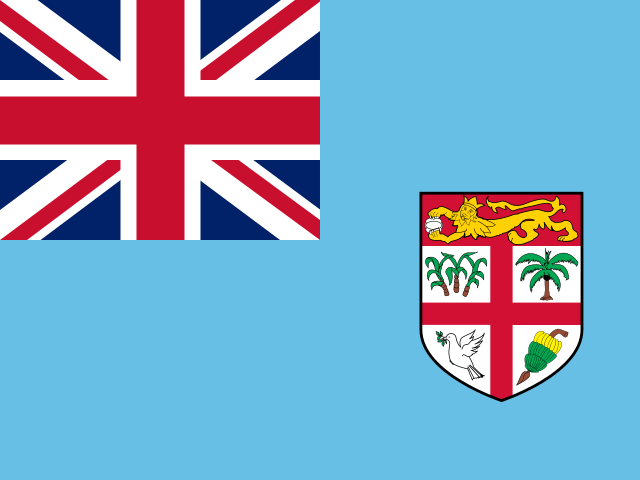
A light-blue field with the Union Jack in the canton and the shield from Fiji's coat of arms in the fly. The shield is white, divided by a red Cross of Saint George, with sugar cane, a coconut palm, a dove of peace holding an olive branch and a bunch of bananas in its quarters, beneath a golden lion holding a cocoa pod. No Fijian law assigns the colours a meaning: the 2013 Constitution does not mention the flag, and the National Flag Protection Act 2015 describes no design. The designer, Tessa Mackenzie, said she chose the pale blue to represent the sea.
Source: parliament.gov.fj
Fiji FACTS ◢
| Capital | Suva |
|---|---|
| Continent | Insular Oceania |
| Population | 933,154 (2025) |
| Area | 18,274 km² |
| Population density | 51/km² |
| Currency | Fijian dollar (FJD) |
| Main languages | English, Fiji Hindi, iTaukei |
| Calling code | +679 |
| Internet TLD | .fj |
| Time zone | UTC+12:00 |
| Drives on the | Left |
| ISO codes | FJ / FJI |
DID YOU KNOW? ◢
- It's made up of more than 300 islands, though only around a third are inhabited.
- Rugby sevens is the national obsession, and Fiji won Olympic gold in the sport's debut in 2016.
- The 180th meridian passes through it, placing it among the first places on Earth to greet each new day.
- Traditional kava, a drink made from a pepper plant root, is central to its social ceremonies.
Fiji QUICK ANSWERS ◢
What is the capital of Fiji?
The capital of Fiji is Suva.
What is the population of Fiji?
Fiji had a population of 933,154 in 2025.
What currency does Fiji use?
Fiji uses the Fijian dollar (FJD).
What languages are spoken in Fiji?
Fiji designates no official language. The languages of government and education are English, Fiji Hindi and iTaukei.
Think you know your flags? Play Flag Daily → · Browse all countries →
MORE ON THE FLAG ◢
The Fiji flag carries the Union Jack in its top corner, and Fiji is a republic whose head of state is a president. That combination is rare enough to look like an oversight. It is not.
It very nearly ended. In 2015 the Fijian Parliament passed an Act whose first stated objective was to "provide for the declaration of a new Fijian national flag". A competition drew 1,430 entries by the government's count, a shortlist of 23 designs was published, and a date was booked for the replacement to fly.
Then the Prime Minister called it off, on 17 August 2016. The flag over Suva is still the one first raised on 10 October 1970.
Key Takeaways
- Fiji's 2013 Constitution never mentions the flag. It carries no national symbols provision at all.
- Parliament passed the National Flag Protection Act 2015 so that a replacement flag could be declared. That declaration was never made.
- The competition closed on 1 May 2015 with 1,430 entries announced, cut to a shortlist of 23 designs.
- The explanatory notes to Fiji's own 2015 bills name the colonial elements: the Union Jack, the Cross of Saint George and the golden lion.
- Neither the 2013 Constitution nor the only Act devoted to the flag gives the light blue a meaning. The designer said she chose it to represent the sea.
- Section 14 of that Act would have put any later change behind a three-quarters parliamentary majority and a referendum carried by three-quarters of every registered voter.
Why does the Fiji flag have the Union Jack?
Because the two people who designed it in 1970 chose to put it there, and no government has since taken it out.
It came out of a competition run in the rush before independence. The Fijian government's own description of the flag, quoted on Flags of the World, records the outcome plainly: the design "was selected as the result of a competition won jointly by Mr. Robi Wilcock and Mrs. Murray MacKenzie". Two entrants had arrived at the same idea separately.
That record names the winner by her husband's name. She is Tessa Mackenzie, and in 2008 she explained her thinking to the Fiji Times, in a profile by Sophie Foster that Flags of the World reproduces in full. She kept the Union Jack because, as she put it, "this was the mood of the time". Her field was "a pale blue background to represent the sea".
Ratu Sir Kamisese Mara, chief minister at independence, described the design in his memoir The Pacific Way, published in 1997 with the University of Hawai'i Press among the imprints on its Open Library record. That passage reaches this article at two removes, and it is worth saying so: the same Fiji Times profile quotes the book, and Flags of the World reproduces the profile. In it, Mara has the two entrants producing identical designs with the Union flag in the top left quarter and the shield in the fly, "all on a background of Pacific blue". He adds that the pale shade "differentiated us from the dark blue of a number of our Pacific neighbours".
What is on the shield of the Fiji flag?
Four charges, a red cross and a lion, all of which belong to Fiji's coat of arms first and reach the flag second.
Fiji's own description of the arms, as quoted on Flags of the World, gives the lion "holding a cocoa pod across the top", with sugar cane, a coconut palm and a bunch of bananas in three of the shield's sections. A dove of peace fills the remaining one.
Two things usually get left out.
The first is the cross. The shield is white and divided by a red Cross of Saint George, with the four charges in its quarters. The heraldic description Christopher Southworth published on Flags of the World opens "Argent, a Cross Gules overall" and closes with "a Lion passant guardant Or, holding between its forepaws a Cocoa pod proper". The cross is the second of the three things Fiji named when it tried to strip the flag back in 2015.
That naming came in a bill, though not in a part of one that Parliament enacted. The explanatory note to the National Flag Protection Bill 2015, signed by the Attorney-General and prefaced "this note is not part of the Bill", lists "the Union Jack, including the Cross of Saint George and the golden lion on the Coat of Arms" as symbols "which belong to our former colonial ruler, the United Kingdom". The explanatory note to the Coat of Arms Bill 2015 says the same of the arms.
The second is where the dove comes from. It carries an olive branch, and the same government description traces it to "the Cakobau Government's flag before cession". That makes it the one charge on the shield that is not British in origin, and Flags of the World records Whitney Smith's 1985 reference work agreeing: the dove and the motto were both pre-colonial.
The two descriptions do not agree on the detail. Flags of the World records Whitney Smith's 1985 work calling what the lion holds a peeled coconut, where Fiji's own text and the blazon both say a cocoa pod, and the blazon puts the dove in the third quarter with the bananas in the fourth, where Fiji's text has the dove in the fourth.
Only the shield goes on the flag. The two Fijian warriors who support the arms stay off it, and so does the motto, Rere vaka na kalou ka doka na Tui, which Flags of the World renders as "Fear God and Honour the King".
Does any law say what the Fiji flag colours mean?
No. Neither the Constitution nor the only Act devoted to the flag assigns a meaning to the light blue, or to anything else on it.
Start with the Constitution. The 2013 Constitution of the Republic of Fiji is the country's supreme law, and its text does not mention the flag once. No flag, no coat of arms, no anthem. The words "flag", "emblem" and "symbol" appear nowhere in it.
The only Act of Parliament devoted to the flag describes no design either. Section 4 of the National Flag Protection Act 2015 has the Prime Minister declare a flag by notice in the Gazette, once and once only, since section 4(2) bars any further declaration under that subsection. The Act then protects whatever the notice names. It never says what the thing looks like.
Two limits on that finding are worth stating. It covers the instruments that define and protect the flag, read in full, rather than a search of every Fijian law. And the Act's own commencement clause leaves it to come into force on a date the Prime Minister appoints by notice in the Gazette; no such notice could be reached for this article, so whether the Act ever commenced is not established here.
The 1970 flag itself sits in a similar gap. No instrument declaring it was traced for this article, and the 2015 Act refers to it only as "the former Flag", meaning whatever was in use before the Act commenced. Flags of the World dates its adoption to 10 October 1970 and nothing in the two instruments read here fixes it.
Even the shade is unfixed. Christopher Southworth, writing for Flags of the World, reports that as far as he could discover no officially recommended or defined shades exist for Fiji's flag, which is why the reference books disagree over which Pantone blue to print.
Fiji's Pacific neighbours show how differently this can be done. Flags of the World reproduces the text the Cook Islands government publishes about its own flag: the constitution declares the ensign at Article 76C, and the schedule that goes with it gives every element a meaning. The Union Jack "indicates our historical association with and membership of the British Commonwealth", and the blue stands for the expanse of Pacific the islands are scattered across. Fiji has no equivalent text.
So "the light blue is the Pacific Ocean" is not a legal fact. It is the designer's stated intention, given in an interview thirty-eight years after she drew it, and it is the nearest thing to an authority that exists.
The closest thing to an official Fijian statement of what a flag's colours mean was written for a flag that never flew. The National Flag Committee issued a guide to the symbols in its 23 shortlisted designs of 2015, reproduced by the Portland Flag Association, which gave "Fiji Blue" as "peace, serenity, and freedom, as well as the Pacific Ocean" and yellow as "radiance, life, sustenance, and a new beginning". Those readings were written for the replacement, not for the flag on the pole.
How close did Fiji come to changing it?
Close enough to have a Bill, a committee, a shortlist and a date.
Entries closed at 4pm on 1 May 2015, and the government announced 1,430 of them, lodged at the Department of Information. Most arrived at the end, and Iliesa Delana, the assistant minister for sport who chaired the National Flag Committee, called the late surge "incredible".
How the committee worked is known first hand, because one of its members described it publicly. The vexillologist Ted Kaye, who sat on it alongside what Flags of the World calls a broad cross-section of Fijian community leaders, gave an account at the 26th International Congress of Vexillology which an attendee wrote up on Flags of the World: the committee spent two and a half days learning flag design principles, then cut the field to 167, to 47, to 20, to 10 and finally to five designs, which it handed to the government. The government went the other way, expanding the five to 12, to 24, and releasing 23.
One number in that account does not sit easily with the official one. Kaye put the pile at 2,000 submissions, against the 1,430 the government announced at the deadline, and said that total excluded 7,000 copies of the existing flag sent in by the opposition party. Nothing opened for this article reconciles the two counts.
The Bill's explanatory note fixed the moment: the new flag would be "declared by the Prime Minister by notice in the Gazette and hoisted on 10th October, 2015 at the Independence Day celebrations". Parliament passed the Act on 26 August 2015 and President Ratu Epeli Nailatikau assented five days later.
The Act would also have made the new flag far harder to replace than the old one. Section 14 allows a flag declared under section 4 to be altered only by an amending Act carried by three-quarters of Parliament and then confirmed at a referendum, a threshold set out below. No vote on whether to change the flag was ever offered, only a planned ballot on which design should replace it. A Tebbutt-Times poll reported by RNZ at the start of July 2015 found 53 per cent wanted the existing flag kept and at least 86 per cent would rather decide the question at the ballot box.
Then the timetable slid twice. By 7 July 2015 consultation had been extended to the end of the year. A media release published late in 2015 moved it again, to 29 February 2016: five designs would be chosen between 1 and 19 March, the public would vote on them for three months, the winner would be announced on 1 July and raised on Constitution Day, 7 September 2016.
None of it happened. Days after Fiji won Olympic gold in rugby sevens, Prime Minister Voreqe Bainimarama's statement of 17 August 2016 ended it. "It is a question of resetting national priorities as our people continue to recover from Tropical Cyclone Winston," he said, in a statement the Portland Flag Association reproduced in full. "The cost of any flag change is better spent at the present time assisting Fijians back on their feet."
Which other countries still fly the Union Jack?
Four other UN member states, and Fiji is the odd one out. The two flag columns below are drawn from each country's page on Flags of the World; the head-of-state column from each country's own constitutional text.
| Country | Head of state | Field behind the Union Jack | Device in the fly |
|---|---|---|---|
| United Kingdom | The flag is its own | The Union Jack is the whole flag | None |
| Australia | The Queen (constitution, section 61) | Dark blue, a British Blue Ensign | Commonwealth Star and Southern Cross |
| New Zealand | The Sovereign (Constitution Act 1986, section 2) | Dark blue, a British Blue Ensign | The Southern Cross in four stars |
| Tuvalu | The Sovereign (constitution, section 48) | Light blue | Nine yellow stars, one per island |
| Fiji | The President (2013 Constitution, section 81) | Light blue | Shield from the coat of arms |
That count is of UN member states only, and it is this article's own enumeration rather than a published list. Two more national flags carry the Union Jack outside that membership: the Cook Islands and Niue, self-governing and in free association with New Zealand.
Tuvalu is the closest match of the four, and the pair catches people out in flag quizzes.
The real difference is constitutional. Three of the other four are realms of the British Sovereign, and the fourth is Britain. Fiji is neither: its 2013 Constitution names a President as head of state, and the words Queen, Crown, majesty, monarch and Commonwealth appear nowhere in its text. That leaves Fiji flying another nation's flag in its canton with no constitutional tie to that nation at all.
Frequently asked questions
Has Fiji ever changed its flag?
Yes, at independence. The design first raised on 10 October 1970 replaced the colonial flag Fiji flew as a British dependency, and it is still the national flag as of August 2026. A second change was prepared in 2015, when Parliament passed the National Flag Protection Act 2015 and a competition drew 1,430 entries, but the Prime Minister cancelled it on 17 August 2016 and no new flag was ever declared.
Why is there a lion on the Fiji flag?
The lion belongs to Fiji's coat of arms, and the flag carries the shield from those arms. The explanatory note to Fiji's Coat of Arms Bill 2015 calls it "a golden lion which represents the United Kingdom, our former colonial ruler". Flags of the World records Whitney Smith's 1985 work dating the grant of the arms to Royal Letters Patent of 4 July 1908, confirmed on 30 September 1970, and the heraldic description it publishes has the lion "holding between its forepaws a Cocoa pod".
What does the dove on the Fiji flag mean?
It is a dove of peace holding an olive branch, and it is the oldest Fijian element on the flag. Fiji's own description of the arms records that it came from the flag of the Cakobau Government, which governed before cession to Britain.
What do the colours on the Fiji flag mean?
Neither the 2013 Constitution nor the only Act devoted to the flag assigns them a meaning: the Constitution does not mention the flag, and the National Flag Protection Act 2015 describes no design. The light blue is widely explained as the Pacific Ocean, which is the explanation the designer herself gave. Tessa Mackenzie told the Fiji Times in 2008 that she chose "a pale blue background to represent the sea".
Could Fiji change its flag now?
Nothing found for this article stands in the way of an ordinary Act of Parliament doing it. Section 14 of the National Flag Protection Act 2015 protects a flag declared under section 4 of that Act, and no such declaration could be traced: no Gazette notice, of the Act's commencement or of any declaration, was reachable for this article, and no new flag was ever raised.
Had one been made, a later change would have taken an amending Act read three times, supported at the second and third readings by three-quarters of the members of Parliament, with at least 30 days between those two readings and a committee report before the third, and then a referendum. The Act requires the President to assent where "three-quarters of the total number of the registered voters have voted in favour", a threshold counted against every registered voter rather than every vote cast, and section 14(1) allows no other route to a change.
Sources
- Constitute Project, Fiji's Constitution of 2013 - retrieved 14 August 2026.
- Parliament of the Republic of Fiji, National Flag Protection Act 2015 (Act No. 14 of 2015) - retrieved 14 August 2026.
- Parliament of the Republic of Fiji, National Flag Protection Bill 2015 (Bill No. 4 of 2015) - retrieved 14 August 2026.
- Parliament of the Republic of Fiji, Coat of Arms Bill 2015 (Bill No. 5 of 2015) - retrieved 14 August 2026.
- Flags of the World, Fiji - carries the Fijian government's flag and arms description, the Fiji Times profile of Tessa Mackenzie of 12 October 2008 and the shield's blazon - retrieved 14 August 2026.
- Flags of the World, Fiji: 23 designs for the new flag (2015-2016) - carries the write-up of Ted Kaye's account of the committee's work - retrieved 14 August 2026.
- Flags of the World, Cook Islands - retrieved 14 August 2026.
- Flags of the World, Niue - retrieved 14 August 2026.
- Flags of the World, United Kingdom, Australia, New Zealand and Tuvalu - the four other national flags in the comparison table - retrieved 14 August 2026.
- Constitute Project, Australia's Constitution of 1901 with amendments through 1985 and Tuvalu's Constitution of 1986 - retrieved 14 August 2026.
- New Zealand Parliamentary Counsel Office, Constitution Act 1986 - retrieved 14 August 2026.
- Xinhua, Fiji's national flag designing competition sees extensive participation, 1 May 2015 - retrieved 14 August 2026.
- RNZ, Fiji's PM insists flag change proposal is popular, 7 July 2015 - retrieved 14 August 2026.
- RNZ, Fiji PM says flag won't be changed, 18 August 2016 - retrieved 14 August 2026.
- Portland Flag Association, Fijian PM cancels plans to change flag, 18 August 2016 - reproduces the Prime Minister's statement of 17 August 2016 in full - retrieved 14 August 2026.
- Portland Flag Association, 23 (1st round) finalists for new Fiji flag, 9 June 2015 - reproduces the National Flag Committee's guide to the symbols in the shortlisted designs - retrieved 14 August 2026.
- Portland Flag Association, Fiji still looking for new flag designs, 18 January 2016 - reproduces the Fijian government's media release extending the feedback period - retrieved 14 August 2026.
- Open Library, The Pacific Way: a memoir, Ratu Sir Kamisese Mara, 1997 - the edition record lists three imprints, the University of Hawai'i Press among them - retrieved 14 August 2026.
PLAY ANOTHER →
One quote, one scrambled alphabet. Crack it before tomorrow.
CRACK THE QUOTEDAILYDaily CodeA short message, hidden in a different cipher every day.
ONE CIPHER A DAYDAILYGuess the CountryThree clues, three guesses. Work out where in the world it is.
THREE CLUESDAILYDaily TriviaFive questions a day. Everyone gets the same five.
FIVE QUESTIONS