
Tuvalu
One of the smallest and lowest-lying nations on Earth, Tuvalu is a scattering of nine tiny Pacific atolls whose highest point barely rises a few metres above the sea.
WHAT THE FLAG MEANS ◢
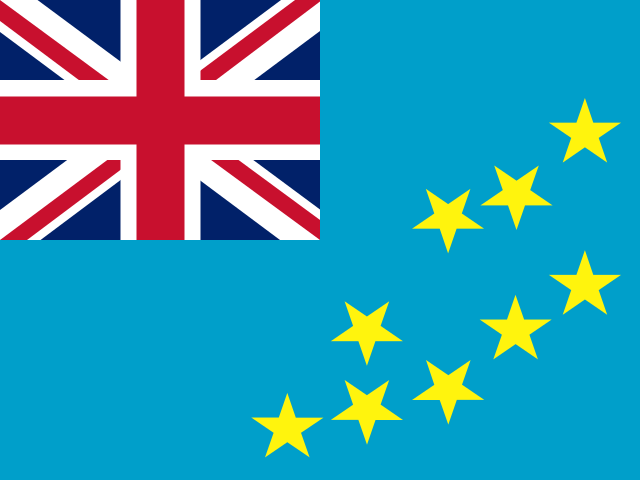
A light blue field with the Union Jack in the canton, reflecting Commonwealth ties, and nine yellow five-pointed stars arranged to map the country's nine islands.
Tuvalu FACTS ◢
| Capital | Funafuti |
|---|---|
| Continent | Insular Oceania |
| Population | 9,492 (2025) |
| Area | 26 km² |
| Population density | 365/km² |
| Currency | Australian dollar (AUD) |
| Official languages | English, Tuvaluan |
| Calling code | +688 |
| Internet TLD | .tv |
| Time zone | UTC+12:00 |
| Drives on the | Left |
| ISO codes | TV / TUV |
DID YOU KNOW? ◢
- It is one of the smallest countries in the world by both land area and population.
- Its highest natural point is only about 4.5 metres above sea level.
- It earns significant income by licensing its '.tv' internet domain, popular with television and streaming brands.
- The nation is made up of just nine coral islands scattered across the Pacific.
Tuvalu QUICK ANSWERS ◢
What is the capital of Tuvalu?
The capital of Tuvalu is Funafuti.
What is the population of Tuvalu?
Tuvalu had a population of 9,492 in 2025.
What currency does Tuvalu use?
Tuvalu uses the Australian dollar (AUD).
What languages are spoken in Tuvalu?
The official languages of Tuvalu are English and Tuvaluan.
Think you know your flags? Play Flag Daily → · Browse all countries →
MORE ON THE FLAG ◢
Tuvalu's flag is described in law, in two short paragraphs, and both are worth reading in full.
Paragraph 1 of Schedule 1 to the Tuvalu National Flag Act gives the design in two sentences: an azure blue background with nine yellow stars running diagonally across the right side from the top right-hand corner, and the Union flag in the top left. Paragraph 2 then gives four proportions, and that is the whole of the written description.
A star for each of the nine islands is a widely repeated reading, and it is not in the statute. Schedule 1 contains no mention of an island: no count, no naming, and no statement that a star stands for anything.
The country's own local-government statute, passed two years after the flag Act, establishes eight Falekaupule.
Key Takeaways
- Schedule 1 of the Tuvalu National Flag Act describes the flag without ever mentioning an island.
- The Flag Act's Schedule 1 describes the stars by number, colour and arrangement in paragraph 1, and paragraph 2 adds two proportions, a star width and a star area, and nothing else about them.
- The Flag Act fixes no point count in words, and the flag it reproduces in Schedule 2 draws the stars with five points.
- Section 4(1) of the Falekaupule Act establishes the eight Falekaupule listed in its Schedule 1, with Niulakita administered together with Niutao.
- Both of the Flag Act's schedules were substituted in 1997, fifteen months after it took effect.
| Provision | What it fixes | What it leaves unsaid |
|---|---|---|
| Flag Act, section 3 | The flag described in Schedule 1 and reproduced in Schedule 2 is the Tuvalu National Flag | Nothing about meaning |
| Flag Act, Schedule 1, paragraph 1 | Azure blue field, nine yellow stars diagonally across the right side, Union flag top left | Islands, symbolism, points per star |
| Flag Act, Schedule 1, paragraph 2 | Width:Height printed as 1:2, star area one half, star width about one twelfth of the flag's width, Union flag area one quarter | The colour values, and which way round the first ratio runs |
| Flag Act, section 4 | The Minister may authorise use of the design, plain or defaced | Any general public right |
| Falekaupule Act, Schedule 1 | Eight Falekaupule, six elected Kaupule members each | Any link to the flag |
Tuvalu's Flag Act describes an object and declares it
The Act is short: five sections and two schedules, in the 2008 Revised Edition published by Tuvalu's own legislation database as Cap. 4.40. Its long title opens "AN ACT TO DECLARE A CERTAIN FLAG TO BE THE TUVALU NATIONAL FLAG", and adds that it is for connected purposes. Section 3 does exactly that: "The flag described in Schedule 1 and reproduced in Schedule 2 is declared to be the Tuvalu National Flag."
Schedule 1 then describes it: "The Tuvalu National Flag has an azure blue background with nine yellow stars lying diagonally across the right side from the top right-hand corner. In the top left-hand corner is the Union flag."
That is a description of an object and nothing else. The Act names a colour for the field, a colour and a count for the stars, an arrangement, and a device in the canton, and it attaches no meaning to any of them. Section 3 then declares that object to be the national flag, which is the only work the Act sets out to do.
The second paragraph of the schedule is a proportions clause of four items. It gives the shape of the flag, then two areas and a width: the stars are to cover one half of it, the Union flag one quarter, and each star is to be about one twelfth of the flag's width.
That clause disagrees twice with the picture printed on the next page of the same Act. It gives the shape as "Width: Height - 1:2", in that order, which describes a flag twice as tall as it is wide, and the flag reproduced in Schedule 2 is plainly wider than it is tall. And it gives "Area covered by Stars: One half", where the nine stars drawn in Schedule 2 occupy nothing like half the cloth, though they do fall within roughly the half of it that the Union flag does not touch.
Neither is worth much on its own. Together they are a reminder that Schedule 1 is a written description of a thing the Act settles by printing it, and section 3 declares the flag "described in Schedule 1 and reproduced in Schedule 2" rather than either alone.
Nine stars, eight Falekaupule
Tuvalu's local-government statute is the Falekaupule Act, Cap. 4.08 in the same revised edition. Its section 4(1) provides that the Falekaupule listed in Schedule 1 are established and have the areas of authority specified there.
Schedule 1 lists eight, in alphabetical order: Funafuti, Nanumaga, Nanumea, Niutao, Nui, Nukufetau, Nukulaelae and Vaitupu. Each gets six elected members of its Kaupule.
The ninth place is in that table, but not as a Falekaupule of its own. The area of authority of the Falekaupule o Niutao is given as "Niutao and Niulakita atoll", so Niulakita is administered together with Niutao rather than separately.
So Tuvalu's law counts its island communities as eight, and there are nine stars on the flag, and none of the four Tuvaluan instruments read for this piece connects the two numbers, the Flag Act never mentioning Falekaupule, islands or atolls and the Falekaupule Act never mentioning the flag.
That does not make the island reading wrong. It makes it something other than a statutory fact, which is worth knowing on a question whose answer looks as though it ought to be in a statute.
Tuvalu's 2008 constitutional text counts no islands
Tuvalu's constitutional text, in the version the national legislation database carries as current, is the 2008 Revised Edition of the Constitution of Tuvalu, Cap. 1.02. It contains no flag provision of any kind.
It also declines to define the country by counting its islands. Section 2 sets the area of Tuvalu by four lines on a chart: the land areas consist of all islands, rocks and reefs within the area bounded by the parallel 05°S, the meridian 180°E, the parallel 11°S and the meridian 176°E, "together with all small islands, islets, rocks and reefs depending on them".
That is a rectangle of ocean with everything inside it, plus whatever further lands and waters a law declares to be part of Tuvalu. A definition drafted that way has no island count anywhere in it for a flag to match.
The preamble it recites from the Independence Constitution does supply a date worth having. It records that on 1 October 1975 the Ellice Islands were established as a separate colony "under their ancient name of Tuvalu", three years before independence. The name is older than the state, and older again than the statute that describes the flag.
Both of the Flag Act's schedules were replaced in 1997
The most revealing part of the Act is its endnotes, which are where a consolidated statute keeps its history.
They record that the Act is Act 4 of 1995, in force from 22 December 1995 by Legal Notice 14 of 1995, and that it was amended by Act 2 of 1997, in force from 11 April 1997 by Legal Notice 4 of 1997. Against Schedule 1 and against Schedule 2, separately, the endnotes then print the same six words: substituted by Act 2 of 1997.
So the written description and the reproduced image were both replaced fifteen months after the Act took effect, and the text quoted above is the 1997 one.
The original schedules cannot be recovered from the consolidated edition, which prints only the current version, and the 1997 amending Act is not separately listed in the database's index. That leaves the change and its date on the record, and what it changed from off it.
The two endnotes record a substitution and no extent, so they do not distinguish a corrected phrase from a new description. What it establishes is that the text in force from April 1997 replaced the text before it.
The 2026 Rules on flying the flag, and on using it commercially
Section 5 of the Act lets the Minister make rules for the flying and use of the flag, and in 2026 that power was used. The Tuvalu National Flag Rules 2026 were made under section 5 and came into effect on 1 July 2026, so they are now in force.
Rule 2 is about dignity. The flag "shall be honoured and treated with the utmost respect, and it shall not be subjected to any indignity". A flag that has become frayed by ordinary wear "shall not be displayed and should be retired in a dignified manner to avoid any misuse or desecration thereof".
Rule 3 requires the flag to be flown from a list of State or Government buildings: the Governor-General's residence, the Prime Minister's residence, Kaupule offices, primary and secondary schools, police stations and the premises of the Police Services, airports, and any other public or private premises of prominence the Minister designates. It may also fly from vessels and vehicles in official government service.
The same rule sets out half-mast mourning for the Governor-General and former Governors-General, the Prime Minister and former Prime Ministers, Ministers, current and former Members of Parliament, the Head of the Falekaupule under the Falekaupule Act, and any other person the Minister approves from time to time. The ceremonial flag is then "folded and gifted to the deceased’s next of kin as a token of the nation’s gratitude".
Rule 5 closes off commerce. The flag or any part of it may not be used in a trademark or logo, for advertising, or for any commercial purpose, except with the Minister's prior written approval. Section 4 of the Act runs alongside it, letting the Minister authorise a person, body or authority to use the design "either without defacement or defaced in the manner specified in the notice" - the power under which a defaced version of the national design can be authorised.
If you want to find out whether you could pick this flag out of a line-up of blue ensigns, a daily flag round gives you three guesses at one flag, and three written clues and no flag at all removes the canton as a shortcut.
Frequently asked questions
What do the nine stars on the Tuvalu flag mean?
None of the four Tuvaluan instruments read for this piece says. Schedule 1 of the Tuvalu National Flag Act describes the stars by number, colour and arrangement, as nine yellow stars lying diagonally across the right side of the flag from the top right-hand corner, and its paragraph 2 adds two proportions, a star width and a star area, and nothing else about them. None of it assigns them a meaning or an island, and it gives no number of points.
Nothing in the statutes contradicts an island reading, and none of them states one. The Falekaupule Act, which is where Tuvalu's law does enumerate its island communities, establishes eight of them and never mentions the flag.
Why does Tuvalu's flag have the Union Jack on it?
The Tuvalu National Flag Act does not say. Its Schedule 1 puts what it calls "the Union flag", the flag of the United Kingdom, in the top left-hand corner and gives it one quarter of the area, without a reason and without mentioning the Commonwealth or the Crown.
The constitutional preamble does record the colonial sequence, without connecting it to the flag: the islands came under British protection in September 1892, on 12 January 1916 became known, in conjunction with the Gilbert Islands, as the Gilbert and Ellice Islands Colony, and were established as a separate colony under the name Tuvalu on 1 October 1975.
Are the stars on Tuvalu's flag five-pointed?
The Flag Act's Schedule 1 does not say, and its Schedule 2 does. The written description fixes the number at nine, the colour as yellow, the arrangement as diagonal across the right side, and the width of each star as approximately one twelfth of the width of the flag, without ever giving a number of points. The flag reproduced in Schedule 2, which section 3 makes equally part of the declaration, draws them with five.
Did Tuvalu change its flag?
The Tuvalu National Flag Act's endnotes record that both of its schedules, the written description and the reproduced image, were substituted by Act 2 of 1997, in force from 11 April 1997. What that substitution changed cannot be read from the consolidated edition, which prints only the current text, so the endnotes establish that a replacement happened and leave open whether the design changed.
So the description in force today is the 1997 one, and it replaced something.
Can you use the Tuvalu flag on a product?
Not without permission. Rule 5 of the Tuvalu National Flag Rules 2026 provides that the flag or any part of it shall not be used in any trademark or logo, for any advertising purpose, or for any commercial purpose, except with the prior written approval of the Minister. The Rules came into effect on 1 July 2026 and are in force.
Sources
- Government of Tuvalu, Tuvalu National Flag Act, Cap. 4.40, 2008 Revised Edition - sections 3 to 5, Schedules 1 and 2, and the endnotes. Retrieved 26 August 2026.
- Government of Tuvalu, Tuvalu National Flag Rules 2026 - rules 1 to 5. Retrieved 26 August 2026.
- Government of Tuvalu, Falekaupule Act, Cap. 4.08, 2008 Revised Edition - section 4(1) and Schedule 1. Retrieved 26 August 2026.
- Government of Tuvalu, The Constitution of Tuvalu, Cap. 1.02, 2008 Revised Edition - the preamble and section 2. Retrieved 26 August 2026.
PLAY ANOTHER →
One thing that happened today in history. Every day, a new one.
TODAY IN HISTORYDAILYDaily TriviaFive questions a day. Everyone gets the same five.
FIVE QUESTIONSDAILYDaily CodeA short message, hidden in a different cipher every day.
ONE CIPHER A DAYDAILYDaily CryptogramOne quote, one scrambled alphabet. Crack it before tomorrow.
CRACK THE QUOTE