
United Kingdom
An island nation off Europe's coast whose empire, engines and English once spanned the globe. The UK stitches together England, Scotland, Wales and Northern Ireland under one crown.
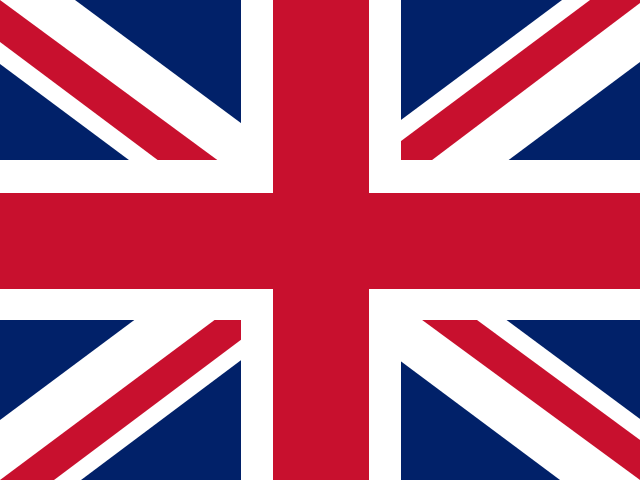
WHAT THE FLAG MEANS ◢
A blue field carrying the red cross of St George, the white saltire of St Andrew and the red saltire of St Patrick, the two saltires counterchanged so that the flag has a right way up. The royal proclamation of 1 January 1801 that created it is a blazon: it fixes the tinctures and the geometry and assigns the crosses and the colours no meaning at all. England, Scotland and Ireland are named in that proclamation only against the quarters of the coat of arms, never against a cross, so the familiar reading of the three crosses is conventional rather than official. Wales has no element because it was not a separate kingdom to be united.
Source: thegazette.co.uk
United Kingdom FACTS ◢
| Capital | London |
|---|---|
| Continent | Europe |
| Population | 69,487,000 (2025) |
| Area | 242,495 km² |
| Population density | 287/km² |
| Currency | Pound sterling (GBP) |
| Main language | English |
| Calling code | +44 |
| Internet TLD | .uk |
| Time zone | UTC±00:00 |
| Drives on the | Left |
| ISO codes | GB / GBR |
DID YOU KNOW? ◢
- It's made up of four nations: England, Scotland, Wales and Northern Ireland.
- The Industrial Revolution began here in the 18th century, reshaping how the whole world works.
- London's Underground, opened in 1863, was the world's first underground passenger railway.
- It has no single written constitution, relying instead on centuries of accumulated law and convention.
United Kingdom QUICK ANSWERS ◢
What is the capital of the United Kingdom?
The capital of the United Kingdom is London.
What is the population of the United Kingdom?
The United Kingdom had a population of 69,487,000 in 2025.
What currency does the United Kingdom use?
The United Kingdom uses the Pound sterling (GBP).
What languages are spoken in the United Kingdom?
The United Kingdom designates no official language. The language of government and education is English.
Think you know your flags? Play Flag Daily → · Browse all countries →
MORE ON THE FLAG ◢
The United Kingdom's flag was created by one sentence in a royal proclamation dated 1 January 1801. Here is the whole of it:
"And that the Union Flag shall be Azure, the Crosses Saltires of St. Andrew and St. Patrick Quarterly per Saltire, counterchanged Argent and Gules; the latter fimbriated of the Second, surmounted by the Cross of St. George of the Third, fimbriated as the Saltire".
That is a blazon. It fixes a blue field, two diagonals, one upright cross and two white borders, in the technical language of heraldry. It assigns no meaning to any cross and no meaning to any colour. It does not even say which country each cross belongs to.
Key Takeaways
- The flag was defined by a royal proclamation of 1 January 1801, published in The London Gazette. The definition is one sentence of heraldry and it assigns the design no meaning at all.
- Neither Act of Union drew the flag. Each handed the design to the monarch instead, in 1706 and again in 1800, and in 1707 the monarch kept what was already flying.
- Wales has no element on the flag because it was never a separate kingdom to be united with. An Act of 1535 had already declared it annexed to the realm of England.
- The line that Parliament settled the flag's name in 1908 overstates the record. A minister answered a question in the Lords, and his words were "should be regarded as".
- There is no legal specification for the flag's proportions or its colours. The recommended shades come from a charity, and one of the three is not specified at all.
What does the United Kingdom flag mean?
Officially, nothing. The instrument that created it declares a design and stops.
Read the 1801 sentence again and notice what it withholds. "Azure" is the field. "Argent and Gules" are white and red. "Quarterly per Saltire, counterchanged" is the arrangement that makes the two diagonals swap colours across the four quarters, which is why the flag has a right way up and why it can be flown upside down. The word fimbriated means edged with a narrow border, and the border is white in both cases.
None of that is a meaning. It is a set of drawing instructions.
The proclamation does name the three countries, but in the description of the coat of arms, not the flag: the arms are to be "Quarterly; First and Fourth, England; Second, Scotland; Third, Ireland". Immediately afterwards it turns to the flag and names only saints. The reading that gives St George to England, St Andrew to Scotland and St Patrick to Ireland is entirely reasonable and entirely conventional. It is not in the document.
A flag can be defined without being explained, and when that happens the popular meanings fill the gap afterwards. What is striking here is how much confident symbolism has attached to a flag whose founding text is a single sentence.
Two Acts of Union, and neither one drew the flag
The most telling thing in the flag's history is what the statutes did not do.
When England and Scotland were united, the Treaty of Union did not describe the new flag. The Treaty was ratified on the English side by the Union with Scotland Act 1706, under which the two kingdoms were united on 1 May 1707, and its Article I said the arms should be as the Queen appointed, "and the Crosses of St. George and St. Andrew be conjoyned in such manner as Her Majesty shall think fit and used in all Flags Banners Standards and Ensigns both at Sea and Land".
Conjoined in such manner as she thinks fit. Parliament named the two crosses and left the drawing to the Crown. What Anne then did with that power was nothing: the Flag Institute records simply that "The Queen decided to keep the existing design." The flag of 1707 is the flag of 1606.
The same thing happened again when Ireland was added. Article First of the Union with Ireland Act 1800 declared the kingdoms united, then handed the symbols over in identical fashion: the royal style and titles, "and also the ensigns, armorial flags and banners thereof, shall be such as his Majesty, by his royal proclamation under the Great Seal of the United Kingdom, shall be pleased to appoint".
That delegation is why the 1 January 1801 proclamation exists at all, and the proclamation says so in its own opening words. The flag of the United Kingdom is not a statutory creation. It is the exercise of a power that two statutes handed to the Crown rather than settling it themselves.
| Instrument | What it fixed | Meaning assigned |
|---|---|---|
| Proclamation of 12 April 1606 | The crosses of St George and St Andrew joined, worn at the maintop | None |
| Proclamation of 5 May 1634 | The joined flag reserved to the King's own ships | None |
| Union with Scotland Act 1706, Article I | The two crosses to be conjoined as the Queen thinks fit | None |
| Union with Ireland Act 1800, Article First | Flags and banners to be as the King appoints by proclamation | None |
| Proclamation of 1 January 1801 | The full blazon of the present flag | None |
The first Union Flag, and the one that was taken away
The 1801 flag had a predecessor that lasted nearly two centuries.
James VI of Scotland became James I of England in 1603, and the two kingdoms stayed separate under one king. Their ships promptly began arguing at sea. The Flag Institute, the United Kingdom's vexillological charity, publishes the 1606 proclamation that settled it, which opens by reciting that "some difference has arisen between our Subjects of South and North Britain, Travelling by Sea, about the bearing of their flags".
The proclamation ordered subjects of the whole island to fly the red cross and the white cross "joined together, according to a form made by our Heralds and sent by Us to our Admiral to be published to our said Subjects". Ships of South Britain kept the red cross alone at the foretop, and ships of North Britain the white cross alone, so the new flag was an addition rather than a replacement.
The accompanying design has not survived. The proclamation does not describe it either: it orders the crosses joined "according to a form made by our Heralds" and leaves the form to the drawing. The Flag Institute reproduces the design that was chosen, and notes that even the width of the white fimbriation is uncertain, inferred from surviving flags of the period.
Then in 1634 Charles I took it back. The Flag Institute publishes that proclamation too, in which the King prohibited and forbade that "none of Our Subjects, of any of Our Nations and Kingdoms, shall from henceforth presume to carry the Union Flag in the Main top", reserving it for his own ships. For the rest of that reign the Union Flag was not a national flag that anybody could fly. It was a mark of royal service.
The flag lapsed entirely with the reign itself. The execution of Charles I on 30 January 1649 put a temporary end to the union of the two Crowns and made the Union Flag redundant with it. Several patterns were flown in its place until May 1660, when the restoration of Charles II brought the pre-1649 flags back.
If you are used to seeing the flag as a permanent fixture, the seventeenth-century version is a surprise: created to stop a quarrel, withdrawn from the public once, and out of use altogether for eleven years.
Why is Wales not on the Union Jack?
Because there was no Welsh kingdom left to unite with by the time anyone drew a flag for a union.
The Laws in Wales Act 1535 opens by asserting that Wales "is and ever hath ben incorporated annexed united and subjecte to & under the Imperiall Crowne of this Realme". The spelling is original. So is the tense: the Act does not annex Wales, it declares that Wales has always been annexed, and proceeds from there to extend English law and English courts across the country.
Seventy-one years later, the 1606 proclamation joined the flags of two realms. Wales was not one of them, because on the Act's own account it had not been a separate realm at any point. The later instruments inherited that position without revisiting it.
The 1706 Act is not quite silent, and the way it breaks silence makes the point better than absence would. It names Wales in a clause preserving the Church of England within "the Kingdoms of England and Ireland the Dominion of Wales and Town of Berwick upon Tweed": a dominion, listed between a pair of kingdoms and a town. The 1801 proclamation does not mention Wales at all. The only Wales on either of the proclamation's two Gazette pages is the title of the Prince of Wales, and it belongs to a Privy Council notice printed in the column beside the proclamation, not to the proclamation itself.
There is a small epilogue. What remained of the 1535 Act stayed on the statute book until it was repealed on 21 December 1993. The sentence that explains the flag's shape outlived the flag's most recent redesign by nearly two centuries.
Y Ddraig Goch, the red dragon Wales flies today, has never had an instrument that could put it on the Union Flag, because every instrument that has ever altered the flag was an instrument uniting kingdoms. If you want to see how differently a flag reads once you know what its designers were told to include, Australia's flag is a useful comparison: it carries the Union Jack in its canton and adds stars that its own government does explain.
Whose cross is the red saltire?
This is the part of the flag with the shakiest paperwork.
The 1801 proclamation names it only in passing, as one of "the Crosses Saltires of St. Andrew and St. Patrick", and says nothing about where it came from. That is the entire official record of its origin.
The Flag Institute's account is that the College of Arms designed the new flag and symbolised Ireland with a red saltire on white drawn from two sources, the insignia of the Order of St Patrick founded in 1783 and the arms of the Fitzgerald family, whom it describes as "longtime allies of British rule". It adds a dry note that the saltire "subsequently became known as the cross of St Patrick (although the saint was not a martyr and not in fact entitled to a cross)".
Take that as what it is: an expert body's history, not a statement in the instrument. Nothing in the proclamation, in the 1800 Act or in the Treaty of Union supports or contradicts it. The honest position is that the flag's red diagonal was named after a saint who had no traditional cross of his own, by a document that offered no explanation, and that the best available account of the choice comes from vexillologists rather than from the Crown. Ireland's own flag today is a green, white and orange tricolour, and the Ireland factsheet is the place to see it beside this one.
Union Jack or Union Flag, and what really happened in 1908
Both names are correct, and the story usually told about how that was settled is slightly wrong.
The Flag Institute traces jack to a small flag flown from a staff on the bowsprit, records the Admiralty acknowledging both a formal and an informal name for the flag by 1674, and notes that an Admiralty Circular of 1902 pronounced either name valid. Then it says that "in 1908 Parliament approved this verdict".
The 1908 record does not read like an approval by Parliament. The Institute's own sentence goes on to quote the words "The Union Jack should be regarded as the National flag", which are the minister's, so the verdict it credits to Parliament is his. What the record holds is a short exchange in the House of Lords on 14 July. Earl Howe asked the Government "whether it is a fact that the full Union Jack may be flown on land by every citizen in the Empire as well as on Government Offices and Public Buildings". The Earl of Crewe replied for the Government:
"I think it may fairly be stated, in reply to the noble Earl, that the Union Jack should be regarded as the National flag, and it undoubtedly may be flown on land by all His Majesty's subjects."
One question, one ministerial answer, one further remark. No vote, no resolution, no statute. A minister's opinion, hedged twice over with "I think it may fairly be stated" and "should be regarded as", is the strongest designation the flag has ever been given in Parliament.
The exchange also preserves a detail that gets lost. The Earl of Meath, welcoming the answer, added that "I have known of some instances in this country where the Union Jack has actually been pulled down by the police". Howe had put his question "with a view to removing any possible doubt that may exist on the subject" without saying what the doubt was. Crewe located it in a confusion in the public mind "as to what flags may be flown and what may not", above all a belief "that the Royal Standard could be flown anywhere and by anybody". Meath's is the only remark in the exchange that names an actual incident.
The United Kingdom flag has no legal specification
Today the Government describes the flag without defining it. Its guidance for government buildings states that "The Union Flag is the national flag of the United Kingdom of Great Britain and Northern Ireland, the Crown Dependencies and the Overseas Territories" and dates the design correctly, noting that "The first Union Flag was created in 1606 and combined the flags of England and Scotland; the present Union Flag dates from 1801". It then moves on to which days it must be flown, which is the only part with rules.
The measurable specification comes from the Flag Institute, which recommends 30 units wide by 50 units long, diagonals six units wide split white three, red two and white one, a six-unit red cross with a two-unit white fimbriation, and colours of "Pantone 280 C (royal blue); Pantone 186 C (red); no specification (white)". Note the last item. The body that wrote the specification declines to specify one of its three colours, and no enacted standard fills the gap.
The Flag Institute introduces its own specification by calling the flag the world's "only national flag that has no basis in law", and records that it "has tried without success to give the Union Flag a basis in law, most recently in the Union Flag Bill (2008)".
That description is worth reading precisely. A royal proclamation under the Great Seal is a legal instrument, and the 1801 blazon was made under the power Article First of the 1800 Act expressly conferred. What the flag lacks is not legal authority for its design but a current, measurable, enacted specification. The design has authority. The dimensions and the shades are convention, custom and a charity's recommendation.
Which brings the whole thing back to where it started. The Union Jack means what people have agreed it means, and no instrument exists that could settle an argument about what it stands for. If you want to test how much of a flag you actually know by sight rather than by story, Flag Daily gives you one flag a day and three guesses at the country.
Frequently asked questions
What do the three crosses on the Union Jack stand for?
By long convention the red upright cross is St George for England, the white diagonal is St Andrew for Scotland and the red diagonal is St Patrick for Ireland. No instrument says so. The royal proclamation of 1 January 1801 that defines the flag names the three saints and assigns them no countries and no meanings, and no later instrument has supplied any.
Why is Wales not represented on the Union Jack?
Because Wales was not a separate kingdom when the flag was designed. The Laws in Wales Act 1535 declared that Wales was already incorporated and annexed to the Crown of the realm of England, so when the flags of two realms were joined in 1606, and when Ireland was added in 1801, there was no Welsh kingdom in the union to record. Wales does appear in the 1706 Act, but as a dominion in a clause about the Church of England rather than as a kingdom entering a union. The 1801 proclamation does not mention it at all.
Is the Union Jack defined in any UK law?
Not in a statute. Two Acts of Union expressly declined to specify the flag and handed the design to the monarch instead, and the design was then set by royal proclamation on 1 January 1801. That proclamation is a legal instrument, but it fixes only the heraldic blazon. Proportions and exact colours have never been enacted; the Flag Institute calls the flag the world's only national flag with no basis in law and has tried without success to give it one.
Is it correct to say Union Jack or Union Flag?
Both are correct. The Admiralty was using the two names interchangeably by the seventeenth century, an Admiralty Circular of 1902 pronounced either valid, and in 1908 a Government minister told the House of Lords that the Union Jack should be regarded as the national flag. The Flag Institute states plainly that vexillologists know either name to be valid.
Can the Union Jack be flown upside down?
Yes, and the mistake is easy to make, because the two diagonals are counterchanged rather than symmetrical. The 1801 blazon puts the saltires "Quarterly per Saltire, counterchanged", so the broad white band sits above the red on one side of each diagonal and below it on the other. Flown correctly, the broader white diagonal is uppermost on the side nearest the flagpole.
Sources
- The London Gazette, issue 15324, pages 2 to 3 - the royal proclamation of 1 January 1801 declaring the royal style and titles and the ensigns, armorial flags and banners of the United Kingdom, including the blazon of the Union Flag. Quoted from the page scan rather than from the automatic text layer, which misreads the printed long s and renders fimbriated as "iimbtiated" and Saltires as "Saltircs". Note that The Gazette dates the issue itself to the end of December 1800; the proclamation carries its own date of 1 January 1801, which is the date used here. Retrieved 13 August 2026.
- legislation.gov.uk, Union with Ireland Act 1800, Article First - the delegation of the flag to royal proclamation. Retrieved 13 August 2026.
- legislation.gov.uk, Union with Scotland Act 1706, Article I - the English Parliament's ratification of the Treaty of Union, under which the two kingdoms were united on 1 May 1707, with the crosses of St George and St Andrew to be conjoined as the Queen thinks fit. Retrieved 13 August 2026.
- legislation.gov.uk, Laws in Wales Act 1535 - the preamble declaring Wales incorporated and annexed, repealed 21 December 1993. Retrieved 13 August 2026.
- Hansard, House of Lords, The Flying of the Union Jack, 14 July 1908, vol 192 cc579-80 - Earl Howe's question and the Earl of Crewe's reply. Retrieved 13 August 2026.
- The Flag Institute, History of the Union Flag - the account of the St Patrick saltire, Anne's decision in 1707, and the 1649 to 1660 lapse. The 1606 and 1634 proclamations are quoted here from the Institute's transcriptions, which modernise the original spelling; no original print of either was consulted. Retrieved 13 August 2026.
- The Flag Institute, Union Flag Specification - the recommended geometry, proportions and Pantone colours. Retrieved 13 August 2026.
- The Flag Institute, Union Jack or Union Flag? - the naming history and the 1902 Admiralty Circular. Retrieved 13 August 2026.
- GOV.UK, Union Flag flying guidance for UK government buildings - the current Government description of the flag and the designated days. Retrieved 13 August 2026.
PLAY ANOTHER →
A short message, hidden in a different cipher every day.
ONE CIPHER A DAYDAILYDaily CryptogramOne quote, one scrambled alphabet. Crack it before tomorrow.
CRACK THE QUOTEDAILYDaily TriviaFive questions a day. Everyone gets the same five.
FIVE QUESTIONSDAILYOn This DayOne thing that happened today in history. Every day, a new one.
TODAY IN HISTORY