
Ireland
A green Atlantic island of misty hills and outsized cultural reach, Ireland has given the world four Nobel literature laureates and a saint's day the whole planet celebrates.
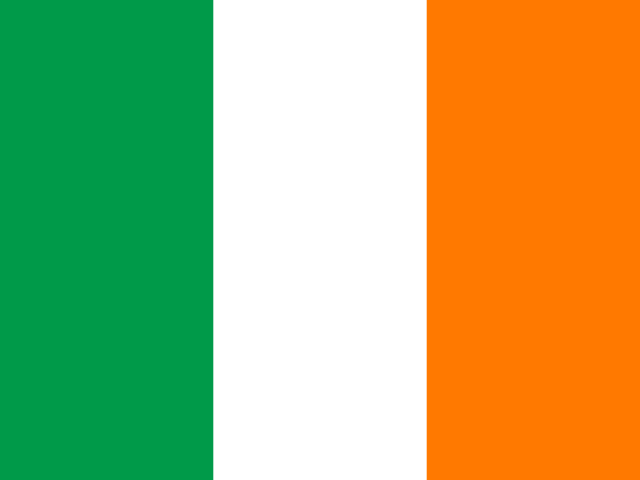
WHAT THE FLAG MEANS ◢
Three equal vertical bands of green, white and orange. Article 7 of the constitution is the whole of the law on it: in English, the national flag is the tricolour of green, white and orange, and no colour is assigned a meaning. The white was given one in 1848, when the flag was presented in Dublin and the white in the centre was called a lasting truce between the orange and the green. The flag as a whole is officially read as a symbol of inclusion and of hoped-for union between the island's different traditions.
Source: irishstatutebook.ie · checked 2026-08-19
Ireland FACTS ◢
| Capital | Dublin |
|---|---|
| Continent | Europe |
| Population | 5,484,367 (2025) |
| Area | 69,797 km² |
| Population density | 79/km² |
| Currency | Euro (EUR) |
| Official languages | English, Irish |
| Calling code | +353 |
| Internet TLD | .ie |
| Time zone | UTC±00:00 |
| Drives on the | Left |
| ISO codes | IE / IRL |
DID YOU KNOW? ◢
- St Patrick's Day is celebrated in more countries than any other national festival.
- Ireland has produced four Nobel Prize winners in Literature, including W.B. Yeats and Samuel Beckett.
- The Cliffs of Moher rise more than 200 metres straight out of the Atlantic.
- Halloween traces back to the ancient Celtic festival of Samhain.
- Newgrange, a passage tomb in the Boyne Valley, is older than Stonehenge and the pyramids of Giza.
Ireland QUICK ANSWERS ◢
What is the capital of Ireland?
The capital of Ireland is Dublin.
What is the population of Ireland?
Ireland had a population of 5,484,367 in 2025.
What currency does Ireland use?
Ireland uses the Euro (EUR).
What languages are spoken in Ireland?
The official languages of Ireland are English and Irish.
Think you know your flags? Play Flag Daily → · Browse all countries →
MORE ON THE FLAG ◢
Green for one tradition, orange for the other, white for peace between them. That is the reading almost everyone gives of Ireland's tricolour, and no Irish instrument opened for this article contains it: not the constitution in either of its two languages, not the 1922 constitution before it, and no flag act, because on that record there is none. The constitution names the three colours in a single sentence and stops there. The Department of the Taoiseach's guidance on the flag says in its own words that there are no statutory requirements, and gives the flag a meaning as a whole while giving none to any single band.
One stripe is different. The white was explained, on a datable day, by the man who presented the flag to a Dublin banquet after carrying it back from revolutionary Paris. He explained the white and only the white, and he opened by saying that he would not explain the rest.
There is a second oddity, and it is hiding inside the constitution. Article 7 exists in two languages, the Irish text prevails over the English one where they conflict, and the Irish text does not use the words for green and orange that the state's own flag guidance reaches for when it describes them. That guidance names the three colours in Irish in one sentence, and quotes the constitution's different words for them two sentences later.
Key Takeaways
- Article 7 of Bunreacht na hÉireann is a single sentence naming the three colours. It assigns no meaning to any of them, and it is the only article of the constitution that mentions the flag.
- The constitution has an Irish text and an English text, and Article 25.5.4 gives the Irish one priority in a conflict. The Irish text calls the bands uaine, bán and flannbhuí. The state's own flag guidance uses those words when it quotes Article 7 and glas and oráiste when it describes the colours in its own words.
- There is no Irish flag act. The Department of the Taoiseach's guidelines state that there are no statutory requirements and that the department's role is advisory, and no Bill in the Oireachtas database since 1922 has proposed one, on a scan of Bill titles.
- No deputy spoke to Article 7 when the Dáil agreed it in committee on 25 May 1937. The only description of the colours anywhere in the debates is Éamon de Valera's own, made in Irish on 11 May, and it uses the constitution's words rather than the guidance's.
- Thomas Francis Meagher explained the white stripe in Dublin on 14 April 1848, and prefaced it by saying he need not explain the flag's meaning.
| Document | Date | What it does about the flag | Meaning it assigns to a colour |
|---|---|---|---|
| Meagher's presentation speech, Music Hall, Dublin | 14 April 1848 | Presents a tricolour brought from Paris | The white only |
| Constitution of the Irish Free State | 1922 | Nothing. The word flag does not appear in it | None |
| Bunreacht na hÉireann, Article 7 | 1937 | Names the tricolour as the national flag, in one sentence | None |
| The National Flag, Department of the Taoiseach | Published 2018, last updated 22 September 2025 | Advisory guidance on design and display | None per colour. A reading of the flag as a whole |
The Irish text of Article 7 uses two colour words the state's guidance does not use when it describes them
Article 7 of the English text is eleven words long: "The national flag is the tricolour of green, white and orange." That is the whole of it. The word tricolour appears in the English text of the constitution once, in that sentence.
The Irish text of the same article reads "An bhratach trí dhath .i. uaine, bán, agus flannbhuí, an suaitheantas náisiúnta." The abbreviation .i. stands for eadhon and does the work of the Latin id est. In English it says that the national emblem is the three-coloured flag, that is, uaine, bán and flannbhuí.
The interesting part is the colour words. Foclóir Gaeilge-Béarla, the standard Irish-English dictionary, gives uaine as "(Vivid) green" and, in its heraldic sense, as "Vert". The word a learner would reach for first is glas, which the same dictionary gives first as "Green (colour)" and then, in the next sense, as "Grey (colour)", and which it illustrates with grass, sod, foliage and field.
For the third band the Irish text has flannbhuí. That dictionary entry is one line long: "(Of colour) Orange." It is a compound of flann, given poetically as "Blood" and as an adjective as "(Blood-)red; bloody, sanguinary", and of buí, which the same dictionary gives as "Yellow". The other Irish word available is oráiste, which the same dictionary treats as the fruit and as the colour named after it.
None of that establishes why the drafters chose those two words rather than the two the state's guidance uses in its own descriptions, and no source opened for this article says. What the documents show is narrower and still worth having: the sentence with legal force uses uaine and flannbhuí, and the department that publishes guidance on the flag uses glas and oráiste.
Which of the two texts prevails when they differ
Article 25.5.4 of the constitution settles it: "In case of conflict between the texts of any copy of this Constitution enrolled under this section, the text in the national language shall prevail." The Irish text says the same thing in its own words, ending "is ag an téacs Gaeilge a bheidh an forlámhas". Article 8 sets up that hierarchy in the first place, making Irish the first official language and English the second.
The priority was live in the chamber in the minutes before the flag article passed. On 25 May 1937 Patrick McGilligan pressed Éamon de Valera on the reliability of the Irish text and asked "Is not the aim to have this eventually determined by Irish-speaking lawyers in the courts operating on Irish texts?" De Valera's answer, in the record, is two words: "It is."
That exchange concerned a different article, and nothing about the flag has ever turned on the difference. The mechanism is still the point. When a reader asks what the Irish constitution calls the colours of the national flag, the answer with priority is uaine, bán and flannbhuí.
The state's guidance names the colours in Irish in two different sets of words
The Department of the Taoiseach publishes a bilingual booklet called The National Flag. It sets English and Irish in parallel columns, and both columns open on the same fact. The English column says the flag "consists of three colours" and names them as green, white and orange.
The Irish column, in the same paragraph, names them "glas, bán agus oráiste".
Two sentences later the same Irish column quotes Airteagal 7 correctly, as uaine, bán and flannbhuí. The technical data panel a few pages on repeats glas and oráiste, this time beside the Pantone references. A reader of the Irish column is therefore given the colours more than once, in two different sets of words, one of which is the constitution's and one of which is not.
The same booklet fixes the design in numbers the constitution never mentions. The proportion is given as "Proportion = 2:1", each colour as "1/3 of width", and the colours themselves as "Green = pms 347" and "Orange = pms 151". Yellow or gold in place of orange is called "a misrepresentation of the National Flag" that "should be actively discouraged", and the history section adds that the substitution "destroys the symbolism of the National Flag", a symbolism the booklet nowhere breaks down colour by colour.
What Meagher actually said, and what the state quotes him as saying
The tricolour reached Ireland from revolutionary Paris. The guidance records that from March 1848 Irish tricolours appeared side by side with the flag of France at meetings held all over the country to celebrate the revolution that had just happened there. It also records that the tricolour was little used between 1848 and 1916, and that on the eve of the Rising the green flag with a harp still held undisputed sway.
Thomas Francis Meagher flew a tricolour from 33 The Mall in Waterford on 7 March 1848. In April he brought one back from Paris and presented it, through the president of a banquet, to the citizens of Dublin. His speeches were collected in 1853, and the collection heads that one "Music Hall, Dublin, 14th April, 1848."
The closing paragraphs of that speech carry the explanation everybody quotes, and two that almost nobody quotes with it. He begins "From Paris, the city of the tricolor and the barricade, this flag has been proudly borne." Then, before any explanation at all: "I need not explain its meaning. The quick and passionate intellect of the generation now springing into arms will catch it at a glance."
Then the sentence everybody quotes. The white in the centre, he said, "signifies a lasting truce between the 'orange' and the 'green'", and he trusted that beneath its folds "the hands of the Irish Protestant and the Irish Catholic may be clasped in generous and heroic brotherhood". In the 1853 printing both colour names are lower case and each sits inside quotation marks of its own; they appear here as single quotes only because they are nested inside a quotation.
The marks are doing work. Meagher glosses the two words himself in the next clause, as the Irish Protestant and the Irish Catholic, so what sits in quotation marks is the political vocabulary of the day rather than a pair of dyes. The element he assigned a meaning to is the white between them.
The department's version of the sentence differs from the 1853 text in several respects of punctuation and wording, all of them small. Where the printing has the two colour names in lower case, in quotation marks, and each behind a definite article, the department has "between Orange and Green": marks gone, capitals in, articles gone with them. The second half is pluralised to "the hands of Irish Protestants and Irish Catholics", and the comma after "beneath its folds" is dropped.
The department's largest departure is not punctuation at all. It stops where the 1853 printing does not. Meagher's next paragraph, the last of the speech, imagines the same white centre bearing "the Red Hand that struck her down from the hills of Ulster", and prays "that Heaven may bless the vengeance it is sure to kindle". The truce and the Red Hand are consecutive paragraphs, and only one of them is reprinted.
Of the punctuation changes, the articles do the most damage: the marks showed the point, and the articles carried it. The printed "the 'orange' and the 'green'" names the things people were calling orange and green; the department's "Orange and Green" names two factions, as proper nouns. The sense of the sentence survives the change; the machinery that showed Meagher was quoting a vocabulary rather than describing a dye does not.
The Dáil agreed the flag article without discussing it, and named the colours once, in Irish
Article 7 went through the Dáil in committee on 25 May 1937. The record of that passage reads, in full, "Question put and agreed to. Article 7 agreed to. ARTICLE 8." The question put belonged to the article before it. No amendment was moved to Article 7, and nobody spoke to it.
The colours had been named on the floor a fortnight earlier, in the other language. Éamon de Valera introduced the draft constitution on 11 May 1937 twice, once in Irish and once in English. The English introduction gave the flag one clause of one sentence: "The flag which is accepted as the national flag is laid down here specifically in the Constitution as the tricolour". Even that phrasing is telling. The flag is described as one already accepted, which the constitution is writing down rather than choosing.
The Irish introduction, at the same sitting, gave it a sentence of its own and named all three colours: "Suaitheantas na hEireann an bhratach trí ndath go bhfuilimíd go léir dílis dó, bratach na Poblachta, uaine, bán agus flann-bhuidhe." Ireland's emblem, it says, is the tricolour to which we are all loyal, the flag of the Republic: uaine, bán and flann-bhuidhe.
The record spells the third colour flann-bhuidhe, in the older orthography it uses throughout. The same passage has dlighthe and adhbhar where the constitution's own modernised Irish text has dlíthe and ábhar. That modernised text is where flannbhuí is spelled the way this article spells it.
That sentence answers a question the dictionary on its own cannot. Ó Dónaill's Foclóir was published in 1977, forty years after the constitution, so it can show what the words mean and not what a drafter in 1937 would have reached for. Speaking rather than drafting, on the floor of the Dáil, de Valera reached for uaine and flann-bhuidhe.
One deputy picked the sentence up the next day, and used it against its author. On 12 May a Deputy Hogan recalled it across the floor in Irish, in an otherwise English speech: "Dilis do'n mbrat na bopalachta." "I think these were his words", he added, and they nearly were. De Valera had said "dílis dó, bratach na Poblachta", which Hogan had run together into one phrase. The record spells Poblachta as bopalachta and, alone among the speakers quoted here, does not say which Hogan was speaking.
He was arguing about Article 5 and what kind of state Éire was to be, and he asked whether the constitution was going to be "the swaddling clothes of the expected republic" or "the winding sheet of the republic". He took the flag sentence for ammunition about the form of the State. He said nothing about the colours.
That is the whole of it. Across every Dáil sitting on the draft constitution from 11 May to 14 June 1937, the English word tricolour appears exactly once, in de Valera's clause, and the English word flag six times: twice in the same clause, three times in an exchange about a red flag in Tipperary, and once about ships entering European ports. On the Irish side the flag is named in two passages in the eighteen sittings, de Valera's sentence and Hogan's recollection of it.
Ireland has no flag act, and the guidance says there are no statutory requirements
The guidance is explicit about its own status. "There are no statutory requirements, so observance of these guidelines is a matter for each person", it says, and of the department that issues it: "The Department's role, therefore, is an advisory one."
The legislative record agrees. The Houses of the Oireachtas publish a database of every Bill from 1922 to the present. Of the 6,035 Bills in it, exactly one has the word flag in its short or long title, and that is the Mercantile Marine (Avoidance of Flags of Convenience) Bill 2005, which lapsed and which is about ship registration.
That is a scan of titles rather than of full texts, so it does not rule out an incidental mention of the flag inside some other act. It does show that in more than a century of legislating, nobody has introduced a flag law.
The gap runs further back than 1937. The Constitution of the Irish Free State, enacted in 1922, has 83 articles and contains no instance of the words flag, colour, emblem or harp. The guidance says the tricolour "was adopted as the flag of the Irish Free State in 1922" without naming an instrument, and there is none in the constitution of that state to name.
What Ireland's own guidance does say the tricolour means
Having assigned nothing to any single colour, the guidance does offer a reading of the flag as a whole, and it is worth quoting, because it is the closest thing to an official meaning that exists.
The booklet says the flag "is intended to symbolise the inclusion and hoped-for union of the people of different traditions on this island, which is now expressed in the Constitution as the entitlement of every person born in the island of Ireland to be part of the Irish nation (regardless of ethnic origin, religion or political conviction)". The publication page that carries the booklet gives a shorter version of the same claim.
Read against Meagher, that is a careful piece of drafting. It keeps his idea, a flag whose point is the relation between two traditions rather than the qualities of three dyes, and it drops his specific pairing of Protestant with orange and Catholic with green in favour of "different traditions". It also declines to say which tradition each band belongs to, which is exactly the step almost every popular gloss takes.
The nearest the state comes to a statement about one colour is negative. Substituting gold for orange is said to destroy the flag's symbolism, which implies that the third band's being orange rather than gold carries meaning, without ever saying what that meaning is.
Three colours, and the order they go in
Ireland is not the only country flying green, white and orange in equal vertical bands. Ivory Coast flies the same three in the opposite order, which is why the guidance is firm about where each colour sits: "The Flag should normally be displayed on a staff, the green being next to the staff, the white in the middle and the orange farthest from the staff." Reverse the order and you have flown a different country's flag.
The early tricolours were not consistent about it. The guidance records that all of the 1848 tricolours showed green, white and orange, but that orange was sometimes put next to the staff, and that on at least one flag the order was orange, green and white.
If you want to find out whether you can tell one flag from another on sight, Flag Daily puts up one flag a day and gives you three guesses at the country.
Frequently asked questions
Does the Irish constitution say what the colours of the flag mean?
No. Article 7 of Bunreacht na hÉireann is one sentence, "The national flag is the tricolour of green, white and orange", and it assigns no meaning to any colour. It is the only article of the constitution that mentions the flag, and there is no Irish flag act to add anything to it.
Who said the white stripe stands for peace between the orange and the green?
Thomas Francis Meagher, presenting a tricolour brought from Paris to a banquet at the Music Hall in Dublin on 14 April 1848. As printed in the 1853 collection of his speeches, he said the white in the centre signifies a lasting truce between the orange and the green, setting both colour names in quotation marks and in lower case. It is his reading, given in a speech, and no Irish constitution or Act has ever enacted it.
Are the Irish and English texts of Article 7 the same?
Not word for word. The English text says green, white and orange. The Irish text says uaine, bán and flannbhuí. Article 25.5.4 gives the Irish text priority where the two conflict, and Article 8 makes Irish the first official language. The Department of the Taoiseach's own flag guidance quotes the constitution's words when it quotes Article 7, and uses glas and oráiste when it describes the colours in its own words.
What are the official colours of the Irish flag?
The Department of the Taoiseach's guidelines give Pantone 347 for the green and Pantone 151 for the orange, with a proportion of 2:1 and each colour occupying a third of the width. Those figures come from advisory guidance rather than from law, because the same guidance states that there are no statutory requirements.
Is it acceptable to fly the Irish flag with a gold stripe instead of orange?
No. The guidelines call yellow or gold in place of orange "a misrepresentation of the National Flag" that "should be actively discouraged", and the history section says the substitution destroys the flag's symbolism. Because nothing here has statutory force it is advice rather than a prohibition, but it is the state's clearly stated position.
Sources
- Bunreacht na hÉireann / Constitution of Ireland, Articles 7, 8 and 25, Office of the Attorney General, electronic Irish Statute Book. The Irish text is served at the parallel
/eli/cons/ga/htmladdress. Retrieved 19 August 2026. - The National Flag, Department of the Taoiseach, published 1 November 2018 and last updated 22 September 2025, together with the bilingual booklet it links to. Retrieved 19 August 2026.
- Dáil Éireann debate, committee stage of the draft constitution, 25 May 1937, the official record published by the Houses of the Oireachtas as open data. The second stage speech quoted is from the sitting of 11 May 1937, at the same address with that date. Retrieved 19 August 2026.
- Thomas Francis Meagher, Speeches on the Legislative Independence of Ireland, Redfield, 1853, pages 262 to 263, read from the Internet Archive's page scans. Retrieved 19 August 2026.
- Foclóir Gaeilge-Béarla (Ó Dónaill, 1977), entries for uaine, glas, flannbhuí, flann, oráiste and buí, Foras na Gaeilge, teanglann.ie. Retrieved 19 August 2026.
- Legislation database, all Bills from 1922 onwards, Houses of the Oireachtas. Counted through the open data API at
api.oireachtas.ie/v1/legislation. Retrieved 19 August 2026. - Constitution of the Irish Free State (Saorstát Éireann) Act, 1922, electronic Irish Statute Book. Retrieved 19 August 2026.
PLAY ANOTHER →
A short message, hidden in a different cipher every day.
ONE CIPHER A DAYDAILYOn This DayOne thing that happened today in history. Every day, a new one.
TODAY IN HISTORYDAILYDaily TriviaFive questions a day. Everyone gets the same five.
FIVE QUESTIONSDAILYDaily CryptogramOne quote, one scrambled alphabet. Crack it before tomorrow.
CRACK THE QUOTE