
Barbados
The easternmost island in the Caribbean, standing alone out in the Atlantic. Barbados is the birthplace of rum and the pop superstar Rihanna.
WHAT THE FLAG MEANS ◢
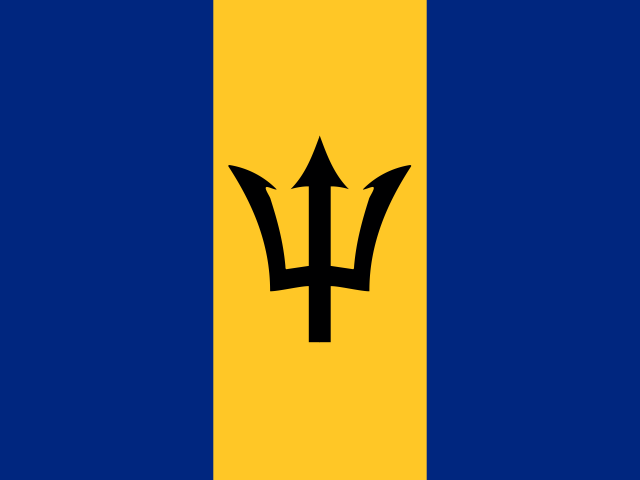
Three vertical bands of ultramarine, gold and ultramarine with a black trident head in the centre. Blue is the sea and sky, gold the sand; the trident is broken from its shaft to symbolise Barbados's clean break from its colonial past.
Source: barbados.gov.bb
Barbados FACTS ◢
| Capital | Bridgetown |
|---|---|
| Continent | North America |
| Population | 282,623 (2025) |
| Area | 439 km² |
| Population density | 644/km² |
| Currency | Barbadian dollar (BBD) |
| Official language | English |
| Calling code | +1246 |
| Internet TLD | .bb |
| Time zone | UTC-04:00 |
| Drives on the | Left |
| ISO codes | BB / BRB |
DID YOU KNOW? ◢
- It's widely credited as the birthplace of rum, distilled here since the 17th century.
- The global pop star Rihanna was born and raised on the island.
- It lies further east than the rest of the Caribbean, out on its own in the Atlantic Ocean.
- Its capital, Bridgetown, and its historic garrison are recognised as a UNESCO World Heritage Site.
Barbados QUICK ANSWERS ◢
What is the capital of Barbados?
The capital of Barbados is Bridgetown.
What is the population of Barbados?
Barbados had a population of 282,623 in 2025.
What currency does Barbados use?
Barbados uses the Barbadian dollar (BBD).
What languages are spoken in Barbados?
The official language of Barbados is English.
Think you know your flags? Play Flag Daily → · Browse all countries →
MORE ON THE FLAG ◢
The trident on the Barbados flag is broken because the shaft was deliberately cut away from it. Officially, that missing handle marks the country's break with its colonial past, and the government says so in as many words.
Barbados did not invent an emblem for independence. It took the trident that already stood for the island under British rule, kept the head, and threw the handle away.
Key Takeaways
- Officially the broken shaft marks Barbados's break with its "historical and constitutional ties as a former colony".
- The trident is Neptune's, lifted from the seal of the colony that the Barbados Coat of Arms replaced in 1966.
- Grantley W. Prescod's design was picked from 1,029 entries in an open government competition, judged by a panel of six.
- The Act that defines the flag gives colour codes and a proportion, and assigns no meaning to any part of it.
- Barbadian law lists the Broken Trident as an emblem in its own right, and puts the flag's etiquette in binding regulation rather than advice.
Where did the broken trident come from?
From the seal of the colony, with the shaft cut off.
The Government of Barbados calls the device in the centre panel "the Trident of the Mythical sea god Neptune", and notes that "This symbol appears in the Seal of the colony which was replaced by the Barbados Coat of Arms." Then the line that carries the meaning: "The shaft of the Trident is broken indicating Barbados' break with its historical and constitutional ties as a former colony."
The Flags of the World archive gives the trident to Britannia on the colonial badge. The government's own description of the same device differs: it "represented the British Sovereign in a shell chariot being drawn by two sea horses through foaming waves", kings seated, queens standing.
They disagree about who held it and agree on what matters: the trident was inherited, and on 30 November 1966 it flew on a flag of its own.
What do the colours on the Barbados flag mean?
The government reads the panels one way, and the statute does not read them at all. The official wording is "Blue for the sea and sky of Barbados; Gold for the sand of its beaches."
That gloss is nowhere in the law. The National Emblems and National Anthem of Barbados (Regulation) Act, Cap. 300A, or the National Emblems Act, defines the flag in Part II of its First Schedule. Part II is pure specification: the three panels, a broken trident in black, the colour codes Ultramarine BCC 148 and Gold BS 0/002, and a proportion of 3:2. No panel is given a meaning. Neither is the trident.
One widely copied claim has no Barbadian source at all: that the trident's three points stand for three principles of democracy, government of, for and by the people. It appears in neither the Act, nor the government's description of the flag, nor Parliament's. It does appear in the Flags of the World archive, as a contributor note from James Dignan dated 22 November 1995.
Who designed the Barbados flag, and how was it chosen?
A schoolmaster won it, in an open government competition.
Grantley W. Prescod's design was chosen from 1,029 entries. He received a gold medal, an inscribed scroll and $500 donated by the Advocate Company Limited, the newspaper publisher. Parliament calls him "an outstanding secondary school master and Education Officer"; the government's flag page adds a year's training as a specialist teacher of art.
The government also names the six judges: Bruce St. John as chairman, with Major Leonard Banfield, Maurice Cave, Neville Connell, Enid Lynch and Mrs B. Ward.
One name on that list repays a second look. Neville C. Connell designed the Barbados Coat of Arms, presented by royal warrant on 14 February 1966, and directed the Barbados Museum for almost 24 years. No source says outright that the judge and the designer are one man; the name, the year and the island say they are.
The Broken Trident is a national emblem on its own
In Barbadian law the trident is not merely part of the flag. Section 2 of the National Emblems Act defines "National Emblems" as "the Broken Trident, the Coat of Arms, the National Flag, the National Flower and any of the National colours when used together". The trident is listed first, and listed apart from the flag it appears on.
Passed in 1969, the Act did not come into operation until 1 April 1976: the flag had been flying for nearly a decade before the statute protecting it took effect.
Protection is the point of it. The Act vests copyright in the emblem designs in the Crown in perpetuity (section 3). Anyone selling goods bearing an emblem or using one in a business must go to the Minister for a licence (section 4), and doing either without one is an offence carrying a fine of one thousand dollars or a year's imprisonment (section 5).
How Barbadian law says the flag must be flown
Flag etiquette is usually guidance. Barbados put its version in subsidiary legislation: the National Emblems and National Anthem of Barbados Regulations, 1976, made under section 7 of the Act.
The rules are literal. A torn, soiled or faded flag "shall not be flown on any occasion" (regulation 3). Any staff carrying it "shall be painted white" (regulation 8). It comes down at 6.00 p.m., except inside a building; on a ceremonial occasion it may fly later, and must then be flood-lit if possible (regulation 7).
Regulation 15 is the trident rule: the flag shall not be "flown with the trident inverted, except as a signal of distress". Regulation 16 bars flying, displaying or offering for sale a flag that does not match the Schedule.
Those two are also the toothless ones. Regulation 24 lists the regulations whose breach is an offence, and neither 15 nor 16 is on it.
Did the flag change when Barbados became a republic?
No. Parliament's statement is that "Barbados became a parliamentary republic with effect from November 30th, 2021", the fifty-fifth anniversary of independence to the day. The flag was left alone.
Nothing needed removing, the quiet advantage of the 1966 design. A flag built on a British ensign carries the Union Jack in the canton, so a change of head of state puts a question in the top corner: Australia's flag and New Zealand's both still have one. Barbados settled it in 1966, by keeping the emblem it wanted and breaking the shaft off it.
Want to see how well you know it? Flag Daily is one flag a day.
Frequently asked questions
Why is the trident on the Barbados flag broken?
Because the shaft was cut away on purpose. The government describes the device as Neptune's trident, taken from the seal of the colony, and says the broken shaft indicates "Barbados' break with its historical and constitutional ties as a former colony". The Coat of Arms replaced that seal in 1966, and the new flag went up on 30 November.
What do the ultramarine and gold panels stand for?
The government's description is "Blue for the sea and sky of Barbados; Gold for the sand of its beaches". No Barbadian statute says so, though: the National Emblems Act gives only the colour codes Ultramarine BCC 148 and Gold BS 0/002 and the 3:2 proportion.
Do the three points of the trident have an official meaning?
Not in any Barbadian government source that publishes the flag's symbolism. The claim that they stand for government of, for and by the people is repeated widely, but it is absent from the National Emblems Act, from the government's description of the flag, and from Parliament's.
Who won the competition to design the flag of Barbados?
Grantley W. Prescod, a Barbadian schoolmaster trained as a specialist teacher of art, later an Education Officer. His entry was one of 1,029 in an open competition organised by the government and judged by a panel of six chaired by Bruce St. John. His prize was a gold medal, an inscribed scroll and $500.
Can you print the Barbados flag on a T-shirt?
Not freely. The National Emblems Act vests copyright in the emblem designs in the Crown in perpetuity, and selling goods that reproduce one needs a licence approved by the Minister, at a fee, under the 1976 regulations, of fifteen dollars to sell or thirty-five to import or manufacture. The government's flag etiquette guidance separately says the flag should not be printed on articles of clothing.
Sources
All retrieved 12 August 2026.
- Government of Barbados, National Emblems and National Anthem of Barbados (Regulation) Act, Cap. 300A - sections 2 to 6 and First Schedule Part II.
- Government of Barbados, National Emblems and National Anthem of Barbados Regulations, 1976 - regulations 3, 7, 8, 15, 16, 18 and 24.
- Government of Barbados, The National Flag of Barbados - the retired official flag page: symbolism, entries, prize, judges.
- Parliament of Barbados, Independence - flag description and Prescod.
- Parliament of Barbados, The Constitution of Parliament - the republic date.
- Government of Barbados, Coat of Arms - the seal of the colony and Neville Connell.
- Government of Barbados, Flag Etiquette - the clothing guidance.
- Flags of the World, Barbados - the 1995 contributor note carrying the three-points claim.
PLAY ANOTHER →
Three clues, three guesses. Work out where in the world it is.
THREE CLUESDAILYDaily TriviaFive questions a day. Everyone gets the same five.
FIVE QUESTIONSDAILYOn This DayOne thing that happened today in history. Every day, a new one.
TODAY IN HISTORYDAILYDaily CryptogramOne quote, one scrambled alphabet. Crack it before tomorrow.
CRACK THE QUOTE