
Guinea
A West African country shaped like a crescent, Guinea holds some of the planet's biggest bauxite reserves and the highlands where the Niger, Senegal and Gambia rivers all begin their long journeys to the sea.
WHAT THE FLAG MEANS ◢
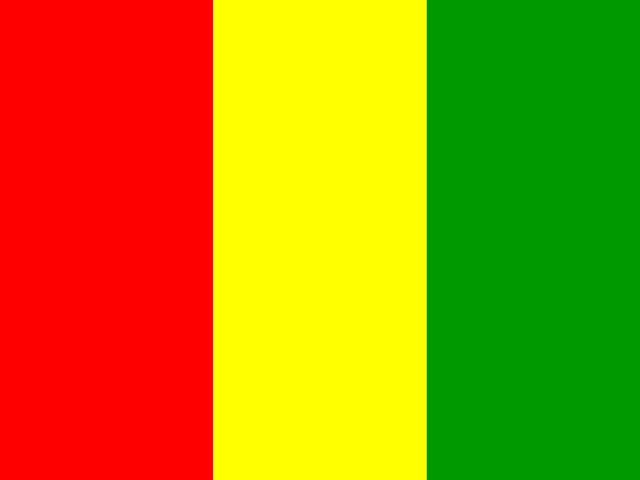
Three equal vertical bands of red, yellow and green, the Pan-African colours in the vertical arrangement of the French tricolour. The constitution states just that much, three vertical and equal bands of red, yellow and green, and assigns them no meaning. They are conventionally read as red for sacrifice and labour, yellow for the sun and mineral wealth, and green for the country's vegetation.
Guinea FACTS ◢
| Capital | Conakry |
|---|---|
| Continent | Africa |
| Population | 15,099,727 (2025) |
| Area | 245,857 km² |
| Population density | 61/km² |
| Currency | Guinean franc (GNF) |
| Official language | French |
| Calling code | +224 |
| Internet TLD | .gn |
| Time zone | UTC±00:00 |
| Drives on the | Right |
| ISO codes | GN / GIN |
DID YOU KNOW? ◢
- It holds some of the world's largest reserves of bauxite, the ore that aluminium is made from.
- The Niger, Senegal and Gambia rivers all rise in the Guinea Highlands.
- Mount Nimba, on its border, is a UNESCO World Heritage nature reserve famed for unique wildlife.
- It was the only French West African colony to vote for immediate independence in 1958.
Guinea QUICK ANSWERS ◢
What is the capital of Guinea?
The capital of Guinea is Conakry.
What is the population of Guinea?
Guinea had a population of 15,099,727 in 2025.
What currency does Guinea use?
Guinea uses the Guinean franc (GNF).
What languages are spoken in Guinea?
The official language of Guinea is French.
Think you know your flags? Play Flag Daily → · Browse all countries →
MORE ON THE FLAG ◢
Guinea's flag is three vertical bands, red at the hoist, then yellow, then green. That much is written into the constitution, to the same effect as the two instruments before it.
What none of the three says is what the colours are for. The current one, promulgated on 26 September 2025, gives the flag one sentence in Article 4 and then moves on to the anthem. There is no symbolism clause, no gloss, nothing to interpret.
The meanings are real, though, and they are official. They are just published somewhere else: on the Presidency of the Republic's own national-symbols page, which reads the red as the blood of the martyrs, gives the yellow to what is mined rather than to anything in the sky, and names the green as a particular shade.
Key Takeaways
- Article 4 of Guinea's 2025 constitution describes the flag and assigns its colours no meaning.
- The Presidency's national-symbols page does assign meanings, so the gloss is official without being constitutional.
- It reads red as the blood of the martyrs, yellow as the riches of the Guinean subsoil, and green as the country's vegetation.
- The word soleil (sun) appears nowhere in the Presidency's flag section, which gives the yellow to the subsoil.
- The same page names the shade: Guinea's green is malachite green, and Mali's is grass green.
| Instrument | What it says about the flag | Meaning assigned |
|---|---|---|
| Constitution of 2010, Article 1 | Three vertical and equal bands of red, yellow and green | None |
| Charte de la Transition, Article 4 (2021) | The tricolour, red, yellow and green, in vertical bands of equal dimensions | None |
| Constitution of 2025, Article 4 | The tricolour "Rouge, Jaune, Vert", in equal vertical bands, left to right | None |
| Presidency of the Republic, national symbols page | Three vertical bands from the hoist | Martyrs, subsoil, vegetation |
The Presidency of Guinea reads red as blood and yellow as what is mined
The Presidency of the Republic publishes a page of national symbols covering the motto, the coat of arms, the anthem and the flag. Its own metadata dates it to January 2022 and its last revision to 15 April 2024, so it was written under the Transition, and its last revision predates the 2025 constitution by about seventeen months. It has not been rewritten since that constitution came in. Its flag section is the closest thing Guinea has to a state gloss, and it is considerably more specific than the constitution it sits beside.
Red, it says, "représente le sang de tous les martyrs versé pour la lutte contre l’occupation coloniale mais aussi pour l’indépendance du pays le 2 octobre 1958" - it represents the blood of all the martyrs shed in the struggle against colonial occupation and for the country's independence on 2 October 1958. The claim is narrow and dated. It names one fight, ties it to one day, and says nothing about labour or sacrifice in the abstract.
Yellow "représente les richesses du sous-sol guinéen (or, bauxite, diamant, fer, uranium, etc.)": the riches of the Guinean subsoil, with gold, bauxite, diamond, iron and uranium listed in the page's own parentheses. That band points downward, at what is dug out of the country, and the word soleil does not appear in the Presidency's flag section or anywhere in the constitutional texts opened for this article.
Green, given as "vert malachite", represents the vegetation of the country, savannah in the north-east and forest in the south-east, "mais aussi les potentialités agricoles de la Guinée" - and also Guinea's agricultural potential.
Only after all three does the page mention the family the colours belong to: "Ces couleurs sont aussi les couleurs panafricaines", these colours are also the pan-African colours. The pan-African resemblance arrives as an additional fact about the palette rather than as the explanation for it.
Article 4 names the colours and stops there
The instrument in force is the Constitution of the Fifth Republic, adopted by referendum on 21 September 2025 and promulgated five days later by Décret D/2025/176/PRG/CNRD/SGG of 26 September 2025. It was published in the Journal Officiel de la République de Guinée as a standalone issue.
Its Article 4 opens by declaring Guinea an independent and sovereign state, then handles the symbols in four short lines. The flag gets one of them: "L’Emblème national est le drapeau tricolore « Rouge, Jaune, Vert », disposé en bandes verticales égales, de la gauche vers la droite." The national emblem is the tricolour flag Rouge, Jaune, Vert, arranged in equal vertical bands, from left to right.
Then the anthem, "Liberté". Then the motto, "Travail, Justice, Solidarité". Then a sentence handing the seals and the coat of arms to the legislature: "Les Sceaux et les Armoiries de la République sont déterminés par voie législative."
That last line marks the difference the article turns on. The arms are left to statute, as they were in the 2021 charter before it. The flag is not. It is fixed in the constitutional text itself, described down to the reading direction of the bands, and left entirely without an interpretation.
The instrument with the authority to settle what the colours mean is the one that declines to say.
The flag came through a coup in almost the same words
The Charte de la Transition, dated 27 September 2021, governed in the 2010 constitution's place. Its preamble dates the Guinean army's "prise effective du pouvoir" to 5 September 2021, under the direction of the Comité National du Rassemblement pour le Développement. Among the missions the charter sets for the transition, in Article 2, is "L’élaboration d’une nouvelle Constitution et son adoption par référendum".
Article 4 of that charter reads: "L’emblème national est le drapeau tricolore, Rouge, Jaune et Vert de bandes verticales et de dimensions égales." The national emblem is the tricolour flag, red, yellow and green, of vertical bands and equal dimensions.
The 2010 constitution had put its flag provision inside Article 1, in wording an English translation renders as "The flag is composed of three vertical and equal bands of color RED, YELLOW and GREEN", so the substance survives the change of instrument intact: a military committee with a free hand over every institution of the state left the flag exactly as it found it.
The 2025 text made one addition, and it is a small one: "de la gauche vers la droite". The earlier texts listed the colours in order without ever saying which end of the flag the list starts from. A reader had to know that already, or infer it. The 2025 constitution writes the direction down.
The provision also moved. In 2010 the flag shared Article 1 with the form of the state, the equality guarantee and the languages; the 2021 charter split the symbols out into an Article 4 of their own, and the 2025 constitution kept them there.
The Presidency says Guinea's green is not Mali's green
The Presidency's page closes on a comparison rather than on the symbolism. "Le drapeau de la Guinée ne doit pas être confondu avec le drapeau du Mali" - Guinea's flag should not be confused with Mali's, which carries almost the same colours in the reverse order, green, yellow and red from the hoist.
It then separates the two flags by shade, which no Guinean legal instrument does: "La couleur verte du drapeau de la Guinée est d’un vert malachite tandis que celle du drapeau du Mali est d’un vert gazon." Guinea's green is a malachite green, while Mali's is a grass green.
Both halves of that comparison name an object rather than a value. Malachite is a green copper carbonate mineral, mined and polished for centuries as a pigment and an ornamental stone, and grass is grass. A flag chart that renders every green band in the same green erases the difference the Presidency is pointing at.
That shade is named on a government page and nowhere with legal force. No Guinean text opened for this article specifies a colour standard, a Pantone reference or a set of coordinates for any of the three bands, so "vert malachite" is a description rather than a specification. And the reversal is not the only difference. If the two flags were one drawing mirrored, Mali's green would be Guinea's green, and on the Presidency's account it is not.
10 November 1958, six weeks after the vote
The Presidency dates the flag: "Il a été adopté le 10 novembre 1958 après l’indépendance du pays." It was adopted on 10 November 1958, after the country's independence.
The 2025 constitution's preamble opens on that sequence in the state's own voice. Its opening clause has the people of Guinea attached to what determined, in a sentence the gazette prints with an evident misprint at its head, "le vote pour le NON au Referendum du 28 Septembre 1958 et l’institution, le 02 Octobre de la même année, d’un État indépendant et souverain" - the No vote in the referendum of 28 September 1958, and the founding of an independent and sovereign state on 2 October of the same year. The flag followed on 10 November, six weeks and a day after the ballot.
So this was not a flag chosen at leisure. It was adopted by a republic five and a half weeks old, in a palette the Presidency identifies as the pan-African one, and its red is the colour that same page now reads as the blood of the people who died getting the country there.
The date the red points at is the independence date, 2 October, not the referendum. That is the Presidency's own wording in its flag section, and the rest of the page keeps the two apart: the section on the motto dates the historic vote to 28 September 1958, and its section on the anthem refers to the No campaign without touching the independence date.
Protected in principle, unprotected against revision
The 2025 text bears on the flag twice more without ever naming it, and the two provisions pull in opposite directions.
Article 6 lists the fundamental principles the state undertakes to respect and to have respected. Item (e) is "l’inviolabilité du patrimoine national, des symboles et biens de l’Etat" - the inviolability of the national heritage, and of the state's symbols and property. The flag is a state symbol, so it sits inside that guarantee, even though the article never names it.
Article 193 goes the other way. It lists what may not be revised at all: the republican form of the state, its secularity, its unicity, the separation and balance of powers, political and trade-union pluralism, and the number and duration of the presidential term. A project or action of the President of the Republic that would touch the letter or the spirit of any of those is defined as high treason; the article makes contributing to any project of that kind, by a support movement or any form of propaganda, an offence for any state agent or other person, on terms a statute is to set.
The national emblem is not on that list. So on the text of Article 193 the flag is constitutionally described, covered by the Article 6 principle of inviolability, and still open to change through the ordinary revision procedure that Articles 192 to 194 set out.
If you want to find out whether you can actually tell this flag from its neighbours' at a glance, a daily flag round gives you three guesses, and three written clues with no flag at all is the harder version of the same problem.
Frequently asked questions
What do the colours of the Guinea flag mean?
The reading is the Presidency of the Republic's, not the constitution's. Its national-symbols page gives red as the blood of the martyrs of the anti-colonial struggle and of independence on 2 October 1958, yellow as the riches of the Guinean subsoil, and green as the country's vegetation and agricultural potential.
The yellow is the specific one. The page lists gold, bauxite, diamond, iron and uranium in its own parentheses. Article 4 of the 2025 constitution, like the 2021 charter and the 2010 text before it, assigns the colours no meaning at all.
Does Guinea's flag stand for the sun?
Not on any Guinean source opened for this article. The Presidency's national-symbols page gives the yellow band to the riches of the subsoil and names the minerals it means, and the word soleil appears nowhere on it.
The constitutional texts are no help to a sun reading either, because they assign the colours nothing. Article 4 of the 2025 constitution describes the flag and stops.
What does Guinea's constitution say about the flag?
Article 4 of the 2025 constitution says that the national emblem is the tricolour flag "Rouge, Jaune, Vert", arranged in equal vertical bands, from left to right. That is the whole provision. The same article covers the anthem and the motto, and hands the seals and coat of arms to ordinary legislation, so the flag is the symbol the constitution keeps to itself.
How do the flags of Guinea and Mali differ?
Both use the pan-African colours in vertical bands, in opposite orders: Guinea runs red, yellow, green from the hoist, and Mali runs green, yellow, red. The Presidency of Guinea addresses the confusion directly and adds a distinction of shade, saying Guinea's green is a malachite green while Mali's is a grass green.
When was the flag of Guinea adopted?
The Presidency gives 10 November 1958, after independence. Guinea had voted No in the referendum of 28 September 1958 and become independent on 2 October, so the flag was adopted by a republic five and a half weeks old.
Sources
- Secrétariat Général du Gouvernement, Journal Officiel de la République de Guinée, Constitution, 26 September 2025 - Article 4, Article 6, Article 193 and the promulgating Décret D/2025/176/PRG/CNRD/SGG. Retrieved 26 August 2026.
- Présidence de la République de Guinée, Symboles - the state's reading of the three colours, the adoption date and the comparison with Mali. Published January 2022, last revised 15 April 2024 per the page's own metadata. Retrieved 26 August 2026.
- Secrétariat Général du Gouvernement, Charte de la Transition, 27 September 2021 - Article 4. Retrieved 26 August 2026.
- Comparative Constitutions Project via constituteproject.org, Guinea's Constitution of 2010 - Article 1, English translation by William S. Hein & Co. Retrieved 26 August 2026.
PLAY ANOTHER →
One thing that happened today in history. Every day, a new one.
TODAY IN HISTORYDAILYDaily CryptogramOne quote, one scrambled alphabet. Crack it before tomorrow.
CRACK THE QUOTEDAILYGuess the CountryThree clues, three guesses. Work out where in the world it is.
THREE CLUESDAILYDaily TriviaFive questions a day. Everyone gets the same five.
FIVE QUESTIONS