
Mali
A landlocked giant on the edge of the Sahara, Mali built its fortune on gold and salt caravans - and its fabled city of Timbuktu once held one of the world's great libraries.
WHAT THE FLAG MEANS ◢
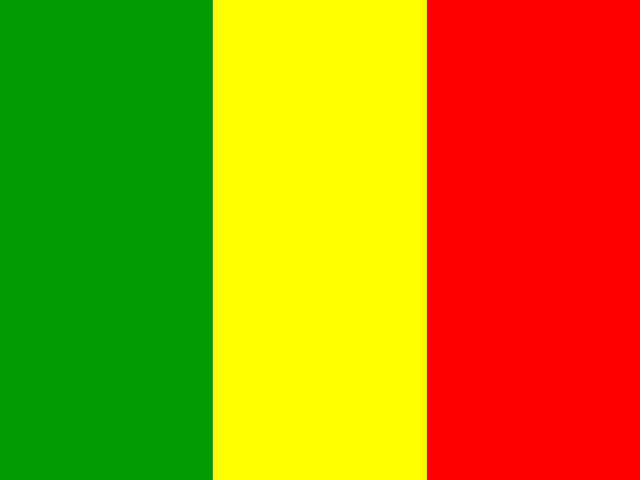
A vertical tricolour of green, gold and red, in the Pan-African colours. Every Malian constitution since 1960 describes the flag in the same terms, three vertical and equal bands of green, gold and red, and none of those provisions assigns the colours a meaning. Until 1961 the gold band carried a black human figure with its arms raised to the sky, and the constitutional amendment that removed it gives no reason. The state has published a reading of its own, giving the green to hope and the greenness of Mali's fields, the gold to the gold and other minerals in the country's subsoil, and the red to the blood shed in defence of the homeland.
Mali FACTS ◢
| Capital | Bamako |
|---|---|
| Continent | Africa |
| Population | 25,198,821 (2025) |
| Area | 1,240,192 km² |
| Population density | 20/km² |
| Currency | West African CFA franc (XOF) |
| Official languages | Bamanankan, Bomu, Bozo, Dogozo, Fulfuldé, Hasanya, Kassonkhé, Mamara, Manikakan, Songhay, Soninké, Syenara, Tamasheq |
| Calling code | +223 |
| Internet TLD | .ml |
| Time zone | UTC±00:00 |
| Drives on the | Right |
| ISO codes | ML / MLI |
DID YOU KNOW? ◢
- Timbuktu was a renowned centre of learning, home to tens of thousands of ancient manuscripts.
- The Great Mosque of Djenné is the largest mud-brick building in the world.
- The Niger River curves through the country, creating an inland delta that floods each year.
- The medieval Mali Empire was one of the wealthiest states of its age, built on gold and trans-Saharan trade.
Mali QUICK ANSWERS ◢
What is the capital of Mali?
The capital of Mali is Bamako.
What is the population of Mali?
Mali had a population of 25,198,821 in 2025.
What currency does Mali use?
Mali uses the West African CFA franc (XOF).
What languages are spoken in Mali?
The official languages of Mali are Bamanankan, Bomu, Bozo, Dogozo, Fulfuldé, Hasanya, Kassonkhé, Mamara, Manikakan, Songhay, Soninké, Syenara and Tamasheq.
Think you know your flags? Play Flag Daily → · Browse all countries →
MORE ON THE FLAG ◢
Look up what Mali's three bands stand for and the web will hand you a confident answer about fertility, purity and blood. Mali has published an answer of its own, and it is not that one. The state reading gives the green to hope and to the greenness of the country's fields, the gold to the gold in the ground, and the red to remembrance of the blood shed for the homeland. Purity belongs to a reference website.
The constitutional provisions that describe the flag assign the colours nothing at all. What Malian law records about the flag is instead a subtraction: until 1961 the gold band carried a black human figure with its arms raised, and a two-article amendment took it off. That amendment quotes the old sentence, prints the new one, and offers no reason for the change at all.
The reasons in circulation were supplied by other people, later, and they are worth separating from the record.
Key Takeaways
- The constitution of 22 September 1960 put a black "idéogramme de l'Homme les bras levés vers le ciel" on the gold band.
- Loi n° 61-26 struck that one sentence out of the constitution and changed nothing else. It gives no reason.
- The National Assembly adopted it on 20 January 1961; it was promulgated on 18 February and published on 1 March. The widely quoted 1 March date is the gazette's.
- A 1960 federal decree fixed the figure down to a stroke thickness of a twelfth of the band, and never says what it stood for.
- The colour readings that circulate are not Mali's. The state's own published gloss reads the gold for the gold in the ground, not for purity.
| Instrument | Date it bears | What it says about the flag | Colour meaning in that provision |
|---|---|---|---|
| Décret n° 60-88 (Mali Federation) | 25 Apr 1960 | Prescribes the ideogram's proportions in fractions of the band | Not given |
| Constitution of the Republic of Mali, art. 1 al. 5 | 22 Sept 1960 | Three equal vertical bands, green, gold, red, with the black ideogram of Man on the gold band | Not given |
| Loi n° 61-26 A.N.-R.M. | 20 Jan 1961 | Deletes the ideogram sentence from art. 1 al. 5 | Not given |
| Constitution, art. 1 | 2 June 1974 | Three equal vertical bands, green, gold, red | Not given |
| Constitution, art. 25 | 25 Feb 1992 | Three equal vertical bands, green, gold, red | Not given |
| Constitution, art. 30 | 22 July 2023 | Three equal vertical bands, green, gold, red | Not given |
The figure that used to stand on Mali's gold band
Mali's flag began as the flag of a federation. French Sudan and Senegal joined as the Mali Federation in 1959, and the federal flag was a green, gold and red vertical tricolour charged with a black stick figure of a person, arms lifted. Flags of the World dates that flag to 4 April 1959 and Senegal's secession to 22 August 1960.
When Senegal left, the Sudanese Republic proclaimed itself the Republic of Mali on 22 September 1960 and kept the design. Its constitution, annexed to Loi n° 60-1 and printed in the special issue of the Journal officiel of 29 September 1960, sets out the emblem in the fifth paragraph of its first article:
"Le drapeau est composé de trois bandes verticales et égales de couleurs vert, or et rouge. Il porte en noir sur la bande or l'idéogramme de l'Homme les bras levés vers le ciel."
The flag is composed of three vertical and equal bands of the colours green, gold and red; it bears in black on the gold band the ideogram of Man with his arms raised to the sky. That is the whole provision. The same article names the motto and leaves the anthem and seal to be fixed by law. It interprets nothing.
The figure is usually called the kanaga, after the Dogon mask of that name, and Mali's presidency calls it that today: its flag page describes the Federation's flag as carrying "un masque Kanaga (Dogon)" on its band. The constitution called it something else. It called it the ideogram of Man.
A decree measured the figure to a twelfth of the band
Five months before Mali became a republic, the Federation's government legislated the figure's geometry. Décret n° 60-88 of 25 April 1960, signed in Dakar by Modibo Keïta as president of the federal government, states its own purpose: to give the flag "une présentation uniforme tant sur le territoire des Etats fédérés qu'à l'extérieur", a uniform presentation both in the territory of the federated States and abroad.
It is an unusual document to read. In one article it fixes the figure's width at half the band, its height at the central third, and the diameter of the head-dot as "la septième partie de la largeur de la bande or centrale", the seventh part of the width of the central gold band. The arms and legs each get an outer height of a ninth of the band's total height. The strokes making up limbs, trunk and neck are given "une épaisseur égale à la douzième partie de la bande or centrale", a thickness equal to the twelfth part of the central gold band.
Then it stops. Two articles, a signature, and no sentence anywhere saying what the figure meant, where it came from, or why a man with raised arms was the right image for a federation. A government that cared enough to specify a twelfth of a band did not think the symbolism needed recording.
Note the word the decree keeps using for the middle band: or, gold. It is in the title, and six more times in the decree's one substantive article.
The 1961 amendment, in full
Loi n° 61-26 A.N.-R.M. runs to two articles. Its operative sentence is:
"L'alinéa 5 de l'article 1er de la Constitution du 22 septembre 1960 de la République du Mali est modifié ainsi qu'il suit"
Paragraph 5 of article 1 of the constitution is amended as follows. What follows is a before-and-after, headed "Au lieu de", instead of, and "Lire", read. The first block prints both sentences of the old paragraph. The second prints one:
"Le Drapeau est composé de trois bandes verticales et égales de couleurs vert, or et rouge."
That is the entire change. The ideogram sentence is not replaced, qualified or explained. It is simply absent from the second block.
Article 2 is the only other content, and it is procedural. It provides that the law goes to a referendum within thirty days if it fails to attract the votes of two thirds of the deputies, and that on approval it is promulgated within ten. The gazette records no vote count, so which branch of article 2 operated cannot be told from these documents. Décret n° 11 P.G.-R.M. promulgated the law on 18 February, twenty-nine days after the vote, and that interval turns out to be routine: the same issue promulgates ten laws adopted on 19 January by instruments dated 17 February, the same twenty-nine days.
The recitals are formulaic. The law cites the proclamation of the republic, the constitution, and "les nécessités d'Etat" - the necessities of State - and then goes straight to the amendment. There is no preamble and no statement of reasons, and nothing in that issue of the gazette that its own table of contents identifies as a covering document.
Was the figure removed because Islam forbids images of people?
That is the reason almost every account gives, and it does not come from the law.
Encyclopaedia Britannica's flag article states it directly: "Muslim fundamentalists in Mali objected to the human figure as being contrary to the precepts of Islam." English Wikipedia carries the same explanation, citing Britannica and Guide to the Flags of the World by Mauro Talocci as revised by Whitney Smith, and adds a pointer to aniconism in Islam.
It is a plausible reading of a Muslim-majority country dropping a human image, and this article is not in a position to say it is wrong. What can be said is what the documents do and do not contain. Loi n° 61-26 gives no reason. The 1960 decree that measured the figure gives no rationale for it.
And neither version of the Malian presidency's flag page mentions the removal at all. The longer of the two, published on the presidency's site in 2003 under the source line "Grande Chancellerie du Mali" and read here from an Internet Archive capture of February 2008, runs through the whole episode without it. It says the deputies adopted the law "qui crée le drapeau national du Mali", which creates the national flag of Mali, and that the law of 20 January 1961 "consacre la version définitive du drapeau national du Mali", enshrines the definitive version. It describes the earlier flag with the ideogram, notes that it "fut immédiatement adoptée par la population", was immediately adopted by the population, and then moves on to the colours. The instrument that deleted a figure is written up as the instrument that created a flag.
So the honest position is that the explanation is Britannica's and the encyclopaedic tradition behind it, not Mali's. If a Malian instrument or a Malian state page states the religious objection, it was not found here.
The change is dated 1 March 1961 because that is the gazette date
Reference works date Mali's current flag to 1 March 1961. The Journal officiel de la République du Mali shows where that date comes from, and it is the least interesting of the three dates the record carries.
The National Assembly adopted the law in public session at Bamako on 20 January 1961, signed by its president Mahamane Alassane Haïdara. It was promulgated by Décret n° 11 P.G.-R.M. at Koulouba on 18 February 1961. It appeared in issue 79 of the gazette, dated 1 March 1961.
The presidency's own account leads with the first of those: it opens by saying that on 20 January 1961, four months after independence was proclaimed, the deputies meeting in plenary session adopted loi n° 61-26. The government's online legal index, confusingly, files the same law under 18 February, the promulgation date. Three official dates, three different documents, and the one that reached the reference works is the printer's.
The later constitutions, and one line in the anthem
The flag paragraph has been re-enacted three times since 1961 and has never acquired a gloss.
The 1974 constitution, approved at the referendum of 2 June 1974 and promulgated on 1 July, gives article 1: "L'emblème national est composé de trois bandes verticales et égales, de couleurs : vert, or et rouge." The national emblem is composed of three vertical and equal bands, of the colours green, gold and red.
The 1992 constitution repeats the sentence at article 25, dropping the colon and the comma before it: "L'emblème national est composé de trois bandes verticales et égales de couleurs vert, or et rouge."
The constitution now in force, approved at the referendum of 18 June 2023 and promulgated on 22 July 2023, carries it at article 30 with the word tricolore added and the number given in digits as well as words: "L'emblème national est le drapeau tricolore composé de trois (03) bandes verticales et égales de couleurs vert, or et rouge." The national emblem is the tricolour flag composed of three vertical and equal bands of the colours green, gold and red.
None of the three sets a ratio, a shade or a meaning. The neighbouring provisions do more work than the flag one: each names the motto, each names the anthem, and each leaves the seal and the arms to be fixed by statute, which is what Loi n° 07-018 of 26 February 2007 does - describing the Djenné mosque, the vulture and the rising sun without interpreting any of them either.
The nearest thing to an official reading of the flag sits in a different instrument. Loi n° 62-72 created the national anthem in 1962 and annexed its text; the refrain includes the line "Notre drapeau sera liberté". Our flag shall be liberty. It is the closest thing to a statement of significance in any Malian instrument opened for this article, and it is about the flag as a whole rather than about any band.
Whose colour meanings are these?
Mali's presidency has published a colour gloss, and it is not the one in circulation.
The text, dated 2003 and sourced on the page to the Grande Chancellerie du Mali, gives the green as hope and as "la verdure des prairies et des champs du Mali", the greenness of Mali's meadows and fields, together with the country's agro-pastoral vocation. The gold is the gold "dont recèle le sous-sol du Mali", which the subsoil of Mali conceals, plus other potential mining resources - and the passage reaches for a fourteenth-century emperor to make the point: "Qui ne se rappelle l’histoire du fabuleux voyage de Kankou Moussa à la Mecque ?" Who does not remember the story of Kankou Moussa's fabulous journey to Mecca, the emperor English usually calls Mansa Musa. The red is "un souvenir, une méditation et une exhortation", a remembrance, a meditation and an exhortation, remembering "du sang versé par les leurs pour la défense de leur Patrie", the blood shed by their own in defence of their homeland.
The 2003 page is no longer live. The presidency's current flag page carries no colour meanings at all; it describes the bands, gives a 2:3 ratio, and then spends its remaining paragraphs on how to tell Mali's flag from three others.
The familiar reading is easy to trace and it is not Malian. English Wikipedia's flag article says "gold stands for purity and mineral wealth", and cites WorldAtlas, a commercial reference site, whose Mali page says the "gold color represents the country's mineral wealth, as well as purity". Purity appears in no Malian text found for this article - not the constitutions, not the decrees, not the presidency in either version of its page. The CIA World Factbook is not the culprit here either. Its Mali entry, read from a 2021 capture, gives the bands and adds one note, that Mali uses the Pan-African colours of Ethiopia and that the order matches Senegal and reverses Guinea. That is an origin, not a symbolism, and it assigns the colours no meanings at all.
Is the middle band of Mali's flag gold or yellow?
In every instrument opened for this article it is gold. Or is the word in the 1960 constitution, in the 1960 federal decree, in the 1961 amendment, and in the 1974, 1992 and 2023 constitutions. None of them uses jaune.
Practice is looser, and the state itself is the proof. The presidency's current page opens by calling the flag "vert-or-rouge" and then, in the next sentence, says the colours used are "vert, jaune, rouge"; a paragraph later it describes the Federation's band as "sa bande jaune". Two words for one band, on one page.
That matters because the shade is otherwise undefined. No Malian instrument specifies a Pantone value, an RGB triple or a ratio; the only ratio on any Malian state page is the 2:3 the presidency's site carries, which no law enacts. Flags of the World, which collects the published values, puts it plainly: "There is no official source that gives exact colors of the national flag; these are all approximate colors from these documented sources." It records that the Beijing 2008 manual gave PMS 032, 355 and 109 for the red, green and yellow, and that the London 2012 protocol manual gave the same three. Those are event organisers approximating a flag, not Mali specifying one.
Telling Mali, Senegal and Guinea apart
Two of the three paragraphs on the presidency's flag page are given over to distinguishing Mali's flag from other flags, which is a fair reflection of how often they are mixed up.
Senegal, the partner in the failed federation, kept the same three bands in the same order and kept a device on the middle one. The Malian page notes that its flag differs only by "l’étoile verte", the green star, that it carries on that band. Where Mali subtracted, Senegal substituted.
Guinea uses the same three colours in the opposite order, red at the hoist and green at the fly. Mali's page names Bolivia as the third trap, on the grounds that the bands are horizontal there rather than vertical.
Each of those distinctions turns on one feature, which is what makes a plain tricolour hard to identify at speed. It is the kind of call a round of Flag Daily comes down to: one flag, three guesses, and nothing to go on but the arrangement.
Frequently asked questions
What do the colours of the Mali flag mean?
The Malian instruments opened for this article that describe the flag assign the colours no meaning at all. All four constitutions since 1960 give the same bare description, three vertical and equal bands of green, gold and red, and the 1960 decree that specified the old ideogram interprets nothing either. A gloss published on the presidency's website and attributed to the Grande Chancellerie du Mali reads the green for hope and the greenness of Mali's fields, the gold for the gold and other minerals in the country's subsoil, and the red for the blood shed in defence of the homeland. The widely repeated "purity" reading of the gold is traceable to a commercial reference site by way of Wikipedia, and appears in no Malian source read for this article.
Why was the man removed from the Mali flag?
The instrument that removed him does not say. Loi n° 61-26, adopted on 20 January 1961, amends one paragraph of the constitution by quoting the old text, printing the new text without the ideogram sentence, and giving no reason beyond "les nécessités d'Etat". The explanation usually given, that Muslim objections to depicting the human form drove the change, comes from Encyclopaedia Britannica and the flag literature behind it, not from Malian law.
What was the figure on the old Mali flag?
A black human figure with its arms raised, standing on the gold band. The constitution of 22 September 1960 called it the ideogram of Man with his arms raised to the sky. It is commonly identified with the Dogon kanaga, and the presidency's own site calls the Federation's charge a Kanaga mask, but the constitutional text uses neither the word kanaga nor the word mask.
When did Mali adopt its current flag?
The amendment was adopted by the National Assembly on 20 January 1961, promulgated by decree on 18 February 1961, and published in the Journal officiel on 1 March 1961. Reference works generally give 1 March, which is the publication date rather than the date the law was made.
Is the middle stripe of Mali's flag gold or yellow?
Every Malian instrument opened for this article that describes the flag calls it or, gold, from the 1960 constitution through to the one promulgated in July 2023, and not one of them uses the word jaune. The presidency's current website uses both words on the same page, and no Malian text specifies a shade, so descriptions calling the band yellow are following usage rather than law.
Sources
- Journal officiel de la République Soudanaise, Deuxième Année n° 54, 1er juin 1960, p. 453, Décret n° 60-88 du 25 avril 1960, Secrétariat général du Gouvernement du Mali - retrieved 27 August 2026. A page scan with no text layer.
- Journal officiel de la République du Mali, Deuxième Année n° 65 (numéro spécial), 29 septembre 1960, p. III, Loi n° 60-1 A.N.-R.M. and the annexed Constitution of 22 September 1960, Secrétariat général du Gouvernement du Mali - retrieved 27 August 2026.
- Journal officiel de la République du Mali, Troisième Année n° 79, 1er mars 1961, p. 203, Loi n° 61-26 A.N.-R.M. and Décret n° 11 P.G.-R.M., Secrétariat général du Gouvernement du Mali - retrieved 27 August 2026.
- Journal officiel de la République du Mali, Seizième Année n° 440 (numéro spécial), 25 juillet 1974, p. II, Constitution promulgated by Décret n° 3-PG-RM du 1er juillet 1974, Secrétariat général du Gouvernement du Mali - retrieved 27 August 2026.
- Journal officiel de la République du Mali, Trente Quatrième Année n° 4, 29 février 1992, p. 118, Constitution promulgated by Décret n° 92-073/P-CTSP, Secrétariat général du Gouvernement du Mali - retrieved 27 August 2026.
- Journal officiel de la République du Mali, Soixante-quatrième Année, spécial n° 13, 22 juillet 2023, Décret n° 2023-0401/PT-RM portant promulgation de la Constitution, Secrétariat général du Gouvernement du Mali - retrieved 27 August 2026.
- Journal officiel de la République du Mali, Quatrième Année n° 126, 15 septembre 1962, p. 627, Loi n° 62-72 A.N.-R.M. créant un Hymne de la République du Mali, Secrétariat général du Gouvernement du Mali - retrieved 27 August 2026.
- Journal officiel de la République du Mali, n° 15, 31 mai 2007, p. 564, Loi n° 07-018 du 26 février 2007 relative aux Armoiries de la République, Secrétariat général du Gouvernement du Mali - retrieved 27 August 2026.
- Secrétariat général du Gouvernement du Mali, legal database search - retrieved 27 August 2026. The index lists the law as "Loi n°61-026 du 18 février 1961", which is the date of its promulgating decree rather than of its adoption.
- Présidence de la République du Mali, Le Drapeau et la Devise - retrieved 27 August 2026.
- Présidence de la République du Mali, Le Drapeau National du Mali, 4 juin 2003, source line "Grande Chancellerie du Mali" - the live page is gone. Read from the Internet Archive capture of 21 February 2008.
- Encyclopaedia Britannica, Flag of Mali - read from the Internet Archive capture of 26 April 2025.
- WorldAtlas, What Do The Colors And Symbols Of The Flag Of Mali Mean? - retrieved 27 August 2026, cited only as the origin of the circulating gloss.
- English Wikipedia, Flag of Mali - retrieved 27 August 2026, cited only as the route by which the WorldAtlas gloss and the Britannica explanation reached general circulation.
- Flags of the World, Mali - retrieved 27 August 2026, cited for the 1959 and 1960 dates and for the flag-manual colour values.
- Central Intelligence Agency, World Factbook, Mali - read from the Internet Archive capture of 17 January 2021, cited only to establish what it did not say.
PLAY ANOTHER →
One thing that happened today in history. Every day, a new one.
TODAY IN HISTORYDAILYDaily CodeA short message, hidden in a different cipher every day.
ONE CIPHER A DAYDAILYGuess the CountryThree clues, three guesses. Work out where in the world it is.
THREE CLUESDAILYDaily CryptogramOne quote, one scrambled alphabet. Crack it before tomorrow.
CRACK THE QUOTE