
Senegal
The westernmost country on mainland Africa, Senegal reaches out toward the Atlantic at Dakar and gave the world the rolling, drum-driven sound of mbalax music.
WHAT THE FLAG MEANS ◢
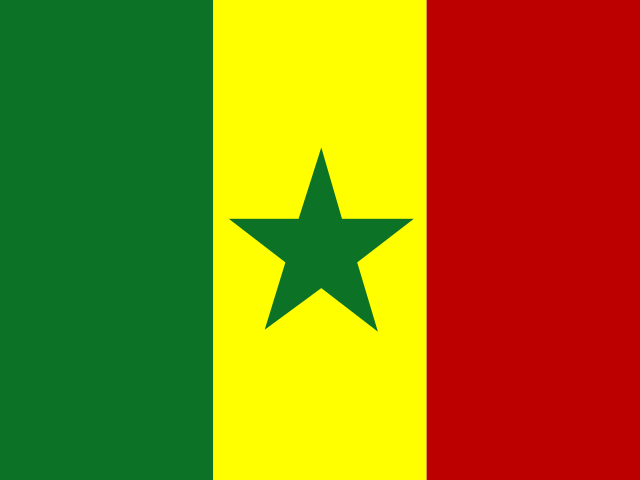
A vertical tricolour of green, gold and red with a green five-pointed star at the centre. Article 1 of the constitution composes the flag of three equal vertical bands in those colours and places the star in green at the centre of the gold band; it assigns none of them a meaning. The state reads the green as the colour of the Prophet's flag for Muslims, of hope for Christians and of fertility for animists, the gold for wealth, the fruit of labour and the arts and letters, and the red for blood, life, the sacrifice of the whole nation and a determination to fight underdevelopment. It gives the star's five points for openness to the five continents and its green for the hope of a young independence.
Source: conseilconstitutionnel.sn · presidence.sn · sec.gouv.sn · checked 2026-08-27
Senegal FACTS ◢
| Capital | Dakar |
|---|---|
| Continent | Africa |
| Population | 18,931,966 (2025) |
| Area | 196,722 km² |
| Population density | 96/km² |
| Currency | West African CFA franc (XOF) |
| Official language | French |
| Calling code | +221 |
| Internet TLD | .sn |
| Time zone | UTC±00:00 |
| Drives on the | Right |
| ISO codes | SN / SEN |
DID YOU KNOW? ◢
- Its Cape Verde peninsula, near Dakar, is the westernmost point of continental Africa.
- Lake Retba, or the 'Pink Lake', can turn a vivid rose colour thanks to salt-loving microorganisms.
- The Dakar Rally, the famous off-road race, took its name from Senegal's capital, its original finish line.
- The island of Gorée, off Dakar, is a UNESCO World Heritage Site remembered as a centre of the Atlantic trade.
Senegal QUICK ANSWERS ◢
What is the capital of Senegal?
The capital of Senegal is Dakar.
What is the population of Senegal?
Senegal had a population of 18,931,966 in 2025.
What currency does Senegal use?
Senegal uses the West African CFA franc (XOF).
What languages are spoken in Senegal?
The official language of Senegal is French.
Think you know your flags? Play Flag Daily → · Browse all countries →
MORE ON THE FLAG ◢
The green star is the whole difference between Senegal's flag and Mali's. Both are green, gold and red in three equal vertical bands, because until August 1960 they were one flag flown by one country.
That flag belonged to the Mali Federation, a short-lived union of Senegal and the Sudanese Republic, and its middle band did not carry a star. It carried a black human figure with its arms raised. When the Federation broke apart, each half edited that one sentence of its constitution in a different direction. Senegal put a five-pointed green star where the figure had been. Mali took the figure out and put nothing in its place.
Neither state, then or since, has written down in law what any of it is supposed to mean. Senegal's constitution describes its flag in two sentences and leaves it at that. The readings that get quoted alongside it, green for the Prophet's flag and for hope, gold for wealth, red for sacrifice, the five points for the five continents, are the Senegalese Presidency's, published on its own symbols page. They are not the constitution's, and the difference matters more than it sounds.
Key Takeaways
- Senegal had no flag of its own in law until 26 August 1960. Its 1959 constitution describes none.
- The Mali Federation's flag carried, in its own words, the ideogram of a man with his arms raised to the sky. A 1960 decree specified that figure down to twelfths of a band.
- Mali removed the figure by constitutional amendment on 20 January 1961, in an edit whose entire substance is the deletion of one sentence.
- Article premier of Senegal's constitution describes the flag in two sentences and assigns it no meaning at all.
- The colour meanings people quote come from the Senegalese Presidency's own symbols page, which publishes them in French, English, Wolof and Arabic.
Senegal had no flag of its own in law until August 1960
Senegal's first constitution as a republic is Loi n° 59-003 of 24 January 1959, made at Saint-Louis. Read its article premier and the absence is conspicuous. It names the republic, adopts French as the official language, and records the country's place in the world in one clause: "Elle est Etat membre de la Fédération du Mali", it is a member state of the Mali Federation. Then it states the principle of government of the people, and moves on to sovereignty.
There is no flag in it, and no motto, no seal and no anthem either. None of those words appears anywhere in the text. Senegal in 1959 was a state inside a federation, and the flag over Dakar was the federation's.
A green field with a five-pointed star is sometimes given as a Senegalese flag for 1958 and 1959, taken from the banner of the party then in power. No instrument reachable for this piece shows it, and the constitution of 24 January 1959 describes no flag at all, so treat that design as a claim about what was flown rather than about what was enacted.
The Federation proclaimed independence on 20 June 1960 and lasted two months. The crisis broke on 19 August at a meeting of the federal council, and the Senegalese National Assembly proclaimed the country's independence during the night that followed. The date of record is 20 August.
Six days later there was a new constitution. Loi n° 60-045 A.N. of 26 August 1960 was adopted by the National Assembly at its sitting of the previous day, and calls itself a law revising the constitution of the Republic of Senegal. The preamble opens by solemnly proclaiming independence. Its article premier is the 1959 article with the missing pieces filled in: the motto, the seal and anthem left to statute, and this.
"Le drapeau de la République est composé de trois bandes verticales et égales, de couleur verte, or et rouge."
The flag of the Republic is composed of three vertical and equal bands, green, gold and red in colour. A second sentence places a five-pointed star, in green, at the centre of the gold band. That is the whole of it, and it has barely moved since. The 1963 constitution repeats it; so does the constitution of 22 January 2001, which only changes "de la République" to "de la République du Sénégal" and makes the anthem "national".
Two editions of that 1960 text sit in this article's sources and they differ by one word. The Digithèque MJP transcription spells the number out, a star of "cinq branches". The CREDILA edition of the gazette text prints the numeral instead. Nothing turns on it, but it is a useful reminder that a constitutional text can be reproduced faithfully twice and still not be identical.
Article premier describes the flag and then stops
The best available consolidated text is the one the Conseil constitutionnel publishes, because Senegal has no official consolidated edition of its own constitution. The court says so itself, in the explanatory note attached to that text: the many constitutional laws since 2001 have never been folded together officially, so several versions circulate and are "diversement appréhendées", understood differently, by different actors.
In that consolidated text the flag appears once, in article premier, and nowhere else. It says:
"Le drapeau de la République du Sénégal est composé de trois bandes verticales et égales, de couleur verte, or et rouge. Il porte, en vert, au centre de la bande or, une étoile à cinq branches."
Four things are fixed and one thing is absent.
| What article premier fixes | The words it uses | What it says the element means |
|---|---|---|
| The bands | three, vertical, equal | nothing |
| The colours | verte, or, rouge | nothing |
| The star's colour and place | en vert, au centre de la bande or | nothing |
| The star's shape | une étoile à cinq branches | nothing |
The next line of the same article is "La loi détermine le sceau et l’hymne national", the law determines the seal and the national anthem. So the drafters knew how to send a symbol off to be settled by statute, and did that for two of them. The flag they kept in the constitution and described, without a word of interpretation.
The flag over Dakar carried a man before it carried a star
The Federation's own constitution used the same sentence, in the same shape, with a different thing in the middle. Article premier: "Le drapeau de la Fédération est composé de trois bandes verticales et égales de couleur verte, or et rouge. Il porte, en noir, sur la bande or, l'idéogramme de l'Homme les bras levés vers le ciel." It bears, in black, on the gold band, the ideogram of Man with his arms raised to the sky.
The figure is sometimes identified as a kanaga, a Dogon mask. That identification appears in no Federation instrument read for this piece. From title to signature the constitution and the decree that specifies the figure both call it the ideogram of the man, and nothing else.
They also specified it, which is the part nobody expects. On 25 April 1960, Modibo Keïta signed at Dakar a decree whose operative clause lays down "les prescriptions suivantes relatives à l'idéogramme de l'homme qui doit figurer sur la bande or centrale", the following prescriptions relating to the ideogram of the man that must appear on the central gold band. Its purpose, in its own opening words, was "d'assurer au drapeau de la Fédération une présentation uniforme", to give the Federation's flag a uniform appearance.
What follows is an engineering drawing written as prose. The figure occupies half the band's width and the central third of its height. The dot of the head overshoots the line bounding the upper third by half its own diameter, and that diameter is one seventh of the band's width. The arms and the legs each stand, on the outer face, one ninth of the band's total height. The strokes making up the arms, legs, trunk and neck have "une épaisseur égale à la douzième partie de la bande or centrale", a thickness equal to a twelfth part of the central gold band.
The decree is dated 25 April 1960. Senegal proclaimed its independence on 20 August, and the figure it had just been told how to draw was gone from Dakar within four months.
Mali deleted the figure; Senegal had already replaced it
Senegal moved first, in the constitution of 26 August 1960. Mali took until the following January.
Its instrument is Loi n° 61-26 A.N.-R.M., and what it amends is the fifth paragraph of article premier of Mali's own constitution of 22 September 1960, not the Federation's, which had ceased to exist. It was adopted in public session at Bamako on 20 January 1961, promulgated at Koulouba on 18 February by decree n° 11 P.G.-R.M., and published in the Journal officiel de la République du Mali of 1 March. All three of those dates circulate as the date Mali changed its flag, and each of them is really the date of a different step.
The law is set out as a substitution, and reading it is the clearest way to see what happened. Under "Au lieu de", instead of, it prints two sentences: the flag is composed of three equal vertical bands of green, gold and red, and "Il porte en noir sur la bande or, l'idéogramme de l'Homme les bras levés vers le ciel." Under "Lire", read, it prints one sentence: the first.
That is the entire amendment. The man is not replaced, corrected or reinterpreted. The sentence that contained him simply stops being there.
Set the two edits side by side and the flags explain themselves. Mali's gold band is empty because a sentence was struck out of its constitution. Senegal's carries a star because a different constitution, written nearly five months earlier in a different capital, put one there.
The colour meanings belong to the Senegalese state
The readings in circulation are not folklore and they are not a foreign vexillologist's. They have an author, and it is the Senegalese state, publishing on its own symbols page rather than in its law.
The Presidency's page on the flag and the motto quotes article premier and then supplies what article premier withholds. On the green: "Pour les Musulmans, le vert est la couleur du drapeau du Prophète. Pour les Chrétiens, il est le symbole de l’espérance. Pour les Animistes, il symbolise la fécondité." For Muslims, green is the colour of the Prophet's flag; for Christians, the symbol of hope; for animists, fertility. Three readings for three communities, kept apart on purpose.
On the middle band: a sign of wealth, representing the fruit of labour for a people that has given priority to economic problems, and "L’or (le jaune) est aussi couleur des Arts et des Lettres et couleur de l’Esprit", gold, or yellow, is also the colour of Arts and Letters and the colour of the Spirit. On the red: blood, life, the sacrifice consented to by the whole Nation, and also "la détermination ardente et la force résolue" in the fight against underdevelopment.
And on the star, which most short accounts drop: "Les cinq branches marquent l’ouverture du Sénégal aux cinq continents." The five points mark Senegal's openness to the five continents. It represents the sky and the spiritual values of a people who do not live by rice and bread alone. It is green, the page says, "pour signifier, plus particulièrement, l’espoir qu’exprime la Jeune Indépendance de la République du Sénégal", to signify more particularly the hope expressed by the young independence of the Republic of Senegal.
None of that is law, and Senegal has never pretended it was. The state publishes it as its own account, in four language editions of the same site, and the Wolof edition gives it in full rather than deferring to the French.
Gold in the constitution, yellow on the Presidency page
The middle band gets called gold in some places and yellow in others. Senegal is the unusual case where both words turn out to be the state's own.
The legal word is "or", gold. It is "or" in Senegal's article premier, in the Mali Federation's, in Mali's 1960 constitution as quoted by the amendment that changed it, and in both the title and the operative clause of the 1960 decree that specified the ideogram on "la bande or centrale". Four instruments across two countries, and no flag clause in any of them says "jaune".
Now read the Presidency's explanation of that same band. The French edition heads the section "Le jaune", the yellow. The English edition heads it "Yellow". The Wolof edition heads it "Mboq", yellow, while the flag description at the head of the same page uses "wurus", gold. The Arabic edition does the same thing in the same order.
So the band is legally gold and colloquially yellow, and the Senegalese state uses both words about two paragraphs apart without apparent difficulty. Its own gloss even sets the equivalence out in brackets. A source that calls Senegal's middle band yellow is not making a mistake. It is using the state's everyday word rather than the constitution's.
The neighbour makes the contrast sharp. Guinea borders Senegal and flies the same three colours in the opposite order, and its constitution picks the other word. Article 4 of the text promulgated in 2025 makes the national emblem the tricolour "Rouge, Jaune, Vert", arranged in equal vertical bands from left to right. Two constitutions on either side of one border, and two different words for the middle stripe.
What Senegalese law still leaves open
For a flag described in the constitution, a surprising amount is not fixed anywhere reachable.
There is no proportion in article premier. There is no shade: no Pantone, no RGB, no specification of which green or which red. There is no geometry for the star, which is worth noticing because the Federation had specified its predecessor's figure to a twelfth of a band, in a decree addressed to the civil and military authorities of the member states, Senegal among them.
No Senegalese equivalent of that decree could be opened for this piece, and the reason is the gazette rather than the search. The country's Journal officiel site is not answering: jo.gouv.sn has no address record, and www.jo.gouv.sn resolves but times out. The Internet Archive holds 207 URLs from that host, two thirds of them errors, and the newest capture in that set, from June 2022, is a 404. So the pre-1970 Senegalese gazette is not searchable the way Mali's is, and whether Senegal ever issued a flag-geometry decree of its own should be treated as an open question until it is reachable again.
One more gap is worth naming because it used to be a source. The Secrétariat général du Gouvernement published a fuller version of the same symbols text at sec.gouv.sn, with a longer passage on the star and a description of the arms. That page was live from at least February 2019 to November 2021 and has returned a 404 since March 2022. The state's account of its own flag now lives in one place instead of two, and the older, longer one survives only in the archive.
None of which makes the flag hard to recognise. Three equal vertical bands, green, gold, red, and a green five-pointed star in the middle. The star is what saves you when a game like Flag Daily puts one flag in front of you and gives you three guesses at the country, because the field of near-misses is crowded.
Frequently asked questions
Why does Senegal's flag have a green star?
Because Senegal's constitution puts one there. Article premier of the constitution of 22 January 2001, repeating wording first enacted on 26 August 1960, says the flag bears, in green, at the centre of the gold band, a star of five points. The article does not say why, and assigns the star no meaning. The Senegalese Presidency's symbols page supplies one separately: the five points mark Senegal's openness to the five continents, and the star is green to signify the hope of the young independence.
Why do Senegal and Mali have almost the same flag?
Because it was one flag first. Senegal and the Sudanese Republic formed the Mali Federation in 1959, and the Federation's constitution composed its flag of three equal vertical bands of green, gold and red, bearing a black ideogram of a man with his arms raised on the gold band. Senegal left the Federation in August 1960 and replaced that figure with a green star. Mali removed it by constitutional amendment in January 1961 and put nothing in its place.
What was on the Mali Federation's flag before the star?
A black human figure with its arms raised to the sky, on the central gold band. The Federation's constitution calls it the ideogram of Man with his arms raised to the sky, and a decree of 25 April 1960 signed by Modibo Keïta specified its proportions in detail, down to strokes a twelfth of the central gold band in thickness. It is sometimes identified as a Dogon kanaga mask, but neither the Federation constitution nor the decree uses that word.
Does Senegal's constitution say what the flag's colours mean?
No. Article premier describes the bands, their colours, and the star's colour, position and point count, and stops there. The same has been true of every Senegalese constitution that has had a flag clause, from 1960 through 1963 to the text of 2001 in force today. The readings in circulation come from the Senegalese state's own symbols pages rather than from any instrument.
Is the middle band of Senegal's flag gold or yellow?
Legally it is gold. Every instrument uses the French word "or": Senegal's article premier, the Mali Federation's, and Mali's own constitution as quoted in the 1961 amendment. In everyday use the Senegalese state itself says yellow. The Presidency's explanation of the flag heads that section "Le jaune" in French and "Yellow" in English, and writes the two words as equivalents inside the text.
Sources
- Conseil constitutionnel du Sénégal, La constitution, consolidated text of the Constitution of 22 January 2001 with the court's explanatory note - retrieved 27 August 2026.
- Présidence de la République du Sénégal, Le drapeau et la devise du Sénégal, French, English, Wolof and Arabic editions, read from the site's own content payloads, the page itself being a client-rendered shell - retrieved 27 August 2026.
- Secrétariat général du Gouvernement du Sénégal, Symbolique nationale - the live page has returned 404 since March 2022; read from the Internet Archive captures of 4 February 2019 and 22 November 2021, retrieved 27 August 2026.
- Ismaïla Madior Fall (ed.), Textes constitutionnels du Sénégal de 1959 à 2007, CREDILA, Faculté des Sciences Juridiques et Politiques, Université Cheikh Anta Diop de Dakar, Collection du CREDILA XXIII - the constitutions of 1959, 1960, 1963 and 2001 as published in the Journal officiel - retrieved 27 August 2026.
- Secrétariat Général du Gouvernement de la République de Guinée, Journal Officiel de la République de Guinée, Constitution of 26 September 2025, Article 4 - cited only for the word its flag clause uses. The extracted text is the copy downloaded for the published Guinea explainer, saved in this draft folder as gn-constitution-2025-raw.txt - retrieved 26 August 2026.
- Digithèque MJP, Université de Perpignan, Constitution de la Fédération du Mali and Constitution du Sénégal du 26 août 1960, transcribed from the Journal officiel de la Communauté and the Journal officiel de la République du Sénégal of 31 August 1960 - retrieved 27 August 2026.
- Secrétariat général du Gouvernement du Mali, Journal officiel de la République soudanaise, n° 54 of 1 June 1960, page 453, décret n° 60-88 of 25 April 1960 - image-only scan, transcribed beside this draft - retrieved 27 August 2026.
- Secrétariat général du Gouvernement du Mali, Journal officiel de la République du Mali, n° 79 of 1 March 1961, page 203, loi n° 61-26 A.N.-R.M. of 20 January 1961 and its promulgation decree - image-only scan, transcribed beside this draft - retrieved 27 August 2026.
PLAY ANOTHER →
A short message, hidden in a different cipher every day.
ONE CIPHER A DAYDAILYDaily CryptogramOne quote, one scrambled alphabet. Crack it before tomorrow.
CRACK THE QUOTEDAILYDaily TriviaFive questions a day. Everyone gets the same five.
FIVE QUESTIONSDAILYGuess the CountryThree clues, three guesses. Work out where in the world it is.
THREE CLUES