
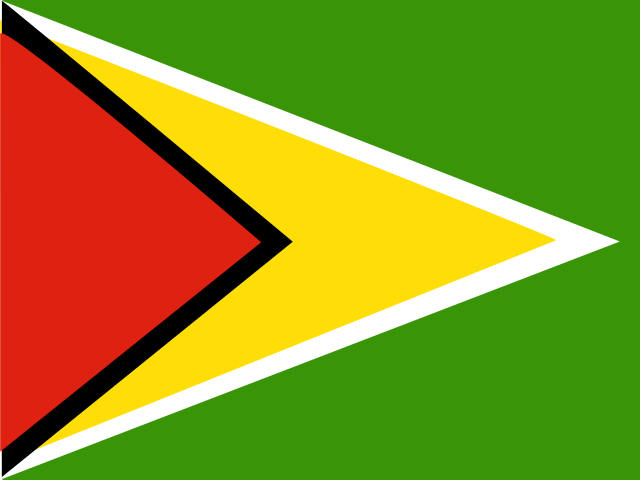
Guyana
The only English-speaking country in South America, Guyana looks more to the Caribbean than the continent, with a wall of rainforest inland and Kaieteur Falls dropping in a single sheet nearly five times the height of Niagara.
WHAT THE FLAG MEANS ◢
The 'Golden Arrowhead': a green field crossed by a white-edged gold triangle and a black-edged red triangle pointing from the hoist, three by five on land and one by two at sea. The constitution's schedule interprets every element: green for the agricultural and forested nature of the country, white for its waters and rivers potential, the golden arrow for its mineral wealth and its forward thrust, the black border for the endurance that will sustain that thrust, and the red triangle for the zeal and dynamic nature of the nation building ahead of a young and independent country.
Guyana FACTS ◢
| Capital | Georgetown |
|---|---|
| Continent | South America |
| Population | 835,986 (2025) |
| Area | 214,970 km² |
| Population density | 4/km² |
| Currency | Guyanese dollar (GYD) |
| Official language | English |
| Calling code | +592 |
| Internet TLD | .gy |
| Time zone | UTC-04:00 |
| Drives on the | Left |
| ISO codes | GY / GUY |
DID YOU KNOW? ◢
- It's the only country in South America where English is the official language.
- Kaieteur Falls is one of the world's most powerful single-drop waterfalls, far taller than Niagara.
- Most of the country is covered in dense, largely untouched tropical rainforest.
- Its name is thought to come from an Indigenous word meaning 'land of many waters'.
- It's culturally tied to the Caribbean rather than its Spanish- and Portuguese-speaking neighbours.
Guyana QUICK ANSWERS ◢
What is the capital of Guyana?
The capital of Guyana is Georgetown.
What is the population of Guyana?
Guyana had a population of 835,986 in 2025.
What currency does Guyana use?
Guyana uses the Guyanese dollar (GYD).
What languages are spoken in Guyana?
The official language of Guyana is English.
Think you know your flags? Play Flag Daily → · Browse all countries →
MORE ON THE FLAG ◢
Most national flags come with a story about their colours, and for most of them that story is carried by convention, by tourist boards and by official websites rather than by an instrument you can cite. Guyana's story is in the law. Whatever its parentage, the reading of the Golden Arrowhead's five colours now has constitutional force: it sits in the Constitution of the Co-operative Republic of Guyana, in the Second Schedule, with a line for each colour.
What is far less well known is when it got there. The Golden Arrowhead was first raised at midnight on 25 May 1966, as Guyana's independence began. The paragraph that explains it was inserted into the constitution by an Act the President assented to on 7 August 2001, thirty-five years later.
Guyana's schools, agencies and reference pages had long since settled on a wording of their own, close to the constitutional text without being the same as it. The differences are not trivial ones.
Key Takeaways
- The Second Schedule to Guyana's constitution assigns a meaning to green, white, the golden arrow, the black border and the red triangle.
- That schedule was put there by the Constitution (Amendment) (No. 4) Act 2001, assented to on 7 August 2001.
- The wording in the current Laws of Guyana differs from the wording Parliament passed in 2001 in several places: the blazon has gained a word, two colour clauses were reworded, and two whole passages were dropped.
- The colour-proportion line in the current Laws of Guyana names four colours, omits red, and gives figures totalling 142.
- A 2016 Government of Guyana statement credits the flag to Whitney Smith, a twenty-year-old American student who designed it in 1960; a Guyanese ambassador's 2000 account dates it to 1962 and to an international competition.
The Second Schedule of Guyana's constitution, line by line
Article 4 of the constitution does one thing only. It says that "The national flag of the State is the flag known as" the Golden Arrow Head, spelled as three words there, and points at the Second Schedule. Everything a reader wants is in the schedule.
The schedule opens with heraldry. As the Laws of Guyana print it today, the flag's blazon is "presented by the Garter King of Arms from the Royal College of Arms", England - though that credit is itself an addition, and the seventh divergence set out below: the Act Parliament passed introduces the same blazon as "The official heraldic description of the Guyana Flag - popularly known as the golden arrowhead", naming nobody. As the Laws of Guyana print it today, that reads: "Vert upon a pile throughout issuant from the dexter or, fimbriated argent; white upon a pile gules fimbriated sable, upon the same base". In plain terms that is a green field, a gold wedge running the whole length from the hoist with a white edge, and a red wedge on the same base with a black edge. The stray "white" in the middle of that line is not heraldry, and it is not in the Act Parliament passed.
Then comes the part everyone quotes. "The design and the colour of Guyana Flag are interpreted as follows", and five sentences follow.
| Element | What the Second Schedule says |
|---|---|
| Green | "The green background symbolises the agricultural and forested nature of Guyana." |
| White | "The white symbolises its waters and rivers potential." |
| Gold | "The golden arrow symbolises Guyana's mineral wealth and its forward thrust." |
| Black | "The black border the endurance that will sustain the golden arrow's forward thrust into the future." |
| Red | "The red triangle represents the zeal and dynamic nature of the nation building that lies before this young and independent country." |
Two things in that table are worth slowing down for. The black clause has no verb, in every printing of the constitution consulted for this article, so that is the text and not a transcription slip.
And the gold is called gold, never yellow. That matters more than it sounds, because the colour tables used to make flags for international events call it yellow: The Flag Manual for Beijing 2008 and the Flags and Anthems Manual for London 2012 both give Guyana a Pantone yellow, and the London one was compiled from images each national Olympic committee had approved. So do the Album des Pavillons, Vexilla Mundi and Flag Color Codes.
The colours entered Guyana's constitution in 2001
Guyana's Act No. 6 of 2001, the Constitution (Amendment) (No. 4) Act 2001, ran to twenty-four sections and rewrote the constitution's preamble. Buried in its third section is the change that matters here.
That section altered article 4 "by the insertion immediately after the words" naming the Golden Arrow Head, of the words "as set out in the Second Schedule". It did the same for the coat of arms in article 5 and the anthem in article 6. It created article 6A for the National Pledge, which had no constitutional home at all before. And it printed the Second Schedule those articles now point to, carrying the flag, the arms, the anthem and the pledge.
So the constitution had named the flag since 1980, and described it only from 2001. The 1980 constitution is Act No. 2 of 1980, and the printed editions carry "[20TH FEBRUARY, 1980]" beneath its long title, in the position the Laws of Guyana use for commencement; none of the editions read for this article labels that date, and the constitution's own appointed day, by Proclamation 2 of 1980, is 6 October 1980. The 2001 Act is where a reading that already existed acquired the force of the constitution.
That it already existed is easy to show. Flags of the World quoted a version from a Guyanese information site on 6 January 1999, two years before the Act. Its black already read the way Guyana's schools still write it, and not the way either later official text does: it "portrays the endurance that will sustain the forward thrust of the Guyanese people". The Lands and Surveys Commission's page cites a Guyanese school text of 2000, although for its sentence naming the designer rather than for its colour list; the colour list carries no citation of its own, and the only other reference the page gives is an undated national-symbols page on guyana.org.
What the Act of 2001 does not do is say who wrote the interpretation, when, or on whose authority. It adopts a text and leaves its parentage alone.
The words Parliament passed are not the words now printed
Guyana publishes its statute book as revised editions prepared by the Law Revision Commissioner. The Second Schedule appears in the editions authorised as L.R.O. 1/2012 and L.R.O. 1/2022, and both print the same text. The Act of 2001 is also online, as a scan of the original print. Set the two side by side and they do not match.
| In Act No. 6 of 2001 | In the revised editions |
|---|---|
| "the dexter or fimbriated argent a pile gules fimbriated sable" | "the dexter or, fimbriated argent; white upon a pile gules fimbriated sable" |
| "The white border symbolises its waters and rivers potential." | "The white symbolises its waters and rivers potential." |
| "The red triangle symbolises the zeal and the dynamic task of nation building which lies before this young and independent country." | "The red triangle represents the zeal and dynamic nature of the nation building that lies before this young and independent country." |
| A plain-English paragraph glossing the blazon | Not printed |
| A sentence quoting the Garter King of Arms on the design | Not printed |
| "a proportion 3 x 5 on land and 1 x 2 at sea" | "a proportion 3* 5 on land and 1* 2 at sea" |
| "The official heraldic description of the Guyana Flag - popularly known as the golden arrowhead" | The same sentence, with official and popularly dropped and a credit inserted: "presented by the Garter King of Arms from the Royal College of Arms" |
The last row is the one a reader is most likely to repeat, because it is the sentence that introduces everything else. The Act presents the blazon as the official heraldic description and attributes it to nobody. The revised editions drop "official" and "popularly", and insert a credit: the description is now "presented by the Garter King of Arms from the Royal College of Arms". That credit may well be accurate - the Act's own closing sentence has the Garter King of Arms commenting on the design, so he plainly saw it - but the enactment does not say he presented the blazon, and the OAS printing does not carry the credit either. Every source that quotes the constitution's flag schedule today quotes an attribution that Parliament did not pass.
The first row is the blazon itself, and it has picked up a word. Heraldry names white by its tincture, argent, and the Act's line does exactly that: the gold pile is "fimbriated argent", edged white. The revised editions put the plain English "white" in front of "upon a pile gules", so the printed description edges the gold pile argent and then announces white a second time, this time in front of the red pile that the same clause fimbriates sable. "white upon a pile gules" is not an instruction a herald can follow, and a reader working from the current text has no way to know the word is not part of the description the Garter King of Arms supplied.
The second row changes the scope of a colour. In the Act, white is the border. In the revised edition, white is white, wherever it appears on the flag. The third row changes a noun: nation building is a "task" in the Act and a "nature" in the revised edition, which are not the same idea.
The two dropped passages are the more striking loss. The Act carried a translation of its own heraldry, for readers who have none: "This in simple terms means a mass of green issuing from the right, a pile bordered with white, a pile of red bordered with black upon the same base." It also carried the only line in the whole schedule that says anything about how the design was received: "The Garter King of Arms has described the design as being one of the most significant departures in national flag design in modern times."
The last row is a typographical accident with a real consequence. Read the revised edition alone and the land proportion is given as 3* 5, which is not a ratio in any notation. The Act shows it was typed as 3 x 5, and 1 x 2 at sea.
One caution about that comparison. The scan of the Act is a poor photocopy, legible only when rendered at high resolution and read as a picture rather than as text. Where it is not legible, this article says so rather than guessing.
One printing looks like a counter-example and is not. A copy of the constitution hosted by the Organization of American States runs the footer "L.R.O. 3/1998" on every page and prints the flag interpretation, which taken at face value would put it in the statute book three years before the Act. Its own pages give it away. The Second Schedule is headed "Articles 4,5 6 and 6A", and article 6A did not exist until section 3(d) of the 2001 Act created it. Marginal notes elsewhere in the same document cite an Act of 2000. This is a compilation that keeps an older revision stamp over post-2001 material.
It is worth reading anyway, because it sits between the two texts. Its colour sentences are already the revised wording: white rather than the Act's white border, and dynamic nature rather than the Act's dynamic task. Its proportions already carry the stray character. But it still prints the sentence about the Garter King of Arms that the 2012 and 2022 editions drop, in a scan that renders it "The Greater King of Arms has described the design as being one of the most significant departures in national flag design in modern times." And its blazon, mangled as it is, has no stray white in it. It reads "a pile gules", as the Act does.
Can you build the flag from the constitution?
No, and the reason is one line.
After the proportions, the schedule says "The colour proportions are:" and then, exactly as printed in both revised editions: green 50" gold 24" white 67" and black 1".
Red is not in that list. The four figures given total 142. Whatever the marks after the numbers were meant to be, no combination of green, gold, white and black can occupy 142 of anything, and one of the flag's five colours is missing from the accounting altogether.
Flags of the World, the long-running flag reference, hit the same wall independently in 2009. A contributor found the schedule on the parliament's own website and reported that "it looks really useless since it provides no drawing or any sort of hint", quoting those same four figures. That is not a criticism anyone had to invent; it is what the schedule on the parliament's site actually contains.
There is no official construction sheet and no official shade either. In 2020 Hemendra Bhola compared a locally made flag bought in Guyana against a scan of the approved 1966 flag obtained from the College of Arms; writing again on the same page in 2024, he concludes flatly: "There are no established shades of the flag." The one thing he treats as fixed is the naming, and it is the naming the constitution shares, that "the gold on the flag is always described as gold and never yellow".
The printed law contains one more oddity. The illustration beside that text, in the same schedule, shows the wedge in an unmistakably bright yellow, so the picture and the words disagree inside one instrument. If you have only ever met this flag in a quiz, the wedge you saw was probably yellow too: a daily flag round puts one flag in front of you and gives you three guesses at the country.
How Guyanese sources word it differently
Ask a Guyanese state body what the flag means and you will get an answer that is close to the constitution and never identical to it. The differences run in a consistent direction.
The Guyana Lands and Surveys Commission publishes a national fact page. Its white is scoped to the fimbriation, the white "bordering the golden arrowhead symbolizes the many rivers and water potential of Guyana". Its black is given an owner the constitution withholds, "the strength and endurance of the Guyanese people", and then hands the thrust straight back to the flag: it is that strength and endurance "which sustains the Golden Arrowhead's forward thrust into the future". Its red is "the zeal and dynamic task of nation building which lies before our nation", using the Act's word, task, where the revised edition has nature.
The Ministry of Education teaches the same shape. A Grade Seven social studies worksheet in its Secondary Engagement Programme tells students that "The GREEN background represents our agricultural and forest products" and that "The WHITE border reminds us of the water potential of our country", dropping the rivers entirely. Its black is "the endurance that will sustain the forward thrust of the Guyanese people".
That last substitution is the one to watch, because it changes the meaning. The constitution ties the black border to the golden arrow's forward thrust, which is a statement about the design: the black edge holds up the gold wedge. The teaching version ties the thrust to the Guyanese people, which is a statement about the country. One is heraldry explaining itself. The other is a national motto in miniature.
That substitution is not universal, though, and the exception is the interesting one. It is made by the Ministry of Education worksheet and by the guyana.org wording that Flags of the World captured in 1999, two years before the Act, but not by the Lands and Surveys Commission, which moves the strength and endurance to the Guyanese people and still leaves the forward thrust with the arrowhead, so that the heraldic reading and the national reading sit inside one sentence.
None of these is wrong, exactly. The people-centred wording was in print before the constitutional text existed, and both state pages carry a Guyanese institution's name. But when a flag chart tells you the black stands for the endurance of the Guyanese people, it is repeating Guyana's schoolroom rather than Guyana's constitution.
Who designed the Golden Arrowhead
An American undergraduate named Whitney Smith. The Guyanese accounts part company over how his design reached the country: the government's version is a letter that got an answer, an ambassador's is an international competition.
When Whitney Smith died in November 2016, the Government of Guyana issued a statement of condolence, reported by the Guyana Chronicle. "He designed the national flag in 1960, six years before Guyana's independence." He was twenty, a political science student at Harvard, and he had written to Cheddi Jagan to ask what the new country's flag was going to be. Jagan invited him to submit ideas, "which were subsequently adopted with some modifications".
The archive that now holds Smith's papers records the same thing in its own words. The Dolph Briscoe Center for American History at the University of Texas at Austin, which accessioned the Flag Research Center collection beginning in 2013, describes Smith as "the designer of the national flag of Guyana, adopted in 1966, and also known as the Golden Arrowhead". The Flag Institute in Britain, in its notice of his death, says he "in 1966 designed the national flag of Guyana", dating the design to the adoption rather than to the drawing.
Between the letter and the flag there was a process. A Colonial Office file at the UK National Archives, covering 1962, is catalogued as "British Guiana: ministerial committee to consider new name, national anthem, flag and coat of arms." A message on the Flags of the World page for Guyana, attributed to Odeen Ishmael of the Guyana Embassy in Washington and dated December 2000, says the flag "was the result of an international competition held by the then government", held when 1962 was expected to be independence year, and that the design was not changed by the government that took office in December 1964.
That message also disagrees with the government's own account of the date. It says the flag "was designed in 1962 by an American, Mr. Whitney Smith", two years after the year the 2016 condolence statement gives, and it describes a competition rather than a letter and an invitation to submit. One account is a government statement issued in 2016. The other is Guyana's ambassador to Washington writing in 2000. Nothing found for this article reconciles them, and both are reported here as they stand.
Smith himself, in his book Flag Lore of All Nations, gave the colours a reading that no Guyanese instrument contains: "Green stands for the jungles and fields, white for the many rivers of Guyana; black is for perseverance, and red for nation building." He also wrote that the arrowhead "recalls the original Indian inhabitants of Guyana". That book could not be opened directly for this article; the passage is quoted here from the Portland Flag Association, which reproduced the Guyana entry in full in 2016.
The Amerindian arrow is worth separating out, because it is the most repeated fact about this flag and it is the designer's reading rather than the state's. The constitution's flag gloss does not mention Amerindians at all. The very next page of the same schedule does, for a different emblem: "The Amerindian head-dress, the Cacique Crown, symbolises the Amerindians as the indigenous people of the country." That is the coat of arms, not the flag.
Did the College of Arms change the design?
The record runs out here, and it is worth saying so rather than picking a side.
The current printed constitution credits the College of Arms with one thing only: the heraldic description, "presented by the Garter King of Arms from the Royal College of Arms". That credit is not in the Act Parliament passed, which introduces the same blazon without naming anyone, so the attribution reaches the reader from the revision rather than from the enactment. The institution's own name, on its own website, is the College of Arms, and its official records include, among the grants and the pedigrees, "official enrolments of flags".
The claim that the College also altered the design is the more widely circulated one, and it is the better published. Flags of the World has carried it since 1996, where Roy Stilling states that "The black and white fimbriations were not in Whitney Smith's original design, but were added by the English College of Arms". In 2000 another contributor quotes DK's Complete Flags of the World (1999) on the same page: "The original design had a red field, but this was altered by the College of Arms (in England) in 1966, which also added the black and white fimbriations." He reports it "corroborated in Crampton's FOTW (1990)" and by Stilling.
In 2020 that page acquired a contradiction. Hemendra Bhola, who had compared a locally made flag with the College of Arms scan, reported an interview he had seen in a video of independence days with a member of the design committee: the committee kept Smith's arrangement, reversed the red and the green, and then an artist on the committee objected that nothing in it stood for the waters and rivers. White was added for that reason, black added to balance it, and only then was the design sent to the College of Arms. His conclusion: "So we now know that the black and white were never added by the college."
They are not flatly opposed, though. Both have the colours rearranged from Smith's original before the flag was adopted in 1966: DK has a red field altered that year, and the committee member has the committee itself keeping Smith's design and reversing the red and the green. What they disagree about is who made the change and, separately, who added the black and white edges. On one side, DK, Crampton and Stilling. On the other, one second-hand report of one committee member. No Guyanese state publication settles between them, and what the state does say is what the 2016 condolence statement says, that Smith's ideas were adopted "with some modifications". That is as far as an official source goes.
The night the Golden Arrowhead first went up
The first hoisting is better documented than the design, because the man who did it wrote it down.
Second Lieutenant Desmond Roberts of the Guyana Defence Force raised the flag at midnight on 25 May 1966 at the National Park in Georgetown, alongside Lieutenant Ulric Pilgrim. In an account published for the fiftieth anniversary he remembered being pulled off the parade during rehearsals and put back on it "a day or two before the event", and that the flag they went up with was not the one they had rehearsed with. It was larger and needed a different rig, which he supposed was why a second officer had been put beside him.
He also remembered the crowd, and one line of his suggests how little of the flag the public had seen before that night. "It was really a beautiful flag. Nobody had ever seen it." Then, he wrote, Prime Minister Forbes Burnham called Cheddi Jagan up and the two men embraced.
The Golden Arrowhead is one of the flags a quiz can put in front of you. If you would rather work a country out with no flag to lean on at all, three written clues is the version without one.
The flag flew for thirty-five years before the constitution said what it meant. When the constitution finally did, it gave the Golden Arrowhead five clear sentences and one line of colour proportions that nobody can use.
Frequently asked questions
What do the colours on the Guyana flag mean?
Guyana's constitution answers this itself, in the Second Schedule, as the Laws of Guyana now print it. Green is "the agricultural and forested nature of Guyana"; white is "its waters and rivers potential"; the golden arrow is "Guyana's mineral wealth and its forward thrust"; the black border is "the endurance that will sustain the golden arrow's forward thrust into the future"; and the red triangle is "the zeal and dynamic nature of the nation building that lies before this young and independent country".
Is the arrowhead on Guyana's flag gold or yellow?
The constitution calls it gold. The blazon in the Second Schedule gives the wedge the heraldic tincture for gold, the interpretation beneath it calls it the golden arrow, and the schedule's colour-proportion line calls it gold. Yellow appears nowhere in the text, although the illustration printed in the same schedule shows a bright yellow wedge, and most flag charts follow the picture rather than the words.
Does the Guyana flag stand for the Amerindian people?
Not in the constitution. The reading that the arrowhead recalls Guyana's Indigenous peoples comes from the flag's designer, Whitney Smith, who wrote in Flag Lore of All Nations that it "recalls the original Indian inhabitants of Guyana". The constitutional gloss of the flag says nothing about Amerindians. The passage in the same schedule that does is about the Cacique Crown on the coat of arms.
Who designed the flag of Guyana?
Whitney Smith, an American vexillologist. He was a twenty-year-old Harvard student when he sent a design to Cheddi Jagan in 1960, according to a Government of Guyana statement issued after his death in 2016, and the design was adopted "with some modifications" for independence in 1966. Guyana's ambassador to Washington gave a different account in 2000, dating the design to 1962 and to an international competition. Whether the black and white edges were among the modifications, and who added them, is disputed between published accounts and is not settled by any Guyanese state source found for this article.
What are the official proportions of the Guyana flag?
The schedule gives two: 3 by 5 on land and 1 by 2 at sea. The revised editions of the Laws of Guyana print those ratios with a stray character where the multiplication sign belongs, and the scan of the 2001 Act shows them as 3 x 5 and 1 x 2. The schedule's separate line on colour proportions cannot be used at all, because it names only four of the five colours and its figures total 142.
Sources
- Parliament of Guyana, Constitution of the Co-operative Republic of Guyana, Cap. 1:01 (authorised L.R.O. 1/2012), articles 4 to 7 and the Second Schedule at pages 260 to 262 - retrieved 26 August 2026.
- Ministry of Legal Affairs of Guyana, Laws of Guyana, Chapter 001:01, Constitution of the Co-operative Republic of Guyana Act (authorised L.R.O. 1/2022), Second Schedule at pages 222 to 224 - retrieved 26 August 2026.
- Parliament of Guyana, Act No. 6 of 2001, Constitution (Amendment) (No. 4) Act 2001, section 3 and the Second Schedule - retrieved 26 August 2026.
- Organization of American States, Constitution of the Co-operative Republic of Guyana, an intermediate printing stamped L.R.O. 3/1998 with the Second Schedule at page 201 - read 26 August 2026 from the Internet Archive, the live host redirecting to an error page.
- Georgetown Chamber of Commerce and Industry, Constitution of the Co-operative Republic of Guyana, a third printing of the revised text - retrieved 26 August 2026.
- Guyana Lands and Surveys Commission, The Golden Arrowhead - retrieved 26 August 2026.
- Ministry of Education of Guyana, Grade Seven Social Studies, Week Six, Lesson One: Symbols of Nationhood - retrieved 26 August 2026.
- Guyana Chronicle, Designer of Golden Arrowhead passes on - retrieved 26 August 2026.
- Guyana Chronicle, The man who first raised the Golden Arrowhead - retrieved 26 August 2026.
- Dolph Briscoe Center for American History, University of Texas at Austin, Dr. Whitney Smith Flag Research Center Collection finding aid - retrieved 26 August 2026.
- The Flag Institute, In memoriam: Whitney Smith - retrieved 26 August 2026.
- The National Archives (UK), Discovery catalogue, CO 1031/3638, British Guiana: ministerial committee to consider new name, national anthem, flag and coat of arms - retrieved 26 August 2026.
- College of Arms, Records and Collections - read 26 August 2026 from the Internet Archive capture of 1 February 2026, the live site being behind a bot challenge.
- Flags of the World, Guyana, contributions by Roy Stilling (1996), Dov Gutterman (1999), Jarig Bakker and Odeen Ishmael (2000), Zachary Harden (2009), Ian Sumner (2012), Hemendra Bhola (2020 and 2024) and Zoltan Horvath (2024) - retrieved 26 August 2026.
- Portland Flag Association, Whitney Smith's Flag of Guyana, reproducing the Guyana entry from Whitney Smith, Flag Lore of All Nations - retrieved 26 August 2026.
PLAY ANOTHER →
One thing that happened today in history. Every day, a new one.
TODAY IN HISTORYDAILYDaily CryptogramOne quote, one scrambled alphabet. Crack it before tomorrow.
CRACK THE QUOTEDAILYDaily CodeA short message, hidden in a different cipher every day.
ONE CIPHER A DAYDAILYGuess the CountryThree clues, three guesses. Work out where in the world it is.
THREE CLUES