
Iceland
A volcanic island parked between two continental plates, where geysers, glaciers and lava fields share the neighbourhood. Iceland runs almost entirely on the heat and water beneath its own feet.
WHAT THE FLAG MEANS ◢
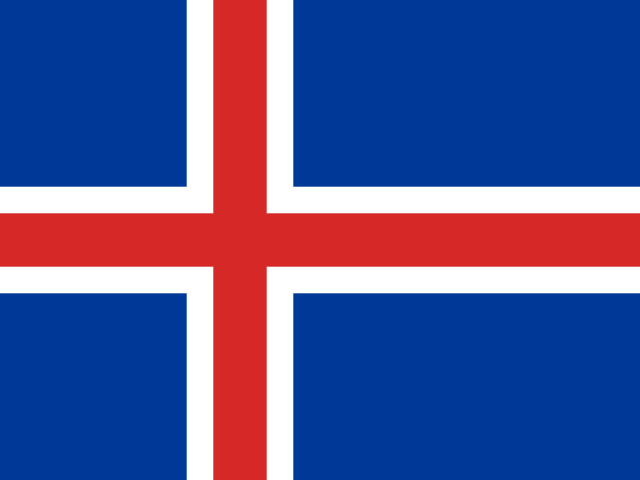
A blue field bearing a white-edged red Nordic cross. The flag law names the colours rather than interpreting them: the field is heiðblár, sky blue, the outer cross mjallhvítur, snow white, and the inner cross eldrauður, fire red. Article 1 of that law sets the white arms at two ninths and the red at one ninth of the flag's width and the proportions at 18 to 25. The reading of the colours as the mountains, the ice and the fire is the designer's, given by Matthías Þórðarson when he first showed the design in 1906.
Iceland FACTS ◢
| Capital | Reykjavík |
|---|---|
| Continent | Europe |
| Population | 392,404 (2025) |
| Area | 103,004 km² |
| Population density | 4/km² |
| Currency | Icelandic króna (ISK) |
| Official language | Icelandic |
| Calling code | +354 |
| Internet TLD | .is |
| Time zone | UTC±00:00 |
| Drives on the | Right |
| ISO codes | IS / ISL |
DID YOU KNOW? ◢
- Nearly all of its heat and electricity come from geothermal and hydro power, tapping the volcanoes underneath.
- It was long one of the very few countries on Earth with no mosquitoes at all, until the first were finally detected there in 2025.
- The Althing, founded in 930 AD, is one of the world's oldest surviving parliaments.
- The word 'geyser' comes from Geysir, a hot spring in the Icelandic countryside.
- It sits astride the Mid-Atlantic Ridge, where the North American and Eurasian plates pull apart.
Iceland QUICK ANSWERS ◢
What is the capital of Iceland?
The capital of Iceland is Reykjavík.
What is the population of Iceland?
Iceland had a population of 392,404 in 2025.
What currency does Iceland use?
Iceland uses the Icelandic króna (ISK).
What languages are spoken in Iceland?
The official language of Iceland is Icelandic.
Think you know your flags? Play Flag Daily → · Browse all countries →
MORE ON THE FLAG ◢
Ask what Iceland's flag means and you will be told mountains, ice and fire. That reading is real, it is documented, and Iceland's own government publishes it. It is not, though, what the law says, and the government never claims it is.
It belongs to one man on one evening. Matthías Þórðarson, later Iceland's Keeper of National Antiquities, showed his design to the Reykjavík Students' Association on 27 September 1906: a white cross on a blue field with a red cross inside the white one. The Prime Minister's Office history of the flag records what he intended by the colours in one sentence, and then leaves it there.
The Flag Act that governs the flag today says nothing of the sort. Read end to end, Act No. 34/1944 measures the flag, regulates who may fly it and what may not be done to it, and never once explains it.
Key Takeaways
- Iceland's flag colours are read as mountains, ice and fire because the designer said so in 1906, not because any Icelandic instrument says so.
- Act No. 34/1944 describes the flag in three compound colour words and assigns none of them a meaning.
- The Act's snow-white and fire-red are not the words the flag was created with. The royal decree of 19 June 1915 said plain white and bright red.
- A parliamentary committee moved to strike the word ultramarineblár out of the flag bill on 14 June 1944, and the Act passed the next day without it, leaving the law with no technical colour term at all.
- On the government's own account, Iceland flies a red cross rather than the blue and white flag it wanted because King Christian X refused the blue and white one.
| The text | Date | The field | The white cross | The red cross |
|---|---|---|---|---|
| Royal decree on the design of the flag | 19 June 1915 | heiðblár (ultramarineblár) | hvítum | hárauðum |
| Government bill drafted by Sveinn Björnsson | 1941 | heiðblár (ultramarineblár) | hvítum | hárauðum |
| The same bill after the Lower Chamber committee amended it | 1941 | heiðblár (ultramarineblár) | mjallhvítum | eldrauðum (hárauðum) |
| Bill as laid before Alþingi, þingskjal 249 | 12 June 1944 | heiðblár (ultramarineblár) | mjallhvítum | eldrauðum (hárauðum) |
| Act No. 34/1944 (dated 17 June 1944), Article 1 | passed 15 June 1944 | heiðblár | mjallhvítum | eldrauðum |
Who says the colours mean mountains, ice and fire?
Matthías Þórðarson does, and the state repeats him without adopting him.
The Prime Minister's Office publishes a history of the flag by Birgir Thorlacius, first printed in its own 1991 volume Fáni Íslands, skjaldarmerki, þjóðsöngur, heiðursmerki. On the 1906 meeting it says: "Áttu litirnir að tákna fjallablámann, ísinn og eldinn." The government's own English edition renders that as "These colours were supposed to represent the blue of the mountains, white ice and red fire."
Notice what the Icelandic assigns to the blue. Its word there is fjallablámann, the blue of the mountains, the colour hills take at a distance. It is not the sea and it is not the sky. Descriptions of the flag that give the blue to the ocean are following neither the designer nor the statute.
The statute's own word for the field is different again. Article 1 of Act No. 34/1944 calls it heiðblár, which the government's English edition translates as sky blue. Sky, that is, and not mountainside. So the two Icelandic texts a reader is likeliest to meet, the designer's intention and the law's description, do not agree about which blue is being named, and neither of them says the colour stands for anything.
That is the whole evidential position. One private reading from 1906, published by the state as history, and one statutory description that interprets nothing. Anything else in circulation is a gloss on one of those two, and worth attributing to whoever wrote it.
Why Iceland's flag has a red cross at all
Because the flag Iceland asked for was refused.
Through the 1900s the popular design was the one the Prime Minister's Office calls the bláhvíti fáninn, a plain white cross on a blue field, proposed by the poet Einar Benediktsson in his paper Dagskrá on 13 March 1897. It was that flag, not Matthías Þórðarson's, that Icelanders were flying when the flag question turned into a political crisis.
Hannes Hafstein, the minister who had taken the flag question to King Christian X on 22 November 1913, appointed a government flag committee on 30 December 1913 to settle the design. The committee asked him to find out whether the king would sanction the blue and white flag. The Prime Minister's Office records the answer in one sentence: "Svar konungs var neitandi, þar eð fáninn líktist um of grískum fána." The king said no, because the flag was too like the flag of Greece.
A second objection arrived from a different direction. After a study by the principal of the Maritime College, the committee also concluded that in poor visibility a blue field with a white cross could be taken for the Swedish flag, which is a yellow cross on blue.
So the committee dropped the blue and white design and put forward two others. The first was sky blue with a white cross and a bright red cross inside it. That is the flag Iceland has.
Matthías Þórðarson had drawn that cross in 1906, seven years before the committee sat, and it had gone nowhere. On the government's own account his design advanced because the other one was blocked. He was also one of the five men on the committee that put it forward.
The most interesting sentence in the state's account is the one that doubts the state's own explanation. Writing about the whole episode, Birgir Thorlacius says the spirit of independence that had attached itself to the blue and white flag played a greater part in the refusal than any resemblance to Greece, and adds the detail that makes the point: "at least, Greece itself expressed no reservations about the design."
Where snow-white and fire-red entered the flag law
Not with the flag. They arrive twenty-six years after it.
The design was fixed by royal decree on 19 June 1915, and its wording is on the record: "Heiðblár (ultramarineblár) með hvítum krossi og hárauðum krossi innan í hvíta krossinum." Sky blue, in the specific sense of ultramarine, with a white cross and a bright red cross inside the white cross. Two of those three colour words are plain, and the third is a pigment name.
In 1941 the government brought a flag bill to Alþingi. Sveinn Björnsson had drafted it, and on the colours it simply copied the royal decree. The Lower Chamber's allsherjarnefnd, its general affairs committee, then rewrote the sentence, and the Prime Minister's Office gives its version in full: "Hinn almenni þjóðfáni Íslendinga er heiðblár (ultramarineblár) með mjallhvítum krossi og eldrauðum (hárauðum) krossi innan í hvíta krossinum." White had become snow-white, and bright red had become fire-red with the older word kept in brackets behind it.
The bill died twice, in 1941 and again in 1942. It came back on 12 June 1944, five days before the republic was founded, in exactly that form. Alþingi's paper for it, þingskjal 249, still carries both brackets.
Two days later the allsherjarnefnd reported again. Its first amendment is one line, and it removes the last technical anchor in the description: the parentheses "(ultramarineblár)" and "(hárauðum)" are to "falli niður", to fall away. The report does not say why either word went. The same report records a reservation from one member, who thought it "æskilegast hefði verið, að gerð fánans væri bláhvíti fáninn", that the better design would have been the blue and white flag. The initials against that line are Jörundur Brynjólfsson's.
Þingskjal 255, the bill after its second reading in the Lower Chamber, carries the sentence the Act still has: "Hinn almenni þjóðfáni Íslendinga er heiðblár með mjallhvítum krossi og eldrauðum krossi innan í hvíta krossinum." The Act as passed on 15 June 1944 is recorded on þingskjal 262 as samhljóða that text, identical to it.
So the flag law's poetry is the residue of a deletion. Snow and fire are in Article 1 of the Act because a committee put them there in 1941, and they stand alone because a committee took the plainer words out in 1944.
Why Iceland ended up publishing colour numbers
To remove doubt about the colours. The Prime Minister's Office puts the reason plainly on its flag page: "Til að taka af vafa að því er snertir litina er nú miðað við alþjóðlega litastaðla". Its English edition says the same thing: "To dispel any doubt concerning the colours, standards are now used as a reference".
Where that doubt came from is not something the ministry says, and it does not have to. Mjallhvítur and eldrauður name a colour without fixing one, and after 1944 no technical colour term was left in the Act.
The Act does anticipate the problem, in a roundabout way. Article 9 of the Act requires samples of the flag in its correct colours and proportions to be kept at places the ministry names and at every police commissioner's office, and it forbids offering for sale, selling or hiring flags made in any other colours or in any other proportions of fields and crosses. A physical sample rather than a number.
The current instrument is Announcement No. 32/2016, signed on 10 May 2016 and published the next day. It opens "Litir þjóðfána Íslendinga ákvarðast sem hér segir" and then does exactly that, anchoring the colours to the SCOTDIC textile system and giving equivalents in Pantone, CMYK, RGB, HEX and Avery. The blue is Pantone 287 and hex #02529C, the red Pantone 199 and hex #DC1E35, and the white is opaque white with no Pantone reference at all. One line reads, in the middle of an Icelandic legal text, "Eldrauði liturinn: SCOTDIC ICELAND FLAG RED." The announcement repealed an earlier one, No. 6/1991, which had done the same job for the previous twenty-five years.
Announcement No. 32/2016 is not part of the Act. It is made under it, and says so in its closing line: it is issued under Article 13 of the Act, read with Article 9. So the numbers that actually fix Iceland's flag colours sit outside the text that names them, and they have been replaced at least once.
The blue and white flag a Danish warship took off a rowing boat
The Prime Minister's Office traces the flag's sudden political heat to one incident in a harbour.
The Prime Minister's Office history is brief about it. The blue and white design became popular, it says, "ekki síst eftir að danskt herskip gerði 1913 upptækan slíkan fána, sem var á kappróðrarbáti á Reykjavíkurhöfn." A Danish warship confiscated one in 1913 from a boat in a rowing competition in Reykjavík harbour. The account adds that the incident turned the flag into a heated political issue, and what follows is fast: the matter went to King Christian X on 22 November 1913, and his decree of that day opens "For Iceland, a special flag shall be sanctioned by law."
The rejected flag did not disappear. In the government's own English account it is now the school flag of Laugarvatn Grammar School, presented on its founding day, 13 April 1953, with the blue and white silk flag that had draped Einar Benediktsson's coffin at a commemorative service in Reykjavík Cathedral on 26 January 1940. The Icelandic youth movement adopted it as its emblem too.
If you want to find out whether you could actually pick Iceland out of a row of Nordic crosses, a flag a day and three guesses at the country is the quickest test of it.
A flag like Iceland's, painted in India around 1740
There is one loose end in the state's account, and the state raises it against itself.
The National Museum of Maritime History in Stockholm holds an illustration of Calicut, now Kozhikode, in Kerala, from a book by Captain Mathias Gustaf Holmers of the Swedish East India Company dated to about 1740 to 1750. One of the two flags in it is Danish. The other, in the Prime Minister's Office's own description, appears to be the same shape and colours as the Icelandic flag: a white cross on a blue field with a red cross inside the white one. The history suggests it may have been a trading company's private flag.
That is roughly a hundred and sixty years before Matthías Þórðarson stood up at the students' meeting, and the obvious question is whether he had seen it. The government's answer is careful and negative: "As far as is known Matthías Þórðarson was not familiar with this flag when he proposed his design for the Icelandic flag in 1906." The account names Pétur Sigurðsson, then director of the Icelandic Coast Guard, as the man who noticed the illustration in the Swedish museum, and dates that to 1957.
The government prints the resemblance and declines to draw anything from it, which is the harder thing to do with a story this good.
Special flag, sovereign flag, statute
The design has been fixed since 1915, but its status changed twice more after that, and only the last change put it in a statute.
The 1915 decree gave Iceland a sérfáni, a special flag usable in Iceland and Icelandic waters, and it was issued with reference to the king's decree of 22 November 1913. That earlier decree set a condition on that flag. The swallowtail flag of Denmark was to be flown at Government House in a place no less worthy and a size no smaller than the Icelandic flag. The ministry attaches the condition to the 1915 decree, but the words it quotes are the 1913 decree's. Flagpoles for both went up behind the building in the summer of 1915, one for each.
The Act of Crown Union was ratified on 30 November 1918, and a fresh royal decree issued with it changed nothing about the shape or colour. At noon on 1 December 1918 the swallowtail flag went up on the pole above the door of Government House, and Sigurður Eggerz, the acting Prime Minister, said of it in his address from the steps: "Fáninn er tákn fullveldis vors." The flag is the symbol of our sovereignty. A twenty-one gun salute answered from the Danish coastguard vessel Islands Falk.
The Act came last. Passed on 15 June 1944 after four days in the house, it was the first legislation ratified by Iceland's newly elected president, at Þingvellir on 17 June 1944. The president was Sveinn Björnsson, who had drafted the 1941 bill that Alþingi had twice let die.
Frequently asked questions
What do the colours of the Icelandic flag mean?
No Icelandic instrument assigns the flag's colours a meaning: Article 1 of Act No. 34/1944 names the three of them and interprets none. The reading that they stand for mountains, ice and fire comes from the designer, Matthías Þórðarson, who gave it when he presented the design to the Reykjavík Students' Association in 1906, and Iceland's Prime Minister's Office publishes it as his intention rather than as an official meaning.
Who designed the Icelandic flag?
Matthías Þórðarson, later Keeper of National Antiquities, presented a white cross on a blue field with a red cross inside the white one at a meeting of the Reykjavík Students' Association on 27 September 1906. His proposal eventually prevailed over the plain blue and white flag, but only after the government flag committee of 1913 abandoned that design in the face of royal opposition.
Why was Iceland's blue and white flag rejected?
King Christian X refused to sanction it because it was too like the flag of Greece, which the Prime Minister's Office records in as many words. A study by the principal of the Maritime College added that in poor visibility it could be confused with the Swedish flag. The same government history doubts the official reason, arguing that the independence movement's attachment to the blue and white flag mattered more, and noting that Greece did not object itself.
What are the official colours of the Icelandic flag?
Announcement No. 32/2016 of the Prime Minister's Office fixes them against the SCOTDIC textile system and gives equivalents in five other systems. The blue is Pantone 287 and hex #02529C, the red is Pantone 199 and hex #DC1E35, and the white is specified as opaque white with no Pantone reference. The announcement replaced Announcement No. 6/1991, which had set the colours before it.
When did the Icelandic flag become the national flag?
The design was fixed by royal decree on 19 June 1915, but only as a special flag for use in Iceland and Icelandic waters. It became the flag of a sovereign state on 1 December 1918, when the Act of Crown Union came into force. It was put into statute by Act No. 34/1944, passed on 15 June 1944 and ratified at Þingvellir on 17 June 1944, the day the republic was founded.
Sources
- Alþingi, Lög um þjóðfána Íslendinga og ríkisskjaldarmerkið nr. 34/1944, consolidated text, Articles 1 and 9 - retrieved 26 August 2026.
- Alþingi, þingskjal 253 of the 63rd legislative session, the general affairs committee's report of 14 June 1944, with þingskjal 249 (the bill as laid before Alþingi), 255 (after the second reading) and 262 (the Act) at the same path - retrieved 26 August 2026. Read from 220 dpi page renders. A transcription is filed with the draft.
- Prime Minister's Office of Iceland, Fáni Íslands - retrieved 26 August 2026.
- Prime Minister's Office of Iceland, Saga fánans, by Birgir Thorlacius, first published in Fáni Íslands, skjaldarmerki, þjóðsöngur, heiðursmerki (Prime Minister's Office, 1991) - retrieved 26 August 2026.
- Government of Iceland, A brief history of the Icelandic flag, the government's own English edition of the same text - retrieved 26 August 2026.
- Stjórnartíðindi, Auglýsing nr. 32/2016 um liti íslenska fánans, A-deild, signed 10 May 2016 - retrieved 26 August 2026.
PLAY ANOTHER →
One thing that happened today in history. Every day, a new one.
TODAY IN HISTORYDAILYGuess the CountryThree clues, three guesses. Work out where in the world it is.
THREE CLUESDAILYDaily TriviaFive questions a day. Everyone gets the same five.
FIVE QUESTIONSDAILYDaily CodeA short message, hidden in a different cipher every day.
ONE CIPHER A DAY