
India
The world's most populous country and largest democracy, home to more than 1.4 billion people, hundreds of languages and the source of the very number system you count with.
WHAT THE FLAG MEANS ◢
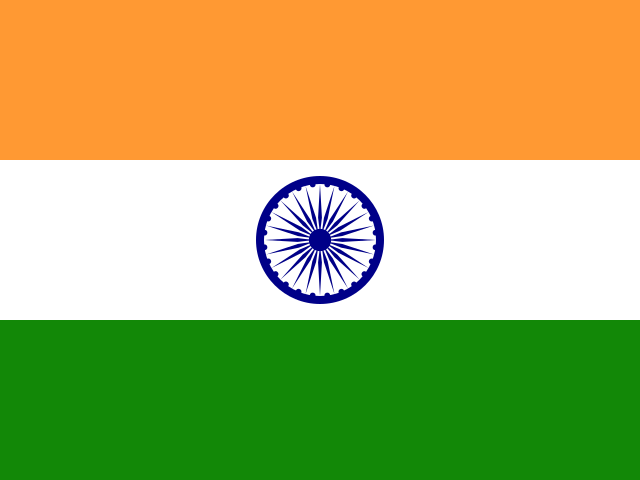
Three horizontal bands of India saffron, white and India green, with a navy-blue twenty-four-spoke Ashoka Chakra centred in the white band. The constitution refers to the National Flag only in the fundamental duties, which require every citizen to respect it, and never describes it or assigns it a meaning; the resolution that adopted the flag in 1947 describes the design in detail and says only that the wheel represents the charkha. The colours are conventionally read as saffron for renunciation, white for the path of truth and green for the relation to the soil, and the wheel as the wheel of the law of dharma, a reading taken from one member's speech in that debate rather than from any instrument.
Source: constitutionofindia.net
India FACTS ◢
| Capital | New Delhi |
|---|---|
| Continent | Asia |
| Population | 1,463,865,525 (2025) |
| Area | 3,287,263 km² |
| Population density | 445/km² |
| Currency | Indian rupee (INR) |
| Official languages | English, Hindi |
| Calling code | +91 |
| Internet TLD | .in |
| Time zone | UTC+05:30 |
| Drives on the | Left |
| ISO codes | IN / IND |
DID YOU KNOW? ◢
- It is the most populous country on Earth, home to more than 1.4 billion people.
- The decimal number system and the concept of zero were developed by Indian mathematicians.
- It has no single national language, but recognises 22 official languages in its constitution.
- The Kumbh Mela is the largest human gathering on the planet, drawing tens of millions of pilgrims.
- Chess evolved from an ancient Indian game called chaturanga.
India QUICK ANSWERS ◢
What is the capital of India?
The capital of India is New Delhi.
What is the population of India?
India had a population of 1,463,865,525 in 2025.
What currency does India use?
India uses the Indian rupee (INR).
What languages are spoken in India?
The official languages of India are English and Hindi.
Think you know your flags? Play Flag Daily → · Browse all countries →
MORE ON THE FLAG ◢
Ask what the Indian flag means and you will get the same three lines back: saffron is courage and sacrifice, white is peace and truth, green is faith and fertility. Ask which document says so, and the trail goes cold.
The resolution that adopted the flag, moved in the Constituent Assembly on 22 July 1947, describes the design in careful detail and assigns the colours no meaning whatsoever. The only meaning it states is about the wheel. The Flag Code of India, 2002, does not define the colours either. Nor does the Act that makes insulting the flag a criminal offence.
The famous gloss is real, and it is worth knowing. It just is not law, and it is not what most people think it is. It comes from a speech made by one member during that day's debate, and the version now in circulation has drifted a long way from what he said.
Key Takeaways
- The 22 July 1947 resolution fixes the colours, the wheel and the proportions. It assigns no meaning to saffron, white or green.
- The only symbolism in the operative text is that the wheel is there "to represent the Charkha", Gandhi's spinning wheel.
- The popular reading comes from Dr S. Radhakrishnan's speech in that debate. He spoke for himself, not for the Assembly.
- A government re-upload of the Flag Code adds a paragraph quoting him. Six of its eleven sentences appear nowhere verbatim in the record of what he said.
- Nehru, moving the resolution, said flatly that the colours carry no communal meaning.
What India's Constituent Assembly actually resolved
Jawaharlal Nehru moved the resolution on the afternoon of 22 July 1947, just over three weeks before independence. Its operative words are a specification:
Resolved that the National Flag of India shall be horizontal tricolour of deep Saffron (Kesari), white and dark green in equal proportion. In the centre of the white band, there shall be a Wheel in navy blue to represent the Charkha.
It goes on to fix the wheel's design as the one on the abacus of the Sarnath Lion Capital of Asoka, its diameter as roughly the width of the white band, and the flag's proportions as ordinarily two to three.
Read it again for what is missing. Deep saffron, white, dark green, in equal proportion, and not one word about what any of them stands for. The single piece of symbolism the Assembly voted on is the wheel, and the meaning it gives the wheel is not dharma. It is the charkha.
The layout it describes is not unique, either. Niger's flag also sets a round device in the centre of a white band between two coloured ones, and at a glance the two are easy to confuse.
Nehru explained why the spinning wheel had become a bare wheel, and the reason turns out to be practical rather than spiritual. The old Congress flag carried a full charkha, wheel and spindle, and a spindle points one way on the front of a flag and the other way on the back. So, he told the House, it was decided "that the essential part of the Charkha should be there, that is the wheel." The design problem came first; the choice of Asoka's wheel to solve it came second.
Where the famous meanings come from
Later that afternoon Dr S. Radhakrishnan rose to speak. He was a philosopher, later India's second President, and what he said is the source of almost everything you have ever read about the flag's colours.
On white: "The white means the path of light." On the wheel: "The Asoka's wheel represents to us the wheel of the Law, the wheel Dharma." On saffron: "The red, the orange, the Bhagwa colour represents the spirit of renunciation". On green: "our relation to the soil, our relation to the plant life here on which all other life depends."
He drew the four together in one line: we must be guided by "truth (white), practice virtue (wheel), adopt the method of self-control and renunciation (saffron)."
That is a beautiful reading, and it is not the reading now printed everywhere. Radhakrishnan's saffron is renunciation and detachment, not courage and sacrifice. His green is soil and plant life, not faith and fertility. His white is light and truth, with no mention of peace.
The wheel is where the drift is sharpest. The gloss in circulation calls it the eternal law of dharma. Radhakrishnan used the word eternal and then spent a sentence refusing exactly that reading:
Our Dharma is Sanatana, eternal, not in the sense that it is a fixed deposit but in the sense that it is perpetually changing.
He had already made the same point about the wheel itself, saying that because it is "a perpetually revolving thing", it "indicates to us that there is death in stagnation. There is life in movement." A version that hands the reader an eternal fixed law has inverted the one thing he was most insistent about.
None of this makes Radhakrishnan wrong. It makes him a speaker in a debate. The Assembly voted on the resolution, not on his interpretation of it.
The Flag Code of India does not define the colours either
If any document were going to make the gloss official it would be the Flag Code of India, 2002, and it is worth being precise about what that document is. Its own preamble says Part I "contains general description of the National Flag", and Part I is one page long. It fixes that the top panel "shall be India saffron (Kesari)" and the bottom "shall be India green", that the middle panel is white "bearing at its centre the design of Ashoka Chakra in navy blue colour with 24 equally spaced spokes", that the material was, as enacted in 2002, "hand spun and hand woven wool/cotton/silk khadi bunting", and that the proportions are 3:2. Then it lists nine standard sizes in millimetres.
It is a manufacturing specification. It says nothing about meaning.
Here is the wrinkle. The Code gets re-uploaded all over Indian government websites, and at least one of those copies carries an extra paragraph at the top. On the Uttar Pradesh Police's copy the preamble opens with a sentence introducing a quotation, "Dr. S. Radhakrishnan explained", followed by eleven sentences of colour symbolism. That paragraph is not in the booklet the Ministry of Home Affairs publishes. In the Ministry's own scanned edition the preamble runs straight from the first paragraph about the tricolour flying in its full glory to the second about universal affection and respect. The inserted text occupies a gap that, in the Ministry's copy, is not there.
How many other re-uploads carry it is not something this article can tell you: four more government copies were tried and none of them came back, so one is simply the number verified here. What is clear is that the text itself circulates, because a shortened version of it also sits on the Bureau of Indian Standards' page about the flag standard, with no attribution to anyone at all.
Compared sentence by sentence against the record of the debate, two of its eleven sentences are verbatim, three are recognisable rewordings, and six have no five-word run anywhere in what Radhakrishnan said. Its closing line, that the wheel "represents the dynamism of a peaceful change", is nowhere in the record at all. Its opening line, "Bhagwa or the saffron colour denotes renunciation of disinterestedness", is incoherent: renunciation and disinterestedness were two separate things in the speech.
So the most-quoted authority for the meaning of India's flag is a paraphrase, printed as a quotation, in copies of a document that does not itself contain it.
Five sources, and only two of them assign a meaning
| Document | What it fixes | What it says the colours mean |
|---|---|---|
| Constituent Assembly resolution, 22 July 1947 | Colours, wheel, diameter, proportions | Nothing, except that the wheel represents the charkha |
| Flag Code of India, 2002, Part I | Colours by name, 24 spokes, khadi, 3:2, nine sizes | Nothing |
| IS 1:1968, second revision, per the Bureau of Indian Standards' summary | Design and constructional details of a cotton khadi flag | Nothing in the standard's scope or design clauses |
| BIS explanatory page on IS 1:1968 | Not an instrument | Saffron "strength and courage", white "peace and truth", green "fertility, growth and auspiciousness" |
| Dr S. Radhakrishnan, in the 22 July 1947 debate | Not an instrument | Saffron renunciation, white light and truth, green relation to the soil, wheel the wheel of the Law |
The last two rows disagree with each other, and neither is the state speaking in its own voice. The Bureau of Indian Standards is a statutory body, but the gloss appears on an explanatory page, not in the standard, whose scope its own summary describes as prescribing "the design, constructional details and other particulars" of the flag.
That same BIS page manages to disagree with itself. A few paragraphs below the strength-and-courage reading it prints the other one, unattributed and in its own voice: "Bhagwa or the saffron colour denotes renunciation of disinterestedness. The white in the centre is light, the path of truth to guide our conduct." One page, two incompatible answers to the same question, and no instrument behind either.
Does saffron stand for Hindus and green for Muslims?
This is the reading the Assembly was most concerned to head off, and Nehru addressed it in the speech moving the resolution. Some people, he said, "having misunderstood its significance, have thought of it in communal terms and believe that some part of it represents this community or that. But I may say that when this Flag was devised there was no communal significance attached to it."
The record shows why he bothered. Three members that afternoon gave the colours three different readings.
Seth Govind Das argued that the saffron on this flag stood for no community. He granted that it had once been a Hindu colour, under the Peshwas and on Rajput ensigns, but held that calling any colour the ancient colour of the Hindus was historically wrong, and that green in 1857 had belonged to everyone who fought under it rather than to Muslims alone.
Syed Muhammad Saadulla, of the Muslim League, welcomed green as the colour Muslims had carried since the Prophet and as the colour of the flag Bahadur Shah raised in 1857, and read saffron as the colour of those living a spiritual life "not only among Hindus but also among Muslims".
Govind Malaviya went furthest, then said that was not the whole of it. He opened by saying that a national flag's importance does not depend on its colours or its bands at all, and that the colours it contains are immaterial. He went on that the flag belonged to no particular community but to the whole of India, and that a Hindu, a Muslim or a Christian could each claim it as his own. He then allotted green to Muslims, white to Christians and other communities and saffron to Sikhs, said every community was represented, and immediately added that the colours did not merely mean that, that there might be other interpretations, and that they represented Hindus as well.
The Hindu cosmological reading he went on to give, the top colour for fire and the sun, the white for the moon, the green for the planet Budha, is his answer to Hindus who had complained in the press that Hindu colours should predominate and the flag should be changed.
Govind Das and Malaviya both spoke in Hindustani, and the Report prints such speeches in English translation, so they are summarised here rather than quoted; Saadulla spoke in English. Frank Anthony, who had served on the committee that finalised the design, told the House "that this Flag did not contain any communal motives or significance."
An assembly that had just been partitioned along religious lines adopted a flag and declined, deliberately, to tell anyone what its colours meant. Read that way, the silence in the resolution is not an oversight. It is the point.
What Indian law does fix
Plenty, once you stop asking about meaning, and the material rule has moved. The 2002 Code required khadi; an order of December 2021 amended it so that the flag "shall be made of hand spun and hand woven or machine made, cotton/polyester/wool/silk khadi bunting", and a further order in July 2022 replaced the clause on household display so that "where the Flag is displayed in open or displayed on the house of a member of public, it may be flown day and night".
Behind the Code sits the Prevention of Insults to National Honour Act, 1971, which makes it an offence to burn, mutilate or deface the national flag "in any public place or in any other place within public view", punishable by imprisonment "for a term which may extend to three years, or with fine, or with both". Even there the law is about conduct. It protects the flag without ever saying what it means.
That gap between what a state specifies and what its people read into the result is the ordinary condition of national flags, and it is why recognising one from its bands is harder than it looks. If you want to test that, Flag Daily shows one flag a day and gives you three guesses at the country.
Frequently asked questions
What do the colours of the Indian flag mean?
No Indian instrument assigns them a meaning. The Constituent Assembly resolution of 22 July 1947 names the colours as deep saffron (Kesari), white and dark green and stops there, and Part I of the Flag Code of India, 2002 does the same. The familiar reading of saffron as courage, white as peace and green as fertility comes from interpretation, not from law.
Is the saffron, white and green symbolism official?
It is not. The closest thing to an official-sounding source is a speech by Dr S. Radhakrishnan during the debate that adopted the flag, and even his reading differs from the popular one: he gave saffron as renunciation and green as our relation to the soil, not as courage and fertility. He was one member speaking, and the Assembly voted on the resolution rather than on his interpretation.
What does the Ashoka Chakra represent?
The resolution says the wheel is there "to represent the Charkha", the spinning wheel of Gandhi's movement, and that its design is taken from the wheel on the abacus of the Sarnath Lion Capital of Asoka. The reading of it as the wheel of dharma traces to Radhakrishnan's speech in the same sitting, which called it "the wheel of the Law, the wheel Dharma".
How many spokes does the Ashoka Chakra have?
Twenty-four. Part I of the Flag Code of India, 2002 specifies the design of the Ashoka Chakra "in navy blue colour with 24 equally spaced spokes", and requires it to be completely visible on both sides of the flag.
Why is the Indian flag ratio 3:2?
Because the Flag Code says so: "The ratio of the length to the height (width) of the Flag shall be 3:2." The 1947 resolution had put it more loosely, as a width to length ratio that should ordinarily be two to three. The Code also lists nine standard sizes, from 6300 by 4200 millimetres down to the 150 by 100 millimetre table flag.
Sources
- Constituent Assembly of India, Debates, Volume IV, 22 July 1947, transcribed by the Centre for Law and Policy Research - retrieved 13 August 2026. Parliament's own copy of the Official Report, at eparlib.sansad.in, could not be reached from here, so every quotation from the debate above is taken from this transcription.
- Ministry of Home Affairs, Flag Code of India, 2002 - retrieved 13 August 2026. The published booklet, scanned; pages 2 and 3 were transcribed by hand for this article.
- Uttar Pradesh Police, Flag Code of India - retrieved 13 August 2026. A re-uploaded copy of the same Code, and one of those carrying the added paragraph discussed above.
- Ministry of Home Affairs, Strict compliance of the provisions of Flag Code of India, 2002 as amended in 2021 and 2022 - retrieved 13 August 2026.
- Press Information Bureau, Salient Features of Flag Code of India, 2002 - retrieved 13 August 2026.
- Government of India, The Prevention of Insults to National Honour Act, 1971, via India Code - retrieved 13 August 2026.
- Bureau of Indian Standards, A brief on IS 1:1968 'Specification for the national flag of India (cotton khadi) (Second revision)' - retrieved 13 August 2026.
PLAY ANOTHER →
One quote, one scrambled alphabet. Crack it before tomorrow.
CRACK THE QUOTEDAILYDaily TriviaFive questions a day. Everyone gets the same five.
FIVE QUESTIONSDAILYOn This DayOne thing that happened today in history. Every day, a new one.
TODAY IN HISTORYDAILYGuess the CountryThree clues, three guesses. Work out where in the world it is.
THREE CLUES