
Niger
A vast, mostly Saharan country in West Africa, Niger takes its name from the great river that curves through its southwest, and it regularly ranks among the hottest nations on the planet.
WHAT THE FLAG MEANS ◢
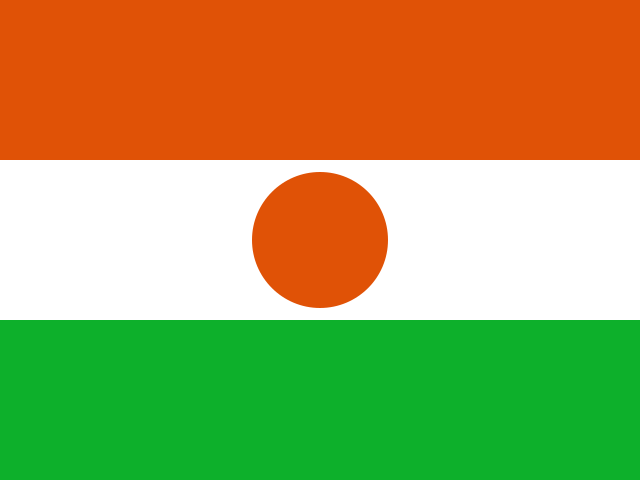
Three horizontal bands of orange, white and green with an orange disc in the centre of the white band. Article 4 of the Charte de la Refondation of 2025, the instrument in force since the 2010 constitution was suspended in 2023, fixes that order from top to bottom and calls the central charge simply a disc of orange colour, assigning none of it a meaning. The government's own reading, published outside the law, gives the orange for the desert in the north, the green for the fertile plain of the Niger basin in the south and the disc for the sun, and says nothing about the white band.
Source: niger.dk · adsdatabase.ohchr.org · gouv.ne · presidence.ne · embassyofniger-usa.org · checked 2026-08-27
Niger FACTS ◢
| Capital | Niamey |
|---|---|
| Continent | Africa |
| Population | 27,917,831 (2025) |
| Area | 1,267,000 km² |
| Population density | 22/km² |
| Currency | West African CFA franc (XOF) |
| National language | Hausa |
| Calling code | +227 |
| Internet TLD | .ne |
| Time zone | UTC+01:00 |
| Drives on the | Right |
| ISO codes | NE / NER |
DID YOU KNOW? ◢
- More than two-thirds of the country lies within the Sahara Desert.
- It's named after the Niger River, which flows through its southwestern corner.
- The Aïr and Ténéré region is home to a vast desert nature reserve, one of the largest protected areas in Africa.
- The Tree of Ténéré was once considered the most isolated tree on Earth, standing alone in the open desert.
Niger QUICK ANSWERS ◢
What is the capital of Niger?
The capital of Niger is Niamey.
What is the population of Niger?
Niger had a population of 27,917,831 in 2025.
What currency does Niger use?
Niger uses the West African CFA franc (XOF).
What languages are spoken in Niger?
Niger designates no official language. The national language of Niger is Hausa.
Think you know your flags? Play Flag Daily → · Browse all countries →
MORE ON THE FLAG ◢
Niger's flag is three horizontal bands, orange over white over green, with an orange disc in the middle of the white band. Ask what the disc stands for and you will be told, almost everywhere, that it is the sun.
The country's own law does not say it. From the constitution of 1996 through to the Charte de la Refondation promulgated on 26 March 2025, every Nigerien instrument that describes the flag uses nearly the same sentence, and every one of them stops at the geometry: a disc, orange in colour, in the middle of the white band. The word for sun never appears, and nothing in the flag is given a meaning of any kind.
The sun reading does come from the Nigerien state, though not from its law. It comes from one sentence on the government's own web portal, and that sentence turns out to have a traceable history that has nothing to do with Niamey. (Niger is not Nigeria. This is the landlocked Sahelian republic whose capital the constitution names as Niamey.)
Key Takeaways
- Every Nigerien constitution since 1996, the transitional ordonnance of 2023 and the Charte de la Refondation of 2025 describe the flag in almost the same words, and not one of them assigns any colour, or any element, a meaning.
- The Charte de la Refondation of 26 March 2025 calls the central charge only "un disque de couleur orange", a disc of orange colour.
- The gloss Niger's government publishes is one sentence on its own portal. It reads the orange for the desert, the green for the fertile plain of the Niger basin, and the orange circle for the sun, and says nothing at all about the white band.
- The portal's flag section is two sentences, the adoption date and the gloss, and both match, word for word, the French Wikipedia article on the flag as it stood on 30 September 2004. The flag page on Niger's earlier official government site, captured in 2002 and 2003, carried the constitutional clause and no symbolism at all. The reading itself is older than either: the desert, the plain and the sun were in print in English on Flags of the World in 1996. What dates to 2004 is the French wording.
- The same article that fixes the state seal's diameter at forty millimetres gives the flag no measurements at all: no proportions, no size for the disc, no colour value.
What Niger's law actually says about the disc
The best copy of Niger's Seventh Republic constitution of 25 November 2010 that can be opened from outside the country is the French text hosted by the UN human rights office. That constitution's article premier runs through the national attributes in order, and the flag comes first:
"L'emblème national est le drapeau tricolore composé de trois (3) bandes horizontales, rectangulaires et égales dont les couleurs sont disposées de haut en bas dans l'ordre suivant : orange, blanc et vert. La bande blanche médiane porte en son milieu un disque de couleur orange."
The national emblem is the tricolour flag made of three horizontal, rectangular and equal bands whose colours are set out from top to bottom in the following order: orange, white and green. The median white band carries in its middle a disc of orange colour.
That is the whole of it. Article premier then moves on to the anthem, the motto, the seal and the coat of arms, and the flag is never mentioned again in the constitution's remaining 184 articles.
The 2010 constitution was suspended on 28 July 2023 and replaced, in March 2025, by the Charte de la Refondation. The Charte's article 4 is the same clause with the parenthetical numeral and one comma removed:
"Art. 4 : L'emblème national est le drapeau tricolore composé de trois bandes horizontales rectangulaires et égales dont les couleurs sont disposées de haut en bas dans l'ordre suivant : orange, blanc et vert."
"La bande blanche médiane porte en son milieu un disque de couleur orange."
Set the 2010 clause beside the 2025 one and the pattern is clear. Twenty-nine years, four constitutions, an interim ordonnance, a transitional charter and four ruptures, and from the first of those instruments onward the sentence describing the flag survives essentially untouched, carrying no interpretation with it.
The instruments name those ruptures in their own words. Article 141 of the 1999 constitution grants an amnesty "aux auteurs des coups d'État des 27 janvier 1996 et 9 avril 1999", to the authors of the coups of 27 January 1996 and 9 April 1999. Article 185 of the 2010 constitution does the same for the "coup d'Etat du dix-huit (18) février 2010". The Charte's preamble records the events of 26 July 2023 that ended the Seventh Republic. None of those ruptures changed the flag clause beyond the numeral and the comma.
Even the parenthetical numeral is a smaller difference than it looks. The Perpignan transcriptions of the 1996, 1999, 2009 and 2010 constitutions are identical to one another in this clause and none of them carries the "(3)", while the Nigerien government's own website printed "trois (3) bandes" in 2002 and 2003, when the 1999 constitution was in force and the Perpignan text of it has no numeral. So the "(3)" travels with the printing rather than with the instrument. A comma the gazette drops is the only other change in the whole period.
| Instrument | Where the flag sits | Does it assign a meaning? |
|---|---|---|
| Constitution of the Fourth Republic, 1996 | Article premier | No |
| Constitution of the Fifth Republic, 1999 | Article premier | No |
| Constitution of the Sixth Republic, 2009 | Article premier | No |
| Constitution of the Seventh Republic, 25 November 2010 | Article premier | No |
| Ordonnance n° 2023-02 of 28 July 2023 | Article 2 | No |
| Charte de la Refondation, 26 March 2025 | Article 4 | No |
Three of those texts are read here from the Digithèque MJP transcriptions at the University of Perpignan: the constitutions of 1996, 1999 and 2009. The 2010 text comes from the UN copy, the 2023 ordonnance from the Digithèque again, which gives Niger's Office national d'édition et de presse as its source, and the 2025 Charte from the gazette scan itself.
The reading Niger's government publishes runs to one sentence
The Government of Niger's official portal has a page called "Les Symboles de la République". Its entire treatment of the flag is two sentences:
"Le drapeau du Niger a été adopté le 23 novembre 1959."
"La bande orange représente le désert, situé au nord du pays, la bande verte la plaine fertile du bassin du Niger, au sud du pays, et le rond orange le soleil."
The flag of Niger was adopted on 23 November 1959. The orange band represents the desert, in the north of the country, the green band the fertile plain of the Niger basin, in the south of the country, and the orange circle the sun.
So the sun reading is a state reading, in the sense that a Nigerien government website prints it. It is worth being precise about what that is and is not. It is not in any instrument, it carries no article number, and it is not the law. And it leaves out a third of the flag: the white band is simply not mentioned.
The same two sentences were on the website of the Presidency of the Republic, under the heading "Le Drapeau", when the Internet Archive captured that page on 18 November 2022. They are also, today, the whole of the flag section on the site of Niger's embassy in Washington. The government portal, the archived presidency page and the embassy site carry one sentence of symbolism between them, and not a word about the white.
The same sentence was on French Wikipedia in 2004
The French Wikipedia article "Drapeau du Niger" was created on 22 February 2004 at 14:49 UTC by an anonymous editor, and its entire content was one unpunctuated line: the orange band represents the desert, the green band the fertile plain of the Niger basin, and the orange circle the sun.
Four minutes later, at 14:53 UTC, a registered editor rewrote it with punctuation, wikilinks and two added clauses, "situé au nord du pays" and "au sud du pays". Three minutes after that a third editor added a sentence dating the flag to 1959, and a minute later replaced the year with the full date, 23 November. The whole of what the Nigerien government now publishes about its flag was on the page within eight minutes of its creation, and a fourth edit at 15:03 UTC put the adoption sentence into the word order the government portal uses today.
An edit on 30 September 2004 corrected "represente" to "représente". From that date the Wikipedia article's two opening sentences read exactly as the Government of Niger's symbols page reads today. Strip the wikilink markup out of the 2004 revision and the two texts match character for character.
What is old here is the reading, and what is new is the sentence. Writing to Flags of the World on 4 June 1996, nearly eight years before that Wikipedia page existed, Stuart Notholt gave the disc as "symbolizing the sun", the orange as "the Sahara desert, which borders Niger to the north" and the green as "the grassy plains of the south and west". So the desert, the plain and the sun were already a published vexillological reading long before 2004.
Notholt glossed the white as well, for purity and hope and, in Niger's case, "the savannah region of the country". That makes the sentence the Nigerien state publishes not merely silent on the white band but shorter than the reading it otherwise reproduces. What the 2004 edits fix is the particular French wording the state now publishes, down to the punctuation.
None of that proves who copied whom. The earliest capture of the current portal's symbols page held by the Internet Archive is from 23 October 2021, seventeen years after the Wikipedia edit, and the page as archived then is identical to the page as served now.
There is an older government site, and it is the more useful test. Writing to Flags of the World on 1 November 2002, Ivan Sache named www.niger-gouv.org as the Nigerien government's own website, and the Internet Archive holds that site's page "Le drapeau du Niger" from 12 October 2002 and again from 13 February 2003. Both captures carry the constitutional clause and nothing else: the tricolour, the three bands, the order of the colours, the disc of orange colour in the middle of the white band. No desert, no plain, no sun. The state's own flag page, in the years either side of the Wikipedia edit, glossed nothing at all.
What can be shown is the order of the surviving evidence, and it runs one way.
This matters for a practical reason rather than a pedantic one. A reader who checks the sun reading against the Nigerien government's own site, finds it there, and concludes it is official has very likely not left the encyclopaedia.
The seal has a diameter in the law. The flag has no measurements at all.
The clearest evidence that the silence about the flag is deliberate rather than an oversight sits a few lines further down the very clause that describes it. Article premier of the 2010 constitution moves from the flag to the state seal, and on the seal it is exact:
"Le sceau de l'État, d'un diamètre de quarante millimètres"
A seal of forty millimetres in diameter, with its charges then blazoned in full heraldic language, down to the two Tuareg swords laid saltirewise and the three ears of millet. The Charte of 2025 keeps the same clause, and its printers set it "Le sceau de l'Etat, d'un diamètre de quarante millimètre", in the singular and without the accent.
Against that, nothing anywhere fixes the flag's ratio, the size of the disc relative to the band, the shade of the orange or the green, or which way up it flies. A drafter willing to legislate a diameter in millimetres and unwilling to legislate a flag's proportions has made a choice.
That choice has consequences that are still visible. Flags of the World, a long-running vexillological reference, has been asking since at least July 2002 whether Niger's proportions are prescribed anywhere. In February 2003 one of its contributors, Christopher Southworth, answered that "there has been no legislation since the original law which established the flag", said he held a copy of that 1959 act as published in the Journal Officiel, and reported that it "gives neither a ratio for the flag, nor a size for the disk". He gives its reference, spelling and all, as "Actes du Government de la Republique du Niger No, 59-1", which leaves it open whether 59-1 numbers the act or the series it sits in. That is one more reason to want the gazette itself. A 2024 contribution to the same page reports that no official source gives exact colour values for the flag either.
So where does Niger's 6:7 ratio come from?
Almost every reference work gives Niger's flag as 6:7, which is an unusual shape for a national flag. No Nigerien instrument that describes the flag fixes it.
The figure was in circulation well before Wikipedia carried it. Writing to Flags of the World on 4 July 2002, Željko Heimer reported that "All the sources I consulted quickly give the ratio as 6:7 or 6:7~" and asked whether 6:7 was prescribed in any legislation. That is nineteen months before the figure reached French Wikipedia, so the 2004 line records a figure already standard rather than inventing one. It is not the only figure on that page: the oldest contribution there, Notholt's of 1996, gives the proportions as 2:3, so on that page the 6:7 consensus Heimer reports is the later of the two.
What the 2004 line does fix is a date. The figure entered the French Wikipedia article at 15:06 UTC on 22 February 2004, seventeen minutes after the page was created and three minutes after the last edit to the two sentences the government portal now carries, as a bare line reading "Ratio : 6:7".
It is also, measurably, the shape of the flag on Niger's own state websites. The image on the Presidency's archived page is a file named "2000px-Flag_of_Niger.svg.png", which is the standard naming pattern for a rendering of a Wikimedia Commons drawing; downloaded from the archive and measured, it is 2000 by 1714 pixels, or 7:6 across. Niger's embassy in Washington serves two resized copies of the same file, and they measure 300 by 257 and 500 by 429, the same proportion twice more. The Commons original is 700 by 600, exactly 7:6. The static flag on the government portal's own server is 120 by 103, the same proportion again. Not everything on these pages agrees: the portal also loads an animated waving-flag GIF at 240 by 180, which is 4:3 and is not this drawing.
So the shape Niger's own web pages display is the Commons drawing's, while the shape the reference works give is older than that drawing and older than the Wikipedia line. The state pages have simply used whatever image was to hand, and it has not always been this one: Southworth remarked in February 2003 that "the official Government website of the Niger shows the flag at 2:3". Nothing anywhere in that chain is a legal specification, and 2:3 and 1:2 versions of the flag are also flown.
The 1959 law, and why it is hard to read
Niger became a republic within the French Community on 18 December 1958, by deliberation of its territorial assembly, which then turned itself into a constituent assembly. Its constitution of 12 March 1959 did not describe a flag. It promised one:
"Une loi de la République déterminera le choix du drapeau"
A law of the Republic will determine the choice of the flag, the anthem and the motto of Niger. That law was passed on 23 November 1959, eight months after the constitution and just over eight months before independence on 3 August 1960, and the flag it chose is the flag Niger flies today.
The text of that law is the one primary source for this article that could not be opened. The Bibliothèque nationale de France records the Journal Officiel de la République du Niger as beginning with its issue of 1 January 1959 and appearing monthly until November 1960, printed in Niamey by the Imprimerie générale du Niger, which fits Southworth's citation of the flag act in the issue of 1 January 1960. No digitised run of it could be found, in the Internet Archive's text collections or anywhere else reached for this article.
So the 1959 act is reported here at second hand, from a vexillologist who says he has a copy, and the honest position is that its wording has not been read for this article. Every statement here about what the law does not say is drawn from instruments that were read in full.
Both the 2010 constitution, at article 182, and the 2025 Charte, at article 76, keep earlier legislation in force where it does not contradict them and has not been expressly repealed. On that basis the 1959 act is presumably still the instrument that adopted the flag, and no instrument read for this article replaces it.
What 2023 and 2025 changed, and what they left alone
On 28 July 2023, ordonnance n° 2023-01 suspended the constitution of 25 November 2010 and created the Conseil national pour la sauvegarde de la patrie. Its own text was not obtainable for this article; what it did is recited both in the decree that promulgated the 2025 Charte and in the Charte's own preamble, which is where it is taken from here. A second ordonnance the same day, n° 2023-02, organised public powers for the transition, and its article 2 carried the flag clause across word for word in the form the Perpignan transcriptions give for 1996, 1999, 2009 and 2010.
It did not carry everything across. The anthem named in that same article 2 of ordonnance n° 2023-02 is no longer "La Nigérienne" but, in the ordonnance's own capitalisation, "L'honneur de la Patrie". Niger's embassy in Washington dates that change of anthem to 2023. The flag came through untouched while the anthem beside it was replaced, which is a fair measure of how settled the design is.
The Charte de la Refondation was promulgated by decree on 26 March 2025 and published in the Journal Officiel de la République du Niger, special edition number 5, of 31 March 2025. The first recital of its preamble reads "Considérant les évènements patriotiques du 26 juillet 2023 ayant mis fin à la septième République", which is how the instrument now in force describes the events of July 2023. The Charte's article 78 declares that "La présente Charte a valeur constitutionnelle" and repeals ordonnance n° 2023-02. The Charte's article 73 sets the Refondation period at "soixante (60) mois", sixty months, from promulgation, adjustable against the security situation, the Refondation's own schedule and the agenda of the Confederation of Sahel States.
One thing did quietly disappear. Every constitution from 1996 to 2010 carried a second article reserving the attributes of the Republic to the use of public authorities and making their illegal use or desecration punishable by law. Neither ordonnance n° 2023-02 nor the Charte's seventy-eight articles contain any equivalent. The flag is still described in the country's highest instrument, and for the moment no instrument says who may fly it.
If you want to see how much of a flag you can actually recall once the reading is stripped away, Flag Daily shows one flag a day and gives you three guesses at the country. Niger's is a good test: most people remember a disc and then have to think hard about which colour it sits on.
Frequently asked questions
What does the orange circle on Niger's flag mean?
No Nigerien instrument that describes the flag says. Every constitution from 1996 onwards, the transitional ordonnance of 2023 and the Charte de la Refondation of 2025 call it only "un disque de couleur orange", a disc of orange colour, and assign it no meaning. The Government of Niger's own symbols page reads it as the sun, in one sentence that carries no legal citation.
What do the colours of Niger's flag mean?
Officially, nothing: no Nigerien instrument that describes the flag assigns any of its colours a meaning. The government portal's one-sentence gloss gives the orange band for the desert in the north of the country and the green band for the fertile plain of the Niger basin in the south. It does not mention the white band at all, and the white readings that circulate, purity and the savannah, come from the Flags of the World gloss and appear on none of the Nigerien state pages.
When was Niger's flag adopted?
On 23 November 1959, by a law of the Republic. The constitution of 12 March 1959 had promised at its article 2 that a law would choose the flag, the anthem and the motto; the text of that law could not be opened for this article and is reported here at second hand. That was just over eight months before Niger's independence on 3 August 1960, and the design was kept at independence.
What are the proportions of Niger's flag?
Reference works usually give 6:7, but none of the instruments that describe the flag fixes a ratio, and 2:3 and 1:2 versions are also flown. The 6:7 figure was already standard across reference works by July 2002, when a contributor reported as much to Flags of the World, so the French Wikipedia line of February 2004 repeats it rather than originates it. What does trace to that page is the imagery: the flag files on the Nigerien Presidency's and Washington embassy's own websites are renderings of a Wikimedia Commons drawing measuring 7:6 across.
Has Niger's flag changed since 1959?
No design change is recorded. The Government of Niger dates the flag to 23 November 1959, and the wording describing it has been carried forward almost unaltered through every instrument read for this article: the constitutions of 1996, 1999, 2009 and 2010, the transitional ordonnance of 28 July 2023, and article 4 of the Charte de la Refondation of 26 March 2025. The instruments between 1959 and 1996 were not read here. Over the period that was read, the national anthem was replaced and the article reserving the national attributes to public authorities was dropped.
Sources
- Republic of Niger, Constitution de la VIIe République du 25 novembre 2010, French text, hosted by the Office of the United Nations High Commissioner for Human Rights - retrieved 27 August 2026.
- Republic of Niger, Charte de la Refondation, promulgated by décret n° 2025-160/P/CNSP of 26 March 2025, in Journal Officiel de la République du Niger, édition spéciale n° 05, 31 March 2025, pp. 1916-1921, the scan published by the Embassy of the Republic of Niger to the Nordic countries, Copenhagen - retrieved 27 August 2026. Scanned gazette pages with no text layer, transcribed beside this article.
- Gouvernement du Niger, Les Symboles de la République, Portail Officiel du Gouvernement du Niger - retrieved 27 August 2026.
- Présidence de la République du Niger, Les symboles - page now returns 404, read from the Internet Archive capture of 18 November 2022, retrieved 27 August 2026.
- Ambassade du Niger aux États-Unis, Les symboles - retrieved 27 August 2026.
- Digithèque MJP, Université de Perpignan, Niger, Constitution de 1959, Constitution du 12 mai 1996, Constitution du 18 juillet 1999, Constitution du 4 août 2009, Constitution du 25 novembre 2010 and Ordonnance n° 2023-02 du 28 juillet 2023 - retrieved 27 August 2026.
- Wikipédia, Drapeau du Niger, revision history, revisions 270734, 270742, 270745, 270754, 270759 and 404478 of 22 February 2004 and revisions 907961 of 22 September and 1209377 of 30 September 2004, with the revision list and its editor names, read through the MediaWiki API - retrieved 27 August 2026.
- Gouvernement du Niger, Le drapeau du Niger,
www.niger-gouv.org/drapeau.htm, the government portal in use before the current one - site long gone, read from the Internet Archive captures of 12 October 2002 and 13 February 2003, retrieved 27 August 2026. - Flags of the World, Niger, contributions by Stuart Notholt (4 June 1996), Željko Heimer (4 July 2002), Ivan Sache (1 November 2002), Christopher Southworth (1 February 2003), Santiago Dotor (5 February 2003) and Zoltán Horváth (8 August 2024) - retrieved 27 August 2026.
- Wikimedia Commons, File:Flag of Niger.svg, image dimensions read through the MediaWiki API - retrieved 27 August 2026.
- Bibliothèque nationale de France, Notice bibliographique: Journal officiel de la République du Niger - retrieved 27 August 2026.
PLAY ANOTHER →
A short message, hidden in a different cipher every day.
ONE CIPHER A DAYDAILYDaily TriviaFive questions a day. Everyone gets the same five.
FIVE QUESTIONSDAILYDaily CryptogramOne quote, one scrambled alphabet. Crack it before tomorrow.
CRACK THE QUOTEDAILYGuess the CountryThree clues, three guesses. Work out where in the world it is.
THREE CLUES