
Nigeria
Africa's most populous country by a mile, Nigeria is home to more than 200 million people, hundreds of languages and Nollywood, a film industry that out-produces almost everyone.
WHAT THE FLAG MEANS ◢
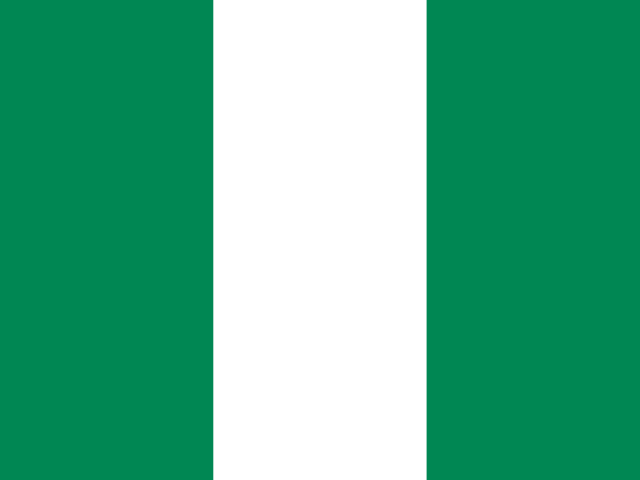
Three equal vertical bands of green, white and green. The Flags and Coats of Arms Act regulates only how the flag may be flown and never describes it, and the constitution mentions it once, in the citizen's duty to respect it; neither assigns the colours a meaning. Outside the law the state has published more than one reading of them, the fullest giving the green to agriculture and the white to unity and peace.
Source: lawsofnigeria.placng.org · commonlii.org · nigeria.gov.ng · checked 2026-08-27
Nigeria FACTS ◢
| Capital | Abuja |
|---|---|
| Continent | Africa |
| Population | 237,527,782 (2025) |
| Area | 923,768 km² |
| Population density | 257/km² |
| Currency | Naira (NGN) |
| Official language | English |
| Calling code | +234 |
| Internet TLD | .ng |
| Time zone | UTC+01:00 |
| Drives on the | Right |
| ISO codes | NG / NGA |
DID YOU KNOW? ◢
- It's the most populous country in Africa, home to more people than any other nation on the continent.
- Its film industry, nicknamed Nollywood, is one of the most prolific in the world by number of films made.
- More than 500 languages are spoken across the country.
- The capital was moved from Lagos to the purpose-built city of Abuja in 1991.
Nigeria QUICK ANSWERS ◢
What is the capital of Nigeria?
The capital of Nigeria is Abuja.
What is the population of Nigeria?
Nigeria had a population of 237,527,782 in 2025.
What currency does Nigeria use?
Nigeria uses the Naira (NGN).
What languages are spoken in Nigeria?
The official language of Nigeria is English.
Think you know your flags? Play Flag Daily → · Browse all countries →
MORE ON THE FLAG ◢
Ask what the green on Nigeria's flag means and Nigerian government sources will give you two answers. The Federal Ministry of Information said agriculture. Two Nigerian embassies say the country's wealth and rich natural resources. The Presidency has published a third gloss, but on the flag as a whole rather than on the green: announcing the designer's death in 2023, it called the flag a legacy reflecting fruitfulness, resilience and harmony. And a fourth reading, forests and abundant natural wealth, is the one a Nigerian newspaper reached for in the designer's obituary. None of the three above uses it.
None of them is the law, because Nigerian law does not say. The statute that governs the flag runs to ten sections and never describes it. The constitution mentions the flag exactly once, in a list of things every citizen has a duty to respect.
And the flag those readings are attached to is not quite the design that won the competition. The winning entry carried a red sun on the white band, and the committee that picked it took the sun off before anyone flew the thing.
Key Takeaways
- The Flags and Coats of Arms Act regulates how the flag may be flown and never describes what it looks like. Its interpretation section defines the National Flag as the National Flag of the Federal Republic of Nigeria.
- The 1999 Constitution mentions the flag once, at section 24(a), among the citizen's duties. It assigns nothing a meaning.
- The Federal Ministry of Information's own account gave the green to agriculture, not to forests. The forests wording comes from the sunset CIA World Factbook, not from any Nigerian government page that could be opened.
- Michael Taiwo Akinkunmi's entry had a red quarter sun on the white stripe. The committee dropped it, so the flag as designed was never the flag as flown.
- The fine for flying a defaced National Flag is one hundred naira, the same in the 1990 and 2004 consolidations. Bills to raise it to one hundred thousand passed second reading in the House of Representatives in 2017 and again in 2024.
| The reading | What it is a reading of | Whose it is | Where it is published |
|---|---|---|---|
| Green for agriculture, white for unity and peace | The colours | Federal Ministry of Information | Its national flag page on the federal portal, captured in 2002 and 2004 |
| Green for the country's wealth and rich natural resources, white for peace and unity | The colours | Nigerian missions in Washington and Tel Aviv | Both embassy websites, in identical wording |
| Green for forests and abundant natural wealth, white for peace and unity | The colours | CIA World Factbook | Its Nigeria entry, sunset in February 2026 |
| Fruitfulness, resilience and harmony | The flag as a whole, not the colours | President Bola Tinubu's office | State House press release, 30 August 2023 |
| A symbol that truth and justice reign | The flag as a whole, not the colours | The national anthem | Second stanza, in force again since 2024 |
The competition, and the element that did not survive it
The story is documented well enough in outline and badly in detail.
Work toward independence produced a national planning committee, and in 1958 that committee called for a competition to choose a national flag. Michael Taiwo Akinkunmi, born in May 1936 and then a student at Norwood Technical College in London, saw the advertisement in a newspaper and posted an entry to Lagos.
He was called to the London office of the Commissioner for Nigeria in the United Kingdom in October 1959 and told his green and white design had won. The prize was one hundred pounds. He still had the letter acknowledging his entry when he was interviewed at home in Ibadan in 2016.
The number of entries is where the retellings come apart. Whitney Smith's account for Britannica says "Almost 3,000 designs were submitted, many of great complexity." Pedersen's The International Flag Book in Color, in the 1971 English edition quoted by the Flags of the World archive, gives 2,870 suggestions. The Nigerian Tribune's obituary in 2023 said roughly 2,000. No Nigerian government page that could be opened carries a figure at all.
That Tribune notice also disagrees with itself. It calls him a nonagenarian in its first line and gives his age as 86 in its second, names his college as Norway Technical College, and says his national honour was the MON in a story whose own headline gives it as O.F.R. The Presidency's statement names him Pa Taiwo Akinkunmi, OFR, and the birth date the Tribune itself supplies, 10 May 1936, makes him 87 at his death rather than 86.
What every account agrees on is the alteration. Smith's sentence is the plainest: "The original design also included a red quarter sun on the white stripe as a symbol of divine protection and guidance, but this was omitted by the committee." The Tribune describes the same thing from the other end, as a red sun with streaming rays on the white band that was "eventually done away with by the overseeing committee".
So the design Nigeria has flown since 1 October 1960 is the winning entry minus one element. Whoever sat on that committee made the last design decision on the national flag, and no reachable Nigerian source names them.
There is a further difficulty with the record, and the reporting that established most of it is honest about it. When the journalist Femke van Zeijl interviewed Akinkunmi in 2016, he gave the wrong name for the college he had attended, could not say why he had undergone surgery days after winning, and could not supply a single detail about 1 October 1960. Asked how he felt on the day the flag went up, he said he was just pleased. What he did remember was what came after. "Everybody was calling me Mr Flag Man."
Nigeria honoured him late. A presidential award for a distinguished Nigerian came at the golden jubilee in 2010, half a century after the flag was first raised, and a national honour and the lifetime salary of a presidential special assistant followed in 2014. When his death was announced on 30 August 2023 the Presidency described him as the man "who designed the national flag in 1958 and left a generational legacy".
What the Nigerian government has actually said the colours mean
For at least the years either side of 2003 the Federal Ministry of Information and National Orientation ran a page on the federal portal headed THE NATIONAL FLAG. It is the fullest account of the flag on any Nigerian government page that could be opened for this article, and the internet archive's captures of 2002 and 2004 are word for word identical.
Its description section opens with four sentences. "The Nigerian National Flag is divided vertically into three equal parts. The central part is white and the two other parts are green. The green of the flag represents agriculture and the white Unity and Peace. The white is immaculate white and the emerald green is popularly known as the Nigerian Green."
Agriculture. Not forests, not natural wealth, not resources. And note the fourth sentence: the ministry reports what the shade is popularly called rather than conferring an official name on it.
The rest of the page is protocol, and some of it is memorable. The flag is hoisted at sunrise and lowered at sunset because, as the ministry puts it, "A flag does not sleep." A worn flag is to be destroyed by burning or another method with decorum and respect. Seven offices may fly it on a car, from the President down to deputy governors, plus an eighth entry reading "Others (if any) permitted by protocol"; where permitted it goes on the radiator cap or the right fender.
That page has gone. The federal portal has no national symbols section today, and a search of it for the word flag returns three pages, on festivals, on agriculture policy and on the Vice President. What Nigerian missions publish instead is thinner and different. The Embassy of the Federal Republic of Nigeria in Washington and the Nigerian Embassy in Tel Aviv both carry the same short text, which dates the design to 1959 rather than 1958 and says the green represents the country's wealth and rich natural resources while the white means peace and unity. The two pages match down to a stray "Read more:" left in the middle of a sentence, which is what copied web copy looks like rather than a drafted statement.
The most recent state reading is different again. Announcing Akinkunmi's death, President Bola Tinubu's office said the Green and White flag "is a legacy that has consistently reflected the fruitfulness, resilience, and harmony enjoyed by the nation". That is a eulogy rather than a definition, and it is the only presidential gloss on the flag the State House site now carries.
Where the forests reading comes from
There is one more reading of the green, and it is not Nigerian in origin. It says the green stands for the country's forests and abundant natural wealth.
That is the CIA World Factbook's wording. Its Nigeria entry, captured in May 2018, read: "three equal vertical bands of green (hoist side), white, and green; the color green represents the forests and abundant natural wealth of the country, white stands for peace and unity".
It has travelled a long way from there. The Nigerian Tribune's own obituary of the designer explains that his entry was chosen for its ingenuity and profundity, "the green bands represent the forests and abundant natural wealth of the country, while the white band represents peace". That is the Factbook's clause, in a Nigerian newspaper, describing a Nigerian committee's reasoning. BusinessDay ran the same sentence word for word in its report of the designer's burial, along with most of the surrounding biography, so what travelled is one text rather than two readings.
The word forests appears in none of the Nigerian government material opened for this article: not on the ministry's flag page, not on either embassy site, not in the Presidency's statement, not in the flag Act and not in the constitution. The ministry said agriculture, Britannica says agriculture, and the 1971 Pedersen entry gives the green panels to agriculture and the white to peace and unity.
The Factbook was sunset on 4 February 2026, so the phrase has no live publisher at all. A reading that is absent from every national source opened here, and traceable to a reference work that no longer exists, is one to drop rather than to find a new home for.
Nigeria's flag law never describes the flag
Nigeria has a dedicated flag statute. It was enacted as 1960 No. 48 and commenced on 1 October 1960, independence day itself. It appears as Chapter 148 of the Laws of the Federation of Nigeria 1990 and again in the 2004 consolidation, whose arrangement of sections heads it the Flags and Coats of Arms Act.
Its long title is exact about its scope. "An Act to regulate the display and use of the National Flag, certain other flags and the National Coat of Arms."
Regulate the display and use. Not prescribe the design. Read end to end, the Act has no schedule, no diagram, no measurements, no colour names and no statement of meaning. Its interpretation section defines the object it is about in a closed circle: "the National Flag" means the National Flag of the Federal Republic of Nigeria.
The Act instead creates an offence for almost anything you might do to a flag in public. Section 3 of the Flags and Coats of Arms Act makes it an offence to fly or exhibit in any public place, without a licence, any flag appointed to be flown by the President, any flag appointed for ships of the Nigerian Navy or for armed forces establishments, or any flag of a department of the Federal Government. The same section catches flying a National Flag in a public place if it bears an addition or is modified or defaced.
Section 4 of the Act, subject to the exceptions in the rest of that section, forbids flying the National Flag on the same staff or crossbar as the flag of any state or of any Commonwealth or foreign country. Section 6 forbids using the flag or the coat of arms in connection with a business, trade, profession or calling. Section 7 is the well known one: "Any person who flies or exhibits the National Flag in a defaced or bad condition shall be guilty of an offence against this Act." Section 8 lets any police officer seize the offending flag.
Section 5 of the Act is the humane exception, and it is narrower than it first looks. It disapplies the licence requirement only for the flags described in section 3(2), which are the National Flag and a Commonwealth member state's flag bearing an addition or otherwise modified or defaced, and only where the person flying one "is actuated by no other motive than that of patriotism, the proof whereof shall lie upon such person". Patriotism is a defence, the burden of proving it is yours, and it does not reach the presidential, naval or departmental flags of section 3(1).
Section 10 of the Act sets the penalty: "a fine of one hundred naira and in the case of a continuing offence to a fine of ten naira for every day or part of a day during which the offence is continued after the day on which such person is first convicted". The 1990 and 2004 consolidations print the same figure, so it has stood at one hundred naira through both.
The House of Representatives has tried at least twice to move it. A bill sponsored by Sam Onuigbo passed second reading on 4 May 2017, seeking to replace the hundred-naira fine with one hundred thousand. A second bill, sponsored by Sada Soli of Katsina, passed second reading in March 2024 with the same figure, and would also add Civil Defence Corps and other paramilitary officers to the list of people who may seize a flag under section 8. Deputy Speaker Benjamin Kalu referred it to committee for further legislative action, and no amended text of the Act could be found for this article. Its long title, as one Nigerian paper reported it, cites the statute as "the Flag and Coats of Arms Act, Cap. F30, Laws of the Federation of Nigeria, 2004". That is the only place the chapter number appears in any source opened here.
The Act is not spelled the same way twice, either. The 2004 consolidation heads its arrangement of sections "FLAGS AND COATS OF ARMS ACT" and the Act itself "FLAGS AND COAT OF ARMS ACT". Better still, the two consolidations disagree in mirror image in the one place that settles a statute's name, their own citation sections: the 2004 text says "This Act may be cited as the Flag and Coats of Arms Act.", where the 1990 text has "Flags and Coat of Arms". The bill's long title reads Flag and Coats, which is also how the 2004 short-title section spells it.
The state's own account of that Act misquotes it. The ministry's national flag page quoted the defaced flag offence and attributed it to "Section 5 of the Law", which is the patriotism exemption. The provision it was quoting is section 7. The page also renders the closing words as an offence "against this Ordinance" where both consolidated texts say against this Act. The government misquoted its own flag law on its own flag page.
Nigeria's constitution mentions the flag once
The Constitution of the Federal Republic of Nigeria 1999 is a long document, and the flag appears in one line of it. Section 24 sets out the duties of the citizen, and its first paragraph requires every citizen to "abide by this Constitution, respect its ideals and its institutions, the National Flag, the National Anthem, the National Pledge, and legitimate authorities".
That is the whole of it. No description, no colours, no proportions, no meaning, and no mention of the coat of arms anywhere in the text. The flag is named as an object of respect and never defined.
The position is close to Ghana's, where the 1992 constitution never uses the word flag and the 1959 flag law defines it circularly. A flag can be perfectly well established in national life and still be undefined in the national statute book.
The national anthem says what the flag stands for
There is one exception, and it is not in a flag law.
Nigeria restored "Nigeria, We Hail Thee" as its national anthem in 2024 under the National Anthem Act 2024. The Federal Ministry of Information reported the Federal Executive Council decisions that followed, among them that the first stanza is to be rendered at all official functions and the third adopted as the National Prayer. That second decision matches section 8 of the National Anthem Act 2024 as Nigerian legal publishers reproduce it, which provides that the third stanza of the National Anthem shall be the National Prayer.
The second stanza, which the Nigeria High Commission in London publishes on its own site, is about the flag: "Our flag shall be a symbol, That truth and justice reign, In peace or battle honoured, And this we count as gain, To hand on to our children, A banner without stain."
Neither the flag Act nor the constitution says what the flag stands for. The anthem does, and it says truth and justice. The meaning is sung rather than legislated. That is the same shape as Benin's flag, where the constitution gives the tricolour measurements and the government points to the national anthem for the meaning, and it is worth checking for whenever a flag law turns out to be silent.
Note what the stanza does not do. It gives the flag as a whole a meaning, and says nothing at all about the green or the white.
Even here the texts wobble. The High Commission prints honoured in full where the schedule as Nigerian legal publishers reproduce it has "honour'd", and the first stanza differs between the two on singulars and plurals: "Though tribes and tongues may differ" against "Though tribe and tongue may differ".
The official green is not something you can look up
If a Nigerian instrument fixed the shade, this would all be easier. None that could be opened for this article does.
The ministry page listed three colour references rather than one: British Standard 2660 of 1965 at 0-0-010, the British Colour Council at CC.104 to CC.105, and the SILOR International Colour Chart at 193-173, Emerald Green. Two of those are British trade standards of the 1960s and the third is a paint chart. None is a Nigerian standard, and none is a modern digital specification.
A Nigerian standard is reported to exist. The Flags of the World archive records a Specification for the Nigerian National Flag issued in 1987 as Nigeria Industrial Standards NIS 297, under which the shade of green is set by standard flags held by the Federal Ministry of Internal Affairs and by the Standards Organisation of Nigeria. That description comes from a contributor to a volunteer archive rather than from the standard. No copy of NIS 297 could be reached for this article, and the Standards Organisation of Nigeria publishes no searchable catalogue.
The state has since moved on the gap. In 2024 the Federal Executive Council approved a programme on the restoration of the dignity and standardisation of national symbols including the National Flag, made the National Orientation Agency the source of all official symbols to ensure standardisation, and set aside 16 September as National Symbols Enlightenment Day. Sixty-four years after the flag was first raised, the state decided its own symbols needed a custodian.
What is settled is the shape. The ministry page gives the proportions as a ratio of one to two, so that the flag folded lengthwise makes a square, and lists three manufacturing sizes: 1.2 by 2.4 metres, 0.9 by 1.8 metres and 0.6 by 1.2 metres. Britannica gives the same one to two ratio. On that much everyone agrees.
If you want to find out how much of a flag you actually carry in your head, Flag Daily shows one flag a day and gives you three guesses at the country. Green-white-green is one of the designs people are certain about until they are asked which side the hoist is on.
Frequently asked questions
What do the colours on Nigeria's flag mean?
Nigeria's flag Act and its constitution both assign them nothing. The fullest state account, the Federal Ministry of Information's national flag page, said the green represents agriculture and the white unity and peace. Nigerian embassies now publish a different reading, green for the country's wealth and rich natural resources, and the forests wording came from the CIA World Factbook rather than from any Nigerian government page opened for this article.
Who designed the Nigerian flag?
Michael Taiwo Akinkunmi, a Nigerian student at Norwood Technical College in London, who entered a national design competition called in 1958 and was told in October 1959 that he had won. The prize was one hundred pounds. His death was announced on 30 August 2023, and the Presidency named him as the man who designed the national flag in 1958.
Was there a sun on the original Nigerian flag?
Yes. Akinkunmi's entry carried a red quarter sun with rays on the white band, which Whitney Smith's account describes as a symbol of divine protection and guidance. The committee that selected the design removed it, so the version with the sun was never flown as the national flag.
Does any Nigerian law say what the flag looks like?
Not in any text that can be opened. The Flags and Coats of Arms Act, enacted in 1960 and consolidated in 1990 and 2004, regulates how the flag may be flown and defines the National Flag only as the National Flag of the Federal Republic of Nigeria. The 1999 Constitution mentions the flag once, at section 24(a), in the citizen's duties.
What is the penalty for misusing the Nigerian flag?
One hundred naira, plus ten naira for each further day the offence continues after conviction. That is section 10 of the Flags and Coats of Arms Act, and the 1990 and 2004 consolidations of the Act print the same figure. Bills to raise it to one hundred thousand naira passed second reading in the House of Representatives in May 2017 and again in March 2024, sponsored by Sam Onuigbo and Sada Soli respectively.
Sources
- Policy and Legal Advocacy Centre, Flags and Coats of Arms Act, Laws of the Federation of Nigeria 2004 - retrieved 27 August 2026.
- CommonLII, Flags and Coats of Arms Act, Chapter 148, Laws of the Federation of Nigeria 1990 - the site answers a security challenge to a direct request, so this was read from the Internet Archive capture of 17 July 2025, retrieved 27 August 2026.
- Policy and Legal Advocacy Centre, Constitution of the Federal Republic of Nigeria (Promulgation) Act, Cap. C23, Laws of the Federation of Nigeria 2004 - a scan with no text layer; section 24 was read from the page image at C23-26, retrieved 27 August 2026.
- Federal Ministry of Information and National Orientation, The National Flag - the page is no longer on the federal portal and was read from the Internet Archive captures of 21 August 2002 and 5 November 2004, retrieved 27 August 2026.
- State House, Abuja, President Tinubu Mourns Designer of Nigeria's National Flag, PA Taiwo Akinkumi - retrieved 27 August 2026.
- Embassy of the Federal Republic of Nigeria, Washington DC, The National Flag - retrieved 27 August 2026.
- Nigerian Embassy, Tel Aviv, Who designed the Nigerian flag? - retrieved 27 August 2026.
- Nigeria High Commission, London, Nigeria - the national anthem and national pledge as the mission publishes them, retrieved 27 August 2026.
- Federal Ministry of Information and National Orientation, Federal Government Approves Nation-wide Sensitization on National Anthem and National Values Charter - retrieved 27 August 2026.
- LawCare Nigeria, National Anthem Act, 2024 - a private Nigerian legal aggregator; no official gazette copy of the Act could be opened, retrieved 27 August 2026.
- Whitney Smith, flag of Nigeria, Encyclopaedia Britannica - the site is unreachable from here and this was read from the Internet Archive capture of 17 May 2026, retrieved 27 August 2026.
- Flags of the World, Nigeria and Nigeria - Fact Sheet - for the Pedersen entry count and the NIS 297 report, both contributor material rather than primary sources, retrieved 27 August 2026.
- Central Intelligence Agency, The World Factbook: Nigeria - cited only to establish where the forests wording appeared; the publication was sunset on 4 February 2026 and the text was read from the Internet Archive capture of 23 May 2018, retrieved 27 August 2026.
- Femke van Zeijl, I remember the day ... I designed the Nigerian flag, BusinessDay - retrieved 27 August 2026.
- Damilola Olufemi, Why we waited 371 days before burying Taiwo Akinkunmi, designer of Nigerian flag - Son, BusinessDay, 7 September 2024 - for the forests clause reappearing in a second Nigerian paper, retrieved 27 August 2026.
- Soji Ajibola, Designer of Nigeria's flag, Pa Michael Taiwo Akinkunmi (O.F.R) is dead, Nigerian Tribune - retrieved 27 August 2026.
- Reps propose N100, 000 fine for National flag abuse, Daily Trust, 4 May 2017, from the News Agency of Nigeria - for the Onuigbo bill, retrieved 27 August 2026.
- Joshua Egbodo, Reps move to increase penalty for misuse, abuse of Nigeria's flag, Blueprint, 6 March 2024 - for the Soli bill, its section 8 amendment and the Cap. F30 citation in its long title, retrieved 27 August 2026.
- Lois Akaahimbe, Reps Move To Enact Law To Fine Abusers Of Nigerian Flag, Coat Of Arms, The Whistler, 6 March 2024 - for the referral to committee, retrieved 27 August 2026.
PLAY ANOTHER →
One thing that happened today in history. Every day, a new one.
TODAY IN HISTORYDAILYGuess the CountryThree clues, three guesses. Work out where in the world it is.
THREE CLUESDAILYDaily CryptogramOne quote, one scrambled alphabet. Crack it before tomorrow.
CRACK THE QUOTEDAILYDaily CodeA short message, hidden in a different cipher every day.
ONE CIPHER A DAY