
Benin
A slender strip of West Africa that gave the world Vodun and once hosted one of Africa's most powerful kingdoms. Benin is small on the map but heavy on history.
WHAT THE FLAG MEANS ◢
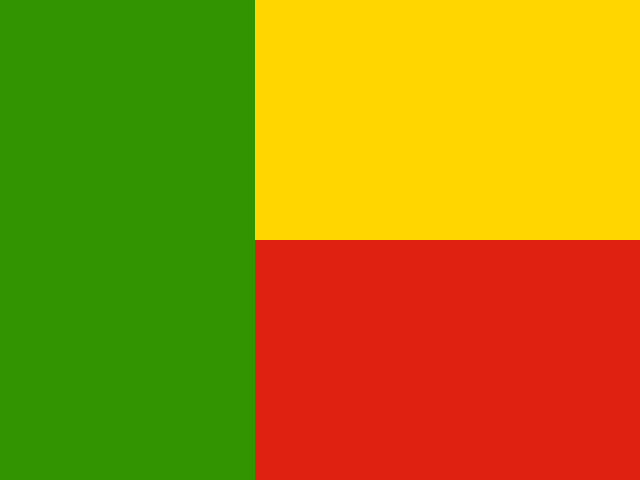
A green vertical band at the hoist over two-fifths of the length, beside two equal horizontal bands of yellow over red - the Pan-African colours. No Beninese law assigns the colours a meaning: the constitution and the 1990 flag law describe the design and stop. The readings usually quoted come from the national anthem, in which green carries the hope of renewal, red evokes the courage of the aieux, the forebears, and yellow is the presage of the country's richest treasures.
Source: gouv.bj
Benin FACTS ◢
| Capital | Porto-Novo |
|---|---|
| Continent | Africa |
| Population | 14,814,460 (2025) |
| Area | 114,763 km² |
| Population density | 129/km² |
| Currency | West African CFA franc (XOF) |
| Official language | French |
| Calling code | +229 |
| Internet TLD | .bj |
| Time zone | UTC+01:00 |
| Drives on the | Right |
| ISO codes | BJ / BEN |
DID YOU KNOW? ◢
- It was the heart of the Kingdom of Dahomey, famed for its all-female regiment of warriors.
- Vodun (voodoo) originated here and remains an officially recognised religion.
- The stilt village of Ganvié sits entirely on Lake Nokoué and is sometimes called the 'Venice of Africa'.
- Its largest city, Cotonou, is the seat of government even though Porto-Novo is the official capital.
Benin QUICK ANSWERS ◢
What is the capital of Benin?
The capital of Benin is Porto-Novo.
What is the population of Benin?
Benin had a population of 14,814,460 in 2025.
What currency does Benin use?
Benin uses the West African CFA franc (XOF).
What languages are spoken in Benin?
The official language of Benin is French.
Think you know your flags? Play Flag Daily → · Browse all countries →
MORE ON THE FLAG ◢
Benin's flag is defined in two sentences of Article 1 of its constitution, and neither says what the green, the yellow and the red stand for. Between them, they give measurements.
The meanings that circulate everywhere are real, and official in a narrow sense. They come from the national anthem, and Benin's government says so itself, in one line on its own portal: "La signification des couleurs est expliquée dans l’Aube Nouvelle, l’hymne national du Bénin." The meaning of the colours is explained in The New Dawn. No Beninese instrument that can be read today says what they mean.
Key Takeaways
- Article 1 of the Constitution of 11 December 1990 fixes the flag's proportions and assigns its colours no meaning.
- The readings people quote sit in the second verse of L'Aube Nouvelle, the 1960 anthem by the abbé Gilbert Jean Dagnon.
- The anthem gives red to the courage of the aïeux, the forebears, not to the living population.
- Benin flew a bright green flag with a red star from 1976, and the ordinance defining it assigned no meaning either.
- Mathieu Kérékou, who presided over the tricolour's abolition, signed the law that brought it back.
What do the colours on Benin's flag mean?
The Beninese government publishes three short glosses, attributing them to the anthem and not to law: "Le vert rappelle l’espoir du renouveau démocratique. Le rouge évoque le courage des aïeux. Le jaune incite à conserver les plus riches trésors du pays." Green recalls the hope of democratic renewal, red the courage of the forebears, and yellow urges that the country's richest treasures be kept.
They are lifted from the second verse of L'Aube Nouvelle, written and composed by the abbé Gilbert Jean Dagnon and adopted at independence in 1960. The verse tells the citizen to look at the flag, then reads it colour by colour:
Confiant dans l'avenir, regarde ton drapeau ! Dans le vert tu liras l'espoir du renouveau, De tes aïeux le rouge évoque le courage; Des plus riches trésors le jaune est le présage.
Two words in those lines do the work that English summaries lose. Aïeux means ancestors and forebears, not a country's present-day people, so the courage is inherited rather than current. And a présage is a foretoken of riches rather than a claim that the riches are in hand, which is why the government's gloss turns yellow into an instruction to hold on to them.
The green survives best. Where the anthem has the hope of renewal, the government adds a word a 1960 lyric could not have carried and makes it democratic renewal: a state reading its own song back through 1990. Burkina Faso next door does the same, its constitution silent on the colours and its presidency reading them anyway.
What does the constitution actually say?
It describes a shape. Article 1 runs through the republic's attributes, and the flag gets two lines among the capital, the anthem, the motto, the seal and the arms:
L'Emblème national est le drapeau tricolore vert, jaune et rouge. En partant de la hampe, une bande verte sur toute la hauteur et sur les deux cinquièmes de sa longueur, deux bandes horizontales égales: la supérieure jaune, l'inférieure rouge.
That is the clause in full: a green band over the full height and two-fifths of the length, then two equal horizontal bands, yellow above and red below. The two-fifths is the detail most often dropped, in favour of a symbolism the article never supplies. Set the 1990 text beside the consolidated one and it came through the revision of 7 November 2019 untouched.
The habit predates the republic. The 1976 ordinance and the 1990 statement of reasons both name the tricolour's founding text as Loi n° 59-23 of 16 November 1959, which is not in the state's online documenthèque and which I could not read; the government dates the design's adoption to that day and its first flying to independence day, 1 August 1960. The Constitution of Dahomey of 1960 is readable, and opens with almost the same sentence, two-fifths included, stopping in the same place.
| Instrument | What it fixes | Meaning assigned to the colours |
|---|---|---|
| Loi n° 59-23, 16 November 1959 | unknown; named later as the tricolour's founding text | not read: text unavailable |
| Constitution of Dahomey, 1960, article 1 | the tricolour's proportions | none |
| Ordonnance n° 76-1, 2 January 1976 | the green flag with a red star | none |
| Loi Fondamentale, 26 August 1977, article 149 | the green flag with a red star | none, though article 150 does gloss the arms |
| Loi n° 90-020, 27 July 1990, articles 2 and 3 | the tricolour, restored | none |
| Constitution, 11 December 1990, article 1 | the tricolour's proportions | none |
When Benin flew a green flag with a red star
Dahomey became the People's Republic of Benin on 30 November 1975, a date the current constitution's preamble records. The flag followed five weeks later: Ordonnance n° 76-1 of 2 January 1976 repealed Loi n° 59-23 and installed a rectangle two-thirds as tall as it is long, "de couleur vert-vif avec une étoile rouge à 5 branches régulières". Bright green, with a red five-pointed star.
That gap is why sources split between 1975 and 1976. The renaming belongs to 1975; the tricolour's legal death is 2 January 1976.
The ordinance's longest article is about where the star sits: the upper hoist square whose side is a third of the flag's length, centred, one point straight up. Not a word about revolution, socialism or unity, all of which get attached to it now.
The revolutionary state did assign meanings to national symbols. It simply did not assign them to the flag. The Loi Fondamentale of 26 August 1977 describes the flag geometrically in article 149, then in article 150 blazons the coat of arms with a running commentary: six ears of ripe yellow maize, "symbole de l'agriculture"; a silver-grey cogwheel, "symbole de l'industrie"; and a bright green centre bearing the red star, "le tout rappelant les couleurs nationales".
So the agriculture reading now pinned to the green field belongs, in the only text of the revolutionary period that states it, to the maize on the arms. Reaching the green and the star, that text points back at the flag instead of explaining it.
Who brought the tricolour back, and on what date?
Not the government. The decision was taken by the Conférence des Forces Vives de la Nation, which met in Cotonou from 19 to 28 February 1990 and opened what the constitution's preamble calls an era of Renouveau Démocratique. The government's statement of reasons records it plainly: the conference decided on the suppression of the green flag and "du retour à l'ancien drapeau tricolore tel qu'il a existé jusqu'en 1976".
Turning that into law took five months. The Council of Ministers approved a bill on 20 June 1990, a decree of 20 July sent it to the Haut Conseil de la République, that body adopted it on 26 July, and Loi n° 90-020 was promulgated on 27 July. Article 1 repeals the 1976 ordinance, article 2 restores the tricolour, article 3 repeats the two-fifths.
Two details in the file are worth keeping. The statement of reasons concedes the treasury could not pay for the change and argues for legislating anyway: even if the state's finances "ne permettent pas l'application immédiate de cette décision", a law should be passed at once. And the signature on the restoring law is Kérékou's, who had signed the 1976 ordinance abolishing the tricolour as well, countersigned here by the transitional prime minister, Nicéphore Soglo.
The restoration is usually dated 1 August 1990, and the government uses that date too. It is not the date of the law. It is Benin's independence day, and the same page records the tricolour first flying on 1 August 1960: legislated in July, raised on the anniversary. It rejoined a crowded field. Togo and much of West Africa use the same three colours, so in Flag Daily, which shows one flag and allows three guesses at the country, the layout does the work the palette cannot.
Frequently asked questions
What do the green, yellow and red on Benin's flag officially mean?
No Beninese law that can be read today assigns them a meaning. Article 1 of the Constitution of 11 December 1990 describes the flag's proportions and stops, and so do the 1990 flag law, the 1960 constitution and both instruments of the revolutionary period. The government instead points readers to the national anthem, whose second verse reads green as the hope of renewal, red as the courage of the forebears and yellow as the presage of the richest treasures.
Why is red said to stand for courage on Benin's flag?
Because of a line in the national anthem: "De tes aïeux le rouge évoque le courage", where aïeux means forebears or ancestors. The courage the verse has in mind is that of earlier generations rather than of the present population, and most short descriptions of the flag drop the distinction.
Did Benin ever have a different flag?
Yes. The People's Republic of Benin flew a bright green flag charged with a red five-pointed star in the upper hoist, defined by Ordonnance n° 76-1 of 2 January 1976, which repealed the 1959 law establishing the tricolour. The state had been renamed five weeks earlier, on 30 November 1975, which is why the change is dated to either year. The green flag lasted until 1990.
When was Benin's tricolour restored?
Loi n° 90-020 was adopted by the Haut Conseil de la République on 26 July 1990 and promulgated on 27 July. The restoration is usually dated to 1 August 1990 because that is Benin's independence day, and the government treats it as the point from which the tricolour flew again.
How wide is the green band on Benin's flag?
Two-fifths of the flag's length, running the full height at the hoist. The remaining three-fifths carry two horizontal bands of equal depth, yellow above and red below. Every Beninese text defining the tricolour since the 1960 constitution has carried that ratio, up to the article in force today.
Sources
All retrieved 12 August 2026.
- Secrétariat général du Gouvernement du Bénin, Loi N° 90-020 du 27 juillet 1990 - articles 1 to 4 and the signatures.
- Secrétariat général du Gouvernement du Bénin, Décret N° 90-166 du 20 juillet 1990 - the transmittal decree and its exposé des motifs.
- Secrétariat général du Gouvernement du Bénin, Ordonnance N° 76-1 du 2 janvier 1976 - articles 1 to 3, and the signature.
- Secrétariat général du Gouvernement du Bénin, Ordonnance N° 77-32 du 9 septembre 1977, promulgating the Loi Fondamentale of 26 August 1977 - chapter IX, articles 148 to 151.
- Association des cours constitutionnelles francophones, Constitution du Bénin, as revised 7 November 2019 - article 1, and the preamble for the 1975 renaming and independence dates.
- Association des cours constitutionnelles francophones, Constitution du Bénin, 1990 text as promulgated - article 1, read against the consolidated text above to confirm the 2019 revision left it unchanged.
- Gouvernement de la République du Bénin, Le drapeau and L'hymne national - the colour glosses, the flag's dates, and the anthem's text, authorship and 1960 adoption.
- Digithèque de matériaux juridiques et politiques, Université de Perpignan, Constitution du Dahomey de 1960, from the Journal officiel du Dahomey, 1960, p. 733 - article 1.
PLAY ANOTHER →
One thing that happened today in history. Every day, a new one.
TODAY IN HISTORYDAILYDaily CodeA short message, hidden in a different cipher every day.
ONE CIPHER A DAYDAILYGuess the CountryThree clues, three guesses. Work out where in the world it is.
THREE CLUESDAILYDaily CryptogramOne quote, one scrambled alphabet. Crack it before tomorrow.
CRACK THE QUOTE