
Burkina Faso
A landlocked West African country whose name means 'land of upright people', known for its mud-brick architecture and a film festival that draws all of Africa. Burkina Faso lives up to that name with pride.
WHAT THE FLAG MEANS ◢
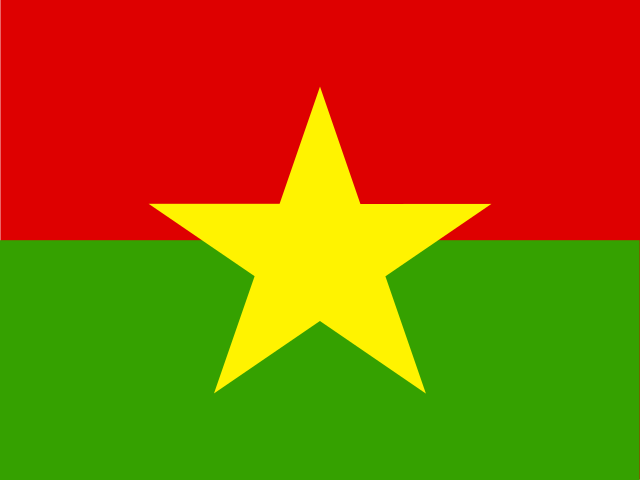
Two horizontal bands of red over green with a yellow-gold five-pointed star at the centre - the Pan-African colours. The constitution assigns no meanings; the presidency reads red as the blood of the Revolution's martyrs, green as agricultural abundance, and the star as the Revolution's ideological guide.
Burkina Faso FACTS ◢
| Capital | Ouagadougou |
|---|---|
| Continent | Africa |
| Population | 24,074,580 (2025) |
| Area | 274,200 km² |
| Population density | 88/km² |
| Currency | West African CFA franc (XOF) |
| Main languages | Dioula, French, Fulfuldé, Mooré |
| Calling code | +226 |
| Internet TLD | .bf |
| Time zone | UTC±00:00 |
| Drives on the | Right |
| ISO codes | BF / BFA |
DID YOU KNOW? ◢
- Its capital, Ouagadougou, hosts FESPACO, the largest African film festival on the continent.
- The name Burkina Faso roughly translates to 'land of honest' or 'upright people'.
- The Grand Mosque of Bobo-Dioulasso is a striking example of Sudano-Sahelian mud architecture.
- It's home to elephants, hippos and lions in reserves like the transboundary W-Arly-Pendjari complex.
Burkina Faso QUICK ANSWERS ◢
What is the capital of Burkina Faso?
The capital of Burkina Faso is Ouagadougou.
What is the population of Burkina Faso?
Burkina Faso had a population of 24,074,580 in 2025.
What currency does Burkina Faso use?
Burkina Faso uses the West African CFA franc (XOF).
What languages are spoken in Burkina Faso?
Burkina Faso designates no official language. The languages of government and education are Dioula, French, Fulfuldé and Mooré.
Think you know your flags? Play Flag Daily → · Browse all countries →
MORE ON THE FLAG ◢
Burkina Faso's constitution states what its flag looks like and declines to say what it means. Article 34 gives the design in a single sentence: two horizontal bands, red above green, with a five-pointed yellow-gold star at the centre. Then it stops.
That flag replaced the black, white and red bands of Upper Volta on 4 August 1984, the day Thomas Sankara renamed the country.
The meanings you will read elsewhere are real and the state does publish them. They just do not come from the constitution, and the two fullest accounts of them contradict each other.
Key Takeaways
- Article 34 describes the flag and assigns it no symbolism whatsoever.
- The same article hands the job of fixing meanings to a law, and only for the coat of arms.
- That law exists. It explains five parts of the arms and says nothing about red, green or the star.
- The Presidency's own flag page supplies the reading most often quoted: martyrs' blood, agricultural abundance, an ideological guide.
- Ferdinand Dabiré, the newspaper sub-editor credited with drawing the flag for Sankara, gave a different reading again.
| The claim | Where it comes from | What it establishes |
|---|---|---|
| Red over green, yellow-gold five-pointed star at the centre | Constitution, Article 34 | The design is constitutional. The colours are named and nothing more |
| The star sits in a circle about one third of the flag's width | Presidency of Burkina Faso, flag page | The geometry is published in detail, unlike the symbolism |
| Red is the blood of the Revolution's martyrs | Presidency of Burkina Faso, flag page | An executive reading, not a statutory one |
| Red is the blood and sweat of the people, green is the environment and hope | Ferdinand Dabiré, quoted 2021 | His own account, and it differs |
| Symbolism is fixed by statute for the coat of arms only | Law 020/97/II/AN of 1 August 1997 | The one law on symbol meanings skips the flag |
| Name, anthem and flag all changed on 4 August 1984 | Message of the President of Faso, 4 August 2024 | The date, stated by the state itself |
What does Burkina Faso's constitution say about the flag?
One sentence, and it is a description rather than an explanation. Article 34 of the constitution, in the text consolidated after the revision of 29 October 2024, reads: "L'emblème est le drapeau tricolore de forme rectangulaire et horizontale, rouge et vert avec, en son centre, une étoile jaune-or à cinq branches." The emblem is the tricolour flag, rectangular and horizontal, red and green with, at its centre, a five-pointed yellow-gold star.
Read that twice and a small oddity surfaces. The article calls the flag a tricolour and then names two colours, leaving the third to be supplied by the star.
The Presidency of Burkina Faso resolves it the other way. Its own page on the emblem opens: "L'emblème du BURKINA FASO est un drapeau bicolore (rouge et vert), divisé en deux bandes horizontales de dimensions égales." A bicolour. So the constitution and the head of state's office disagree, in their opening words, about how many colours the national flag has.
Neither text gives a shade. Red is "rouge", green is "vert" and the star is "jaune-or", so every Pantone and hex value published for this flag is a convention rather than a quotation.
What Article 34 did not do was create the flag. That came in August 1984, and the enacting instrument was not opened for this article: references that cite a 1984 ordinance by number disagree over whether it was signed on 2 or 4 August, so nothing here rests on it. The date rests instead on the state's own commemoration.
Where do the Burkina Faso flag's colour meanings come from?
From the Presidency, under a heading that says so plainly. Its flag page carries a section called SIGNIFICATION DES COULEURS and gives one gloss per element.
Red "symbolise le sang versé hier, aujourd'hui et demain par les martyrs de la RÉVOLUTION pour en assurer la victoire". It symbolises the blood shed yesterday, today and tomorrow by the martyrs of the Revolution to secure its victory, and by extension all the sacrifices of the Burkinabè people.
Green is "le symbole des diverses richesses agricoles de notre peuple", the symbol of the various agricultural riches of the people. By extension it stands for the abundance that will bring their happiness.
The yellow star is the "guide idéologique de la Révolution Démocratique et Populaire dans sa marche radieuse", the ideological guide of the Democratic and Popular Revolution on its radiant march.
Those three are official in the ordinary sense that the head of state's office publishes them. They are not constitutional, they are not statutory, and nothing in the wording claims to be either.
A third reading circulates alongside them, attached to the palette rather than to any text. Red, green and yellow are routinely called the Pan-African colours, and the same three turn up on neighbouring flags including Mali, which arranges them in vertical bands. No Burkinabè instrument read for this article uses the phrase or gives the palette a reason.
The same page is far more exact about shape than about sense. Three of the star's points sit in the red band and two in the green, and the circle drawn through all five is "égal au tiers (1/3) environ de la largeur du drapeau", about one third of the flag's width. Even the geometry hedges with "environ".
Who designed the flag of Burkina Faso?
A newspaper sub-editor, working to a brief from Sankara. Ferdinand Dabiré was one of the first Burkinabè secretaries of the newsroom, at the state daily Sidwaya, and he is credited with drawing the flag. The evidence for that is his own account of the commission, given in an interview in August 2021 and repeated in the Burkinabè press when he died on 3 July 2025.
His words: "Sankara m'a demandé d'élaborer le drapeau, le rouge représentant le sang et la sueur du peuple burkinabè, le vert incarnant l'environnement et l'espérance et l'étoile jaune au milieu, figurant comme le guide pour la révolution. Ce que j'ai fait."
Sankara asked him to draw up the flag, with red for the blood and the sweat of the Burkinabè people, green for the environment and hope, and the yellow star in the middle as the guide for the revolution. So he did.
Set that beside the Presidency's version and three differences appear. Dabiré's red carries sweat as well as blood, and belongs to the people rather than to the Revolution's martyrs. His green is the environment and hope, not agriculture and abundance. His star guides the revolution without being called its ideology.
Both accounts are published by Burkinabè institutions. Neither is a statute, so neither displaces the other, and the drift between them is the honest answer to what the colours mean. The blend most often repeated in English, green for abundance and hope, follows neither of them: abundance is the Presidency's word and hope is the designer's.
Why does the law explain the coat of arms and not the flag?
Because Article 34 asked it to, and only about the arms. Its third paragraph says "La loi détermine les armoiries ainsi que la signification de ses éléments constitutifs", the law determines the coat of arms and the meaning of its constituent elements. There is no matching sentence for the flag.
The law arrived on 1 August 1997, as Law 020/97/II/AN "portant description et signification des Armoiries du Burkina Faso", promulgated by Decree 97-356/PRES on 10 September 1997. Its Article 1 describes an escutcheon of two bands bearing the national emblem, so the flag is physically inside the arms. Its Article 2 then explains the two rearing silver stallions, the escutcheon, the crossed lances, the open book and the millet stalks, one by one.
Red, green and the star are never mentioned in that article. The star appears in the law only as a survey mark, used to place the millet stalks relative to its upper point.
The asymmetry survived a rewrite. When the national motto changed in October 2024, the Council of Ministers took a bill the following month to amend the 1997 law, because, as the government put it, the arms bearing the motto are defined in a law. The flag needed no such bill. Nothing about it is defined that way.
What did the Upper Volta flag stand for?
Three horizontal bands of black, white and red, and its constitution was just as silent. Article 2 of the Voltaic constitution of 13 December 1977 reads: "L'emblème national est le drapeau tricolore: noir, blanc et rouge à bandes horizontales d'égales dimensions." The national emblem is the tricolour flag, black, white and red, in horizontal bands of equal size. The same article named the anthem, which it renders as LA VOLTA, and the motto, Unity, Work, Justice, and explained none of them either.
The reading attached to those bands everywhere else is the country's rivers, and the colours do line up. Burkina Faso's three main watercourses were the Black, White and Red Volta, and they are now the Mouhoun, the Nakambé and the Nazinon, as the education ministry's own primary-school geography puts it: "le Mouhoun (ex Volta noire), le Nakambé (ex Volta blanche) et le Nazinon (ex Volta rouge)".
That is a match, not a citation. The rivers reading appears in no Voltaic or Burkinabè text opened for this article, which leaves the black, white and red exactly as unexplained by law as the red, green and yellow-gold that replaced them. Those rivers still reach the sea through Ghana, which the Volta crosses on its way to the coast. Ghana took the river's name for its own great lake.
Has Article 34 changed since 1991?
Everything around the flag has. The flag sentence has not.
The 1991 constitution as adopted carried the revolutionary motto, "La Patrie ou la Mort, Nous Vaincrons !", a point recorded in note 3 of the 1991 text and note 15 of the current one. The constitutional law of 27 January 1997 replaced it with "Unité - Progrès - Justice" and respelled the anthem. The constitutional law of 5 November 2015 respelled the anthem again and added the words "chant de la victoire, du salut", the song of victory and salvation. The revision of 30 December 2023 rewrote the neighbouring Article 35, making those national languages that a law has made official the country's official languages, and leaving English and French as working languages. On 29 October 2024 the motto reverted to "La Patrie ou la Mort, nous Vaincrons".
Across those revisions, by three very different assemblies, the sentence describing the flag was never touched. The emblem outlasted the words around it, which is a fair description of the thing itself: a design drawn to order in August 1984, still flying, still unexplained by the document that prescribes it.
If you want to know whether you could pick it out of a rack of red, yellow and green neighbours, a daily flag round will tell you in three guesses, and the country list holds the rest of them.
Frequently asked questions
What do the colours of the Burkina Faso flag mean?
The Presidency of Burkina Faso publishes the standard reading: red for the blood shed by the martyrs of the Revolution and for the sacrifices of the people, green for the country's agricultural riches and the abundance they promise, and the yellow star as the ideological guide of the Democratic and Popular Revolution. That reading is not in the constitution, which describes the flag without interpreting it, and it is not in any Burkinabè statute.
Is the Burkina Faso flag a tricolour or a bicolour?
Both words are used officially, for the same flag. Article 34 of the constitution calls it "le drapeau tricolore" and then names only red and green, counting the star's yellow-gold as the third colour. The Presidency's own description opens by calling it "un drapeau bicolore (rouge et vert)".
When did Burkina Faso change its flag?
On 4 August 1984, the first anniversary of the revolution that brought Thomas Sankara to power. A presidential message marking the anniversary in 2024 puts the change of the country's name from Upper Volta, the change of the national anthem and the change of the flag on that single date. The 1984 instrument that enacted it was not opened for this article, and flag references citing it by number disagree over whether it was signed on 2 or 4 August.
Who designed the flag of Burkina Faso?
Ferdinand Dabiré, a sub-editor at the state newspaper Sidwaya, is credited with drawing it to instructions from Sankara, on the strength of his own account of the commission. He recounted the brief in an interview in 2021: red for the blood and sweat of the Burkinabè people, green for the environment and hope, and a yellow star in the centre as the guide for the revolution.
How big is the star on the Burkina Faso flag?
The Presidency's description sets the circle passing through the star's five points at about one third of the flag's width, and the wording includes the word "environ", meaning about. Its upper three points lie in the red band and its lower two in the green, so it straddles the line where the bands meet.
Sources
- Assemblée législative de transition, Constitution du Burkina Faso, consolidated after the revision of 29 October 2024 (PDF), Articles 34 and 35, with notes 3, 15 and 16 - retrieved 12 August 2026.
- Presidency of Burkina Faso, Le drapeau - retrieved 12 August 2026.
- Primature du Burkina Faso, Loi n° 020/97/II/AN du 1er août 1997 portant description et signification des Armoiries du Burkina Faso, Articles 1 and 2, with Décret n° 97-356/PRES promulgating it, via the Internet Archive - retrieved 12 August 2026.
- Constitution de la République de Haute-Volta du 13 décembre 1977, Article 2, Digithèque MJP, Université de Perpignan - retrieved 12 August 2026.
- Constitution adoptée par le référendum du 02 juin 1991, revised to 2002, Article 34 and note 3, FAOLEX (PDF) - retrieved 12 August 2026.
- Presidency of Burkina Faso, Armoiries du Burkina Faso: vers une révision de la loi y relative, Council of Ministers of 27 November 2024 - retrieved 12 August 2026.
- Quotidien Sidwaya, Commémoration du 4 août 1984: message du Président du Faso - retrieved 12 August 2026.
- Lefaso.net, Décès de Ferdinand Dabiré, le journaliste qui a dessiné le drapeau du Burkina - retrieved 12 August 2026.
- Ministère de l'Éducation nationale, Les cours d'eau du Burkina Faso, Fasoeducation - retrieved 12 August 2026.
- Not read: the 1984 instrument that adopted the flag. Flag references cite an ordinance of the Conseil national de la révolution by number but disagree over whether it was signed on 2 or 4 August 1984, so no claim here rests on it.
PLAY ANOTHER →
Three clues, three guesses. Work out where in the world it is.
THREE CLUESDAILYOn This DayOne thing that happened today in history. Every day, a new one.
TODAY IN HISTORYDAILYDaily CodeA short message, hidden in a different cipher every day.
ONE CIPHER A DAYDAILYDaily CryptogramOne quote, one scrambled alphabet. Crack it before tomorrow.
CRACK THE QUOTE