
Ghana
The first sub-Saharan African colony to win independence, Ghana runs on gold, cocoa and football fever, with a coastline of old trading forts and a warm reputation that gave it the nickname 'the friendly country'.
WHAT THE FLAG MEANS ◢
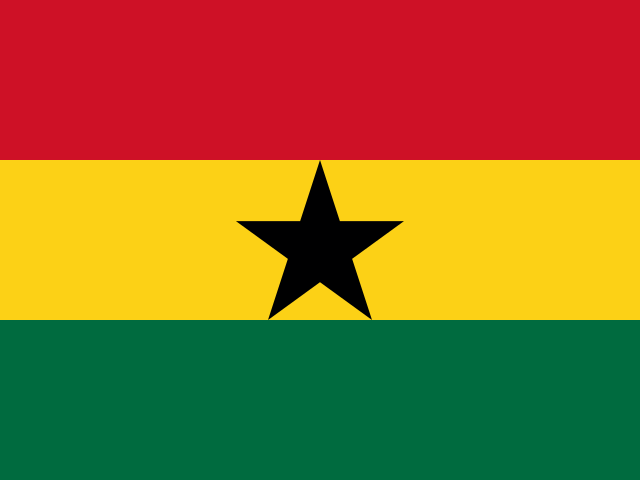
Three horizontal bands of red, gold and green with a black five-pointed star centred on the gold band. No Ghanaian law assigns the colours a meaning: the 1992 Constitution does not mention the flag, and the Flag and Arms Protection Act, 1959 defines 'Flag' only as the national Flag of the Republic. The meanings come from the designer, Theodosia Salome Okoh, whose own account published by the Government of Ghana gives red to those who died or worked for independence, gold to the country's mineral wealth, green to Ghana's tropical vegetation, and the black star to African emancipation and unity.
Source: ghana.gov.gh
Ghana FACTS ◢
| Capital | Accra |
|---|---|
| Continent | Africa |
| Population | 35,064,272 (2025) |
| Area | 238,535 km² |
| Population density | 147/km² |
| Currency | Ghana cedi (GHS) |
| Official language | English |
| Calling code | +233 |
| Internet TLD | .gh |
| Time zone | UTC±00:00 |
| Drives on the | Right |
| ISO codes | GH / GHA |
DID YOU KNOW? ◢
- In 1957 it became the first sub-Saharan African nation to gain independence from colonial rule.
- It's one of the world's largest producers of cocoa, the raw ingredient of chocolate.
- Lake Volta, created by the Akosombo Dam, is one of the largest artificial lakes on Earth by surface area.
- Ghana takes its name from a powerful medieval West African empire.
- Its coast is dotted with centuries-old European forts and castles, now UNESCO World Heritage Sites.
Ghana QUICK ANSWERS ◢
What is the capital of Ghana?
The capital of Ghana is Accra.
What is the population of Ghana?
Ghana had a population of 35,064,272 in 2025.
What currency does Ghana use?
Ghana uses the Ghana cedi (GHS).
What languages are spoken in Ghana?
The official language of Ghana is English.
Think you know your flags? Play Flag Daily → · Browse all countries →
MORE ON THE FLAG ◢
The meanings of Ghana's flag are credited to one woman: Theodosia Salome Okoh, who saw an advertisement in a newspaper, entered a design and won.
What she actually wrote is worth reading. The summary Ghana's government prints beside her statement is not quite the same document, and that difference is what most accounts of the Ghana flag lose.
Key Takeaways
- Okoh said she chose the palette "because of the geography of Ghana". The vexillologist Whitney Smith, quoted on Flags of the World, derives it instead from the ruling party's colours and Ethiopia's.
- Her red commemorates those who "died or worked" for independence, a wider group than the reading Ghana's own pages print.
- She gave the black star to African emancipation and unity, and named no shipping line. Ghana's government pages add the Marcus Garvey link separately.
- None of the three Ghanaian instruments read for this article assigns the colours a meaning. The 1959 Act defines "Flag" circularly and the 1992 Constitution never uses the word.
- The middle band was white, not gold, from 1964 to 1966 on Flags of the World's dating. No Ghanaian source confirms it: Ghana's own publications say only that the flag was flown until 1959, or until 1962, and reinstated in 1966. All three versions are still published.
What do the colours on the Ghana flag mean?
The Government of Ghana's portal published Okoh's explanation in the first person, under the heading "The Meaning of the Flag". It runs to four sentences and it is the closest thing to an authoritative answer anyone has.
I decided on the three colors of red, gold & green because of the geography of Ghana. Ghana lies in the tropics and blessed with rich vegetation. The color Gold was influenced by the mineral rich nature of our lands and Red commemorates those who died or worked for the country's independence. Then the five pointed lone star which is the symbol of African emancipation and unity in the struggle against colonialism.
The same page prints the government's own four-line summary of the flag as well, immediately before that heading, and the summary is not quite what she said.
| Element | Theodosia Okoh's own words | The government portal's own summary |
|---|---|---|
| Red | "commemorates those who died or worked for the country's independence" | "the blood of those who died in the country's struggle for independence" |
| Gold | "influenced by the mineral rich nature of our lands" | "the mineral wealth of the country" |
| Green | Ghana "lies in the tropics and blessed with rich vegetation" | "the country's rich forests and natural wealth" |
| Black star | "the symbol of African emancipation and unity in the struggle against colonialism" | "Symbol of African unity and emancipation" |
Two of those gaps carry weight. Okoh's red takes in Ghanaians who worked for independence as well as those who died for it, a far larger group than blood alone. Her green is a claim about where the country sits, tropics and vegetation, rather than about forests in particular.
Ghanaian departments do not even print the same short version. The portal's 2007 page gave green as "the country's rich forest" and the star as "the lode star of African freedom", with no unity in it; the Information Services Department's Facts About Ghana leaflet, still published on its site, has the star as "African unity and emancipation"; the Permanent Mission of Ghana to the United Nations gives "the symbol of African emancipation" and stops there.
Why did Okoh choose red, gold and green?
Her own answer is geography, and it is the first thing she says. One alternative comes from outside Ghana.
Flags of the World records Ivan Sache quoting the vexillologist Whitney Smith, who wrote that "the green-white-red horizontal of the ruling Convention Peoples' Party and the green-yellow-red of Africa's oldest independent nation (Ethiopia) combined to inspire Ghana's flags". That is a derivation from party and precedent. Okoh's sentence is about the tropics. No Ghanaian source opened for this article mentions the Convention People's Party in connection with the design at all, and none of them settles which reason came first in her mind.
A song that a Flags of the World contributor, David Kendall, posted in 2006 and dated to 1956 to 1960, naming no publication and no composer, glosses the colours a third way again.
Red for the blood of the heroes in the fight, Green for the precious farms of our birth-right, And linked with these the shining golden band That marks the richness of our Fatherland.
Farms, not forests, and a golden band for richness rather than for minerals. The reading that eventually stuck was neither the designer's nor the song's.
Ghana's publications also make a claim about sequence rather than about motive, and it is worth keeping the two apart. The Information Services Department and the government portal both call Ghana's the first African flag after Ethiopia's to carry these colours; the Permanent Mission to the United Nations and the Daily Graphic count Ethiopia in and make Ghana's the second. That is about who flew the palette first, not about why Okoh picked it.
Who designed the Ghana flag, and how was she chosen?
Okoh was an artist, and she won an open call rather than a commission. Rosalind Amoh's Graphic Online profile, published five days after Okoh's death, quotes her on how it happened: "I saw the advertisement in the local paper asking for a design for a national flag. As an artist, I gave it a try and submitted my work, which eventually won."
Asked why hers beat the rest she was, in Amoh's framing, joking. "I bet the designs of the men were dull and filled with motives which would have been difficult for non-artiste to draw. The design I had was simple and anyone and anybody at all could replicate it."
That is the whole test of a national flag, and hers passes it: three bands and one star, redrawable from memory with four crayons. Flag Daily will tell you how many others you actually retain.
The same profile carries the rest of the record. Okoh played hockey from her Achimota schooldays and went on to captain the national team; she chaired the Ghana Hockey Association, and Amoh wrote in April 2015 that she remained "the only female to have held that high position"; the national hockey stadium is named after her. Her husband, Enoch Kwabena Okoh, was Head of the Civil Service under Kwame Nkrumah. She died on 19 April 2015, aged 92.
Does any Ghanaian law say what the flag looks like?
Not one of the three instruments read for this article, and that is the part most flag pages skip.
The word flag does not occur anywhere in the English text of the 1992 Constitution published by the Constitute Project. The nearest approach is article 21, on general fundamental freedoms, which permits laws safeguarding Ghanaians against the propagation of a doctrine encouraging disrespect for "the nationhood of Ghana, the national symbols and emblems". Symbols in the plural, unnamed.
The Flag and Arms Protection Act, 1959 runs to four sections. Section 1 forbids using the design of the flag or the coat of arms, or part of either, without a licence from the Minister responsible for the Interior, and does not restrict display of the flag on a public holiday or a day proclaimed a festive occasion. Section 2 sets the penalty at a fine of up to fifty penalty units, increased by the retail value of any goods the design was used on. Section 4 then says: "'Flag' means the national Flag of the Republic". No colours, no proportions, no star.
Section 4 does leave one trace. It records that the design of the coat of arms is registered in the College of Arms, London, and that the arms, "with the Flag of the Republic was published for information in the Republic in the Gazette on the 25th day of October, 1959". The Act records that the notice was published; its contents were not obtainable for this article, and the Act itself was assented to on 21 November 1959, just under a month after that date.
One caution about that text. The version published by the Judicial Service of Ghana's legal library is a revised edition rather than the 1959 original: its section 3 cross-refers to the Trade Marks Act, 1965 and then to the Trade Marks Act, 2004, both of which postdate the Act they sit inside.
Later law behaves the same way. Section 93 of the Ghana Shipping Act, 2003 reads in full: "The national flag of Ghana is declared to be the national colours for all Ghanaian ships." The Act then spends three more sections on it without describing it once. Section 95 requires a Ghanaian ship to hoist the colours when signalled by a ship or aircraft of the Armed Forces, on entering or leaving port, when passing a warship, and from sunrise to sunset in a Ghanaian port. Section 96 sets a fine of up to the cedi equivalent of one million US dollars for flying them on a ship that is not Ghanaian. Section 482 repeals the Merchant Shipping Act, 1963, which a Flags of the World contributor records as having provided for a Ghanaian red ensign; on that reading the 2003 Act left that ensign obsolete.
Protected, obeyed, punished for, never described. No consolidated Ghanaian flag statute was located for this article, and a contributor to the same archive reported the same gap in 2024: "I haven't found any legal document about the flag. If anybody has, please share it with us."
The gap shows up where an official shade would be. Flags of the World collects the colours the reference works give, and they disagree. The protocol manuals for the Beijing 2008 and London 2012 Olympic Games both give Pantone 032 red, 109 yellow and 355 green, while the Album des Pavillons 2000 gives Pantone 186c red, 116c yellow and 349c green. None of the instruments read here arbitrates between them.
Where does the black star come from, and where else does it appear?
Ghana's government portal, its Permanent Mission to the United Nations and the Daily Graphic all print one sentence: the black star was adopted from the flag of the Black Star Line, the shipping line incorporated by Marcus Garvey that operated from 1919 to 1922. The football team's nickname, the Black Stars, comes from the flag in turn.
Notice what is missing. Okoh's published statement names no shipping line and no Garvey. Flags of the World records Mark Sensen quoting reference [cra93b], which its bibliography gives as William Crampton's "Marcus Garvey and the Rasta colours", in the report of the 13th International Congress of Vexillology held at Melbourne in 1989 and published in 1993: "It is believed that the black star on the flag of Ghana, the lone star of African freedom, is taken from the flag of the Black Star Line". Asserted flatly by the state, hedged in the vexillological literature, absent from the designer's own account.
The star outgrew the flag regardless. It sits on the crest of the coat of arms, which the Permanent Mission describes as "a Black star of Africa with gold outline". It names Black Star Square in Accra, which the Daily Graphic dates to 1961. The Permanent Mission prints the anthem's third stanza, which opens "Raise high the flag of Ghana and one with Africa advance; Black star of hope and honour To all who thirst for liberty". And it multiplied: Flags of the World records that the Ghana-Guinea Union formed on 23 November 1958 flew a flag like Ghana's but with two black stars.
When did the Ghana flag have a white stripe instead of gold?
Flags of the World dates a white middle band, in place of the gold, from 1 January 1964 to 28 February 1966. No Ghanaian source opened for this article confirms it.
On that dating the gold returned four days after Colonel E. K. Kotoka announced on state radio, in the words ASP James Annan reprints in Graphic Online, that "Kwame Nkrumah is overthrown, and the myth surrounding him is broken". The coup came at dawn on 24 February 1966, while Nkrumah was travelling to Hanoi at the invitation of Ho Chi Minh.
White was also the middle colour of the ruling Convention People's Party's own flag, which Whitney Smith, quoted on Flags of the World, gives as green, white and red. None of the sources opened here states why the national flag changed, so the match is worth reporting and not worth explaining.
Ghana's own publications disagree with that chronology and with each other. The government portal and the Information Services Department leaflet both say the flag "was flown until 1959, and then reinstated in 1966"; the Permanent Mission of Ghana to the United Nations says 1962, as did the Daily Graphic in March 2020. Neither Ghanaian date fits a white band that arrived in 1964, and as of August 2026 all three versions, the two Ghanaian ones and the archive's, remain published.
Frequently asked questions
Who designed the flag of Ghana?
Theodosia Salome Okoh, an artist, who entered after seeing a newspaper advertisement calling for a national flag design. Asked why hers won, she joked: "The design I had was simple and anyone and anybody at all could replicate it." She captained the national hockey team and chaired the Ghana Hockey Association, which Rosalind Amoh reported in April 2015 that no other woman had done. She died on 19 April 2015, aged 92.
Is the meaning of Ghana's flag colours written into Ghanaian law?
No. The Flag and Arms Protection Act, 1959 and the Ghana Shipping Act, 2003 protect and command the flag without describing it or assigning its colours a meaning, and the 1992 Constitution does not mention it at all. No source found for this article ties any meaning of the colours to a statute.
What does the black star on the Ghana flag stand for?
Okoh called it "the symbol of African emancipation and unity in the struggle against colonialism". Ghanaian government pages add that the star came from the flag of Marcus Garvey's Black Star Line, a derivation her own published statement does not mention and which the vexillological literature quoted on Flags of the World reports as a belief rather than a fact.
Why did Ghana's flag once have a white stripe?
No source opened for this article states why the change was made. Flags of the World dates a white middle band from 1 January 1964 to 28 February 1966; white was also the middle colour of the ruling Convention People's Party's flag, and on that dating the gold returned four days after the coup that removed Kwame Nkrumah on 24 February 1966. The match is recorded, not explained.
Which came first, Ghana's flag or Ethiopia's?
Ethiopia's. Ghana's Information Services Department calls Ghana's the first African flag after Ethiopia's to carry these colours, while the Permanent Mission of Ghana to the United Nations counts Ethiopia in and makes Ghana's the second. Whitney Smith, quoted on Flags of the World, gives Ethiopia's green, yellow and red as one of the two influences on the Ghanaian design, the other being the ruling party's green, white and red.
Sources
- Judicial Service of Ghana, Legal Library Services, Flag and Arms Protection Act, 1959 No. 61 - retrieved 14 August 2026.
- Constitute Project, Ghana's Constitution of 1992 with Amendments through 1996 - retrieved 14 August 2026.
- Government of Ghana, The National Flag - retrieved 14 August 2026.
- Government of Ghana, Symbols of Ghana: The Ghana National Flag - retrieved 14 August 2026.
- Information Services Department, Ghana, Facts About Ghana - retrieved 14 August 2026.
- Permanent Mission of Ghana to the United Nations, Ghana Flag, Coat of Arms and National Anthem - retrieved 14 August 2026.
- Rosalind Amoh, Graphic Online, You can't negotiate patriotism, Theodosia Okoh - retrieved 14 August 2026.
- Daily Graphic, The Ghana flag - retrieved 14 August 2026.
- ASP James Annan, Graphic Online, Kwame Nkrumah's overthrow - retrieved 14 August 2026.
- Ghana Maritime Authority, Ghana Shipping Act, 2003 (Act 645) - retrieved 14 August 2026.
- Flags of the World, Ghana - retrieved 14 August 2026.
- Flags of the World, Bibliography: Cra - retrieved 14 August 2026.
PLAY ANOTHER →
Three clues, three guesses. Work out where in the world it is.
THREE CLUESDAILYDaily CodeA short message, hidden in a different cipher every day.
ONE CIPHER A DAYDAILYOn This DayOne thing that happened today in history. Every day, a new one.
TODAY IN HISTORYDAILYDaily TriviaFive questions a day. Everyone gets the same five.
FIVE QUESTIONS