
Ethiopia
The only African nation never formally colonised, birthplace of coffee and home to a calendar that runs several years behind the rest of the world. Ethiopia does time, faith and history its own way.
WHAT THE FLAG MEANS ◢
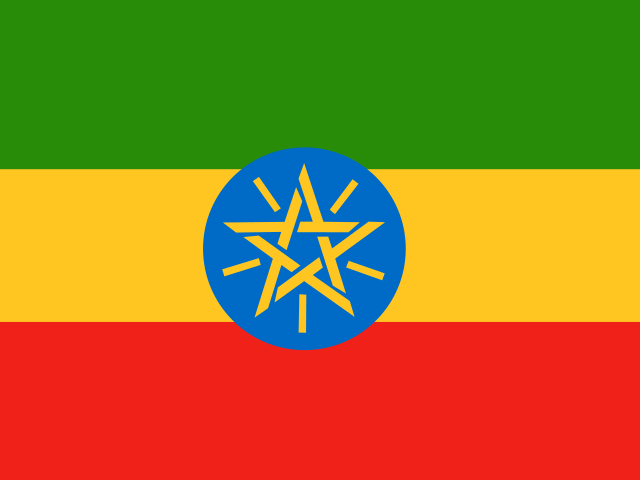
Three horizontal bands of green, yellow and red with a blue disc bearing a golden star and rays at the centre. Ethiopia is one of the few countries whose law states the meanings outright: the Flag Proclamation assigns green to labour, fertility and development, yellow to hope, justice and equality, and red to sacrifice and heroism towards the prevalence of freedom and equality, while peace belongs to the blue disc, not to any band. The star signifies unity founded on the common will of Ethiopia's nations, nationalities and peoples, and the rays their bright prospect. These are the original Pan-African colours, which Ethiopia inspired.
Source: justice.gov.et
Ethiopia FACTS ◢
| Capital | Addis Ababa |
|---|---|
| Continent | Africa |
| Population | 135,472,051 (2025) |
| Area | 1,104,300 km² |
| Population density | 123/km² |
| Currency | Birr (ETB) |
| Main language | Amharic |
| Calling code | +251 |
| Internet TLD | .et |
| Time zone | UTC+03:00 |
| Drives on the | Right |
| ISO codes | ET / ETH |
DID YOU KNOW? ◢
- It's one of the only African countries never to be colonised by a European power.
- It follows its own calendar, which runs roughly seven to eight years behind the Gregorian one.
- Coffee is widely believed to have originated in its highlands.
- The rock-hewn churches of Lalibela were carved downward directly out of solid stone.
- 'Lucy', one of the most famous early human ancestor fossils, was discovered here.
Ethiopia QUICK ANSWERS ◢
What is the capital of Ethiopia?
The capital of Ethiopia is Addis Ababa.
What is the population of Ethiopia?
Ethiopia had a population of 135,472,051 in 2025.
What currency does Ethiopia use?
Ethiopia uses the Birr (ETB).
What languages are spoken in Ethiopia?
Ethiopia designates no official language. The language of government and education is Amharic.
Think you know your flags? Play Flag Daily → · Browse all countries →
MORE ON THE FLAG ◢
What the green, yellow and red bands on the Ethiopian flag mean is not guesswork. Ethiopia writes it down, colour by colour, in a law printed in the Federal Negarit Gazeta.
Article 7 of the Flag Proclamation gives the three bands their meanings in one short list: "the green for labor, fertility and development", "the yellow for hope, justice and equality", and "the red for sacrifice and heroism towards the prevalence of freedom and equality". The gazette prints Amharic and English in facing columns; every quotation here comes from its English column, spellings included.
A separate article gives peace to the disc behind the star. That is where almost every summary goes wrong: peace belongs to the blue circle, not the yellow band.
Key Takeaways
- Proclamation No. 654/2009, in the Federal Negarit Gazeta of 28 August 2009, is the flag law in force; Article 7 assigns each band a meaning.
- Blue carries peace, under the emblem article rather than the colours article.
- Article 3 of the Constitution fixes the bands and requires an emblem at the centre, leaving the star, the blue and the meanings to legislation.
- Using the flag "without its Emblem" is the most heavily punished of the eleven acts in Article 23: a fine of up to 5,000 birr or rigorous imprisonment of up to eighteen months.
What do the colours on the Ethiopian flag mean?
Four colours are assigned meanings, not three: the blue disc gets a meaning of its own, in a different article from the bands.
Article 7 of Proclamation No. 654/2009 covers the bands: green for labour, fertility and development; yellow for hope, justice and equality; red for sacrifice and heroism towards the prevalence of freedom and equality. Red is the one summaries clip.
Blue arrives an article later. Article 8, headed "Meaning of the Emblem", opens with the line that "The circular blue background of the Emblem signifies peace." Read the colours article alone and no peace appears, so it gets attached to whichever band looks like it has room.
What does the star in the middle stand for?
The star signifies unity founded on the common will of Ethiopia's nations, nationalities and peoples, and it is the proclamation that says so, not the constitution.
Article 3 of the 1994 Constitution fixes the design, then states a purpose: the flag carries "a national emblem at the centre", and that emblem "shall reflect the hope of the Nations, Nationalities, Peoples ... to live together in equality and unity". What it does not do is draw it: no star, no blue, no five points, no meaning for any band.
The proclamation supplies the shape and breaks it into parts. Straight and equal lines signify equality of nations, nationalities and peoples "as well as of Religions". The star those lines form signifies unity founded on common will. Yellow rays signify "the bright prospect in sight" for those peoples.
So the star is a drawing of a sentence. The statute never calls it a pentagram: Article 6(4) has the lines join and cross, with the rays radiating from the crossings.
Why is flying the plain tricolour Ethiopia's worst flag offence?
Because the proclamation penalises that act more heavily than any other flag offence it lists.
Article 23 lists prohibited activities, numbered one to eleven. Item one is "to use the Flag without its Emblem as provided under this Proclamation"; the others are the familiar ones, defacing the flag, flying a faded or torn one, using it in commercial advertising.
Article 24 splits the penalties, using one term for both. Article 24(1) makes items two to eleven "punishable with a fine up to 3000 birr or with rigorous imprisonment up to one year". Article 24(2) puts item one alone at "a fine up to 5000 birr or rigorous imprisonment up to one year and six months".
When did the star appear on the Ethiopian flag?
The emblem became law with Proclamation No. 16/1996, printed in Federal Negarit Gazeta No. 4 on 6 February 1996, the date its own Article 17 gives for entry into force. Its Article 3 described a blue circle bearing yellow lines "that come from all directions and join each other", with the star and rays those lines make.
The meanings came with it, at Article 4, and the 2009 text repeats them almost exactly: the 1996 English column spells green's meaning "labour", the 2009 column "labor". What moved is blue. In 1996 the disc sat inside the colours article, at Article 4(4); in 2009 it moved to the emblem article.
The 1996 Article 3 described the emblem without fixing its size; the 2009 replacement did, requiring at Article 6(1) that it "be set at the centre of the Flag in such a way that its circumference curves on the midpoint of the width of both the green and red colors", the gazette's own English mixing the two spellings inside one sentence. So the disc bites into the bands above and below the yellow.
Did Ethiopia give Africa the green, gold and red?
One borrower says so in an official document. The Permanent Mission of Ghana to the United Nations describes Ghana's flag and coat of arms as "the second African flag after the flag of the Ethiopian Empire to feature these colours", while reading its own red as the blood of the independence dead, gold as mineral wealth and green as forests.
None of the five constitutions read here assigns the colours a meaning.
| Country | What the constitution read here says about the tricolour |
|---|---|
| Ethiopia (1994) | Fixes the three bands; requires an emblem reflecting a hope of living together "in equality and unity" |
| Senegal's green star (2016) | Three bands "vertical and equal, of green, gold and red color", plus a green five-pointed star. No meanings |
| Mali's plain tricolour (2023) | "three (03) vertical and equal bands of green, gold and red colors". No meanings |
| Guinea's vertical bands (2010) | "three vertical and equal bands of color RED, YELLOW and GREEN". No meanings |
| Ghana (1992, revised 1996) | The words "flag", "coat of arms" and "anthem" do not appear at all. Article 21 bars doctrines encouraging "disrespect for ... the national symbols and emblems"; Article 41 makes respecting "the symbols of the nation" a citizen's duty. Neither names one |
Of the five, Ethiopia's flag statute was the only one reachable in English for this article, and it is the statute, not the constitution, that assigns the meanings. Whether the other four have laws doing the same, their constitutions do not say. The star repays a second look in any flag quiz.
Frequently asked questions
What do the three colours on the Ethiopian flag mean?
Article 7 of Ethiopia's Flag Proclamation, in the Federal Negarit Gazeta of 28 August 2009, assigns green labour, fertility and development, yellow hope, justice and equality, and red sacrifice and heroism towards the prevalence of freedom and equality.
Does the yellow band on the Ethiopian flag mean peace?
No. Article 8 gives peace to the blue disc behind the star; yellow is assigned hope, justice and equality. Moving peace onto the yellow band reads Article 7 without Article 8.
Is it illegal to fly the Ethiopian flag without its star emblem?
Yes. Article 23 prohibits using the flag without the emblem the proclamation requires, and Article 24(2) punishes that with a fine of up to 5,000 birr or rigorous imprisonment of up to eighteen months, the heaviest penalty on the list.
When was the emblem added to the Ethiopian flag?
Proclamation No. 16/1996 put the blue disc and its star into law, in force on 6 February 1996 under its own Article 17. The rule fixing the disc's size came later, with the 2009 proclamation.
When is Ethiopia's national Flag Day?
Article 4 of Proclamation No. 654/2009 sets National Flag Day on the second Monday of the Ethiopian month of Meskerem, at national level every year. The statute fixes it against Ethiopia's own calendar, not the Gregorian one.
Sources
- Constitute Project, Constitution of the Federal Democratic Republic of Ethiopia 1994 - retrieved 12 August 2026.
- Ministry of Justice of Ethiopia, Flag Proclamation, Proclamation No. 654/2009, Federal Negarit Gazeta No. 58, 28 August 2009 - retrieved 12 August 2026.
- Ministry of Justice of Ethiopia, Flag and Emblem Proclamation, Proclamation No. 16/1996, Federal Negarit Gazeta No. 4, 6 February 1996 - retrieved 12 August 2026.
- Permanent Mission of Ghana to the United Nations, Ghana Flag and Coat of Arms - retrieved 12 August 2026.
- Constitute Project, Constitution of the Republic of Ghana 1992 (revised 1996) - retrieved 12 August 2026.
- Constitute Project, Constitution of the Republic of Senegal - retrieved 12 August 2026.
- Constitute Project, Constitution of the Republic of Mali - retrieved 12 August 2026.
- Constitute Project, Constitution of the Republic of Guinea 2010 - retrieved 12 August 2026.
PLAY ANOTHER →
Three clues, three guesses. Work out where in the world it is.
THREE CLUESDAILYDaily TriviaFive questions a day. Everyone gets the same five.
FIVE QUESTIONSDAILYOn This DayOne thing that happened today in history. Every day, a new one.
TODAY IN HISTORYDAILYDaily CryptogramOne quote, one scrambled alphabet. Crack it before tomorrow.
CRACK THE QUOTE