
Togo
A slender sliver of West Africa barely 100 kilometres wide, Togo stretches from an Atlantic shoreline up to the savanna, packing beaches, hills and bustling markets into a narrow frame.
WHAT THE FLAG MEANS ◢
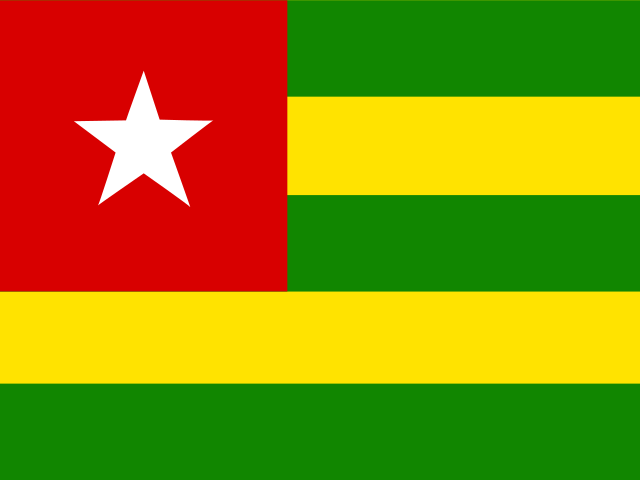
Five horizontal stripes alternating green and yellow, three green and two yellow, with a red square at the upper hoist bearing a white five-pointed star. The constitution no longer describes the flag, leaving the national emblem to statute, and the 1960 law that defines it fixes the design and assigns none of it a meaning. The colours do have official meanings, but they are published elsewhere by the state and the readings have changed over time: green for the land, its forests and its agriculture, yellow for faith and for the wealth of the subsoil, red for the resolve to defend liberty and later for the blood of the martyrs of independence, and the white star for peace as well as purity.
Togo FACTS ◢
| Capital | Lomé |
|---|---|
| Continent | Africa |
| Population | 8,591,626 (2025) |
| Area | 56,785 km² |
| Population density | 151/km² |
| Currency | West African CFA franc (XOF) |
| Official language | French |
| Calling code | +228 |
| Internet TLD | .tg |
| Time zone | UTC±00:00 |
| Drives on the | Right |
| ISO codes | TG / TGO |
DID YOU KNOW? ◢
- The country is a long, narrow strip stretching inland from a short Atlantic coast.
- Its capital, Lomé, sits right on the coast near the border with Ghana.
- Lake Togo and the surrounding region are a centre of traditional Vodun (voodoo) practice.
- Phosphate mining is one of its most important industries.
Togo QUICK ANSWERS ◢
What is the capital of Togo?
The capital of Togo is Lomé.
What is the population of Togo?
Togo had a population of 8,591,626 in 2025.
What currency does Togo use?
Togo uses the West African CFA franc (XOF).
What languages are spoken in Togo?
The official language of Togo is French.
Think you know your flags? Play Flag Daily → · Browse all countries →
MORE ON THE FLAG ◢
Togo's flag colours do have official meanings. They are just not where people look for them.
They are not in the constitution, and they are not in the flag law either. They are in the explanatory memorandum that the government attached to the bill creating the flag, printed in the Journal officiel on 25 April 1960, two days before independence. That memorandum says green is attachment to the soil, yellow is faith in bright tomorrows, red is the resolve to defend liberty, and the white star is purity of heart and the wish to live at peace with other nations.
The presidency of the republic publishes a second set of readings on its national symbols page, and they are not the same ones. Sixty-odd years apart, the same state has explained the same flag twice, and changed its mind about most of it.
Key Takeaways
- The 1960 colour meanings sit in the explanatory memorandum to the emblem bill, not in the enacted law and not in the constitution.
- The presidency's current gloss differs from the 1960 one on all four colours, while keeping the 1960 closing sentence almost word for word.
- The constitution promulgated on 6 May 2024 does not describe the flag at all: it leaves the national emblem to statute, so the operative description is a law from 1960.
- The flag created for the autonomous Togolese republic in 1956 carried the French tricolour in its upper hoist and two gold stars on a diagonal.
- A 1978 ordinance made the national flag the emblem of the ruling party as well, and no later text in the gazette's catalogue names the law it amended in its own title line, which is as deep as that search reaches for these instruments.
| Instrument | What it says about the flag | Meaning assigned |
|---|---|---|
| Loi 56-1, 18 September 1956, art. 1 | A green field with two gold stars on a diagonal from the upper right, the French flag in the upper left corner | None |
| Loi 60-11, 23 April 1960, art. 1 | Three green bands alternating with two yellow, a red square at the upper hoist bearing a white five-pointed star | None |
| Explanatory memorandum to the 1960 bill | Nothing prescriptive; it explains the bill | Green, yellow, red and the white star each glossed |
| Ordonnance 78-31, 27 July 1978, art. 1 | Adds one paragraph to the 1960 article, making the flag the emblem of the Rassemblement du Peuple Togolais as well | None |
| Constitution of 14 October 1992, art. 3 | Five horizontal bands alternating green and yellow, a white five-pointed star on a red square at the upper left | None for the flag; the coat of arms is glossed at length |
| Constitution of 6 May 2024, art. 3 | Nothing; the national emblem is a matter for statute | None |
| Presidency, national symbols page | Five parallel stripes, the first, third and fifth green; a red square with a white five-pointed star | Green, yellow, red and the white star each glossed |
The memorandum attached to the 1960 bill explained every colour
Togo's flag law was printed in a special issue of the Journal officiel de la République togolaise dated 25 April 1960. It runs the last articles of the independence constitution down its left column, then an EXPOSE des MOTIFS, then two short laws.
The memorandum opens by calling the bill "la consécration du choix librement exercé par la Nation", the ratification of a choice the nation had freely made. Then it takes the colours one at a time.
Green is "le vert, notre attachement à nos champs, au sol de notre patrie, terre nourricière toujours généreuse envers ses enfants dont elle ne manque jamais de récompenser les efforts": attachment to our fields, to the soil of our homeland, a nourishing earth always generous towards its children, which never fails to reward their efforts.
Yellow is "le jaune, notre foi en des lendemains clairs et radieux, et notre volonté d’y parvenir", our faith in clear and radiant tomorrows and our will to reach them. There is no mineral in that sentence, and no sun.
Red is "le rouge, l’inébranlable résolution de sauvegarder notre liberté, fut-ce au prix de notre sang", the unshakeable resolve to safeguard our liberty, even at the price of our blood. The emphasis falls on the resolve, not on blood already shed.
The star closes it: "l’étoile blanche enfin souligne la pureté de notre cœur et notre sincère désir de vivre en paix avec les autres nations", the white star underlines the purity of our heart and our sincere wish to live in peace with other nations. Purity and peace, in one clause, not purity alone.
The memorandum then ties the whole thing off: "Ces sentiments, ces idéaux, cette volonté sont exaltés dans l’hymne national et résumés dans la devise togolaise", these feelings, these ideals, this will are exalted in the national anthem and summarised in the Togolese motto.
Togo's presidency now reads the same flag differently
The presidency of the republic keeps a page of national symbols covering the flag, the coat of arms, the anthem and the motto. Its own structured data dates it to February 2020 and its last revision to February 2023, so the page predates the current constitution.
Its gloss is not the 1960 one.
Yellow keeps the faith and gains a mine: the yellow bands "représentent notre foi, mais aussi les ressources du sous-sol et marquent aussi notre maturité à faire face à un destin commun", representing our faith, but also the resources of the subsoil, and marking our maturity in facing a common destiny.
Green becomes economic: the green bands "constituent la forêt et l’agriculture qui est l’élément propulseur de notre économie, mais aussi l’espérance", the forest and agriculture as the driver of the economy, and hope as well.
Red turns retrospective. It "évoque le sang versé par les martyrs de l’indépendance et tous les compatriotes morts pour la démocratie et l’Etat de droit", the blood shed by the martyrs of independence and all compatriots who died for democracy and the rule of law. That second half cannot have been in a 1960 memorandum. It is a reading written after the events it names.
The star changes most of all, and changes owner. It "est comme un peu partout sur le continent africain le symbole de la paix, la lumière et l’intelligence", the symbol, as almost everywhere on the African continent, of peace, light and intelligence. Purity has gone, and the reading is now attributed to a continental convention rather than to anything Togolese.
What survives untouched is the frame. The presidency's paragraph ends "Ces sentiments et ces idéaux se trouvent exaltés dans l’hymne national et résumés dans la devise", which is almost the 1960 sentence: the clause about the national will is gone, the verb has changed, and togolaise has come off the motto. The closing line was kept and the readings that precede it on the page were swapped out.
The law prescribes a square, and it does count the star's points
Loi n° 60-11 of 23 April 1960 is four short articles. Its first defines the flag and says nothing about what any of it stands for.
The design is "le vert et le jaune disposés en bandes horizontales d’égale largeur, trois bandes vertes alternant avec deux bandes jaunes", green and yellow in horizontal bands of equal width, three green alternating with two yellow. So the stripe count is five and the greens are the odd ones, which is how the presidency's own page puts it when it says the first, third and fifth stripes from the top are green.
Then the corner: "au coin supérieur gauche figure un carré rouge ayant pour côté trois largeurs de bande et portant en son centre l’étoile blanche à cinq branches". A red square with a side of exactly three band widths, carrying the white five-pointed star at its centre.
Two things follow from that sentence. The canton is a square keyed to the stripe rather than a free-floating rectangle, and since the flag is five bands deep, its side is three fifths of the flag's height. And the star's five points are in the statute, so a description that counts them is reporting the law rather than adding to it.
The law says nothing about shades, nothing about proportions of the flag as a whole, and nothing about any other country's flag.
The red square is the element none of Togo's three neighbours carries. Ghana, to the west, flies red, gold and green with a black star on the middle band. Benin, to the east, flies green, yellow and red in a quite different arrangement. Burkina Faso, to the north, flies red over green with a yellow star. Red and green appear in all four. The square does not.
The 2024 constitution does not describe the flag at all
Togo's previous constitution, which the 2024 text refers to as "la Constitution du 14 octobre 1992 révisée", described the flag in its own text. Article 3 of that constitution, in the English translation published by the Comparative Constitutions Project, called the national emblem "the flag composed of five horizontal bands[,] alternated of green and yellow color" bearing, "on the superior left corner a white star of five points", on a square red field. The same article then went on to explain the coat of arms, including that "The two young lions represent the courage of the Togolese People".
That is the pattern worth noticing: the constitution glossed the arms and left the flag bare.
The constitution promulgated on 6 May 2024, which its own article 100 calls the fundamental law of the Fifth Republic, does not do either. The word drapeau does not appear anywhere in it. Article 3 of the 2024 text now reads: "Les dispositions définissant le sceau de l’Etat, les armoiries, l’emblème national et la langue officielle de la République togolaise sont du domaine de la loi", the provisions defining the seal of state, the coat of arms, the national emblem and the official language are matters for statute. Article 17 of the same constitution repeats that list among the subjects it reserves to the law.
That same article 3 of the 2024 text does keep two things in the constitution itself: "La fête nationale est célébrée le 27 avril de chaque année" and "L’hymne national est « Terre de nos aïeux »". The holiday and the anthem stayed. The flag was sent out to ordinary legislation.
Nothing was lost in the move. Article 99 of the 2024 constitution provides that "Toutes les lois, tous les décrets et arrêtés en vigueur demeurent dans le droit positif tant qu’il n’en a pas été disposé autrement", so the 1960 law survives, and it is now the whole of the flag's legal description.
The flag of the autonomous republic flew the French tricolour in its corner
The flag this one replaced is the more surprising of the two.
Togo became an autonomous republic on 30 August 1956, and nineteen days later its legislative assembly gave it emblems. Loi n° 56-1 of 18 September 1956 says its purpose is to mark that political promotion by giving Togo "d’un emblême, d’une devise et d’un hymne national".
Article 1 of that law describes the result: "L’emblême officiel de la République Autonome du Togo est un drapeau à fond vert comportant deux étoiles d’or placées sur une diagonale partant de l’angle supérieur droit, le drapeau français placé à l’angle supérieur gauche." A green field, two gold stars on a diagonal running from the upper right, and the French flag in the upper left.
Note the legal word for the stars. In 1956 they were "d’or", gold. In 1960 the bands are "jaunes", yellow, and the star is "blanche", white. The gazette distinguishes the two words, so a description that calls the modern bands gold is not following the law.
The rest of that 1956 package went too. The motto was « UNION - ORDRE - TRAVAIL », the anthem « LA TOGOLAISE », and the national day 30 August. Nine months later, Loi n° 57-32 of 4 July 1957 moved the holiday, to "Le 28 octobre, date anniversaire du Referendum par lequel le Peuple Togolais a ratifié le Statut du Togo". Two national days in four years, and then 27 April, which is the one that stayed: the 1960 law makes it the date the flag law takes effect, and the constitution still names it the national holiday.
That emblem was contested on the ground. The same 1957 gazette carries a written commendation to a trainee guard, Cudjoe Alfred, with a two thousand franc gratuity, for having "participé activement à la défense de l’emblème national Togolais qu’un commando antigouvernemental voulait lapider" on 31 May: taking part in the defence of the Togolese national emblem, which an anti-government commando wanted to stone. The gazette does not say what was defended, only that it was the national emblem. The law then in force defined the national emblem as that flag, so that is most likely what the commando went for.
The 1960 memorandum disposes of all of it in one sentence: the 1956 law, it says, "loi qui n’était pas celle d’un Etat souverain ne peut qu’être abrogée", a law that was not that of a sovereign state can only be repealed.
In 1978 the flag became the ruling party's emblem as well
Something happened to the flag's status that its design does not record.
Ordonnance n° 78-31 of 27 July 1978, signed by Gnassingbé Eyadéma, amends the 1960 law. Its preamble cites a recommendation of 9 May 1978 from the second national council of the Rassemblement du Peuple Togolais, and names the bureau politique alongside the council of ministers as having been heard. Its first article adds a paragraph to the article that defines the flag: "Le drapeau togolais devient cumulativement emblème national du Rassemblement du Peuple Togolais (RPT)." The Togolese flag becomes, cumulatively, the national emblem of the RPT.
Calling the RPT the ruling party is an inference, though a short one. The recommendation is that party's own national council's, and the bureau politique heard beside the council of ministers is on any reading the party's. The presidency's own page, explaining what became of the national anthem, dates its replacement to 1979, by then "sous le régime à parti unique", under the single-party regime.
The same ordinance replaces the motto. Where Loi 60-11 had « Travail-Liberté-Patrie », the ordinance's article 2 substitutes « PAIX - UNION - SOLIDARITE ».
The motto came back. Both the 1992 and the 2024 constitutions give the republic's motto as Travail-Liberté-Patrie in one spelling or another, so the 1978 substitution did not survive.
The flag paragraph is harder to trace, and the tracing has a limit worth stating. The Journal officiel runs a catalogue of official texts with a search box, but its record for each of the old instruments in this chain is a title line and a link to the page scan, not the text: search it for cumulativement, the operative word of the 1978 amendment, and the 1978 ordinance does not come back. Search it for carré rouge, the wording the 1960 law's article 1 uses for the canton, and the 1960 law does not come back either. So for these instruments the search reaches titles only.
Within that limit it says something. Searched for the number of the law the ordinance amends, the catalogue returns exactly one record, the ordinance itself, whose title names Loi n° 60-11. No other record in it names that law in its title. The catalogue also numbers these texts with a padded zero, as 60-011 and 78-031, and searching for either padded number returns nothing at all. It keeps each text's own number in a field of its own and searches only the rest of the title, which is why the 1960 law's record does not come back for its own number in either spelling, and why the single hit for 60-11 is the 1978 ordinance naming the older law inside its title. So no record names the 1960 law in that spelling in its title line either.
What the catalogue does return from later years are texts that touch the flag without touching the party clause. The penal code of 2015 punishes outrage to the flag. The constitution of 2024 sends the national emblem to statute. Neither says anything about the Rassemblement du Peuple Togolais, though the two negatives rest on evidence of different quality: the constitution has a clean text layer and the penal code an imperfect one. What became of the party after 1978 is outside what any of these instruments shows.
Who designed Togo's flag?
The presidency names the designer without hedging: "Le drapeau togolais a été dessiné par le Professeur d’art Ahyi Paul", the Togolese flag was drawn by the art professor Paul Ahyi, and adopted as the emblem of the Togolese state on the day of independence, 27 April 1960.
Ahyi was a painter and sculptor who trained at the École nationale supérieure des Beaux-Arts in Paris. In September 2009 UNESCO named him an Artist for Peace. He died in Lomé on 4 January 2010, and UN News, reporting the tribute UNESCO's director-general paid him that week, listed among his achievements that "he designed the Togolese national flag and contributed to the Independence Monument erected at the heart of Lome".
The attribution rests on the Togolese presidency and on a United Nations news report of a UNESCO tribute, which are independent of each other but are not the same kind of thing: the second is a report about a tribute rather than the tribute. What neither of them describes is the process. The 1960 memorandum says the design ratified a choice freely made by the nation, and the presidency's page mentions, for the anthem, a consultative commission for the study of proposed national emblems and anthems chaired by Dr Rudolph Comlan Trénou. No published source reachable for this article sets out how many designs that commission saw, or what the rejected ones looked like.
Flag Daily shows one flag and gives three guesses at the country, and on this one the square canton is the detail to look for.
Insulting the flag is still a criminal offence
The second law printed beside the flag law in 1960 was about protecting it. Loi n° 60-12 of 23 April 1960 punished "L’outrage ou l’injure envers le drapeau togolais" in any form, spoken, written or by any gesture, with three months to a year in prison and a fine of ten thousand to ten million francs, or with either of the two on its own. Its second article notes that it was itself replacing an earlier provision, the single article of Loi n° 57-11 of 28 March 1957.
The offence is still on the books, in softer form. Togo's penal code of 24 November 2015 defines it at article 490: "Constituent des outrages au drapeau ou à l’hymne national, tous actes, paroles ou gestes de nature à porter atteinte au respect et à l’honneur qui leur sont dus", any act, word or gesture apt to injure the respect and honour due to them.
Article 491 of the same code sets the penalty as a fine alone, of fifty thousand to two hundred thousand CFA francs. Prison returns where the offence is committed "en réunion", in a group, which article 492 punishes with one to six months and a heavier fine.
That is a real change of posture across fifty-five years, from a prison term of three months to a year, with or without a fine, to a fine alone unless the offence is committed in company. It happened in a criminal code rather than in anything called a flag law.
Frequently asked questions
What do the colours of the Togo flag mean?
Officially, green is attachment to the soil of the homeland, yellow is faith in bright tomorrows, red is the resolve to safeguard liberty even at the cost of blood, and the white star is purity of heart and the wish to live at peace with other nations. Those readings come from the explanatory memorandum to the bill that created the flag, published in the Journal officiel on 25 April 1960, and the presidency of the republic now publishes a different set, reading yellow for the subsoil and the star for peace, light and intelligence.
The presidency's page reads the other two colours differently as well: forest, agriculture and hope for green, and the blood of the martyrs of independence for red.
Does Togo's constitution say what the flag looks like?
Not any more. The constitution promulgated on 6 May 2024 does not use the word drapeau at all. Its article 3 says the provisions defining the seal of state, the coat of arms, the national emblem and the official language are matters for statute, and article 17 repeats that among the subjects reserved to the law.
The 1992 constitution did describe the flag, in the same article 3 that explained the coat of arms. Since 2024 the operative description is Loi n° 60-11 of 23 April 1960, which article 99 of the new constitution leaves in force.
Who designed the flag of Togo?
Paul Ahyi, a Togolese artist and art professor trained at the École nationale supérieure des Beaux-Arts in Paris. The presidency of the republic names him on its national symbols page, and UN News, reporting UNESCO's tribute after his death on 4 January 2010, listed the Togolese national flag among his works.
Neither source describes the selection process. The 1960 explanatory memorandum says only that the bill ratified a choice freely made by the nation.
Why does the Togo flag have five stripes and a star?
Loi n° 60-11 of 23 April 1960 prescribes three green bands alternating with two yellow, all of equal width, which is what makes five. It puts a red square in the upper hoist whose side is exactly three band widths, with a white five-pointed star at its centre.
The law gives the geometry and no reasons. It does not explain why five rather than three, and it does not mention any other country's flag.
Is it illegal to insult the flag in Togo?
Yes. Article 490 of the penal code of 24 November 2015 defines outrage to the flag or the national anthem as any act, word or gesture apt to injure the respect and honour due to them, and article 491 punishes it with a fine of fifty thousand to two hundred thousand CFA francs.
Imprisonment of one to six months applies under article 492 where the offence is committed in a group. The 1960 flag-protection law had been harsher: three months to a year in prison and a fine, or either of those on its own.
Sources
- Journal officiel de la République togolaise, numéro spécial, 25 avril 1960, page 3: Exposé des motifs, Loi n° 60-11 du 23 avril 1960 définissant l'Emblème National, l'Hymne National et la Devise de la République togolaise and Loi n° 60-12 du 23 avril 1960 protégeant le drapeau togolais. Page scan with no text layer, transcribed for this article. The imprisonment minimum in Loi n° 60-12 art. 1 is read from the letterpress digit - retrieved 27 August 2026.
- Assemblée nationale, Loi n° 2024-005 du 6 mai 2024 portant Constitution de la République togolaise, Journal officiel, 69e année n° 42 bis, 6 mai 2024 - retrieved 27 August 2026.
- Présidence de la République togolaise, Les symboles de la république Togolaise - retrieved 27 August 2026.
- Journal officiel de la République autonome du Togo, 16 octobre 1956, page 7: Loi n° 56-1 du 18 septembre 1956 portant création d'un emblême national, d'une devise nationale, d'un hymne national et fixation d'un jour de fête nationale - retrieved 27 August 2026.
- Journal officiel de la République autonome du Togo, 1er août 1957, pages 502 to 503 and 523: Loi n° 57-32 du 4 juillet 1957 and the Ministry of the Interior commendation of 8 July 1957. Read from the scan of the whole issue, because the catalogue's separate record for the law carries a title line and a link to a page extract that returns a 404, checked 30 August 2026. The law's printed heading reads 1 juillet while its signature block and the gazette's own index both give 4 July - retrieved 27 August 2026.
- Ordonnance n° 78-31 du 27 juillet 1978 modifiant et complétant la loi n° 60-11, catalogued as 78-031, Journal officiel, 31 juillet 1978, page 2 - retrieved 27 August 2026.
- Loi n° 2015-010 du 24 novembre 2015 portant nouveau code pénal, articles 490 to 492, Journal officiel, 60e année n° 30, 24 novembre 2015 - retrieved 27 August 2026.
- Comparative Constitutions Project, Togo's Constitution of 1992 with Amendments through 2007, English translation - retrieved 27 August 2026. Quoted as a translation. The French original of article 3 could not be opened for this article: the National Assembly's own site answers a security challenge, and the Internet Archive was not serving captures while this was written.
- UN News, UNESCO honours late Togolese Artist for Peace, 7 January 2010 - retrieved 27 August 2026.
- Journal officiel de la République togolaise, catalogue of official texts, searched 27 August 2026 except where noted:
60-11(1 record, the 1978 ordinance),emblème national(32 records),drapeau(23 records),cumulativement(24 records, none of them the 1978 ordinance),carré rouge(3 records, none of them the 1960 law), and the two padded numbers the catalogue itself uses,60-011(no records) and78-031(no records, searched 30 August 2026). Searching for an operative phrase is how the depth of the index was established. Searching for the number each record is headed with is how the reach of the number field was.
PLAY ANOTHER →
Three clues, three guesses. Work out where in the world it is.
THREE CLUESDAILYDaily CodeA short message, hidden in a different cipher every day.
ONE CIPHER A DAYDAILYDaily CryptogramOne quote, one scrambled alphabet. Crack it before tomorrow.
CRACK THE QUOTEDAILYDaily TriviaFive questions a day. Everyone gets the same five.
FIVE QUESTIONS