
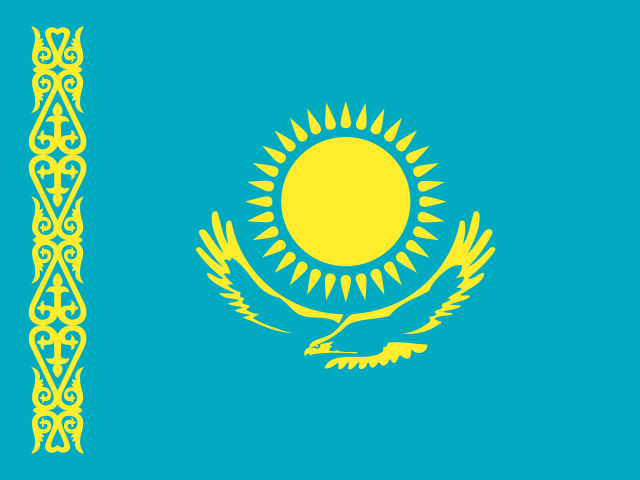
Kazakhstan
The world's largest landlocked country, Kazakhstan sprawls across the steppe from Europe into Asia and launches the world's rockets from the plains of Baikonur.
WHAT THE FLAG MEANS ◢
A sky-blue field with a golden sun and its rays at the centre, a soaring golden eagle beneath it, and a vertical band of golden national ornament at the hoist. Article 1 of the Constitutional Law on State Symbols prescribes exactly that: it fixes the field as sky blue, the sun, rays, eagle and ornament as gold and the ratio of width to length at one to two. It gives none of them a meaning, counts no rays and names neither the eagle's species nor the ornament's pattern. A later article sends every flag, whatever its size, to a national technical standard, which dimensions the eagle and the ornament. The readings of the blue as sky and unity, the sun as life and abundance and the eagle as freedom and power are published by state bodies rather than fixed by the law.
Kazakhstan FACTS ◢
| Capital | Astana |
|---|---|
| Continent | Asia, Europe |
| Population | 20,843,754 (2025) |
| Area | 2,724,900 km² |
| Population density | 8/km² |
| Currency | Kazakhstani tenge (KZT) |
| Official languages | Kazakh, Russian |
| Calling code | +7 |
| Internet TLD | .kz |
| Time zone | UTC+05:00 |
| Drives on the | Right |
| ISO codes | KZ / KAZ |
DID YOU KNOW? ◢
- It is the largest landlocked country in the world, bigger than all of Western Europe.
- The Baikonur Cosmodrome, on Kazakh soil, is the world's oldest and largest space launch site.
- The first human spaceflight, carrying Yuri Gagarin, launched from Baikonur in 1961.
- The apple is thought to have originated in the wild forests of Kazakhstan.
- Its capital was renamed and rebuilt as a purpose-built city on the northern steppe.
Kazakhstan QUICK ANSWERS ◢
What is the capital of Kazakhstan?
The capital of Kazakhstan is Astana.
What is the population of Kazakhstan?
Kazakhstan had a population of 20,843,754 in 2025.
What currency does Kazakhstan use?
Kazakhstan uses the Kazakhstani tenge (KZT).
What languages are spoken in Kazakhstan?
The official languages of Kazakhstan are Kazakh and Russian.
Think you know your flags? Play Flag Daily → · Browse all countries →
MORE ON THE FLAG ◢
Ask how many rays the sun on Kazakhstan's flag has, and the number that comes back is 32. Look for a Kazakh law that says so and there is not one.
The Constitutional Law of the Republic of Kazakhstan on State Symbols, no. 258-III of 4 June 2007, describes the flag's design in four sentences. It gives the field a colour, the sun rays without counting them, the eagle a posture without a species, and the ornament a position without a name. Its Article 3 then approves an official picture of the flag as an appendix, which settles the appearance by depiction and states no figure at all.
What no part of the law ever gives is a measurement. Those go to a technical standard: a 60-page document written by the state's own standards institute, classified alongside textile fabrics, and sold as a watermarked PDF for 7,444 tenge. Kazakhstan publishes its flag's appearance for nothing, as four sentences and a 265-pixel-wide JPEG, and sells the dimensions separately.
Key Takeaways
- Article 1 of the 2007 Constitutional Law on State Symbols prescribes the flag's design in four sentences: a sky-blue rectangle, a gold sun with rays at the centre, a gold soaring eagle beneath it, a gold national ornament as a vertical stripe at the staff, and a width-to-length ratio of 1:2. Article 3 then approves the flag's image as Appendix 1, so the design is fixed by picture as well as in words.
- Article 4(3) of the same law requires the flag, whatever its size, to conform to the national standard. The standard is СТ РК 988-2007, 60 pages, in Kazakh and Russian, sold by the institute that wrote it.
- Three of СТ РК 988-2007's four mandatory annexes are dimensioned drawings: the elements of the soaring eagle, the national ornament, and the finial on the staff.
- A flag that fails the standard is replaced within one working day and destroyed: by burning, melting, shredding into pieces no larger than 2.5 square centimetres, crushing, or reduction to a shapeless mass or powder.
- The 32 rays, the steppe eagle and the ornament's name come from state publications rather than from the flag laws themselves, and those publications use steppe eagle and berkut as interchangeable words rather than naming a species.
| Instrument | Date | What it settles about the flag | What it leaves to something else |
|---|---|---|---|
| Resolution of the Supreme Soviet bringing the Flag Law into force | 4 June 1992, repealed 1996 | Nothing of the design; it directs the Cabinet to arrange the flag's manufacture and the safekeeping of its reference copy | The design itself, to the Law it brings into force |
| Cabinet of Ministers Resolution no. 981 | 24 November 1992, repealed 2005 | The reference flag: blue cloth, 1 m by 2 m, kept in a case in the Residence of the President | Everything else, to the Law |
| Instrument no. 2797 on State Symbols, a presidential decree until 2006 and a constitutional law after it | 24 January 1996, repealed 2007 | The design in words, and conformity measured against that reference flag | Nothing to a standard; the word стандарт does not appear in it |
| Constitutional Law no. 258-III on State Symbols | 4 June 2007 | The design in four sentences and in an image approved as Appendix 1, with conformity measured against the national standard | The dimensions, to СТ РК 988-2007 |
| СТ РК 988-2007, State Flag of the Republic of Kazakhstan. General technical conditions | Brought in by order no. 578 of 19 October 2007 | Manufacturing requirements, and dimensioned drawings of the eagle, the ornament and the finial | Meaning, which no instrument in this table supplies |
| Rules on replacement and destruction, Minister of Culture and Sport order no. 137 | 8 June 2023 | What counts as non-conformity, and how a failed flag is destroyed | The measurements themselves, to the standard |
Where Kazakhstan's flag is prescribed, and where it is dimensioned
Article 1 is not the whole of the 2007 Constitutional Law's description, and this is the half most accounts leave out. Article 3 of the same law opens "Утвердить: 1) изображение Государственного Флага Республики Казахстан (приложение 1 к настоящему Конституционному закону)" - approve the image of the State Flag of the Republic of Kazakhstan, Appendix 1 to this Constitutional Law.
That appendix is published with the law on Adilet and costs nothing to open. It is a JPEG, 265 pixels wide by 158 high and under seven kilobytes. So the appearance of the flag is prescribed twice over and free both times: in four sentences of Kazakh and Russian, and in an official picture. A picture cannot state a figure. It depicts the rays rather than counting them, and it fixes no dimension that could be scaled up to a flag on a building.
That is what Article 4 is for.
Article 4(3) of the 2007 Constitutional Law runs to four sentences, and it opens with the one that is the hinge of the whole scheme: "Государственный Флаг независимо от его размеров должен соответствовать национальному стандарту." The State Flag, regardless of its dimensions, must conform to the national standard.
The second sentence of that clause says what happens if it does not: the flag "подлежит замене и уничтожению", is subject to replacement and destruction.
Article 11 of the same law says who writes the standard. Its first paragraph gives the authorised body in the field of technical regulation and metrology the job of "разрабатывает и утверждает национальные стандарты Государственного Флага и Государственного Герба Республики Казахстан" - developing and approving the national standards for the State Flag and the State Emblem. The same paragraph makes that body responsible for producing the reference copies, and for licensing the manufacture of flags.
So the constitutional law fixes what the flag looks like in the loosest possible terms and hands the binding detail to a standards agency. The document it hands it to has a name and a price.
The register kept by KazStandart, the Kazakhstan Institute of Standardisation and Certification, lists it as СТ РК 988-2007, "Государственный флаг Республики Казахстан. Общие технические условия" - State Flag of the Republic of Kazakhstan, General technical conditions. Status: in force. Sixty pages. Kazakh and Russian. Developed by the institute itself. Introduced by order no. 578 of the Chairman of the Committee for Technical Regulation and Metrology on 19 October 2007. It replaces an earlier standard, 988-1996. Price: 7,444 tenge, VAT included, delivered as a watermarked PDF.
The record is inconsistent with itself in small ways, and those are worth reporting rather than resolving. It gives 1 January 2005 as both the registration date and the date it took effect, which the introducing order of 19 October 2007 does not match. The page names the developer as the Kazakhstan Institute of Standardisation and Certification in the record and as the Kazakhstan Institute of Standardisation and Metrology in its own footer. And the Paragraf database files the same document as СТ РК 988-2008 (988-2007), where the standards body's catalogue says only 988-2007.
What СТ РК 988-2007 contains, as far as it can be read for free
The full text sits behind that 7,444-tenge price. The Kazakh legal database Paragraf publishes the opening of the standard as a free demonstration extract, cutting off at the end of section 2 and before section 3, which is enough to establish the shape of the thing.
Its scope covers the flag and any material object bearing the flag's image or elements of its symbolism, and it ends with a sentence that reads oddly for a textiles document: "Выполнение требований настоящего стандарта обеспечивает защиту интересов национальной безопасности Республики Казахстан." Meeting the requirements of this standard protects the national security interests of the Republic of Kazakhstan.
The contents list four mandatory annexes. The first gives a schematic drawing of the flag with letter designations for its elements. The second is "Схематическое изображение и основные размеры элементов парящего орла" - a schematic drawing with the principal dimensions of the elements of the soaring eagle. The third does the same for the national ornament, and the fourth for the finial on the staff.
Section 2 lists what the standard borrows from, and every item is a textile or light-industry specification: methods for measuring linear dimensions and surface density, methods for tensile strength, sewing thread, packaging and transport, and two colour-fastness tests - one for dry cleaning, one for sea water. The state's own catalogue files the standard under МКС 59.080.30. In ISO's International Classification for Standards, which that number comes from, field 59 is "Textile and leather technology" and 59.080.30 is "Textile fabrics", "Including nonwovens, felts, lace, etc."
That is the vocabulary the flag's measurements are finally settled in. Not heraldry, and not constitutional drafting. Cloth, thread and fastness to sea water.
One state description of what the two symbol standards do exists outside the paywall. A chief specialist of the Committee for Technical Regulation and Metrology's West Kazakhstan department told the regional outlet Zhaiyq Press that the standards "устанавливают размеры, пропорции, цвета и другие параметры", set the dimensions, proportions, colours and other parameters that must be observed when the state symbols are made. That is a second state source for what СТ РК 988-2007 settles, independent of its own contents list.
The 1996 instrument pointed at an object. The 2007 law points at a document
This was not always the arrangement, and the change is easy to miss because both versions use the same word for the reference flag.
Under the 1996 instrument on State Symbols, no. 2797, Article 4 described the flag in almost the same words and then measured conformity against a thing rather than a text. Flags and images of the flag, whatever their size, had to "в точности соответствовать цветному и схематическому изображениям эталона Государственного флага Республики Казахстан, хранящегося в Резиденции Президента Республики Казахстан" - correspond exactly to the colour and schematic representations of the reference State Flag kept in the Residence of the President. The word стандарт appears nowhere in it.
Its own form changed en route: the 1992 resolution's repeal note names no. 2797 as a decree of the President, and an Adilet footnote records that "В форму акта и заголовок внесены изменения", the form of the act and its title were amended, by a constitutional law of 7 January 2006. The 2007 law then repeals it as a constitutional law.
The object it points at was specified four years earlier. Resolution no. 981 of the Cabinet of Ministers, of 24 November 1992, says: "Эталон Государственного флага Республики Казахстан изготовляется из ткани голубого цвета, размером 1м х 2м и хранится в Резиденции Президента Республики Казахстан в футляре вместе с эталоном Государственного герба Республики Казахстан." The reference flag is made of blue cloth, one metre by two, and kept in the Residence of the President in a case, together with the reference emblem. That resolution was repealed on 3 August 2005 by Government resolution no. 810, so the one-by-two-metre figure records what the reference flag was rather than a rule still in force.
The 2007 law keeps the object and demotes it. Its Article 1 still ends "Эталоны Государственного Флага и Государственного Герба Республики Казахстан хранятся в Резиденции Президента Республики Казахстан", the reference flag and emblem are kept in the Residence of the President. But Article 4(3) of the 2007 law now measures a flag against the standard, not against the object, and Article 11 makes the metrology body responsible for producing reference copies that themselves conform to the national standards. The artefact used to be the authority. Now it is an output of one.
There is a smaller wrinkle in the same direction. A note at the head of the consolidated 2007 text records that a constitutional law of 28 June 2012 replaced "государственные стандарты", state standards, with "национальные стандарты", national standards, throughout, in every grammatical form the text used. The delegation did not change. Only the name of the thing it delegates to did.
What happens to a Kazakhstan flag that fails the standard
The 2007 law says a non-conforming flag is replaced and destroyed in a manner set by the authorised body. The rules in force were approved by the Minister of Culture and Sport as order no. 137 of 8 June 2023, registered with the Ministry of Justice on 20 June 2023.
Those rules define the failure first. Paragraph 3: "Несоответствиями национальным стандартам являются нарушения формы, размеров и технических требований" - non-conformities with the national standards are breaches of the form, the dimensions and the technical requirements established for the State Flag and the State Emblem. Paragraph 2 puts the job in the hands of a standing commission at the state body or organisation obliged to display the flag, and paragraph 4 hands it to the building's owner where the flag is flown by choice rather than by obligation.
Paragraph 5 gives the deadline. Replacement happens within one working day.
Paragraph 6 gives the method, and it is unusually specific for a symbolic act. Destruction is by burning, melting, crushing, reduction to a shapeless mass or powder, or "измельчения на кусочки размером не более 2,5 квадратных сантиметра", shredding into pieces no larger than 2.5 square centimetres, so that reuse is impossible. The same wording stood in the Government rules approved on 1 October 2007 and revised in 2012, which were repealed in October 2023.
A flag whose sun is drawn a little wrong is not a flag with a design flaw. It is a flag with one working day left.
No Kazakh flag law names the bird, and the state's own pages use two names
The Russian text of the 2007 law says "парящий орел", a soaring eagle, and stops there. The Kazakh text, equally official, says "ортасында шұғылалы күн, оның астында қалықтап ұшқан қыран бейнеленген тік бұрышты көгілдір түсті мата" - a rectangular sky-blue cloth bearing a radiant sun at the centre with a soaring қыран beneath it. The law's later sentence, "Күн, оның шұғыласы, қыран және ұлттық өрнек бейнесі алтын түстес", uses қыран again and never narrows it.
Neither text uses a species word at any point. The Russian has no беркут and no степной, steppe. The Kazakh has no бүркіт.
Two state bodies do supply a name, and their usage is looser than it first looks.
The website of the President of the Republic, Akorda, writes the design out as "парящий орел (беркут)" - a soaring eagle, in parentheses a berkut, the golden eagle.
The National Bank of Kazakhstan, on its own state symbols page, writes "солнца с 32-мя лучами, под которыми - парящий степной орел" - a sun with 32 rays, beneath them a soaring steppe eagle. Its page is the only official one opened for this article that puts a number on the rays.
That looks like two institutions naming two different birds, and the National Bank's own page dissolves it a few paragraphs further down. Turning to symbolism, the same page writes "В миропонимании кочевников особое место занимает степной орел или беркут" - in the worldview of the nomads a special place is held by the steppe eagle or berkut - setting the two names side by side as alternatives for one figure. Kazinform's report of a 2021 commemoration quotes a speaker on "свободно парящего степного орла" while Akorda's parenthesis says berkut, so the state's writing mixes the two terms rather than splitting into camps.
So the honest finding is not that officials disagree about the species. It is that neither flag law names one, and the descriptive pages that do supply a word treat steppe eagle and berkut as interchangeable. An English reference that prints steppe eagle as though it were a designation is repeating a description.
The National Bank's page is also the only one of those opened that names the ornament. It calls the pattern at the staff кошкар-муйз - бараньи рога, the ram's horns. No law of Kazakhstan uses that name.
Who assigns the meanings, since the flag laws do not
Neither the 1996 instrument nor the 2007 law assigns the colours or devices any meaning at all. Kazakh state bodies publish meanings anyway, and the interesting part is that they say where they are getting them.
Akorda introduces its reading with a disclaimer of authorship: "В традициях геральдики каждый цвет символизирует определенное понятие." In the traditions of heraldry, each colour symbolises a particular idea. Sky blue, on that reading, stands for honesty, fidelity and faultlessness, and carries a second, Turkic layer: the ancient Turks revered the sky as a father-god and their sky-blue banner signified loyalty to that forebear. On the flag it stands for a clear sky, peace and wellbeing, with the single-colour field standing for the country's unity.
For the sun, Akorda again names its authority before its conclusion: "Исходя из геральдических канонов, солнце символизирует богатство и изобилие, жизнь и энергию." Proceeding from heraldic canons, the sun symbolises wealth and abundance, life and energy. It adds a design observation that no law contains: "лучи солнца на флаге страны имеют форму зерна", the sun's rays on the country's flag are shaped like a grain.
Kazinform, the state news agency, reaches for the same elements and lands somewhere else: the sun as a sign of peace, the eagle as the symbol of a freedom-loving people, blue as the colour of sky, calm and highest justice, gold as abundance, wealth and happiness.
A third version came from a chief specialist in the West Kazakhstan department of the Committee for Technical Regulation and Metrology, speaking to the regional outlet Zhaiyq Press for Kazakhstan's Day of State Symbols in 2023. She described the flag as "синего полотнища с изображением желтого солнца в центре", a blue cloth with a yellow sun at the centre, and read blue as sky and national oneness, the yellow of the sun as wealth and prosperity, and the ornament stripe as national identity. Article 1 of the 2007 law calls the field голубого цвета, light blue, and the devices цвета золота, gold. This is one departmental inspector rather than the Committee, but it is the Committee's own field service using синий and желтый for a flag its standard governs.
So the meanings are real, published, and official in the sense that officials publish them. They are simply not the law's, and the state's own pages do not converge on one version. That divergence is the reason an answer that sounds settled is worth checking against the state that flies the flag. If you want to test what you actually remember of a flag rather than what you have read about it, Flag Daily shows one flag a day and gives you three guesses at the country.
Who designed Kazakhstan's flag, and what the 1992 papers record
Akorda names the author: the artist Shaken Niyazbekov, an Honoured Worker of Arts of Kazakhstan. Kazinform reports that he was born on 12 October 1938 in the village of Beszhyldyk in Zhambyl Region, trained at the Vera Mukhina Higher School of Art and Industry in Leningrad, served as chief artist of Almaty from 1969, and won the flag competition "среди более 1 200 художников из разных стран мира", among more than 1,200 artists from various countries of the world.
The competition itself leaves a trace in the statute book, which is rarer than it sounds. The Resolution of the Supreme Soviet of 4 June 1992 bringing the Flag Law into force runs to six numbered points, and three of them are worth reading. It transfers the flag of the Kazakh SSR to the State Museum of the Republic of Kazakhstan for permanent keeping. It instructs the Cabinet to arrange the manufacture of the new flag and the safekeeping of its reference copy. And it directs the working group on the new state symbols, together with the Ministry of Press and Mass Information, to prepare and publish an "иллюстрированный сборник проектов Государственного флага, поступивших на конкурс", an illustrated collection of the State Flag designs submitted to the competition.
A declared gap: the 1992 Law on the State Flag of the Republic of Kazakhstan itself is not in Adilet, the Ministry of Justice's legal information system. A full-text search on its title returns 39 documents across four pages, and a search restricted to 1992 returns three; all four pages and the restricted search were saved, and the Supreme Soviet resolution that brought the law into force and the Cabinet resolution that gave it effect are there while the law's own text is not. Its wording could not be compared with the 1996 and 2007 versions for this article.
The text of СТ РК 988-2007 could not be read either, beyond the free extract. Where this article says the standard sets the eagle's dimensions, that rests on its published contents list and on the metrology inspector's public description of it, rather than on the drawings themselves.
If you want to see how differently other states handle the same problem, the country factsheets set each flag beside the law that prescribes it.
Frequently asked questions
How many rays are on the Kazakhstan flag?
No Kazakh law states a number. The 2007 Constitutional Law on State Symbols and the 1996 instrument it replaced both say only that the flag bears a sun with rays. The rays are prescribed all the same, by picture: Article 3 of the 2007 law approves the flag's image as Appendix 1, so they are fixed by depiction even though no clause states a number; Adilet publishes that appendix free beside the text, as a 265-pixel-wide JPEG. The figure of 32 also appears on a state page, the National Bank of Kazakhstan's own state symbols page. The written measurements sit in the national standard СТ РК 988-2007, which is sold rather than published.
What kind of eagle is on the flag of Kazakhstan?
The law does not say. The Russian text of the 2007 Constitutional Law says only a soaring eagle and the Kazakh text says қыран, and neither беркут nor степной appears in either. State pages that do supply a name are not consistent: the President's website writes berkut, the golden eagle, the National Bank of Kazakhstan writes steppe eagle, and the National Bank's own page then sets the two side by side as alternatives for the same bird. None of them is the statute, and none is a species designation.
What do the colours of the Kazakhstan flag mean?
Officially, nothing, in the sense that neither of the flag laws that prescribe the design assigns them a meaning. The President's website supplies a reading and attributes it to heraldic tradition rather than to law: sky blue for honesty, fidelity and faultlessness, and for a clear sky, peace and wellbeing, with the unbroken field standing for national unity; the sun for wealth, abundance, life and energy. The state news agency Kazinform and a regional metrology inspector have each published different versions.
Who designed the flag of Kazakhstan?
The artist Shaken Niyazbekov, named as the author on the official website of the President of Kazakhstan. He was born in 1938 in Zhambyl Region and worked as chief artist of Almaty. The Supreme Soviet resolution that brought the 1992 Flag Law into force records that the design came out of a competition, and ordered an illustrated collection of the submitted entries to be published.
What happens to a Kazakhstan flag that does not meet the standard?
It is replaced within one working day and destroyed. Rules approved by the Minister of Culture and Sport on 8 June 2023 define non-conformity as a breach of the form, dimensions or technical requirements set for the flag, and prescribe destruction by burning, melting, shredding into pieces no larger than 2.5 square centimetres, crushing, or reduction to a shapeless mass or powder, so that the flag cannot be reused.
Sources
- Ministry of Justice of the Republic of Kazakhstan, Adilet legal information system, Constitutional Law of the Republic of Kazakhstan on State Symbols of the Republic of Kazakhstan, no. 258-III of 4 June 2007, Russian and Kazakh texts, articles 1, 3, 4 and 11, and Appendix 1, the approved image of the flag, published with the Kazakh text - retrieved 26 August 2026.
- Adilet, Constitutional Law of the Republic of Kazakhstan on State Symbols, no. 2797 of 24 January 1996, repealed, article 4 - retrieved 26 August 2026.
- Adilet, Resolution of the Supreme Soviet of the Republic of Kazakhstan of 4 June 1992 on bringing into force the Law on the State Flag of the Republic of Kazakhstan - retrieved 26 August 2026.
- Adilet, Resolution of the Cabinet of Ministers of the Republic of Kazakhstan no. 981 of 24 November 1992 on giving effect to the Law on the State Flag, paragraph 2 - retrieved 26 August 2026.
- Adilet, Order of the Minister of Culture and Sport no. 137 of 8 June 2023 approving the Rules on the replacement and destruction of the State Flag and State Emblem that do not conform to the national standards, paragraphs 2 to 6 - retrieved 26 August 2026.
- KazStandart, Kazakhstan Institute of Standardisation and Certification, standards catalogue record for СТ РК 988-2007, State Flag of the Republic of Kazakhstan. General technical conditions - retrieved 26 August 2026.
- Paragraf legal information system, free demonstration extract of СТ РК 988-2008 (988-2007), State Flag of the Republic of Kazakhstan. General technical conditions, sections 1 and 2 and the contents list - retrieved 26 August 2026.
- Official website of the President of the Republic of Kazakhstan, Flag of the Republic of Kazakhstan and On the state symbols - retrieved 26 August 2026.
- International Organization for Standardization, ICS 59, Textile and leather technology and ICS 59.080.30, Textile fabrics - both read from Internet Archive captures, of 22 June 2026 and 21 June 2025, saved as
src-iso-ics-59-wayback.htmlandsrc-iso-ics-59-080-30-wayback.html, the live pages answering a security challenge to a plain request - retrieved 26 August 2026. - National Bank of Kazakhstan, State symbols - retrieved 26 August 2026.
- Kazinform national news agency, Zhambyl villagers honour the memory of Shaken Niyazbekov, author of the Kazakh flag, 20 December 2021 - retrieved 26 August 2026.
- Zhaiyq Press, Standards of the state symbolism, 6 June 2023, quoting a chief specialist of the West Kazakhstan department of the Committee for Technical Regulation and Metrology - retrieved 26 August 2026.
PLAY ANOTHER →
Five questions a day. Everyone gets the same five.
FIVE QUESTIONSDAILYDaily CodeA short message, hidden in a different cipher every day.
ONE CIPHER A DAYDAILYGuess the CountryThree clues, three guesses. Work out where in the world it is.
THREE CLUESDAILYDaily CryptogramOne quote, one scrambled alphabet. Crack it before tomorrow.
CRACK THE QUOTE