
Kyrgyzstan
A mountain republic where the Tian Shan range fills the horizon and horses still matter more than highways. Kyrgyzstan keeps nomadic traditions alive around the shores of Lake Issyk-Kul.
WHAT THE FLAG MEANS ◢
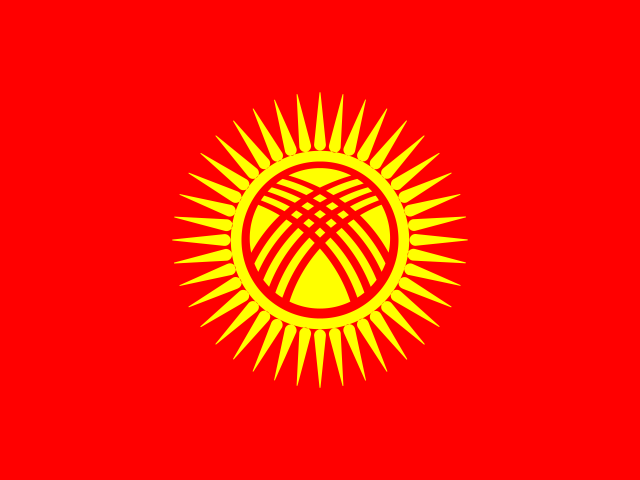
A red field with a golden sun at the centre, its forty rays straight since a December 2023 amendment, and its disc crossed by the red lines of a tunduk, the crown of a Kyrgyz yurt. The constitution provides only that the state symbols exist and that a law establishes their description and official use. That law counts the rays and fixes their shape and assigns none of it a meaning. The meanings come from a government technical specification, which reads the forty rays as the forty tribes reunited into a people, the tunduk as a sign of home, and the tunduk joined to the sun as the unity of all the peoples of the mountain country.
Kyrgyzstan FACTS ◢
| Capital | Bishkek |
|---|---|
| Continent | Asia |
| Population | 7,343,064 (2025) |
| Area | 199,951 km² |
| Population density | 37/km² |
| Currency | Kyrgyz som (KGS) |
| Official languages | Kyrgyz, Russian |
| Calling code | +996 |
| Internet TLD | .kg |
| Time zone | UTC+06:00 |
| Drives on the | Right |
| ISO codes | KG / KGZ |
DID YOU KNOW? ◢
- More than 90% of the country is mountainous, dominated by the towering Tian Shan range.
- Lake Issyk-Kul is one of the largest and deepest alpine lakes on Earth and never freezes.
- The Kyrgyz epic 'Manas' is one of the longest pieces of oral poetry ever recorded.
- Yurts and horseback culture remain central to rural life across its highland pastures.
Kyrgyzstan QUICK ANSWERS ◢
What is the capital of Kyrgyzstan?
The capital of Kyrgyzstan is Bishkek.
What is the population of Kyrgyzstan?
Kyrgyzstan had a population of 7,343,064 in 2025.
What currency does Kyrgyzstan use?
Kyrgyzstan uses the Kyrgyz som (KGS).
What languages are spoken in Kyrgyzstan?
The official languages of Kyrgyzstan are Kyrgyz and Russian.
Think you know your flags? Play Flag Daily → · Browse all countries →
MORE ON THE FLAG ◢
Kyrgyzstan changed how its flag looks in December 2023, and the operative change was one adjective.
Article 3 of the Law on the State Symbols had described the flag since 2004 as a red rectangular cloth with a golden sun disc at its centre, "с сорока равномерно расходящимися лучами золотистого цвета", with forty evenly diverging rays of golden colour. Law No. 208 of 22 December 2023 replaced that phrase with "с сорока равномерно расходящимися прямыми лучами золотистого цвета". One adjective, "прямыми", meaning straight.
Ask what the flag means and you get forty rays for forty tribes and a tunduk for home. Both of those are real and both are written down. Where they are written down is not the constitution and not the flag law.
Key Takeaways
- The December 2023 amendment inserted one word, "прямыми" (straight), into the flag's legal description, deleted three sentences of proportions, approved a new annexed image, and kept every document bearing the old flag valid until it expires.
- No edition of the flag law had ever called the rays wavy. None of the thirteen in the Ministry of Justice database contains a word for wavy or curved.
- The Jogorku Kenesh's own explanatory note gives the reason: people were reading the sun as a sunflower, or as the outside of a yurt.
- The meanings attached to the sun and the tunduk are not in the law at all. They are in a Cabinet technical specification.
- That specification still calls the forty rays "подобные языкам пламени", like tongues of flame, in its text as amended to May 2026.
| Instrument | What it fixes | What it says the flag means |
|---|---|---|
| Constitution 2021, art. 14(1) | That a flag exists, and that a law describes it | Nothing |
| Law No. 91 of 2004, art. 3 (as amended 2023) | Colour, forty straight rays, the tunduk, width at three fifths of length | Nothing |
| Cabinet technical specification (2017, as amended) | Colours, proportions and the construction drawings | Sun, forty rays and tunduk, all glossed in ch. 1 para. 2 |
What Kyrgyzstan's flag law actually said before 2023
Accounts of the 2023 redesign describe it as changing wavy rays to straight ones. The flag did change that way. The statute did not.
The Ministry of Justice's centralised legal database lists thirteen editions of the 2004 Law on the State Symbols, from the original of 17 July 2004 to the consolidation of 18 July 2024. Read end to end, none of them contains a Russian word for wavy, curved or undulating. Before the amendment the rays are "равномерно расходящимися", evenly diverging, and the description stops there. After it they are evenly diverging and straight. Ten of the eleven pre-2023 editions carry that earlier phrase, and the database's text of the edition of 17 March 2012 has a transcription gap where it belongs, which is a defect in the transcript rather than a change in the law.
So the wave was never in the text. It was in the drawing annexed to the text, and the drawing is where the 2023 change had to be made as well.
The Cabinet followed a week later. Resolution No. 724 of 29 December 2023 amended the technical specification with an instruction of exactly the same shape: "слово «расходящимися» заменить словами «расходящимися прямыми»", which replaces the word for diverging with the words for diverging straight. It then restated Appendices 1 and 2 of the specification, which are the sample of the flag and the construction scheme.
Law No. 208 did three other things, and one of them matters to anyone holding a Kyrgyz passport. It changed how the flag's image is attached to the statute: the 2004 text had merely noted in a parenthesis that colour and schematic images were annexed, and the 2023 text gives article 3 a second part that approves the annexed image outright.
It also inserted a new article 9 squared. Every kind of official document bearing the 1992 flag stays valid until it expires, and the article then names them: identity cards, the 2006 and 2020 general passports, diplomatic and service passports, and national driving licences. Where a document has no expiry it stands until the responsible state body decides to replace it, and vehicle number plates and vehicle registration certificates are put under that second rule by a sentence of their own. So nothing had to be reissued on the day the flag changed.
The third change was a deletion. The 2004 wording had fixed the radiant disc at three fifths of the flag's width, the ratio of the sun disc to the radiant disc at three to five, and the tunduk at half the radiant disc. Those figures are gone from the statute. They survive, in substance, in paragraph 3 of the Cabinet specification. The September bill had proposed something different again, replacing them with three new geometric sentences that fixed the tunduk's radius at a sixth of the flag's width and defined the radiant disc's outer and inner radii from it, while keeping the width sentence unchanged. None of that survived into the enacted text.
The sunflower problem the bill set out to fix
The bill was published for public consultation on 28 September 2023 by two deputies of the Jogorku Kenesh, N. Shakiev and U. Primov, under registration No. 6-12041/23. Its explanatory note, in Kyrgyz, states the problem in one sentence.
The note says a dilemma of differing interpretation had arisen in how the tunduk and the sun's rays at the centre of the flag were being perceived: "күн карамынын гүлү, же болбосо боз үйдүн тышкы бети сыяктуу", like a sunflower's flower, or else like the outer surface of a yurt. The stated purpose of the amendment is to remove the ambiguity, and the proposal is put as "күн нурунун толкун сымал формасын күндүн түз чагылдырган нурларынын формасына өзгөртүү", changing the wave-like form of the sun's rays into the form of the sun's directly cast rays.
Note that the word for wave-like, "толкун сымал", appears in the note describing what people see. It does not appear in the law describing what the flag is. The Jogorku Kenesh's own comparative table sets the two versions of article 3 side by side, and the left-hand column, the wording then in force, reads "кырк нуру тегиз чачыраган", forty rays evenly scattered.
One more detail in the note is worth having. The people brought in to draw the new rays were, in its words, the individuals who developed this flag at the initial stage, carried out the mathematical calculations and drew the drawings. Whoever drew the sun in 1992 was asked back to redraw it.
Kyrgyzstan's flag meanings live in a Cabinet resolution
Neither the constitution in force nor the flag law assigns the flag any meaning. Search the whole of the 2004 law for the Russian verbs for symbolise, mean or personify and you get nothing.
The meanings live one level down, in a resolution about how the flag is to be made and drawn. Government Resolution No. 205 of 11 April 2017 approved a technical specification for the flag and the coat of arms, and paragraph 2 of its first chapter is a short essay on symbolism sitting between the description of the cloth and the flag's proportions.
It reads: "Солнце в орнаментальной культуре народа означает свет, открытость, жизнестойкость." The sun, in the ornamental culture of the people, means light, openness and resilience. Then: "Его подобные языкам пламени сорок лучей - это воссоединенные в народ сорок (кырк) племен." Its forty rays, like tongues of flame, are the forty tribes reunited into a people.
The tunduk gets more room. The specification explains that it is the spherical crown of the Kyrgyz dwelling, the boz-uy, and that it is a light window. Its round frame is made of crossbars joined crosswise to the rim. "Тундук связует небо и землю, воспринимается как знак дома", the tunduk binds sky and earth and is perceived as a sign of home. Combined with the sun disc on the flag, it "символизирует единство всех народностей, проживающих в горной стране под мирным знаком общего Дома", symbolises the unity of all the peoples living in the mountain country under the peaceful sign of a common House.
What is not there is Manas. The forty tribes are named in the specification. The hero who is popularly said to have united them is not. Nothing in the flag law mentions him at all. Nothing in the specification did either, in the 2017 text or in the December 2023 amendment that is the only one between, until October 2025, when it acquired an appendix about the flagstaff's finial that quotes the epic twice. Neither instrument connects him to the rays. The 2021 constitution does name him, in its preamble, as the source of a precept to live "в единстве, мире и согласии", in unity, peace and concord. The preamble puts that precept to the whole people, and says nothing about the flag.
The tongues-of-flame gloss was never updated
The December 2023 amendments touched the specification's preamble, its paragraph 1 and the flag's two appendices. They did not touch paragraph 2.
So the state's only published statement of what the flag means still describes forty rays "подобные языкам пламени", like tongues of flame, while the flag those words describe now carries forty straight rays. The simile was written for the shape the 2023 law removed, and it is still in force. The consolidated text as amended to 18 May 2026 carries it unchanged.
There is a second gap of the same kind. The Ministry of Foreign Affairs publishes the technical specification on its own protocol pages, and the version it served when this article was written is the pre-2023 one: paragraph 1 with no "прямыми" in it, and the three proportion sentences the statute has since dropped. More than two years after the redesign, the foreign ministry's published technical description is of the old flag.
The drawing that decides the shape is not published
Article 3 of the flag law says that the flag and any reproduction of it, whatever the size, must correspond exactly to the colour and schematic images of the standard held at the President's residence.
That standard is a physical object. Until December 2023 the flag's two appendices were not reproduced at all: where the drawing should be, the text of the 2017 resolution says only "Бумажная копия в Министерстве юстиции КР", paper copy at the Ministry of Justice. Resolution No. 724 replaced both with published ones, and in doing so printed the flag's colour values in this specification's own text for the first time: red as PANTONE 1788 C, CMYK 0-100-100-0, RGB 255-0-0, and yellow, glossed in the table as gold, as PANTONE Yellow C, CMYK 0-0-100-0, RGB 255-255-0.
The same appendix sets out the construction. The sun disc is divided into four equal parts and ten rays are built on each, which is how forty is arrived at geometrically rather than by counting. A separate drawing sets out the tunduk.
The drawings themselves, though, are still not in the database. In the Ministry of Justice's text of the current specification the word "Рисунок.", figure, stands alone seven times across the flag's two appendices, and not once is there a figure after it.
The words around those missing figures go a surprising distance and then stop. Appendix 2's tunduk drawing is set out as a six-step ruler-and-compass procedure, and its fourth step reads "Делим отрезок на семь равных частей: 1-5, 2-6, 8-3, 7-4", divide the segment into seven equal parts, offering four pairs of numbered points as the division itself. The segment is singular in the Russian and its antecedent is back in step one, so those four pairs are the only concrete thing the step leaves behind, and they constrain the lattice without ever counting it.
Step five defines the chord of the chamgarak, a term the specification uses three times inside this drawing and never defines, from a different measurement altogether: "берем наружный диаметр тундука, умножить на два", take the outer diameter of the tunduk and multiply it by two. Step six then joins "1-4, Л1-Л4, К1-К4", pairs that include none of step four's and whose Cyrillic-lettered points are never defined anywhere in the printed text. The list ends in an ellipsis in the source itself.
So the procedure hands off to labels the reader cannot resolve and a list the source does not finish, and the arcs cannot be drawn from the words alone. The instrument that fixes exactly how many crossbars the tunduk has, and how they curve, is a document the public legal database describes but does not show, and no instrument read for this article states a count. A reader who wants that number cannot get it out of Kyrgyz law, and cannot redraw this flag from its legal description alone.
Kyrgyzstan's neighbour Kazakhstan puts a rayed sun at the centre of its flag too, on a sky-blue field rather than a red one.
Who made the flag, and the resolution the database does not hold
The flag dates from 3 March 1992. The explanatory note to the 2023 bill gives the instrument precisely: resolution No. 708-XII of the Supreme Council, of 3 March 1992.
That resolution is not in the Ministry of Justice's database. A search by its number returns nothing, and a listing of every act the database holds from 25 February to 15 March 1992 returns sixty-five documents, including eight resolutions from the same numbering series, 791, 795, 810, 835, 838, 841, 851 and 864, adopted on those same days, with no flag act among them. The founding instrument of the national flag is missing from the national legal database. There is a wrinkle a careful reader will spot: 708-XII sits below 791-XII, which the database dates to the same 3 March 1992, so the series is not strictly chronological and the note's number and date do not obviously agree. That is a reason to search by number as well as by date, which is what was done, and both came back empty.
The date is corroborated by an instrument that is there. Presidential Decree No. 270 of 10 June 2009 recites that the flag "был утвержден Верховным Советом Республики Кыргызстан 3 марта 1992 года", was approved by the Supreme Council on 3 March 1992, and orders: "Установить 3 марта ежегодно отмечаемым днем Государственного флага Кыргызской Республики." That is where Flag Day comes from, seventeen years after the flag.
For the designers the record is thinner and getting thinner. The Presidency's state symbols page named an authorial collective of five, "Э. Айдарбеков, Б. Жайчыбеков, С. Иптаров, Ж. Матаев, М. Сыдыков". That page now returns a 404, and the reading here is taken from an Internet Archive capture of it made on 5 August 2018.
The flagstaff grew a finial in 2025
The most recent change to Kyrgyzstan's flag is not to the flag. Cabinet Resolution No. 644 of 7 October 2025 added a new paragraph and a fifth appendix to the technical specification, prescribing a finial for the flagstaff. It has been restated twice since, by Resolution No. 753 of 24 November 2025 and again by Resolution No. 350 of 18 May 2026.
The finial is made of golden-coloured metal, and the principal tamga of the ancient Kyrgyz people, a support, a globe and a white falcon with outstretched wings sit inside a staff-top shaped as a spearhead. Standard dimensions are given as 0.3350 m high and 0.1200 m wide, changed in May 2026 from 0.3221 m by 0.18 m.
Its appendix is unusually generous with meaning, and quotes the Manas epic twice to supply it. The tamga is "символ независимости, силы, баланса и справедливости", a symbol of independence, strength, balance and justice. The globe is "символ мира и гостеприимства, обитель и гнездо всего человечества", a symbol of peace and hospitality, the dwelling and nest of all humanity. The falcon, Ak Shumkar, stands for "свободу, великодушие, справедливость, чистоту, мужество и верность", freedom, magnanimity, justice, purity, courage and loyalty.
If you want to test how well you actually know the world's flags rather than the stories about them, Flag Daily shows one a day and gives you three guesses at the country. What it cannot test is which of the stories are law.
Set the finial's glosses beside the flag itself, which the same document explains in six sentences, and the pattern of this flag's paperwork is clear enough. The law describes and never explains. The explaining happens in Cabinet resolutions.
Frequently asked questions
Why did Kyrgyzstan change its flag in 2023?
Because the sun on it was being read as a sunflower. The explanatory note to the bill, published by the Jogorku Kenesh on 28 September 2023, says a dilemma of differing interpretation had arisen over the tunduk and the sun's rays, which were being seen as a sunflower's flower or as the outer surface of a yurt, and proposes changing the wave-like form of the rays to straight ones to remove it.
What exactly did the December 2023 law change?
Law No. 208 of 22 December 2023 did four things. It inserted the word "прямыми", straight, into article 3 of the Law on the State Symbols. It deleted three sentences of proportions. It added a clause approving the flag's image as annexed. And it inserted a new article 9 squared, keeping every official document that carries the 1992 flag valid until that document expires. Cabinet Resolution No. 724 of 29 December 2023 then made the same one-word change to the technical specification and replaced its drawing appendices.
How many rays does the Kyrgyz flag have, and what do they stand for?
Forty. Article 3 of the flag law fixes the count, and the Cabinet's technical specification says the forty rays are the forty tribes reunited into a people. No instrument read for this article connects Manas to the rays: the specification quotes the Manas epic only from October 2025, and only in its appendix about the flagstaff's finial.
What does the tunduk on the Kyrgyz flag mean?
Officially, the Cabinet's technical specification says the tunduk binds sky and earth and is perceived as a sign of home, and that combined with the sun disc on the flag it symbolises the unity of all the peoples living in the mountain country. None of the instruments read for this article counts its crossbars, and the construction drawing that would settle it is not reproduced in the legal database.
Does the Kyrgyz constitution describe the flag?
No. Article 14(1) of the 2021 constitution says only that the republic has state symbols, a flag, a coat of arms and an anthem, and that their description and the procedure for their official use are established by law. The 1993 constitution said even less. Its article 6 named the three symbols and did not add that a law would describe them.
Sources
- Ministry of Justice of the Kyrgyz Republic, Centralised Database of Legal Information, Law No. 91 of 17 July 2004 on the state symbols of the Kyrgyz Republic, all thirteen editions - retrieved 27 August 2026.
- Ministry of Justice of the Kyrgyz Republic, Law No. 208 of 22 December 2023 amending the Law on the state symbols of the Kyrgyz Republic - retrieved 27 August 2026.
- Ministry of Justice of the Kyrgyz Republic, Government Resolution No. 205 of 11 April 2017 approving the technical specification of the State Flag and State Coat of Arms, original text and the consolidated text as amended to 18 May 2026 - retrieved 27 August 2026.
- Ministry of Justice of the Kyrgyz Republic, Cabinet Resolution No. 724 of 29 December 2023 - retrieved 27 August 2026.
- Ministry of Justice of the Kyrgyz Republic, Cabinet Resolutions No. 644 of 7 October 2025, No. 753 of 24 November 2025 and No. 350 of 18 May 2026, which introduced and twice restated the flagstaff finial - retrieved 27 August 2026.
- Ministry of Justice of the Kyrgyz Republic, Constitution of the Kyrgyz Republic of 5 May 2021 and the Constitution of 5 May 1993 - retrieved 27 August 2026.
- Ministry of Justice of the Kyrgyz Republic, Presidential Decree No. 270 of 10 June 2009 on the State Flag of the Kyrgyz Republic - retrieved 27 August 2026.
- Jogorku Kenesh of the Kyrgyz Republic, draft law on amending the Law on state symbols, published for public discussion 28 September 2023, with its explanatory note, comparative table and proposed flag variant - page read from the Internet Archive capture of 2 October 2023, files downloaded from kenesh.kg, retrieved 27 August 2026.
- Ministry of Foreign Affairs of the Kyrgyz Republic, Technical specification of the State Flag and Coat of Arms - retrieved 27 August 2026, serving the pre-2023 text.
- Office of the President of the Kyrgyz Republic, State symbols - the live page returns 404, and this was read from the Internet Archive capture of 5 August 2018.
PLAY ANOTHER →
One thing that happened today in history. Every day, a new one.
TODAY IN HISTORYDAILYDaily TriviaFive questions a day. Everyone gets the same five.
FIVE QUESTIONSDAILYDaily CryptogramOne quote, one scrambled alphabet. Crack it before tomorrow.
CRACK THE QUOTEDAILYGuess the CountryThree clues, three guesses. Work out where in the world it is.
THREE CLUES