
Lithuania
The southernmost Baltic state, Lithuania was once the heart of a medieval empire stretching to the Black Sea. Vilnius hides a self-declared artists' 'republic' and a hill covered in thousands of crosses.
WHAT THE FLAG MEANS ◢
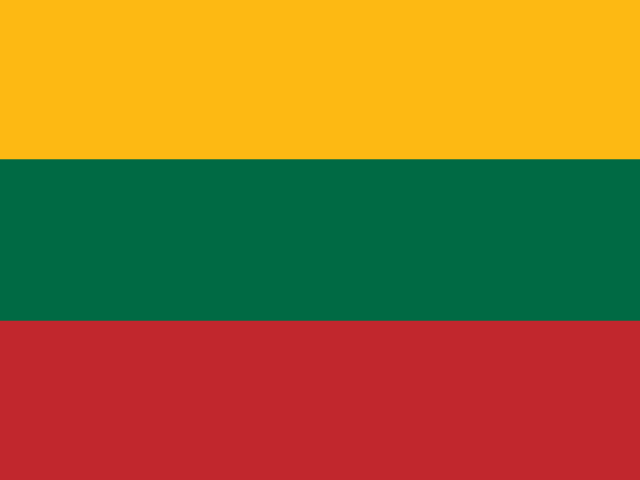
Three equal horizontal bands of yellow, green and red, in a width to length ratio of three to five. Article 15 of the constitution states the colours of the State flag and nothing else about them, referring the flag and its use to ordinary law, and the Law on the State Flag and Other Flags, which describes and measures the flag closely, assigns no colour a meaning either. They are conventionally read as yellow for the sun, light and prosperity, green for the beauty of nature, freedom and hope, and red for the earth, courage and blood shed for the fatherland.
Source: lrs.lt · e-seimas.lrs.lt · vle.lt · lrv.lt · checked 2026-08-27
Lithuania FACTS ◢
| Capital | Vilnius |
|---|---|
| Continent | Europe |
| Population | 2,888,774 (2025) |
| Area | 65,300 km² |
| Population density | 44/km² |
| Currency | Euro (EUR) |
| Official language | Lithuanian |
| Calling code | +370 |
| Internet TLD | .lt |
| Time zone | UTC+02:00 |
| Drives on the | Right |
| ISO codes | LT / LTU |
DID YOU KNOW? ◢
- In the 14th and 15th centuries it was one of the largest states in Europe.
- The Hill of Crosses near Siauliai is covered with well over a hundred thousand crosses.
- Its capital, Vilnius, contains a bohemian district that jokingly declared itself an independent 'republic'.
- It was the first Soviet republic to declare its independence, in 1990.
Lithuania QUICK ANSWERS ◢
What is the capital of Lithuania?
The capital of Lithuania is Vilnius.
What is the population of Lithuania?
Lithuania had a population of 2,888,774 in 2025.
What currency does Lithuania use?
Lithuania uses the Euro (EUR).
What languages are spoken in Lithuania?
The official language of Lithuania is Lithuanian.
Think you know your flags? Play Flag Daily → · Browse all countries →
MORE ON THE FLAG ◢
Ask what the colours on Lithuania's flag mean and the answer comes back the same way nearly everywhere: yellow for the sun, green for the forests, red for the blood shed for the nation. A version of that reading really is published by a serious Lithuanian source. It is also much younger than the flag, printed by that source inside its account of 1988, and no Lithuanian instrument contains it.
The law says nothing at all. Article 15 of the constitution names three colours and stops there. The Law on the State Flag and Other Flags describes the cloth, fixes its proportions, points at a Pantone standard and regulates who may raise it where, and it assigns no colour any meaning anywhere in its text.
The account of the 1917 choice that the Seimas and the national encyclopaedia both publish gives a different reading again. In it the yellow is the dawn rather than the sun, the red is cloud rather than blood, and the stripes run in the opposite order to the flag Lithuania actually adopted.
Key Takeaways
- Article 15 of the constitution gives the colours as yellow, green and red and says nothing else about them.
- The flag statute describes, measures and regulates the flag from end to end without assigning any colour a meaning.
- Every nature reading recorded from the 1917 debate puts red at the top. The design approved in April 1918 puts red at the bottom.
- The 3:5 proportion was restored in 2004. From 1989 the flag was 1:2, a ratio taken over from Soviet flags.
- Lithuania has a second official flag, a red banner with an armoured rider, written into that same 2004 law.
| Instrument | Date | Width to length |
|---|---|---|
| Standard approved by the Presidium of the LSSR Supreme Council | 25 January 1989 | 1:2 |
| Provisional Basic Law, article 10 | 11 March 1990 | 1:2 |
| Law on the Lithuanian State Flag, article 2 | 26 June 1991 | 1:2 |
| Law No. IX-2331, new redaction, article 3(2) | 8 July 2004 | 3:5 |
How Lithuania's three colours were chosen
The first colours recorded as Lithuanian national colours were not these ones, and those did come with meanings attached. The Visuotinė lietuvių enciklopedija, Lithuania's national encyclopaedia, traces the earliest reports to the Kosciuszko uprising: by a decision of the Lithuanian Supreme National Council of 18 May 1794, some three thousand uniformed Vilnius guardsmen wore a blue and green national cockade, blue for constancy and green for hope. Colours that meant something in Lithuania got written down when they meant it, which is what makes the silence about these three a finding rather than a gap in the record.
Yellow, green and red arrive much later, and the record of how is unusually good.
The Seimas of the Republic of Lithuania publishes an account of how it happened, written by its own Division of Historical Memory of Parliamentarism. Its account of the wartime discussion picks the story up with the committees Lithuanians formed after the German occupation of September 1915, and it quotes Petras Klimas, later a signatory of the 1918 Act of Independence, on how urgent the question felt to them: "Vėliava atrodė tiek pat būtina, kaip gimstančiam kūdikiui marškinėliai", a flag seemed as necessary as a shirt to a newborn child.
Serious discussion resumed in 1917. On 6 June that year a group of Vilnius intellectuals met at Jonas Basanavičius's, in the premises of the Lithuanian Science Society, and the Seimas records that Basanavičius read a paper arguing that Lithuania's flag colour had in the past been red, with a rider on it: "o ant raudono dugno buvo pavaizduotas kardu užsimojęs raitelis ant širmo žirgo", a rider with a raised sword on a grey horse against a red ground.
Nobody objected, and the proposal still failed. A red flag was unusable without the rider, and something simpler was wanted for everyday use. So the meeting set a rule for choosing instead: take the colours that turn up most often in Lithuanian folk articles, in the sashes and the aprons. Everyone agreed those were green and red.
What the colours were said to mean in 1917, on a flag arranged the other way up
Green and red were settled. The third colour is where the meanings come from, and it is where the flag as flown parts company with them.
The painter Antanas Žmuidzinavičius argued for keeping it to two. The Seimas gives his reason: "nes šios spalvos reiškia meilę ir viltį", because those colours mean love and hope. His green and red flag decorated the hall of the Vilnius theatre for the Lithuanian Conference of 18 to 22 September 1917, and the delegates found it gloomy.
The archaeologist and heraldist Tadas Daugirdas supplied the fix. In the Seimas account he proposed a narrow yellow stripe between the other two, to liven the flag up and "kad geltona spalva simbolizuotų aušrą", so that the yellow colour would symbolise the dawn. The Seimas repeats it in its own English edition: yellow, to symbolise the dawn.
The national encyclopaedia gives the same proposal with the arrangement and the whole rationale. Daugirdas put the yellow between the red above and the green below, and the reading was a landscape read from the ground up: "žalia reikštų girias ir pievas", green would mean forests and meadows, the yellow the dawn, and the red "saulės apšviestus debesis", clouds lit by the sun.
The Seimas records a second nature reading from the same debate, credited to unnamed others rather than to Daugirdas, and arranged the same way up: green fields and meadows at the bottom, yellow flowers in the middle, a red rising sun at the top. The two accounts do not agree about who said what, and neither is a paraphrase of the other, so they are better kept apart than spliced together. What they agree on is the order. Every 1917 reading on record has red at the top and green at the bottom, with the sun somewhere in the red.
The flag Lithuania adopted is the other way up. The commission appointed to settle it was Basanavičius, Daugirdas and Žmuidzinavičius, and its protocol of 19 April 1918 is quoted by the Seimas: the members "apsistojo ties trispalve vėliava susidedančia iš raudonos spalvos apačioje, žalios viduryje ir geltonos viršuje", settled on a tricolour of red at the bottom, green in the middle and yellow on top. The national encyclopaedia reports the same protocol as also requiring the state coat of arms, in the upper corner by the staff or in the centre. The Council of Lithuania approved the design unanimously on 25 April 1918, and the encyclopaedia notes that the 1922 constitution then gave the three colours state status without any coat of arms.
The landscape had been turned upside down somewhere on the way.
Does Lithuanian law say what the flag's colours mean?
No. The flag is governed by the constitution and by one statute, and neither offers a meaning.
Article 15 of the constitution, adopted by referendum on 25 October 1992, runs to three short sentences. The first names the colours: "geltona, žalia, raudona". The Seimas publishes an official English text that renders it as "The colours of the flag of the State shall be yellow, green, and red." The second sentence gives the coat of arms as a white Vytis on a red field. The third refers the arms, the flag and their use to ordinary law.
That ordinary law was passed on 26 June 1991 as Law No. I-1497 under the title Dėl Lietuvos valstybinės vėliavos, on the Lithuanian State Flag; the 2004 redaction renamed it the Law on the State Flag and Other Flags of the Republic of Lithuania, and it is read here in the consolidated redaction in force since 1 March 2024. Article 2(1) of that law describes the flag as "audeklas iš trijų lygių horizontalių spalvų juostų", a cloth of three equal horizontal coloured stripes, the top yellow, the middle green, the bottom red. Article 3(1) requires the flag to match a colour standard set in the Pantone system. Article 3(2) fixes the shape: "Lietuvos valstybės vėliavos ir Lietuvos valstybės istorinės vėliavos audeklo pločio ir ilgio santykis turi būti 3:5."
The statute is not thin. It sets who raises the flag and where, how it is lowered a third of the mast for mourning, who may make one and who inspects them. Article 12(3) of the same law even has the flags of Estonia and of Latvia raised at the Seimas beside the Lithuanian flag on those two countries' national days.
What it never does is say what a colour stands for. The consolidated text was scanned for eighteen Lithuanian roots, among them sun, light, forest, field, meadow, flower, blood, courage, hope, dawn, freedom, nature, prosperity, love, symbolise and mean, and no provision assigns any colour anything. Three roots match, all of them incidentally: saulė inside Pasaulio lietuvių bendruomenė, the World Lithuanian Community; laisvė inside Laisvės gynėjų diena, the Day of the Defenders of Freedom; and laukas inside the historical flag's own blazon, where it is the red field of the historical flag, the rest of that root's matches being a word about ships.
The colour values are not in the law either. They sit in a Government publication, the vectorised standards issued for the Chancellery in 2007 and based on standards the Lithuanian Heraldry Commission approved in 1991, which give Pantone 1235 for the yellow, 349 for the green and 180 for the red, and repeat the 3:5 field ratio. That document specifies the flag to a printer's tolerance and still says nothing about meaning.
The sun and blood reading is an encyclopaedia's, not the law's
There is a published Lithuanian reading. It is younger than the flag by a wide margin, and it is narrower than the version that circulates in English.
The Visuotinė lietuvių enciklopedija gives it in one sentence, and puts that sentence inside its account of 1988, immediately after describing how the shades were reconstructed from pre-war flags kept safe by museums and by private hands. It opens "Geltona reiškia saulę, šviesą ir gerovę", yellow means the sun, light and prosperity. Green it gives the beauty of nature, freedom and hope. Red it gives the earth, courage, and "už Tėvynę pralietą kraują", blood shed for the fatherland.
That is an encyclopaedia writing in its own voice. It is not attributed to the constitution, to the flag law or to any decision of the Seimas, and the encyclopaedia does not present it as one. The Seimas account, for its part, reports what people in 1917 proposed the colours should mean and never states in its own voice what they do mean.
Set the widely repeated English version beside the encyclopaedia's sentence and two elements have been added. The yellow acquires ripening fields. The green becomes forests and countryside.
The fields and the forests do exist in the Lithuanian record, but in the other reading, and both belong to the green there. Forests and meadows are Daugirdas's green from 1917, and fields and meadows are the green of the second reading the Seimas records from the same debate. The encyclopaedia's 1988 passage has neither: its green is the beauty of nature, with nothing agricultural in it. What the English version has done is fold the 1917 landscape into the later gloss.
So there are three readings, not one. There is the 1917 landscape, in which the yellow is the dawn. There is the reading the encyclopaedia prints in its 1988 passage, in which the yellow is the sun. And there is the English composite, which takes its scenery from the first and attaches it to the second. Only the first two are printed in a Lithuanian source.
Lithuania's flag kept a Soviet proportion until 2004
The colours came back before the country did, and they came back in the wrong shape.
The tricolour flew at Sąjūdis rallies through the summer of 1988 and was raised on the Gediminas Castle tower in Vilnius on 7 October that year, for the first time since the Second World War. On 18 November 1988 the Supreme Council of the Lithuanian SSR, under public pressure, amended the Soviet republic's constitution to give the yellow, green and red flag the status of state flag.
Then came the detail that lasted. On 25 January 1989 the Presidium approved the colour standard together with what the Seimas calls "iš sovietinių vėliavų perimtas ilgio ir pločio proporcijas", length and width proportions taken over from Soviet flags, at 1:2. The national encyclopaedia says the same thing in nearly the same words. The shades themselves, it adds, were rebuilt from surviving interwar flags and came out as a yellow close to orange and a red close to purple.
The ratio outlasted the Soviet Union. It is in article 10 of the Provisional Basic Law of 11 March 1990 and in article 2 of the 1991 flag law, so for the first fourteen years of restored Lithuanian statehood the national flag was cut to a Soviet measurement.
That was corrected on 8 July 2004, when the Seimas passed Law No. IX-2331, a wholesale new redaction of the flag law that took effect on 1 September that year. Its article 3(2) sets 3:5. The Seimas describes what the change did in one clause: it "atkūrė prieškario Lietuvos Respublikos valstybės vėliavos proporcijas", restored the pre-war proportions of the state flag of the Republic of Lithuania. Beside a colour question that has never been settled by anybody, the shape is the thing Lithuania went back and fixed.
Yellow, green and red is awkward heraldry, and Lithuania debated replacing it
The combination has a technical problem, and the interwar republic argued about it for two decades.
The Seimas puts it flatly: discussion of the flag continued until the Second World War because "geltonos, žalios ir raudonos spalvų derinys heraldikos požiūriu buvo netinkamas", the combination of yellow, green and red was unsuitable from the point of view of heraldry. The national encyclopaedia records how sharp it got in 1936. Some argued for moving the yellow stripe to the middle, which is what heraldry requires. Others preferred the green, white and red flag of Lithuania Minor. The artist Mstislavas Dobužinskis proposed yellow, red and white, or white, red and yellow, matching the colours of the coat of arms he had designed.
It reached the President's desk, or very nearly, and the two sources disagree about which. The Seimas says that in May 1940 the commission working on the state coat of arms had resolved to put a new flag to the President: yellow, red and white, with the rider through the middle on one face and the Columns of the Gediminids on the other. The encyclopaedia says the commission delivered it, and dates that to 8 May 1940, crediting the design to Dobužinskis. Either way the Soviet occupation of June 1940 ended the discussion, and the tricolour that survived into 1988 and into the 1992 constitution is the one that was still under review when the argument stopped.
The constitutions meanwhile kept confirming it without explaining it. The 1922 constitution recorded the state colours as yellow, green and red, the 1928 constitution repeated the provision, and the 1938 constitution renamed them the national colours. Not one of them said why.
Lithuania has a second official flag
Basanavičius lost the argument in 1918 and won it eighty-six years later.
At the Council session of 25 April 1918 that adopted the tricolour, he put his dissent on the record. The Seimas quotes him: "Komisija nenusprendė valstybės vėliavos. Ta vėliava buvo raudona su Vytimi." The commission did not decide the state flag. That flag was red, with the Vytis.
The law that changed the tricolour's shape gave him his flag. The 2004 redaction wrote a second flag into Lithuanian law, and the Seimas explains the naming in a clause: it was called the state historical flag "kad nesipainiotų su Lietuvos valstybės vėliava", so that it would not be confused with the state flag. Its prototype is named too, the banners the Grand Duchy's army carried at the battle of Grunwald in 1410.
The flag law blazons it. Article 2(2) of that law describes a cloth "kurio raudoname lauke vaizduojamas baltas (sidabrinis) šarvuotas raitelis ant balto (sidabrinio) žirgo", showing on a red field a white or silver armoured rider on a white or silver horse, holding a raised sword, with a blue shield bearing a double yellow or gold cross at his left shoulder. It fixes the colour of the saddle, the bridle and the belts, and it goes on down to the horseshoes. It has the same 3:5 ratio as the tricolour. Article 10¹ of the same law, added in 2008, puts its design and its standard to the Seimas on the President's proposal, and the Seimas approved both on 17 June 2010.
It is no longer a museum piece either. Amendments of 2018 and 2023 rewrote article 10 of the flag law, and the historical flag is now flown permanently at the Seimas, the President's residence, the Government and the courts among other state institutions, and at the Palace of the Grand Dukes of Lithuania in Vilnius, Trakai Castle and Kernavė.
So Lithuania has a national flag whose colours no instrument explains, flying beside an official historical flag specified down to the horseshoes. If you want to know whether you could pick the tricolour out of a line-up, a daily flag round settles it in three guesses, and working a country out from three written clues is the version with no flag to lean on.
Frequently asked questions
What do the colours on the Lithuanian flag mean?
No Lithuanian instrument assigns them a meaning. Article 15 of the constitution names the colours as yellow, green and red and says nothing more, and the Law on the State Flag and Other Flags describes and regulates the flag without interpreting any of them. The reading published by the Visuotinė lietuvių enciklopedija gives the yellow the sun, light and prosperity, the green the beauty of nature, freedom and hope, and the red the earth, courage and blood shed for the fatherland, in the encyclopaedia's own voice rather than as anybody's official position.
Who designed the Lithuanian flag?
A commission of three appointed by the Council of Lithuania: Jonas Basanavičius, Tadas Daugirdas and Antanas Žmuidzinavičius. Žmuidzinavičius had proposed a green and red flag drawn from folk articles, and Daugirdas added the yellow stripe. The commission approved the three-stripe design on 19 April 1918 and the Council of Lithuania adopted it unanimously on 25 April 1918.
Why is the yellow stripe on the Lithuanian flag at the top?
The commission put it there in April 1918, reversing the arrangement the 1917 proposals had used. Every nature reading recorded from the 1917 debate places red at the top and green at the bottom, whether the yellow is read as the dawn or as flowers. The protocol of 19 April 1918 settled on red at the bottom, green in the middle and yellow on top, and neither the Seimas account nor the national encyclopaedia gives a reason for the switch.
When did Lithuania's flag change to a 3:5 ratio?
On 8 July 2004, when the Seimas passed Law No. IX-2331, a new redaction of the flag law that took effect on 1 September 2004. Article 3(2) of that redaction sets the width to length ratio at 3:5. The flag had been 1:2 since 25 January 1989, a proportion the Seimas describes as taken over from Soviet flags, and the Seimas describes the 2004 change as restoring the pre-war proportions.
What is the Lithuanian state historical flag?
A second official flag, added by that same 2004 law: a red field bearing a white or silver armoured rider on a white or silver horse with a raised sword, blazoned in article 2(2) of the flag statute. The Seimas states that it was given that name so it would not be confused with the state flag, and names its prototype as the banners the Grand Duchy of Lithuania's army carried at the battle of Grunwald in 1410. Its design and standard were approved by the Seimas on 17 June 2010.
Sources
- Seimas of the Republic of Lithuania, Constitution of the Republic of Lithuania, article 15, Lithuanian text, and the official English text - retrieved 27 August 2026.
- Seimas of the Republic of Lithuania, Law on the State Flag and Other Flags of the Republic of Lithuania, No. I-1497 of 26 June 1991, consolidated redaction in force from 1 March 2024 - retrieved 27 August 2026.
- Seimas of the Republic of Lithuania, Law No. IX-2331 of 8 July 2004 amending the Law on the State Flag of Lithuania, the new redaction, published in Valstybės žinios 2004, No. 115-4274 - retrieved 27 August 2026.
- Seimas of the Republic of Lithuania, Division of Historical Memory of Parliamentarism, Lietuvos valstybės vėliavos istorija, prepared by Vilma Akmenytė-Ruzgienė, and its English edition - retrieved 27 August 2026.
- Seimas of the Republic of Lithuania, Division of Historical Memory of Parliamentarism, Lietuvos valstybės istorinės (herbinės) vėliavos istorija - retrieved 27 August 2026.
- Edmundas Rimša, Lietuvos valstybės vėliava, Visuotinė lietuvių enciklopedija, authorship as credited in the Seimas bibliography - retrieved 27 August 2026.
- Chancellery of the Government of the Republic of Lithuania, Lietuvos Respublikos valstybinės vėliavos ir herbo vektorizuoti etalonai, 2007, based on the 1991 standards of the Lithuanian Heraldry Commission. The Government site refuses a direct download, so the document was read from the Internet Archive capture of 27 February 2008 of the same file at the Government's earlier path - retrieved 27 August 2026.
PLAY ANOTHER →
A short message, hidden in a different cipher every day.
ONE CIPHER A DAYDAILYGuess the CountryThree clues, three guesses. Work out where in the world it is.
THREE CLUESDAILYOn This DayOne thing that happened today in history. Every day, a new one.
TODAY IN HISTORYDAILYDaily TriviaFive questions a day. Everyone gets the same five.
FIVE QUESTIONS